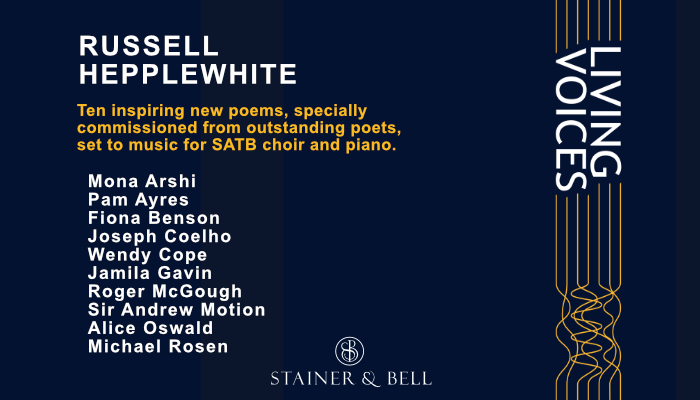
Living Voices is a new collection of ten inspiring choral pieces composed by Russell Hepplewhite. This innovative project brings together the talents of Hepplewhite and ten of Britain’s most outstanding contemporary poets, each commissioned to create poetic responses to our world today.

The idea for Living Voices originated with Russell Hepplewhite, who invited the poets to offer their diverse reflections on the nuances of modern life. The resulting poems explore a wide spectrum of human experience – birth and death, youth and age, sickness and health, landscape and memory. The emotional scope of the collection is equally varied, encompassing pieces that are light-hearted and comic alongside those that are profound and moving.

Accessible and rich in expression, Hepplewhite’s music proves a perfect partner for these contemporary texts. Drawing on his extensive experience writing for the theatre, his compositions aim to translate the poets’ messages into a vibrant collective choral sound. Living Voices promises to engage anyone drawn to the telling interaction of contemporary life and art.

The ten distinguished poets who have contributed to this unique collection and the titles of their commissioned works are:

  1. Mona Arshi – Tender
  2. Pam Ayres – Leaving
  3. Fiona Benson – Three Trees/Angel
  4. Joseph Coelho – The Diarist’s Pages
  5. Wendy Cope – I Wake
  6. Jamila Gavin – Song of Flight
  7. Roger McGough – The Good Ship Attenborough
  8. Andrew Motion – ‘from: Gravity Archives’
  9. Alice Oswald – Riddle
  10. Michael Rosen – True Story

Ten selected choirs around the UK will each give the world premiere one of these new choral works over the coming months. The project has been funded by private donations and support from the Finzi Trust.

Performances:

5th April I Wake by Wendy Cope, Exeter Festival Chorus, St Peter’s Church, Budleigh Salterton

10th May Leaving by Pam Ayres, Gloucester Choral Society, Gloucester Cathedral.

17th May The Diarist’s Pages by Joseph Coelho, Highgate Choral Society, St Michael’s Church, Highgate

14th June ‘from: Gravity Archives’ by Andrew Motion, Wimbledon Choral Society, Wimbledon High School

21st June True Story by Michael Rosen, Epsom Choral Society, St Andrew’s Church, Cheam

26th June Riddle by Alice Oswald, Whitehall Choir, St Andrew Holborn

5th July Song of Flight by Jamila Gavin, Birmingham Bach Choir, Malvern Priory

5th July Tender by Mona Arshi, Divertimento, St Nicholas Church, Warwick.

5th July The Good Ship Attenborough by Roger McGough, Hexham Orpheus Choir, Hexham Abbey

12th July Three Trees/Angel by Fiona Benson, Voices of Hope, Alnwick Playhouse.

This collection promises to be a significant addition to the contemporary choral music repertoire, offering pieces that are both musically engaging and thematically relevant to modern audiences. The music will be published by Stainer & Bell in summer 2025.

Read an interview with Russell Hepplewhite about Living Voices
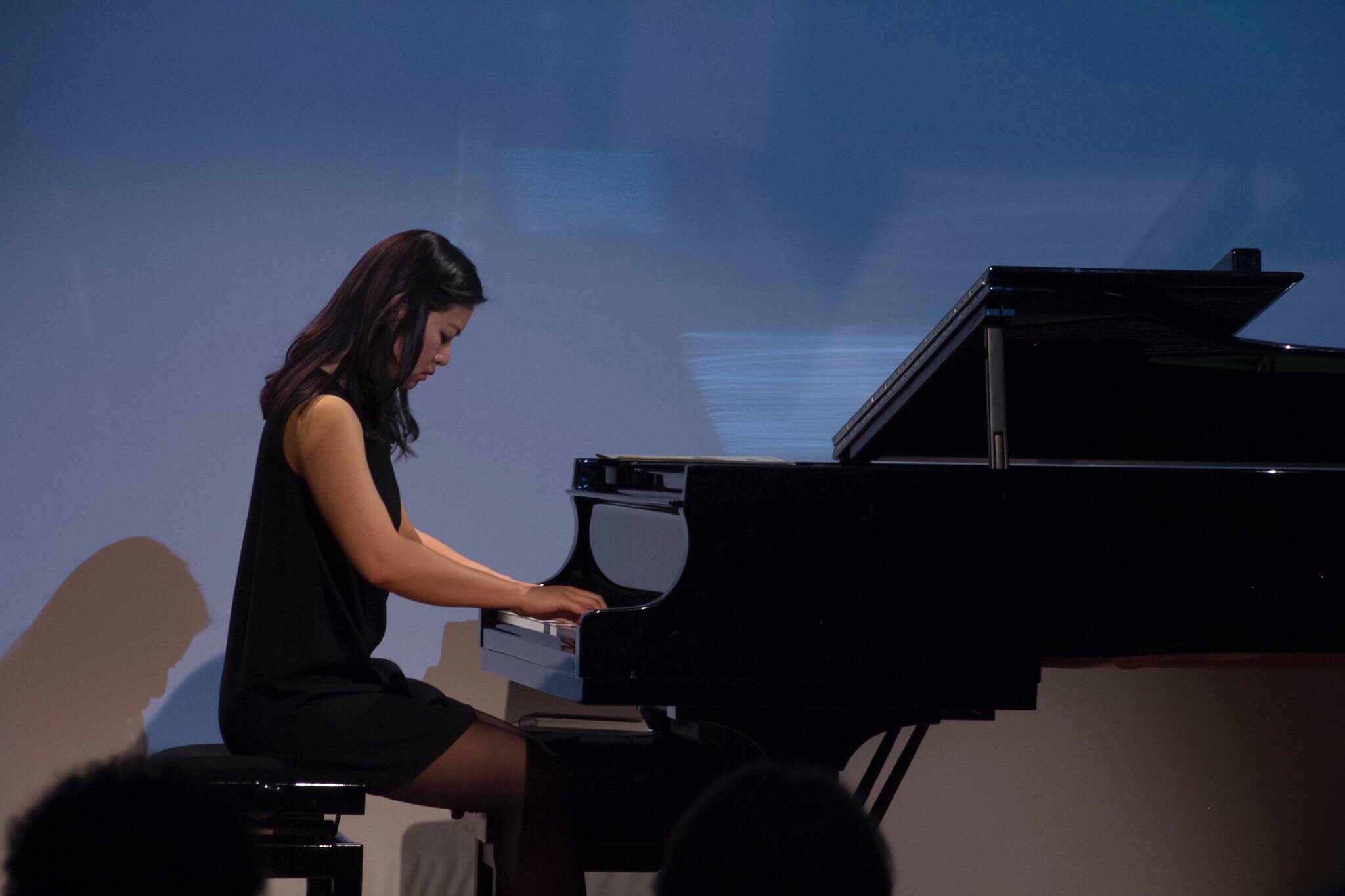
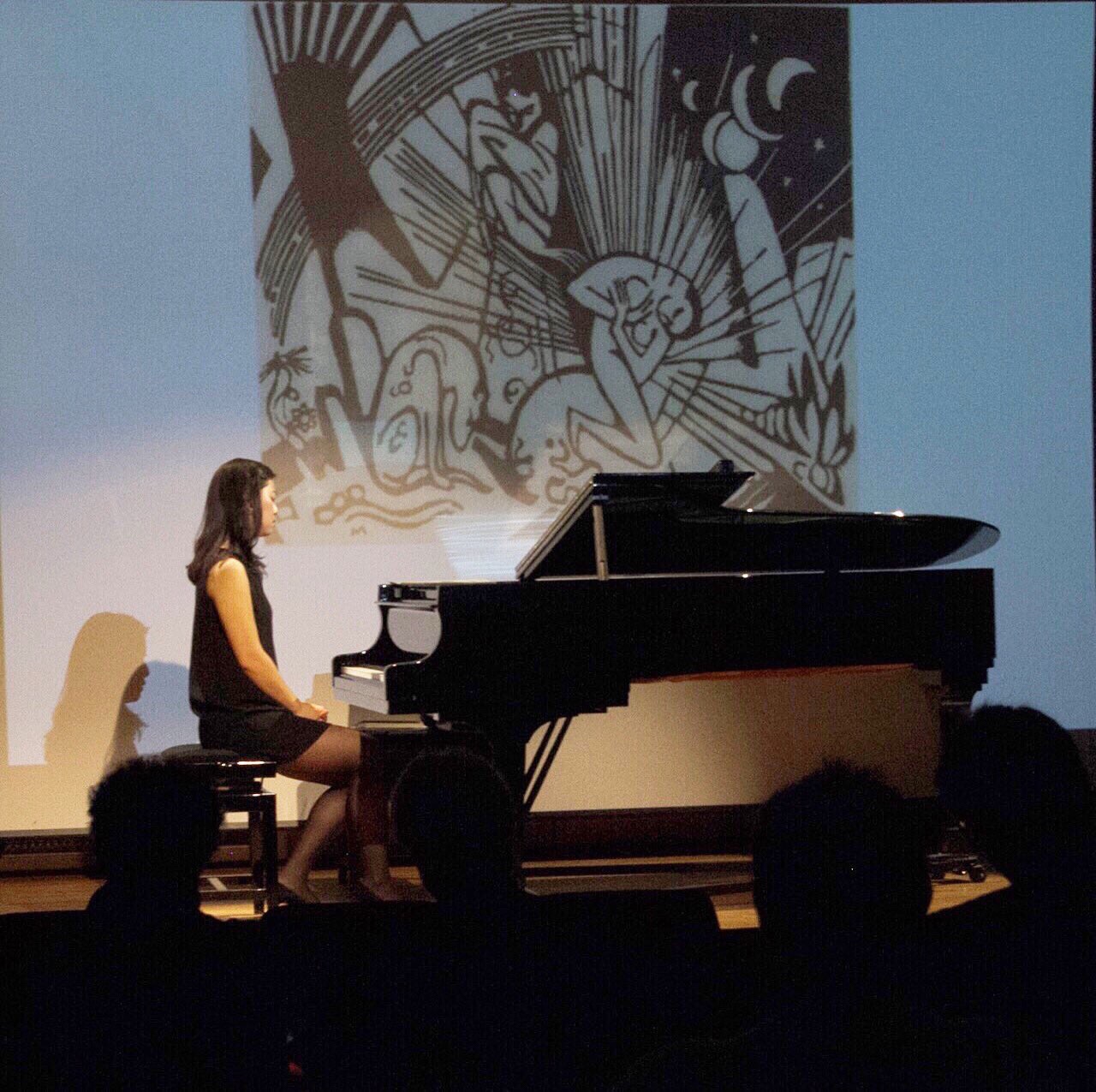
Annie Yim, piano, with recorded voices

The Performance Space, City, University of London

Friday 16 March 2018

My second visit to the Performance Space at City, University of London, and a second performance of John Cage’s infamous 4’33”. Last summer I heard a “straight” performance – the pianist silent yet fully present at the piano while the audience absorbed the myriad sound of the space; this time the piece was complimented by poetry – ‘A Kind of Silence’ by Ed Baker, and a reminder that Cage’s work was conceived with the idea that any sound constitutes “music”.

This was part of an intriguing and highly original concert by pianist Annie Yim in which music and words combined to reveal “tributes, friendships, and artistic affinities” (AY, programme notes). Annie is the creator of MusicArt London, a conceptual concert series which combines music with poetry and visual arts, creating interesting and unexpected dialogues and connections between the works in the programmes and across creative disciplines. Programmes include works by 21st century composers, juxtaposed with historical masterpieces. In this concert, Annie played music by Debussy, Ravel, John Cage, Arvo Pärt, Cheryl Frances-Hoad and Philip Glass, interspersed with readings from poems which sparked a musical impulse or which were written in response to music.

The concert opened with Annie reading Baudelaire’s Harmonie du Soir, a line from which Debussy drew inspiration for his Prelude Les sons et les parfums tournent dans l’air du soir (Sounds and perfumes turn in the evening air). To hear the words of the poet which influenced the composer created a quite different listening experience when the music began. This prelude is deeply sensual, rich in pungent harmonies and languid rhythms as Debussy’s responded to Baudelaire’s equally evocative and musical writing.

It is well known that Ravel drew inspiration from poetry for his Gaspard de la Nuit, and Aloysius Bertrand’s book of poems appealed to Ravel’s love of fairy tales. He set three of Bertrand’s poems to music – Ondine, Le Gibet and Scarbo – and printed each poem in full next to the piano score. Once again, Annie read the poem, seated at the piano, before launching into a characterful and vibrant portrayal of the grotesque gnome, “his fingernails scratching on the silk curtains round my bed!

John Cage’s Dream, a minimalist work scored on a single stave music consisting of groups of tones that are freely sustained (either by holding the keys down or by using the sustaining pedal); the degree of resonance (as determined by the performer) creates the rhythmic and narrative flow of the piece and takes the listener into an otherworldly sense of time suspended. A gentle work, rather like a haiku in its simplicity and depth of expression, it was elegantly and sensitively played by Annie, accompanied by a reading of John Cage’s poem to Merce Cunningham (for whom the music was written) Poem. Cause: I love you. A rather touching addition to this performance was a projection behind the piano of Cage’s original typed manuscript of the poem.

And so to the performance of 4’33” where while the pianist remained silent and still at the piano, a recording of poet Ed Baker reading his ‘A Kind of Silence’ was played. This version of 4’33” was originally conceived in 2016 for a performance in an art gallery on the premise that “silence is musical – silence is poetic – silence is music is poetry“. In our frenetic world it is remarkable how long 4’33” feels and rather than “filling the silence”, the words and cadence of the poem offered special time for reflection and quiet contemplation.

This connected appropriately with Pärt’s Für Alina, a work whose “aesthetic is silence…..present not just as the silence framing the piece, but, paradoxically, silence has been written into the music as an acoustic space of sorts” (Kristina Korver, musicologist, Arvo Part Centre). Poet Zaffar Kunial wrote ‘Sunlight’ in response to the music, a short yet meaningful poem which perfectly complimented the simplicity and profundity of Pärt’s writing: “each line can be read after a pause or as a continuous train of thought” – just as Pärt gives few directions to the pianist as to how his piece should be played. This new poem was specially commissioned by MusicArt London and was reproduced in a delicate limited edition card, designed and handmade by the book artist, Pauline Rafal,

Cheryl Frances-Hoad‘s contemplative miniature Star Falling was composed “as a gift in an attempt to stop a partner from leaving me” (CFH) and is a calm reflection on lines from Else Lasker-Shuler’s poem ‘Reconciliation’. Delicate and expressive, with shimmers of star light, it was accompanied by the composer reading the poem which inspired her.

The final work in the programme was Philip Glass’s Wichita Vortex Sutra. which Glass wrote for a performance with poet Allen Ginsberg, whose poem of the same name (written in 1966) reflected the anti-war mood of the times. Glass’s music was intended as a portrait of America, complete with fragments of hymn tunes and the energy of the big city. At this performance, a collage of Ginsberg’s words was read by Ed Baker, who had selected sections from the poem to reveal his own response, as an American, to Ginsberg’s poem and Glass’s music. Annie performed the work with energy and commitment, bringing to a close this most interesting and engaging lunchtime concert.

annieyim.com

musicart.london

(Photos: Sophie Baker)