Guest post by Luca Bianchini


Mozart is said to have written a catalogue of his works, which he reportedly began in 1784 and completed in 1791—or so it was believed until recently.
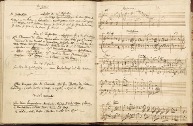
The Thematic Catalogue, held in the British Library in London, is a small, ninety-page book in excellent condition. It is bound and features an elegant part-leather cover. Fifty-eight of its pages contain text and music. The catalogue is arranged with detailed descriptions of the instrumentation on one page and the incipits of the pieces—typically four bars written on two staves—on the opposite page.

All major books on Mozart, including the recently updated Köchel catalogue, which officially lists and dates his compositions, rely on this so-called autograph catalogue as a critical source. It serves to document and certify Mozart’s most important works, including, for example, the Jupiter Symphony. Mozart’s Clarinet Concerto is attributed to him precisely because it is included in this thematic catalogue, supposedly in his own handwriting.

A recent study by Professors Luca Bianchini, Anna Trombetta, and Martin Jarvis, published in the prestigious Journal of Forensic Document Examination (JFDE), introduced an innovative method of ink analysis. This study revealed that the catalogue is a forgery, fabricated around 1798 and written by multiple hands.

To verify the authenticity of a document, one must first examine the paper’s watermark. In the case of the Thematic Catalogue, no identical watermark has been found from before 1802. Furthermore, Mozart never mentioned or wrote about the catalogue during his lifetime, nor did any of his closest relatives or acquaintances. The catalogue was not included in the inventory of Mozart’s possessions compiled by court officials after his death in late 1791. In fact, there is no record of the catalogue until 1798—seven years after his death.

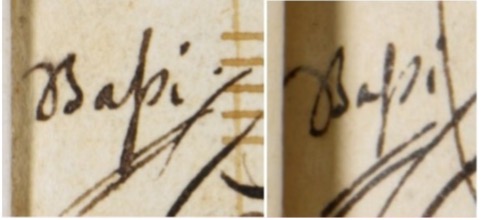
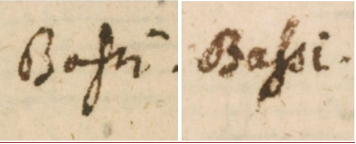
At the IGS 2023 international conference on forensic handwriting analysis, Professors Bianchini and Trombetta demonstrated, using new software developed by Bianchini in C#, that the handwriting in the catalogue does not match Mozart’s own. (For instance, consider how Mozart wrote “Bassi” in his autographs, compared with how it appears in the catalogue.)
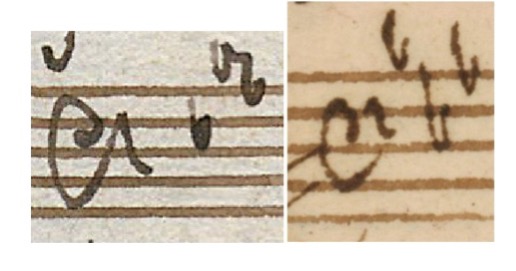
At the same conference, held at the University of Évora, Professor Anthony Jarvis presented another article, also subjected to rigorous double-blind peer review. He showed that all the bass clefs in the catalogue were not written by Mozart. If Mozart did not write the bass clefs on every stave, it is unlikely he wrote the rest of the catalogue. (Compare: on the left is an autograph, on the right the catalogue.)
Professor Heidi Harralson, a leading authority in forensic document examination, co-authored another article with Professor Martin Jarvis of Charles Darwin University in Australia, who is also an expert in the field and a Board Member of the Australia and New Zealand Forensic Science Society Northern Territory Branch. They presented evidence suggesting that Mozart could not have authored the catalogue. (For example, the regular strokes in The Marriage of Figaro autograph differ from the tremulous lines in the Thematic Catalogue, indicating copying or forgery.)
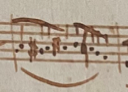
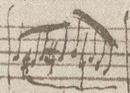
Bianchini and Trombetta had already published a book in 2018 highlighting numerous contradictions between the catalogue and Mozart’s original manuscripts.

For instance, the catalogue claims that a well-known aria was sung by the bass Albertarelli. However, it was written for the tenor Del Sole, since the higher notes would be unsuitable for a deep bass voice. Tempo markings, notes, rests, and musical themes often differ between the catalogue and the original manuscripts. Additional instruments are also listed in the catalogue, though they do not appear in the autographs.

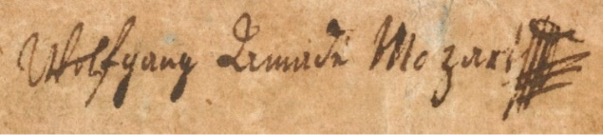
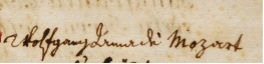
Even the signature on the cover is forged.

Signature in the catalogue:
Mozart’s verified signature (from his marriage certificate):
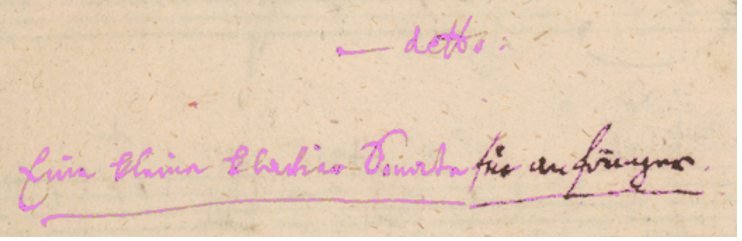
Furthermore, certain entries were added later using different inks. These discrepancies are invisible to the naked eye but become evident when computer filters are applied, as demonstrated in the recent scientific article by Bianchini, Trombetta, and Jarvis. (For instance, the initial text highlighted in pink differs in ink composition from the darker addition at the end of the line.)
It is no wonder that the musical world, especially Mozart scholars, is in turmoil. The revelation that the catalogue is a forgery challenges long-held assumptions.

For the sake of accuracy, the newly published Köchel catalogue must be revised to account for these findings. All works attributed to Mozart from 1784 to 1791 must be re-examined, as their dates and attributions have so far relied on this forged document. Given that Mozart often left his autographs unsigned and undated, the authenticity of many works is now in doubt, potentially revolutionising the history of music.

For those interested in exploring this topic further, please refer to the press release available at: https://www.mozartrazom.com/mozarts-legacy-under-scrutiny-groundbreaking-forensic-study-published/


Luca Bianchini is a musicologist from the University of Pavia, Italy, specializing in historical musicology and document analysis.
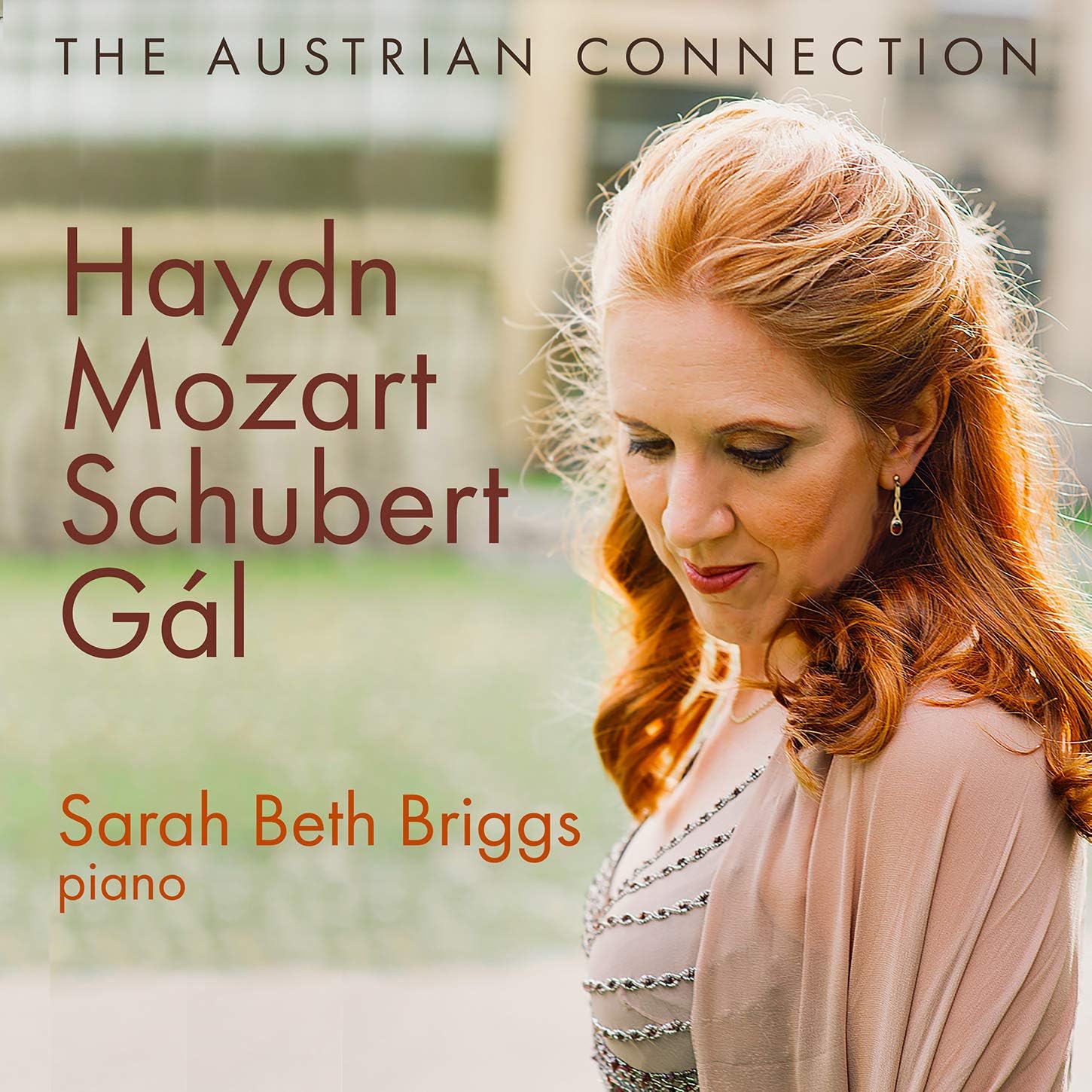
British pianist Sarah Beth Briggs has built her reputation on performing and recording the “core canon” of piano repertoire, and she has a particular affinity with the music of Haydn, Mozart and Schubert. Her playing is always elegant and tasteful, intelligent and sensitive, and in this new release she brings all these qualities to repertoire which she clearly adores.

‘The Austrian Connection’ traces the compositional links between four Austrian composers: Hans Gál (1890-1987) was perhaps the last great composer to uphold the tonal Austro-German tradition that began with Haydn and Mozart, and, arguably, reached its apogee in the music of Schubert (and also Brahms). Sarah Beth Briggs is a keen advocate of Hans Gál’s music – she made a world premiere recording of his Piano Concerto in 2016 – and the three preludes included on this disc perfectly complement the three sonatas which precede them.

As the focus of this disc is on Austrian connections, it is perhaps fitting that the opening piece is Haydn’s variations on “Gott erhalte Franz den Kaiser”, Austria’s first national anthem. From a simple hymn theme, a set of four variations follow, and where one might expect grandeur, given the theme’s significance, Sarah instead offers an intimate and charming account which provides the perfect introduction to one of Haydn’s best-known and loved piano sonatas, Hob. XVI/50 in C.

This sonata was written in 1794, during a visit to London, where Haydn discovered and – if this sonata is anything to go by – delighted in the sonorities of the English fortepiano. He fully exploited the instrument’s boldness, resonance and range, and expanded technical capabilities, in a sonata which is rich in inventiveness, characteristic wit and joie de vivre. The quirks and frivolity of the outer movements are contrasted with an Adagio whose beautiful cantabile qualities Sarah fully appreciates in an elegant and spacious reading. The translucent clarity of the piano sound in the upper registers is somewhat reminiscent of a fortepiano (though without the latter’s distinctive “twang”!).

By contrast, Mozart’s Sonata in A minor K310 is restless and urgent, full of striking drama and dissonances, but like the Haydn before it, this sonata has a slow movement of operatic lyricism, interrupted by a turbulent middle section. Sarah is sensitive to the music’s chiaroscuro, responding deftly to Mozart’s mercurial emotional shifts and the underlying intensity of this work.

In the Sonata in A, D664 we find Schubert at his most genial, though that affability is offset by the shadowy poignancy and tender intimacy of the middle movement. However, a sunny mood is soon restored in the finale, a movement of joyful light-heartedness. Sarah achieves a persuasive warmth of tone and sensitive phrasing which highlights the glorious song-like melodies in this sonata. There is chiarscuro and drama aplenty here too, and once again, these emotional voltes faces are handled with an eloquent sensitivity (Sarah is not a pianist who exploits the “psychobabble” surrounding Schubert’s life, preferring instead to focus on the details within the score to allow the music to speak for itself).

Hans Gál’s ‘Three Preludes’, composed in 1944, have classical characteristics interleaved with distinctly modern twists: the pithy quaver figurations and playful cascades, and quicksilver wit in the first and third Preludes are redolent of Haydn, while the middle one, “Lento Tranquillo”, recalls Schubert in its graceful melody and introspective demeanour. Sarah brings virtuosic sparkle to the first, a quiet, reflective poetry to the second, and a beguiling humour and lightness of touch to the third, which disappears into the ether in a delicate flurry of notes.

An enjoyable “recital disc”, which takes the listener on a varied and stimulating Austrian musical journey.

‘The Austrian Connection’ was recorded in January 2020 at The Clothworkers Centenary Concert Hall in Leeds, produced, engineered and edited by Simon Fox-Gál, and released on the Avie label

Meet the Artist interview with Sarah Beth Briggs

The sonatas of Mozart are unique; they are too easy for children, and too difficult for artists.
― Artur Schnabel

On the page the piano music of Wolfgang Amadeus Mozart looks simple (but never simplistic) yet for many pianists, the music’s greatest challenge lies in that simplicity. Its beauty, and profundity, is contained in a transparency of texture and expression which challenges the most technically assured and artistically insightful musicians.

As pianist Alfred Brendel says of Mozart, “everything in his music counts”. He reduces music to its most essential and it demands from the pianist a precision which easily matches the virtuosity required to play Liszt. Arpeggio passages and trills must shine with jeu perlé playing; literally “pearly playing”, a technique which creates fractional separation between rapid notes to bring a glorious opalescent sheen to the sound – easy to achieve on the lighter instruments Mozart would have known, much harder on a modern piano. His gorgeous melodic lines must sing like the most beautiful, sensual arias from his operas, accompaniments (Alberti bass lines, for example) need the balance of the best string quartet textures, while fioriture and cadenzas call for drama and spontaneity.

For many professional pianists, Mozart is regarded as the ultimate challenge. This may seem surprising, given that his piano scores contain far fewer notes than, say, those of Liszt or Ravel. But every one of those notes demands to be sounded and heard perfectly, and this requires an inordinate level of technical mastery to achieve such refinement, coupled with imagination and artistry to breathe colour and life into those deceptively simple passages. In the piano music of Schumann or Liszt, Brahms or Rachmaninoff there are thickets of notes which give one some cover; in Mozart there is nowhere to hide.

The beautifully-crafted simplicity of the notes belies unfathomable and infinite complexities, and an extraordinary breadth of expression, which easily equals that other master of musical chiaroscuro, of smiling through tears, Franz Schubert. Dismiss the image of Mozart as the giggling, farting Rococo man-child as portrayed in the play and film ‘Amadeus’; the range of emotion in Mozart’s writing is extraordinary: profound, poignant, tender, angry, joyous, witty, passionate, demonic, exuberant, his mercurial mood shifts often occurring within just a handful of bars, or even a single bar, sunshine one moment, dark clouds the next.

Mozart’s piano works should be for the player a receptacle full of latent musical possibilities which often go far beyond the purely pianistic.
– Alfred Brendel

Another challenge for the pianist is Mozart’s complete mastery of orchestration. His musical imagination was not limited by the compass and timbre of the keyboard instruments of his day, or indeed the modern piano, and his solo piano works demonstrate his entire oeuvre in microcosm, from string quartets and wind divertimenti to symphonies, and operatic arias and recitatives. There are grand orchestral tuttis, brass fanfares, articulation drawn from string writing and woodwind, and of course the singing melodies which must speak with clarity, meaning and beauty. Many of the piano sonatas have a symphonic sweep and soundworld in their opening and closing movements, while the slow movements are soprano arias with dramatic interludes. Such piano writing demands that the pianist harnesses his/her imagination to evoke these instruments and sounds within the scope of two staves and just two hands.


The Cross-Eyed Pianist is free to access and ad-free, and takes many hours every month to research, write and maintain. If you find joy and value in what I do, please consider making a donation to support the continuance of the site

Make A Donation

Who or what inspired you to take up the piano and pursue a career in music?

Nobody has forced me or suggested me to become a musician. My parents had many recordings as they were classical music lover. So I often listened to classical music since when I was a child and I liked it very much. That’s how I started to become close to and to love classical music.

Who or what have been the greatest influences on your musical life and career?

I would say meeting with many great musicians have been the most important influences on my musical life, people like Myung-Whun Chung, Radu Lupu, Krystian Zimerman, Mikhail Pletnev, Alfred Brendel, Murray Perahia and many others…..I learned a lot even while having a conversation with them.

What have been the greatest challenges of your career so far?

Maybe participating some competitions….. I wanted to play for audiences across the world and I thought winning the competition was the easiest way to reach that goal. And it was true, the Chopin Competition gave me a lot of opportunities, but I’m still against competitions. Many great musicians like Arcadi Volodos or Piotr Anderszewski didn’t win any competitions.  The competition kills the musical idea, imagination and freedom. I felt so free after I won the Chopin competition because I realized that I don’t have to do this kind of thing anymore.

Which performances/recordings are you most proud of?

Brahms Quartet in g minor from the Rubinstein competition in 2014. It was the only performance which I enjoyed during that competition.

Which particular works do you think you play best?

I have no idea…

How do you make your repertoire choices from season to season?

These days I simply play the pieces that I want to play. A few years ago, I wanted to show or express many sides of my musicality. But not anymore. I always feel comfortable when I play the music I love.

Do you have a favourite concert venue to perform in and why?

So many places where they have a good piano, good acoustic and good audience. Like Carnegie hall in New York, the Concertgebouw in Amsterdam, Paris and Berlin’s Philharmonie, KKL in Luzern, Elbphilharmonie in Hamburg, Suntory hall in Tokyo…..

Who are your favourite musicians?

Radu Lupu, Krystian Zimerman, Mikhail Pletnev, Alfred Cortot, Edwin Fischer, Arcadi Volodos, Grigory Sokolov, Carlos Kleiber, Myung Whun Chung any many others

What is your most memorable concert experience?

My debut recital in Korea in 2005 when I was 11. After the performance, I realized that I really loved sharing my music with the audience.

As a musician, what is your definition of success?

Actually I still don’t know what being successful as a musician is and I don’t want to think about it. My goal is play better than yesterday and to be satisfied with my performance more often. I’m rarely happy with my performance…

What advice would you give to young or aspiring musicians?

Don’t expect the compensation after you decide to become a pianist or musician

What is your idea of perfect happiness?

I love to be in a place where there no noise. I love silence. And having good food and drink with my family or friends.


Seong-Jin Cho was brought to the world’s attention in 2015 when he won the First Prize at the Chopin International Competition in Warsaw. This same competition launched the careers of world-class artists such as ‎Martha Argerich, ‎Maurizio Pollini, or ‎Krystian Zimerman.

In January 2016, Seong-Jin signed an exclusive contract with Deutsche Grammophon. The first recording was released in November 2016 featuring Chopin’s First Concerto with the London Symphony Orchestra and Gianandrea Noseda and the Four Ballades. A solo Debussy recording was then released in November 2017. Both albums won impressive critical acclaim worldwide. In 2018 he will record a Mozart program with sonatas and the D minor concerto with the Chamber Orchestra of Europe and Yannick-Nézet-Seguin.

An active recitalist, he performs in many of the world’s most prestigious concert halls. In the 2018/19 season, he will return to the main stage of Carnegie Hall as part of the Keyboard Virtuoso series where he had sold out in 2017. He will also return to Amsterdam’s Concertgebouw in the Master Pianists series and will play recitals at the Berlin Philharmonie Kammermusiksaal (Berliner Philharmonic concert series), Frankfurt’s Alte Oper, Los Angeles’ Walt Disney Hall (Los Angeles Philharmonic recital series), Zurich’s Tonhalle-Maag, Stockholm’s Konserthuset, Munich’s Prinzregententheater, Chicago’s Mandel Hall, Lyon’s Auditorium, La Roque d’Anthéron Festival, Verbier Festival, Gstaad Menuhin Festival, Rheingau Festival among several other venues.

During the next two seasons, he will play with the London Symphony Orchestra and Gianandrea Noseda, at the Barbican Centre, Radio France Philharmonic Orchestra and Myung-Whun Chung at the Paris Philharmonie, Gewandhaus Orchestra with Antonio Pappano, Hong Kong Philharmonic with Jaap van Zweden, Pittsburgh Symphony Orchestra with Manfred Honeck, Finnish Radio Orchestra and Hannu Lintu, Philadelphia Orchestra and Yannick-Nézet-Seguin, Orchestra della Scala with Myung-Whun Chung. He will also tour with the European Union Youth Orchestra and Gianandrea Noseda in venues like Amsterdam’s Concertgebouw, Royal Albert Hall, Berlin Konzerthaus, the London Philharmonic Orchestra and Robin Ticciati in Germany, the WDR Sinfonieorchester and Marek Janowski in Germany and Japan, and with the Santa Cecilia Orchestra and Antonio Pappano in Asia.

He collaborates with conductors at the highest level such as Sir Simon Rattle, Valery Gergiev, Esa-Pekka Salonen, Vladimir Ashkenazy, Yuri Temirkanov, Krzysztof Urbanski, Fabien Gabel, Marek Janowski, Vasily Petrenko, Jakub Hrusa, Leonard Slatkin or Mikhail Pletnev.

In November 2017, Seong-Jin stepped in for Lang Lang with the Berlin Philharmonic Orchestra for concerts in Berlin, Frankfurt, Hong-Kong and Seoul. Other major orchestral appearances include the Royal Concertgebouw Orchestra, Orchestre de Paris, Mariinsky Orchestra, Munich Philharmonic Orchestra, Rundfunk-Sinfonieorchester Berlin, Royal Liverpool Philharmonic Orchestra, NHK Symphony Orchestra, Philharmonia Orchestra, Seoul Philharmonic Orchestra, Czech Philharmonic Orchestra, Budapest Festival Orchestra, Danish National Symphony Orchestra, Russian National Orchestra, Detroit Symphony Orchestra, NDR Elbphilharmonie Orchester, RAI Symphony Orchestra, Hessischer Rundfunk Sinfonieorchester.

Born in 1994 in Seoul, Seong-Jin Cho started learning the piano at 6 and gave his first public recital at age 11. In 2009, he became the youngest-ever winner of Japan’s Hamamatsu International Piano Competition. In 2011, he won Third prize at the Tchaikovsky Competition in Moscow at the age of 17. In 2012, he moved to Paris to study with Michel Béroff at the Paris Conservatoire National Supérieur de Musique where he graduated in 2015. He is now based in Berlin.

seongjin-cho.com


