I’ve “borrowed” this quote from the great Belgian cyclist Eddy Merckx. Nicknamed “the Cannibal”, Merckx, the most successful male rider in the history of competitive cycling. I reckon Eddy knows what he’s talking about when he says:
Ride as much or as little, or as long or as short as you feel. But ride.
But what does he really mean, and how does this apply to musicians?
“Ride lots” – an abbreviation of Merckx’s above quote – was his simple opinion on how to become a better cyclist. “Play lots” might be a mantra by which musicians can improve their skills.
For the serious cyclist, or committed musician, training or practicing is – or should be – a habit, something we do every day, as regular as brushing one’s teeth. No one, not even professional musicians, or sportspeople, at the top of the game, is born with an innate talent which negates the need to practice and to hone one’s skills.
Those of us who are committed to our musical development, whether amateur or professional, know that regular, intelligent practice equals noticeable progress. There are tens of thousands of articles, blogs, books and social media posts about how to practice better, more efficiently, more productively, in addition to advice one may receive from teachers, mentors, peers, friends….yet this “noise” of information can become overwhelming, to the point where one may feel stalled, unable to practice.
This is where Eddy Merckx comes in.
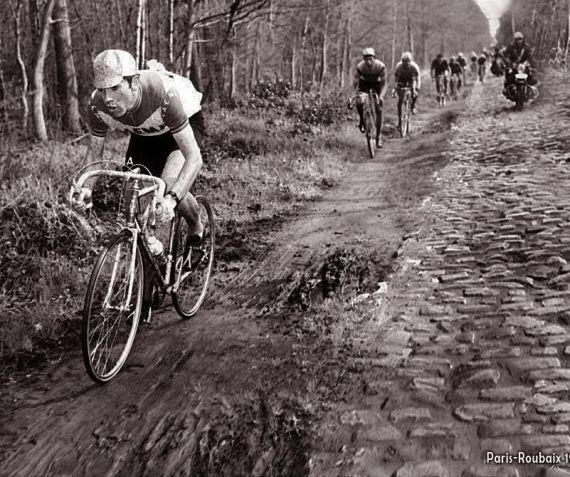
Merckx was an incredible cyclist. He achieved 525 victories over his eighteen-year career, including 11 Grand Tours (5 Tours de France, 5 Tours of Italy and 1 Vuelta d’Espana), all 5 Monuments (classic races which include the brutal Paris-Roubaix), and three World Championships. He attributed his successes less to rigorous training programmes or advice from coaches and more to simply riding “lots”. He believed that any time spent on the bike was hugely valuable, that there were no short cuts to winning, and that if one really desired success, one should simply “ride lots”. In many ways, his attitude mirrors that of Anna Kiesenhofer, the Austrian cyclist who won the women’s road race at the Tokyo Olympics. Both were/are driven by a fierce, all-consuming passion.
Eddy Merckx competing in the gruelling Paris-Roubaix race
Just as Merckx recognised the value of time spent on the bike, so we should recognise that any time spent at the piano is useful.
So stop procrastinating and go play! Stop analysing why you’re not progressing with that Bach Prelude & Fugue – and go play! Stop telling others that you “really should be practicing” – and go and play!
Play for two hours, or five, or for just 10 minutes – but play! Practice the pieces your teacher assigned to you, or play the music you love; but play! Reject the tyranny of “should” – just play! Don’t even think about it – just play!
“You train to ride”
This is a mantra from my husband, a keen amateur cyclist (and great admirer of Eddy Merckx). It seems obvious that training, or practicing the piano, leads to improved skill and greater executive function, yet too much time can be spent theorising and analysing methods of training or practising, without actually doing it. Is it not better to simply “play lots”?
I appreciate that this flies in the face of what most of us are taught – that intelligent, focused, “quality not quantity” practicing leads to noticeable improvement – but I also believe that the intent has to be driven by an overwhelming desire to simply spend time the with instrument. If you prefer to loll on the sofa watching Netflix, while saying “I really should be practicing”, you’re not displaying real intent or commitment. Instead, be driven by that all-consuming passion to play – and play lots
autonomy: the ability to make your own decisions without being controlled by anyone else – Cambridge Dictionary definition
Olympic gold medallist, the cyclist Anna Kiesenhofer is entirely self-coached. She manages everything herself, from her training regime to nutrition, tactics to equipment. Rejecting the norms of professional cycling, she doesn’t always do things the way the coaches say she should. “Don’t trust authority too much” she replies, when asked in interviews what advice she would give to aspiring cyclists. For me, she represents someone who has attained autonomy and proved that it can bring achievement and success.
Her fiercely self-reliant, “go it alone” approach appeals to me because five years ago, after failing to score a hat trick in my performance diplomas (I failed to achieve the final, Fellowship diploma), I decided to cease having regular piano lessons and to instead “self-coach” myself.
Failing to secure that final diploma, after I had recovered from the initial disappointment, made me appreciate that I had in fact achieved something far more significant than additional credentials and letters after my name – and something that is imperative for the musician, whether professional or amateur: autonomy.
In the early and intermediate stages of our learning, and even later on, it may be necessary to have a coach encouraging us to play more accurately, with more expression, greater freedom, artistry and confidence, but ultimately it is important that we recognise the value of what we have to say and to measure this against the score, rather than seek external critique or endorsement or mark our progress against that of others.
As you grow older, converse more with scores than with virtuosi – Robert Schumann
Of course, it takes a degree of courage and a leap of faith to step away from a teacher, especially one with whom you have enjoyed a longstanding, trusted and productive relationship. We may become reliant (sometimes overly reliant) on a teacher’s support, advice and encouragement, to the point where it can become very difficult to part company. But good teachers know that there will come a time when a student needs to move on, and the best teachers aim to make themselves redundant by equipping their students with the necessary tools to be confident, independent learners, able to make their own decisions about their learning and progress, interpretation and artistry. (Bad teachers, on the other hand, are possessive of their students, can be autocratic and dogmatic in their approach (“it’s my way or the high way“) and are less concerned with helping their students succeed than with bolstering their own egos.)
I am fortunate in having received many hours of expert tuition, coaching and mentoring from a number of leading pianist-teachers, who helped me lay the foundations of efficient, intelligent practice habits, secure technique, musicianship and artistry. Their support was invaluable, and without it, I doubt I would have had the confidence to pursue my own path to autonomy.
From observing other teachers and students, in masterclasses and on courses, conversations with pianist-teachers, concert pianists and other musicians, my own reading and research, and indeed a growing scepticism about mainstream methods and didacticism in music teaching, led me to form my own ideas about how I wanted to approach my music making and my ongoing musical development.
I’m fascinated with what happens to the creative output when you isolate yourself from the approval and disapproval of the people around you. – Glenn Gould
There is no doubt that the necessary confidence to pursue this path was imbued in me, in part, by the support of highly-skilled master teachers and mentors, and my achieving Distinctions in two performance diplomas, taken in my late 40s, having returned to the piano seriously after an absence of nearly 25 years. For me, the diplomas were less about external credentialisation, and more about improving my pianistic techniques, along with personal development and self-fulfillment – the best reasons, as I see it, for pursuing qualifications such as these.
Autonomy can be hard won – it took me eight years and two diplomas to step back from regular piano lessons and attending piano courses, quite a few conversations with myself and self-reflection – but one can gradually work towards greater independence, self-determination and self-reliance, for example, by reducing the frequency one’s piano lessons and becoming less dependent on the guidance and feedback from a teacher, and instead relying on one’s own musical knowledge.
The ability to make one’s own decisions about one’s music making and progress – important aspects of autonomy – comes from growing confidence, including the confidence to accept or reject advice, retaining what one will find most helpful and discarding the rest. Be wary of a teacher or mentor who claims to have all the answers and exercise a degree of healthy scepticism when taking advice from others, even the most highly respected teachers. Be open to suggestions, but also questioning and curious.
Alongside this, the autonomous musician will create their own validation methods and accountable tools – technical, interpretative, psychological and artistic – and use such methods and tools in every day practicing and performance. These may include:
Trial and error, exploration and experimentation, reflection and adjustment
Really close attention to all the details of the score
A willingness to learn from mistakes and to see failure as part of the learning process
Acknowledgement and acceptance of one’s strengths and weaknesses and an ability to play to those strengths
Remaining curious and open-minded at all times, alert to new possibilities or alternative ways of doing things (remember, there is no “right” way).
Feeding back to oneself through self-monitoring, recordings/videos, reflection, adjustment – and rinse and repeat
Setting realistic, achievable goals which encourage motivation and ongoing development
Regular study away from the instrument – listening (including going to concerts), reading
Try out performances in less stressful settings (at home to friends, for example), and self-critiquing and reflecting on one’s performance
Trusting one’s own musical knowledge and judgement rather than following received ideas about what the music should sound like/how it should be played
Guarding all the time against routine (which leads to boredom and counter-productivity) and a lack of mindfulness
An acknowledgement that there are no short-cuts or miracles, nor that there is a “right way” to play the music, and that the authority of one’s own interpretative decisions should be borne out in convincing performances
Seeking advice/critique from trusted colleagues, mentors and friends with whom one can have an honest and mutually respectful exchange of ideas. Such discussions may be regular or occasional, but they will have value, offering stimulating food for thought, and often allowing one to see the bigger picture of the music, rather than always focusing on the minutiae, as one surely does – and must – in daily practice sessions.
These points may appear rather exhaustive, but they are habits and skills which can be gradually incorporated into one’s regular practice regime, and developed and finessed to the point where they become intuitive. And then one continues to build on them, making small but significant positive gains which go to create a greater whole.
In achieving autonomy, I have felt liberated, enjoying greater physical and psychological freedom in my playing, less bodily tension and much more pleasure and personal fulfilment in the music which I choose to play.
The point is not to take the world’s opinion as a guiding star but to go one’s way in life and working unerringly, neither depressed by failure nor seduced by applause – Gustav Mahler
This site is free to access and ad-free, and takes many hours to research, write, and maintain. If you find joy and value in what I do, please consider making a donation to support the continuance of this site
Those of us who teach and play ourselves understand that music requires commitment in the form of consistent, focused practising. This does not mean a snatched half-hour here or there or a blitz the night before the weekly piano lesson, but regular engagement with the instrument and its literature (at least 5 days out of 7 for noticeable progress to be achieved).
As pianists, much of our “work” (practising) is done alone, for some in almost monk-like seclusion. This separateness enables us to focus fully on the task in hand, without distraction. Most of us who chose the piano as our instrument actively enjoy the solitariness (I know I do), but equally this time spent alone can trigger self-doubt and negative criticism from within. Looking at what others are doing, what repertoire they are learning, how they are progressing, is toxic too: comparing oneself to others sets up further negative thoughts and can lead to lack of confidence and motivation.
When I returned to the piano after a 20-year absence, I wanted to play EVERYTHING. Of course this was a ridiculous pipe dream, but my appetite for repertoire focused my attention and motivated me to practise diligently and enjoyably virtually every day. But when I co-founded the London Piano Meetup Group and started meeting other pianists, I encountered people whom I perceived as “better” than me – because they were playing repertoire which I believed I could not play. This depressed me and the mantra “I can’t play that” began to haunt – and limit -my practising. I grew increasingly envious of the people who knocked off Ravel’s Jeux d’eau or Grainger’s Molly on the Shore with apparent ease, not to mention countless other pieces which I aspired to play…..
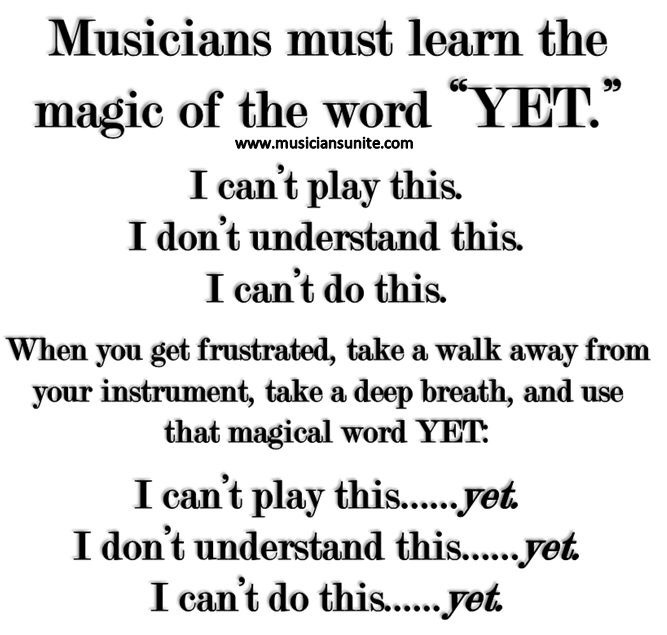
But hindsight and experience have taught me the power of “yet” – that simple three-letter word which can turn a negative phrase into something more positive and affirming:
“I can’t play that – yet”
“Yet” turns the task into a challenge and is the spur to set to and practise, to strive, to master.
“Yet” makes that Beethoven Sonata or Rachmaninov Étude-Tableau achievable, with practise.
“Yet” turns the seemingly impossible into the possible
Those of us who teach and play ourselves understand that music requires commitment in the form of consistent, focused practising. This does not mean a snatched half-hour here or there or a blitz the night before the weekly piano lesson, but regular engagement with the instrument and its literature (at least 5 days out of 7 for noticeable progress to be achieved).
As pianists, much of our “work” (practising) is done alone, for some in almost monk-like seclusion. This separateness enables us to focus fully on the task in hand, without distraction. Most of us who chose the piano as our instrument actively enjoy the solitariness (I know I do), but equally this time spent alone can trigger self-doubt and negative criticism from within. Looking at what others are doing, what repertoire they are learning, is toxic too: comparing oneself to others sets up further negative thoughts and can lead to lack of confidence and motivation.
When I returned to the piano after a 20-year absence, I wanted to play EVERYTHING. Of course this was a ridiculous pipe dream, but my appetite for repertoire focused my attention and motivated me to practise diligently and enjoyably virtually every day. But when I co-founded the London Piano Meetup Group and started meeting other pianists, I rubbed pianistic shoulders with people whom I perceived as “better” than me – because they were playing repertoire which I believed I could not play. This depressed me and the mantra “I can’t play that” began to haunt my practising and my participation in the Meetup group’s regular performance platforms. I grew increasingly envious of, and irritated by the people who knocked off Ravel’s Jeux d’eau or Grainger’s Molly on the Shore with apparent ease, not to mention countless other pieces which I aspired to play…..
But hindsight and experience have taught me the power of “yet” – that simple three-letter word which can turn a negative phrase into something positive and affirming:
“I can’t play that – yet”
“Yet” turns the task into a challenge and is the spur to set to and practise, to strive, to master.
“Yet” makes that Beethoven Sonata or Rachmaninov Étude-Tableau achievable, with practise.
“Yet” turns the seemingly impossible into the possible
The Cross-Eyed Pianist is free to access and ad-free, and takes many hours every month to research, write, and maintain.
If you find joy and value in what I do, please consider making a donation to support the continuance of the site







 The Cross-Eyed Pianist