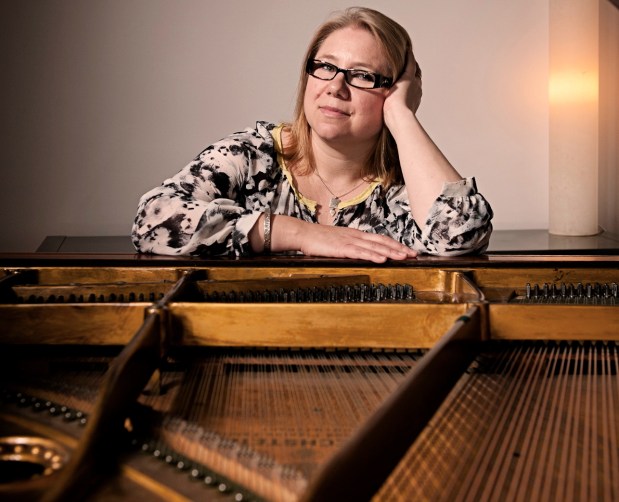
Who or what inspired you to take up the piano, and make it your career?

I grew up in a very much culturally, and musically, rich household, although neither of my parents were musicians. I started my piano lessons early, by the age of four (the Soviet-inspired music education system was then held in great and well- deserved esteem, for one to be judged as apt to pursue a serious, as it was, musical training was considered something of an honour); but it was not until relatively later that my relationship with the instrument and music making was definitely shaped: indeed at 12 I was privileged enough to assist Sviatoslav Richter on stage during his unforgettable recital in my hometown Tarnow, Poland (he let me hold down the bass notes in one of Rachmaninov’s Etudes-Tableaux), while also sharing a conversation and the great man’s private moments. I consider this to be a very major, pivotal event in my life. Schooling over, I realised that the only thing I could do quite decently  was to play the piano, so it stayed that way, eventually evolving into a professional activity. Now it has become a way of life and I can hardly imagine it otherwise.

Who or what were the most important influences on your playing/composing?

I have long been fascinated by the “old school” of piano playing and its total mastery of the keyboard in all of its dimensions: technical, poetic, emotional, transcendental…….I do acknowledge the importance (and consider myself subjected to) and significant influence of the so-called Russian school of piano playing, both of Liszt-Siloti and Neuhaus lineage, its research of sound quality, lyrical expression, rhythmic drive, broadly understood articulation, both digital and epic, stylistic and structural intelligence (curiously and surprisingly enough I found many of these elements in Cortot’s Chopin edition that I value highly). There is also a timeless legacy of individuals like Horowitz or Gould which constitutes a continual and enlightened source of inspiration.

What have been the greatest challenges of your career so far?

At the early stages of a career, what inevitably stands out as a challenge is having to deal with “glass ceiling’ and “moving sands” syndromes, on top of not letting one’s ignorance of basic communication skills and socio-technical tricks stand in the way of personal improvement and, ultimately, personal fullfilment. Understanding the secret life of a professional agenda punctuated by phone calls or lack of, understanding the particularities of different life stages and their impact on social/professional interactions, all this while trying to keep an “inner child” alive, constantly expanding, upgrading and keeping up with the repertoire, knowing it inside out and upside down at all times, being at ease with proselytizing and successfully funding oneself and one’s intimate passions; and also the ability to preserve some time on one’s own, not letting personal life to become a wasteland are but a few of the constant challenges to which a professional musician is subjected during his/her life. I think we would also all reasonably agree that what probably is the most difficult in a long run is sticking to however unrealistic goal, once set, and never diverting from the straight path to achieve it, as well as never giving up in the face of ever-increasing competition.

Which performances/compositions/recordings are you most proud of?

During the last few years I greatly enjoyed performing both Liszt Concertos in France and in the United Kingdom and giving all-Chopin recitals, including on period instruments. I am very proud of my collaboration with the Rio de Janeiro youth string Orquestra de Cordas da Grota conducted by Ubiratan Rodrigues: during the Policia Pacificadora siege of Rio favelas in November and December 2010 we rehearsed, performed and recorded J.S.Bach’s Concertos BWV 1052 and 1058 (prod. Martin Voll for Otherwise Records). I am equally proud of my latest CD release Jozef Kapustka: Improvisations with Bashir containing my own improvisations in the oriental style, and where I am joined by Iranian virtuosi Bashir Faramarzi and Pedram Khavarzamini (sole distributor: DUX Recording Producers/Naxos, 2013). This recording, produced by Sanaz Khosravi, has been well received on both sides of the current diplomatic and ideological conflict.

Do you have a favourite concert venue to perform in?

There are so many of them…… Great pianos, great acoustics, great public, great surroundings or any combination of these makes each experience unique and unforgettable. In terms of psychological impact, performing in some of New York venues while still in my twenties (Lincoln Center Alice Tully Hall, NY Public Library, Metropolitan Museum, Carnegie Hall) made a very lasting impression on me as I was striving not to be intimidated by all the great names, historic and current, that “made” these places.

Exceptional pianos, that one may get to play while travelling the world of concert venues, is another thread worth following in this context: I was allowed to “touch” Chopin’s piano on  a display in the Chopin Society in Warsaw, Schubert’s piano in Germanisches Museum in Nuremberg  and even allowed to practice on Rachmaninov’s piano exhibited in Steinway Hall in New York. No words can describe these moments: the feeling of living out a history, of what the French call “plenitude” (roughly “fullness” or “abundance”), continuity and unity. In 2011 I found myself performing Liszt Concerto No.2 (alongside Leamington Sinfonia conducted by Jenny Barrie) in Stratford-upon-Avon’s Holy Trinity Church, Shakespeare’s burial place – and imagined both Shakespeare’s and Liszt spirits wondering freely around, somewhere up in the skies……

On a more anecdotal side, I had also a fair share of surreal moments in my career, once playing in the ancient seaside Roman theatre of Sabratha in Libya (then still under the rule of Qaddafi) to a virtually non-existent or imaginary public and feeling as if I were on a planet Mars, a blast of light and sound……

Favourite pieces to perform? Listen to?

At the moment my favourite, both to listen and perform, are Rachmaninov’s Moments Musicaux op.16; otherwise the spectrum fluctuates freely, ranging from lesser-known, melancholy Baroque tablatures to Mahler Symphonies to Strauss Symphonic Poems to Soviet and American avant-garde (Ustvolskaya, Feldman). Nevertheless my all time favourites to perform are the two-piano versions of Stravinsky The Rite of Spring and Ravel La Valse, of which I made my own transcription, constantly in the process of being refined. Occasionally I also enjoy the “cheesy” side of the repertoire, with Latin sounds and rhythms or Viennese waltz extravaganzas.

Who are your favourite musicians?

My favourite musicians are: among pianists Rachmaninov, Horowitz, Richter, Cziffra; conductors Celibidache, Scherchen, Kleiber, violinist David Oistrakh; and singers Callas and Wunderlich . Well, I guess everything has been said about these giants, the subject is probably largely exhausted, and any attempt to comment further would be  vain. As far as the contemporary scene is concerned, I will just limit myself to saying that I do have my “pros” and “cons”, however the issue is always delicate, at least since the phrase “de gustibus non disputandum est” has been pronounced in some distant past…

What is your most memorable concert experience?

Besides having the opportunity to listen to Richter and Pogorelich playing live (1991 Lincoln Center recital), which springs to my mind as quite obvious a choice, I would like to surprise you  with the following story:

Whoever lived in Krakow, Poland, back in the 80s will remember the blind Gipsy violinist playing next to the garbage bin on the Florianska street. Stefan Dymiter (1938-2002), for this was his name (although at the time very few knew either his name or his story), used to perform in a way that stands not only against every teaching principle of every possible violin school but also overtly defies quite a few laws of physics, particularly that of gravitation; he was holding his violin with the right hand like a cello, his bow with the left hand and accidentally happened to be the most pure form of a musical genius somewhere in between Mozart and Ervin Nyiregyhazi. Among anecdotes that circulated later, he was rumored to refuse to appear alongside Lord Menuhin, whose playing he disliked; also the late professor Szlezer from the Krakow Higher Academy of Music had been known to be send his students to listen to the man play and try to pick up some of his technical tricks . Well, myself I could just stand there for hours and listen to his inimitable, God-given sound……

What do you consider to be the most important ideas and concepts to impart to aspiring musicians?

It is important to bear in mind that one plays the piano not with  fingers but with the  mind, soul and spirit or with what the ancient Egyptians called “the divine breath”, Shou. This notion is to be somehow skillfully conciliated with the profession’s bare realities.

With a growing contempt for classical music as a highly demanding, noble art in favour of perceiving it as a somehow rather unsophisticated leisure, most conservatories are either deliberately out of focus with the “modern times” or simply are not equipped, in terms of human resources, to deal with shifting priorities,  dogmas, “old boy networks” and a die-hard reality of material strains and psychological violence (as a matter of fact they never were). We are expected to “build a career”, move freely between its different stages, develop and implement a “professional strategy” with the emphasis on “getting there”, no errors, trials and tribulations allowed; good old days of plain music making are no more.

While still within an “ivory tower” world of the music school, few understand that there is no such thing as “getting there”: either you are where you want to be or you are not, and if you are not, someone, let’s call him “the game master”, simply has to put you where you aim to belong, it is as simple as it sounds but you will not pull off the stunt all by yourself. While the right networking moves are essential, the real factor of increased mobility and visibility is spending power; it is evident that money  “buys” a “career”, not the other way around, so you’d better know what you are doing and most importantly, who is paying for it. The subject is largely a taboo.

Moreover, occasionally some wise spirits like to remind us, not without a twinkle in the eye, that music making is a passion and should be the source of infinite, nearly ecstatic pleasure. Yes, it is indeed. Therefore I stand by what I have said earlier in an interview for the London Royal Academy of Music online journal, if I may quote myself here:  As an artist be true, be genuine, be sincere, and be passionate. Do not imitate, it does not interest anybody, be yourself. Respect yourself, respect your colleagues. Be faithful and decent. And last but not least: “Work hard, see large, achieve!”

What are you working on at the moment?

I am working on Rachmaninov Piano Concerto No 3, it has been with me for few decades now and I have finally decided to give it a try.

Where would you like to be in 10 years’ time?

Probably where I am meant to be there and then. Here and now is always what it should be and it is the only valid notion in time/space travels.

What is your idea of perfect happiness?

A happiness within. Contrary to popular belief, one does not need objects to be happy.

What is your most treasured possession?

Sviatoslav Richter handwritten message: “I wish you much happiness and success”

What do you enjoy doing most?

Walking in the countryside

What is your present state of mind?

Alert

Jozef Kapustka was born in 1969. He began receiving early musical tuition from local instructor Danuta Cieślik at the age of 3. He then briefly studied at the State Higher Academy of Music in Kraków with Ewa Bukojemska. Having graduated from The Juilliard School in New York (Bachelor of Music degree, 1992; piano with Josef Raieff, then Jerome Lowenthal and chamber music with Joseph Fuchs), he moved on to obtain a Postgraduate Advanced Studies Diploma specializing in piano performance from the Royal Academy of Music in London (1997), with Martin Roscoe. He also worked with Dimitri Bashkirov (masterclasses held under auspices of the Queen Sofía College of Music in Spain) and Vera Gornostaeva in Paris and Moscow.[2] Being an alumnus of the Music Academy of the West in Santa Barbara, 1991, he holds a Diplome superieur de la langue et civilization francaise from Paris Sorbonne University (1994). In 1994 he received a Grand Prix of the Conservatoire International de Musique de Paris. He was nominated for the Molière award in 2010 (Best musical play: Diva à Sarcelles, written and directed by Virginie Lemoine).

www.jozefkapustka.net

Who or what inspired you to take up the piano, and make it your career?

I don’t think it was the piano specifically that attracted me as a child – I just always loved music and wanted to be involved in it in any way possible. I don’t come from a musical family, and my parents didn’t really know any classical music till I came along (I was brought up on Motown, Bob Marley, Paul Simon, Joni Mitchell, Queen…), but they’re both creative people and incredibly supportive, and recognised that I had an absolute fascination for music of all sorts from a very young age. The first ‘classical’ record I remember my parents buying for me was of David Munrow playing Mediaeval and Renaissance wind instruments, which I became quite obsessed with. As a child, I took up the recorder, piano, cello and oboe, but what I really wanted to be more than anything else was a composer. I’m not quite sure how I ended up being a pianist – I don’t remember a conscious moment of decision, and always feel the instrument chose me rather than the other way round. As for making music my career, I just never considered doing anything else, though for a long time I hadn’t the faintest idea how a career actually worked.

Who or what were the most important influences on your musical life and career?

My first piano teacher, Hilary Morrison, was a schoolteacher who lived round the corner – she’d never taught the piano before, but it’s only with hindsight that I realise what a brilliant start she gave me. I wish she was still alive so I could thank her properly. I was incredibly fortunate to study from the age of nine onwards with Joan Havill at the Guildhall School of Music and Drama, who taught me pretty much everything I know about playing the piano, pushed me to achieve things I thought I couldn’t, and inspired me to work much harder than I ever would have done otherwise. I owe her so much, and my life would have been very different without her. Many of the principles of chamber music playing which I hold dear were instilled in me by the wise guidance of Michael Freyhan at Pro Corda when I was in my teens. He showed me how to really listen – to myself and to others. There are so many other wonderful people who have had a huge influence on me, from primary school music teachers to chamber music colleagues; I can’t list them all for fear of leaving someone out, but I hope they know who they are!

What have been the greatest challenges of your career so far?

In the earlier stages of my career I had to fight hard to avoid being pigeon-holed: I played a lot of chamber music from a young age, because I’ve always loved it, and discovered at a certain point that once people see you in that box, they often assume you’re not really a ‘solo’ pianist, despite the fact that I’ve always had a busy schedule of concertos and solo recitals. Such assumptions strike me as very odd, because it seems only natural to me that a pianist exploring Beethoven (for example) should want to play his solo sonatas, duo sonatas, trios, concertos, songs and so on – everything feeds into everything else. I’ve always thrived off the variety and balance of repertoire, and I’d hate to close the door on any part of it. And I already feel that being a pianist is more of a specialism than I’d originally intended!

Which performance/recordings are you most proud of?

I’m not sure that pride is a feeling I particularly associate with, but sometimes there are wonderful, indefinable moments in certain performances (I wish they happened more often!) where everything comes together in a magical way and it feels like you’re flying, as if anything’s possible. I have so many reservations about the process of recording (not least that I miss the audience hugely when I’m in a studio), and I find it very difficult to listen to my own recordings, but I do feel a sense of achievement over my new recital disc, In Dance and Song, which contains a very personal selection of works and reflects some of my wide-ranging passions. Also, the one time I dared to listen to it, I quite enjoyed the disc of the Chausson Concert which I recorded two years ago with Jennifer Pike and the Doric Quartet – it’s a wonderful piece, full of soaring melodies (and a ridiculous number of notes for the pianist).

Which particular works do you think you play best?

Not sure if I can answer that, but I’ve always adored melodies and vocal music, so I find pieces with a lyrical bent particularly gratifying to play.

How do you make your repertoire choices from season to season?

Pianists are spoiled for choice when it comes to repertoire, and it would take so many lifetimes to explore all the great works – as time goes on, I realise more and more that it’s a waste of time for a pianist to play anything that doesn’t really grab them. I enjoy hugely (though it sometimes requires an exhausting amount of thought) coming up with interesting and (I hope) cohesive programmes. Often, however, the ones I’m most pleased with are then scuppered by promoters saying e.g., “[A much more famous pianist] is already playing most of those pieces in his recital this season” or “Can you include a barcarolle by Snosveldt to mark his 186th anniversary year?” or (and this is a genuine quote, from a much missed promoter in Ireland) “Fauré spells death at the box office”.

Do you have a favourite concert venue to perform in and why?

Among many others, I love the Holywell Room in Oxford, Kettle’s Yard in Cambridge, and the Wigmore Hall. Playing at the BBC Proms is always a huge thrill. The Spoleto Festival in Italy when Gian Carlo Menotti was around was unforgettable.

Favourite pieces to perform? Listen to?

To play – far too many to list, but here are some which I find particularly enjoyable and/or rewarding to play: Beethoven concertos (including the Triple), Brahms piano quartets, Chopin solo works, Dvorak chamber music, Fauré (lots), Grieg miniatures, Mendelssohn chamber music, Messiaen Quartet for the End of Time, Mozart (all!), Rachmaninov concertos, Ravel (lots), Saint-Saens’ Carnival of the Animals, Schubert’s Trout Quintet, Schubert and Schumann Lieder, Richard Strauss’ early chamber music, Tchaikovsky’s Piano Trio. And – stretching back to my schooldays and early jobs in hotel bars – I’ve always loved playing Gershwin, Kern, Cole Porter and the Great American Songbook. To listen to – this changes a lot, but perhaps most consistently Bach, Mozart operas, Sondheim musicals, Ella Fitzgerald’s songbook recordings.

Who are your favourite musicians?

Along with the great composers whose music I play (of whom Mozart has perhaps brought me most joy of all) and the wonderful colleagues I have the pleasure of working with (not least my dear friends in the Aronowitz Ensemble), here is a very incomplete list featuring some musicians who have greatly inspired me in some way or other, which I’ve restricted to those I don’t know personally: Leonard Bernstein, Miles Davis, Ella Fitzgerald, Emil Gilels, Fritz Kreisler, Dinu Lipatti, Radu Lupu, Joni Mitchell, Ginette Neveu, Luciano Pavarotti, Oscar Peterson, Lucia Popp, Nina Simone.

What is your most memorable concert experience?

As a listener – a concert in King’s College Chapel, Cambridge in 1999, part of John Eliot Gardiner’s Bach Cantata Pilgrimage; most specifically the final aria of BWV 159, one of the most heart-stopping moments of my life so far. As a performer – I think I have a pretty good memory, so I remember most of my concert experiences, both good and bad, quite vividly. Two experiences which I will always associate with a wonderfully heady mixture of fear and immense joy both involved Robin Ticciati and the SCO – touring with the Ligeti Concerto in 2010 (the most fiendishly difficult piece I’ve ever played, but also utterly enthralling), and playing my first Brahms 2 at three days’ notice when Pierre-Laurent Aimard cancelled. (That wasn’t actually my most last-minute stand-in: I once got off a plane at 4.30pm and, when I turned on my phone, there was a message asking if I’d play the Grieg Concerto at 7.30pm that evening. The rehearsal had already taken place, but I jumped in a taxi and somehow got through the performance unscathed, and with a curious sense of liberation on stage!) I will always remember with huge fondness my appearance in the BBC Young Musician final back in 2000, under the starry ceiling of the Bridgewater Hall. It was a big, thrilling moment for a rather naïve boy who’d always felt something of an outsider and who’d never experienced anything remotely on that scale. It also opened a lot of doors. On a non-pianistic note – and perhaps reflecting my early desires to be an actor as well as a musician – I enormously enjoyed appearing as reciter in Walton’s Façade a few years back at Aberystwyth Musicfest (where I’ve also played the swanee whistle in drag).

What do you consider to be the most important ideas and concepts to impart to aspiring musicians?

First and foremost, that music is the most important thing, and if you love it so much that you can’t be without it, then immerse yourself and go for it – but try to be flexible and open-minded about your exact path. Avoid cynics and negative people – there are a lot of them around, such as the ones who like to hover after a concert and say helpful things like, “It’s a terrible struggle, the music business, isn’t it? Must be very difficult for you.” Of course there are tricky times, but no money in the world could persuade me to switch to another profession.

Regarding education, I personally think it’s important to remember there are valid alternatives to the music school/music college route. All my schooling took place in the comprehensive system, and my first degree was at university. It dismays me when people express surprise (which they really do) that some of us in the classical music profession hail from a regular state school background; I’m also immeasurably saddened that, if music in state schools continues to be eroded and marginalised by the government, before long there may not be many aspiring musicians to pass such advice to.

Where would you like to be in 10 years’ time?

Doing pretty much what I am now. Though I’d like to have written a hit West End musical in the interim. And to have successfully campaigned (without it having taken up too much time) for the provision of free music education for all children, which would incidentally have enabled world peace.

What is your idea of perfect happiness?

To see an aardvark, moose, tapir or dugong in its natural habitat.

What is your present state of mind?

Sleepy.


Tom Poster is internationally recognised as a pianist of outstanding artistry and versatility, equally in demand as soloist and chamber musician across an unusually extensive repertoire. He has been described as “a marvel, [who] can play anything in any style” (The Herald), “an unparalleled sound-magician” (General-Anzeiger), a “young lion” (The Guardian), and as possessing “great authority and astounding virtuosity” (Est Républicain). He won First Prize at the Scottish International Piano Competition 2007, the Ensemble Prize at the Honens International Piano Competition 2009, and the keyboard sections of the Royal Over-Seas League and BBC Young Musician of the Year Competitions in 2000. 

Tom’s full biography and diary is available on his website: www.tomposter.co.uk

Interview date: 10th March 2014

This weekend sees a celebration of all things piano at London’s Institut Français, with workshops, lectures, film screenings and performances. In the run up to this surfeit of piano goodness, I am delighted to be publishing Meet the Artist Interviews with some of the performers, including acclaimed French pianist Pascal Rogé (who also performs at Wigmore Hall in June) and harpsichordist Kenneth Weiss. The first interview is with French pianist David Bismuth.

Full details about the festival here:

www.institut-francais.org.uk/itsallaboutpiano

Who or what inspired you to take up the piano?

My grandfather had an upright piano in the front room of his house in Ipswich. This room was kept for Sundays and special occasions. He liked to play Methodist hymns, excerpts from Haydn and Beethoven and old music hall songs. I loved to sit next to him as he played, or leaf through the music in the piano stool, with its special antique smell and friable, crumbly pages.

There was lots of music at home when I was growing up: on the radio, LPs and from my father, who was a fine amateur clarinettist. When I was in bed, I used to listen to him practising Mozart’s Clarinet Concerto to Music Minus One: for a while I believed he had a whole orchestra in the sitting room with him!

I think I was about 5 or 6 when I started piano lessons with Mrs Scott in Sutton Coldfield. My piano was an early 20th-century Challen upright. It had lived in a conservatory for two years before it came to us and it needed quite a lot of restoration, but once overhauled it was a really nice instrument, of which I was very fond.

My parents were keen concert-goers and my love of live classical music developed in childhood. We went to many concerts at Birmingham Old Town Hall where a conductor with wild hair conducted the CBSO (this was Louis Fremaux, pre-Simon Rattle). I loved, and still do, the etiquette of concerts – the excited buzz of anticipation in the foyer beforehand, reading the programme, sinking in to the plush seats. Once a year, as a treat, I would be taken to London to go to the Proms, and we also went to the opera and ballet regularly. I was lucky enough to see/hear some of the “greats”: Ashkenazy, Brendel, Lupu, du Pre, Barenboim, Lill. I grew up thinking classical music was something everyone could enjoy and engage with (and music was readily available in state school in the early 1980s) – it felt entirely normal to me – and it was only when I went to secondary school, where my talent for music (I was tested for perfect pitch in front of my entire class, an excruciatingly embarrassing episode – and I don’t have perfect pitch!) marked me out as “different” in a school where being “a team player” was important. Music and the school music department became a place of escape and I threw myself into the school’s musical activities: I took up the clarinet so that I could play in the school orchestra, and joined the choir, recorder group and wind band.

I took all my ABRSM grade exams while still at school, and really wanted to apply for music college, but a rather throwaway comment by my music teacher that I perhaps “wasn’t good enough” to audition led to me to follow a different path into further education and I studied Medieval literature at university. I stopped playing the piano seriously at 19 and hardly touched the instrument until I was in my late 30s and my mother bought me a digital piano, urging me to start playing again. Not long after I turned 40 I had a brand new Yamaha acoustic piano and had begun teaching local school children and a handful of adults. By the time I was 50, I was preparing to take a Fellowship performance diploma, having passed my Licentiate and Associate diplomas with distinction.

Who or what were the most important influences on your musical life and career?

My parents nurtured and encouraged a love of classical music. This was enhanced by my then piano teacher Mrs Murdoch and particularly my music teacher at secondary school, an incredibly energetic and enthusiastic man who organised all sorts of wonderful musical activities in and outside of school, including trips to dress rehearsals at the Royal Opera House (where I saw Tosca, Billy Budd, Peter Grimes, La Bohème and Turandot, amongst others). In c1981, the school choir took part in a performance of Elgar’s Dream of Gerontius with massed school choirs at the Royal Albert Hall, an unforgettable experience, which has stayed with me ever since.

Since I started blogging and writing about music, encounters with other pianists and musicians all feed into my musical life and inform my approach to the piano. My study with a number of master teachers and concert pianists while preparing for professional performance diplomas has had a huge impact on my confidence and skill as a pianist, and the deep learning that is required to prepare for such qualifications enables me to pick up new repertoire without feeling daunted by its challenges.

What have been the greatest challenges of your career so far?

Convincing people that being a musician and writer is “a proper job”.

Dealing with ongoing imposter syndrome, which I think comes from not having attended music college at 18. I don’t think it’s entirely a bad thing, however, as I believe it keeps one humble.

Which performances are you most proud of?

I played Messiaen’s Regard de la Vierge from the ‘Vingt Regards’ at an event hosted by Murray McLachlan at Steinway Hall in 2011 as part of the preparations for my Associate performance diploma. It was the first time I had played a Steinway D piano and the first time I’d played the Messiaen in public. The feedback from Murray and the response from the audience was wonderful and an incredible boost to my diploma preparations and confidence.

In recent years, I have had the great pleasure of performing at a friend’s house concerts in his beautiful home in the Sussex countryside. A lovely setting, convivial atmosphere, friendly audience and a truly stunning Steinway B piano make these concerts the best I’ve ever experienced, and I was very pleased with my performance of the final movement of Schumann’s Fantasie in C, Op 17 at last winter’s house concert. I have yet to learn the other two movements of the Schumann…..!

Which particular works do you think you play best?

I recently read an interview with the pianist Richard Goode, whom I much admire, in which he said he chooses to “perform only the pieces that will be best for you and the audience” and that one should understand one’s own limits. As pianists we have a vast repertoire and one should never feel under pressure to be able to “play everything”. I used to think I was somehow failing if I did not have the requisite number of Bach Preludes & Fugues, Beethoven Sonatas, Chopin Etudes or Debussy Preludes in my fingers; now I just play what interests me and what I believe I can play well.

How do you make your repertoire choices?

I play whatever music interests me, and my tastes change constantly. More and more I am choosing to play 20th-century and contemporary piano music, and the wilder shores of repertoire – I like oddities and lesser-known works. These are often easier to play than the core canon as one is not constantly up against the weight of history and perceived “right ways” to play this repertoire.

Having said all this, Schubert remains my favourite composer; I really should play more of his piano music!

I am currently working on a programme called A Sense of Place – piano music inspired by or evocative of real or imagined places and landscapes. The pieces include movements from Alan Hovhaness’ Visionary Landscapes, John Cage’s In A Landscape, Cyril Scott’s Lotus Land and Britten’s Night Piece.

Favourite pieces to perform? Listen to?

To play, perhaps Bill Evans’ Peace Piece. I played it at a charity concert a few years ago and the audience loved its meditative atmosphere.

I get sent CDs to review all the time and listen fairly widely as a result, though I always tend towards piano music. If I had to pick a favourite recording, it would be Resonance de l’Originaire by Maria Joao Pires.

Most memorable concert experience?

It has to be Steven Osborne’s performance of the complete Vingt Regards at the Queen Elizabeth Hall – I have now heard him play this monument of 20th-century piano music twice, and on both occasions the experience has been transcendent, beautiful, moving, and incredibly profound. Talking to Steven in the bar afterwards, he simply said “one just has to go with this music”.

What do you consider to be the most important ideas and concepts to impart to aspiring musicians?

Be true to your musical self and try not to be distracted or downhearted by what others in your profession are doing. Don’t endlessly compare yourself to your peers or to others in the profession – this can lead to feelings of dismotivation, dissatisfaction and worse, depression. Navigate your own course to find your own musical identity and voice.

Live and love life fully: go to concerts, exhibitions, films, read, eat, socialise, enjoy. Everything feeds the artistic temperament!

What is your definition of success?

Seeing people come out of a concert truly touched or moved by the music they’ve hard.

Witnessing a piano student’s “lightbulb moment”

Being able to play Schumann’s Fantasie in C, Op 17 in its entirety! (one day!!)


img_228121

Frances Wilson is a pianist, piano teacher, writer and blogger on classical music and pianism as The Cross-Eyed Pianist, described by concert pianist Peter Donohoe as “an important voice in the piano world”.

Read more

franceswilson.co.uk