I’ve been going to live classical music concerts since I was a little girl – and not just professional concerts, but also amateur performances when my dad (a clarinettist) played in a local amateur orchestra. As keen music-lovers, my parents took me to all sorts of concerts – big orchestral performances at Birmingham Old Town Hall (the former home of the City of Birmingham Symphony Orchestra), chamber music, opera and choral concerts in churches. I quickly grew to love the “special occasion” nature of going to a live concert and enjoyed the rituals and etiquette (even if I found some of the music over-long or boring on occasion!).

Going to concerts with other people can be a very special shared experience. There is the pleasure of meeting beforehand, perhaps for a drink in the venue’s bar, purchasing a programme, easing oneself into plush seats and enjoying the hum of anticipation before the performers come on stage. Then there is the interval when one can chat about the first half and enthuse with friends before the music begins again.

When I started reviewing concerts in 2011, I tended to go alone, unless a friend or two happened to be at the same performance. At first I felt slightly awkward, sitting alone in the bar beforehand, a glass of wine in hand, reading the programme, making notes…. but gradually I came to enjoy the experience of attending on my own, and now I actively relish it.

Attending a concert can be a powerful, shared experience that transcends the boundaries of individuality, regardless of the genre of music being performed. While the idea of going to a concert alone might seem daunting to some, there is undoubtedly positivity in the shared atmosphere of live music. Whether you’re surrounded by a sea of familiar faces or standing alone in a crowd, the concert space creates a special sense of community, connecting individuals through the universal language of music.
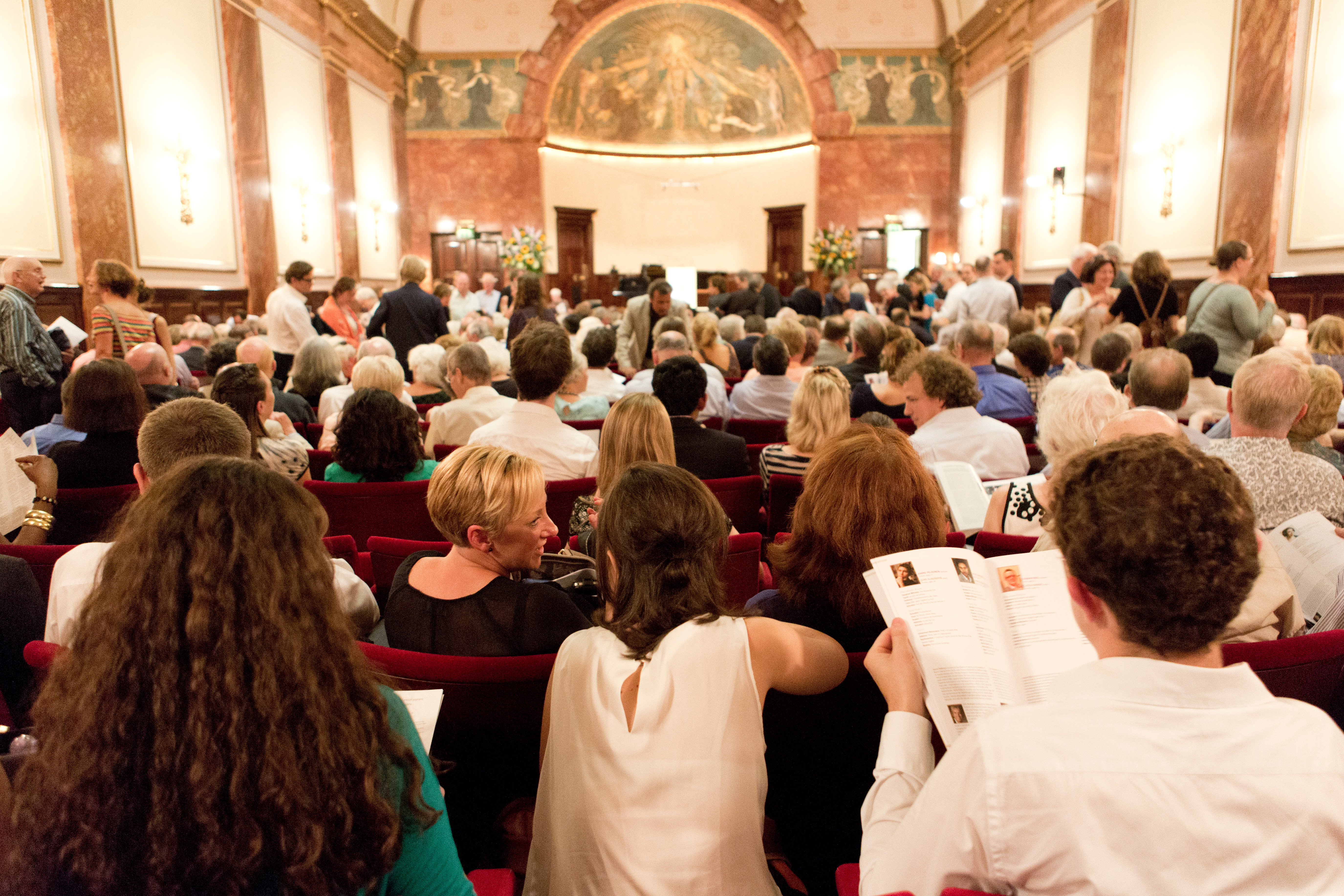
London’s Wigmore Hall

Perhaps one of the most tangible aspects of this shared experience is the palpable sense of communal energy. The collective anticipation, excitement, and emotions create a shared atmosphere that unites the audience. As the house lights dim, an expectant hush pervades the concert space as the audience anticipate the arrival of the artist or artists. In such an environment, it becomes less about being alone and more about being part of a larger, unified whole.

Regardless of whether you attend a concert alone or with friends, the music itself becomes the common thread that binds everyone together. In a crowd of strangers, the shared appreciation for the artist’s craft creates an unspoken connection, fostering a sense of unity and camaraderie among concert goers. I love those moments when it seems that the entire audience is listening really intently, as if with one, collective ear. Or the sense that the audience is holding its collective breath, so engaged are they with the performance. And then, at the end, a joint exhalation as the audience relaxes, anticipating the applause.

Attending a concert on your own offers an opportunity for personal freedom and self-discovery. Free from the expectations of others – the obligation, perhaps, to express your opinion of the performance during an interval chat – when attending a concert alone, you can fully immerse yourself in the music, allowing it to resonate with you personally. You can choose to listen intently, or allow your mind to wander. The solitude within the crowd provides a space for self-reflection, and an opportunity to experience the music in a way that is entirely your own.

Thus, attending a concert alone is not an act of isolation; rather, it is an opportunity to experience the communal tapestry of music. Even if you never speak to a fellow audience member, there is something very special about experiencing music together.This is because the unifying power of live performance goes beyond individuality, creating an environment where strangers become companions in a collective journey of musical expression and a celebration of shared experience.


This site is free to access and ad-free, and takes many hours to research, write, and maintain. If you find joy and value in what I do, why not
When it’s a socially-distanced concert

I’ve been guilty of it myself, proudly trumpeting “this concert is now sold out!” for the events I have been promoting over the past two months (I work for a London-based arts organisation and a local concert series), and I know I’m not alone. For those of us who have been so bereft of live music this year – musicians, venue owners, promoters and of course audiences – the fact that live music, with audiences, has been able to resume is something to celebrate.

Government restrictions in response to coronavirus mean that venues cannot operate at full capacity, whether this is a church (capacity c80) or a major London venue (capacity c3000). Social distancing regulations require a certain amount of space to be allowed between audience members and in order to adhere to these regulations many venues are operating at less than half their normal capacity. Obviously, venues must be safe for audiences – if audiences feel safe they will come to events – but the maths is simple and very stark: fewer “bums on seats” means lower ticket revenues. And venues and concert promoters rely on this revenue in order to pay artists and cover the other costs of putting on concerts and running a venue. Additionally, venues are restricted regarding F&B service (Food and Beverages), in normal times a significant income stream.

So what to do? Obviously, venues and promoters, and of course musicians, are keen to welcome back live audiences – a concert is not really a concert without a live audience – but balancing the costs of presenting a concert against reduced ticket and other income is a significant headache.

If your venue is less than half full do you charge more than double the usual price for the tickets? Of course not. This would be unfair on audiences, and while a few would be prepared to pay more, to support venue and artists, many would be deterred by a hike in ticket prices and would choose to stay away. With current restrictions in place, many venues and promoters are struggling to break-even.

But for those of us who give or promote concerts, to be able to welcome audiences back through the doors once again is very important and I firmly believe that venues must, if they can, offer audiences something, within the limitations of coronavirus restrictions. Some venues are lucky to have generous patrons and benefactors or have benefitted from government handouts; others do not but are still willing to, in the medium term, take a financial hit and bring audiences back. But this scenario cannot last indefinitely and without proper ticket revenues, many venues and promoters will struggle, along with performing musicians.

The last properly sold out concert I attended before the first UK lockdown was at the Wigmore Hall at the end of February, when American pianist Jonathan Biss gave a thrilling performance of Beethoven Piano Sonatas (read more here). At the time, the coronavirus was not yet headline news; of course people were aware of it, and I recall a friend hugging me in the vestibule of the Wigmore before the concert and saying “oh, maybe we shouldn’t do that!” – and then we both laughed. The hall was full to capacity and the bars downstairs were busy and noisy as people enjoyed pre-concert and interval drinks and conversation. At the time, I didn’t know it would be the last live concert I would attend for seven months. When the Weymouth concert series, which I help to organise, resumed in October, we presented two shorter concerts to allow for a socially-distanced audience of reduced numbers (less than half our usual audience) and while the church looked sparse, it was wonderful to hear live music and also applause. We took the decision not to increase ticket prices and hoped to be able to at least cover our costs and pay our guest artist, without eating into our bank balance. We are fortunately in having low overheads, but we face similar difficulties to other concert organisers and promoters.

Times are tough once again for musicians as the UK is poised to enter another period of lockdown and live events must be suspended. Let us hope that the new year will bring more positive developments regarding the management of the virus, which will allow venues to operate more profitably.

Meanwhile, those of us who love live music can support artists and venues by buying concert tickets, to live and online events, and making a donation where possible.

This site is free to access and ad-free, and takes many hours to research, write, and maintain. If you find joy and value in what I do, please consider making a donation to support the continuance of this site

Make A Donation


Header image by Kilyan Sockalingum on Unsplash


