An interview with celebrated baritone Benjamin Appl ahead of his appearance at this year’s Leeds Lieder Festival

Who or what inspired you to pursue a career in music and who or what have been the most important influences on your musical life and career?

I started to sing when I was pretty young. Although no one in my family had trained as a professional musician, we sang a lot together while my mother accompanied us on the guitar. Aged ten I followed my two brothers and joined one of the most renowned boys choirs, called the Regensburger Domspatzen (which means the ‘cathedral sparrows of Regensburg’). Originally I wasn’t so fond of boys singing together – I disliked the sound and thought it sounded shrill – but after being part of this choir community and experiencing that amazing feeling of making music together on such a high level, I then really loved it. I think this was the moment when this addiction was first planted inside me, the feeling that life without music would not be the same.

Then, as a professional musician, of course it was my teacher and mentor Dietrich Fischer-Dieskau. To have had the privilege of working with him is one of the highlights of my career to date. He was a real mentor in many ways and taught me so much, not just vocal technique or interpretation but much more beyond this: he taught me the essence of being a musician, and the responsibilities with which that comes.

I was deeply impressed by his level of preparation, and the seriousness with which he achieved such a deep level of understanding of the music. Every time I went to his home he had prepared himself for our session, looking through the scores again, reading about the poetry and the background of the songs – doing all this even though he had already spent a lifetime on it. But this is also one of the most wonderful aspects of this profession: you never can be too well prepared.

What have been the greatest challenges of your career so far?

I think what’s important is to find a personal connection with the music and how to present it and how to communicate it to people. If you’re yourself and you try to find a good emotional connection and how to communicate it, then it can be fairly easy. Generally, though it’s quite a difficult job in that as a singer, you carry your instrument with you 24 hours a day! We can’t, like a pianist for example, leave the instrument at home for two hours in the evening and go to the pub. That’s also something else we have to live with regarding our instrument – we have to accept when it’s not working and to be kind to it. That does mean that it can be difficult not to become too self-centered and think only about ourselves. That is something very challenging and we have to find ways to cope with it.

Of which performances/recordings are you most proud?

Actually, it will be one of my forthcoming album releases, a project I have been involved with for quite some years now. Together with one of the greatest contemporary, living composers György Kurtág, I am recording some of his compositions as well as songs by Franz Schubert, where he, aged 97, plays the piano. The working process with him is incredibly detailed and challenging, but the rewards are at a level you normally never experience anywhere else.

Which particular composer do you think that you perform best?

I probably would say Franz Schubert. With him and his music I feel most at home, not only because I spent the most time with his music and learned around 400 of his songs by heart. There is something in his music which gets right into my heart – how he creates an environment, a beautifully carpeted pathway, for the poetry to speak directly to the listeners. There is no extraneous material or conceit; the musical textures ar. He is a composer who somehow stands with both feet on the ground. His music feels somehow deeply rooted inside me and I resonate with his sentiments in his music – and therefore I think I can transfer this connection the best also to the audience.

What do you do off stage that provides inspiration on stage?

Finding inspiration is a key element of our profession. We give so much on stage and every evening try to give what we can that we actually have make sure that we fulfil own our inner inspirations – to go to museums, to casually observe life passing by in the underground in how people move around and suddenly think “This is a character in this song.” I enjoy wonderful times with other inspiring people, listening to their stories, being curious, having every pore of your body open so as to find inspiration again a new way of interpreting songs. Also always questions about why we do it this way, why this tempo, why do we take time here, why is this word important for us etc so that we actually create and never just deliver.

How do you make your repertoire choices from season to season?

It really depends on the different kinds of inspiration I get from outside or from within myself. Often reflecting on processes lcan ead to a different direction which you didn’t plan on and then of course the choices also depend on the interesting offers which are given to you.

Do you have a favourite concert venue to perform in and why?

Of course there are certain parameters which are important in a venue. Mostly it’s about the acoustic, so that you as a singer have the feeling that the space is giving you something back, and enhancing the reverberation of your own voice. But just as important is an ambience which makes you feel welcomed and comfortable when you enter. A good piano for my accompanist doesn’t hurt either!

But what would even an ideal venue be without an open and attentive audience? Especially for song recitals which are in many ways presented as a dialogue: even though one party is usually silent, it is an exchange of emotions and very much a shared experience. So the ideal really is to have a wonderful audience who is willing to be taken by the hand to go on a journey together.

What is your most memorable concert experience?

There are a few. Of course someone now would expect me to name performances in the biggest, most prestigious halls around the globe. But for me very often these ‘stellar moments’ happen under different circumstances: music is a comfort for me in moments of solitude or sorrow, and exaggerates my happiness in joyful moments. Performances which stay with me forever are very often linked with big moments which happened in my private life at the same time, like the loss of my grandparents, when I had to go out on stage and sing songs about facing death or mourning the loss of beloved ones; but also when I fell so deeply and freshly in love.

As a musician, what is your definition of success?

Often I hear people say that art song is dead or that we cannot connect anymore to all those old texts and music. And I think exactly the opposite. All these songs are about emotions and feelings we carry very deeply in us, essentials like falling in love, being disappointed, loss of a beloved person or solitude – strong feelings we all can connect with and have experienced. I think within this art form there lie many opportunities and I am constantly searching for ways of combining it with other art forms or putting it in a current context. As a performer I experience very strongly that these songs make me understand myself and others better: My definition of success is when the same happens to my audience, that people connect with each other, go together on a journey and start a process of reflecting.

What advice would you give to young/aspiring musicians?

Find the right balance in life of the amount of performances, travel, working hours and try to have an interest or hobby outside music, which gives you the opportunity to put music aside for a moment and find pleasure and happiness somewhere else as well. It will only enrich your musicianship in the end.

What do you feel needs to be done to grow classical music’s audiences?

The field of Art Song is a bubble within the classical music world, which is a bubble in itself. So, I am very much aware that we will never have huge audiences or huge crowds and millions of people listening to us, but that is also fine to accept. I think that generally, elderly people who have more time in their lives, who don’t have to worry about small kids, or making a lot of money in their jobs, or having to learn a lot in schools etc have the luxury of time. And when you do some recitals, you have to focus fully on the music and the text. It’s not something which you can listen to on playlists or during to a fancy dinner. It really requires one’s full attention. And that’s challenging in the 21st century when everything’s very hectic and people have a short attention span. So that’s a reason why I think particularly people listening to song cycles are very often are in the second half of their lives.

I’m trying with my own programmes to go into schools and bring this Art Song to schoolchilren to try and make them curious about this music. It’s very important to plant the love I feel for this music into the hearts and ears of these young people so that at least they have the chance to encounter it at a young age and to see that other people are passionate about it.

What’s the one thing in the music industry we’re not talking about which you think we should be?

I think it’s wonderful that there are so many young people interested in studying singing or classical music. In colleges there are so many applications, like never before, so that’s something very positive. I find the lack of interest in politics and about people in the arts quite worrying. There are so many studies around the world which show the impact of music on human brains, on children such as how it makes them better human beings with better social skills, but also they learn other subjects faster, like languages etc. There is only good in it and I find it strange that no politicians really see the huge impact of music and how important it is. We have to plant music and art into the brains and hearts of young people. And even if they don’t like it in the beginning, I think it’s important that they have the chance to encounter it so that when they get older and listen to classical music they feel familiar with it. If they don’t get the chance from the very beginning it’s very hard later on to really understand this world which is so important in shaping for everyone. That’s something I feel very passionate about.

What’s next? Where would you like to be in 10 years?

There are so many ideas and interesting places to perform. I would love to perform song recitals for example like Schubert’s ‘Winter Journey’ in the Arctic. Pushing boundaries with other art forms, and strong collaborations. I have so many ideas in my mind that it’s sometimes overwhelming! I definitely have to write them all down, firstly not to forget them, but also to focus my mind on one idea. I have so many ideas all the time and would love to go in different directions, work with different people and never loose the joy and filfillment in performing. Just probing the horizon, being curious, not thinking in boxes but outside my box, and appreciating other people and their work and their love.

What is your idea of perfect happiness?

Despite the stress and demand of my life as a professional singer I always try to remember that it is a huge privilege to live this life. Sometimes I ask myself the question if there is anybody in this world with whom I would like to swap lives and I can always truly say that I am most happy and there is no one with whom I want to exchange life – as long as I can say that, I am very happy with this accomplishment.

What is your most treasured possession?

Due to my profession, I feel like I spend a huge amount of my time researching and booking transport and then travelling from one concert hall to the next. In work circumstances, I often have to prioritise speed as time can be tight and pressure is high. As an antidote to that, a few years ago I bought an old Volkswagen Beetle: a beautiful red convertible from 1974 which I love to drive around the beautiful Bavarian landscapes with their with mountains, lakes and castles. Driving my little car relieves all the stress I typically experience whilst travelling and it calms me in a wonderful way. Also when the roof is open, I get the feeling that I can appreciate the surrounding nature so much more.

What is your present state of mind?

I often ask myself how does doing the kind of work I am doing in the arts change me as a person and as a creator. In this process of reflection, we have to be open, we have to find inspiration and that’s something, of course, that has a huge influence on ourselves as musicians. As singers, if we change our daily routine, we have to be careful with our voice, we can’t have the wildest life before performances, and so on. And the curiosity we have as an artist influences us very much.

The way of reflecting about ourselves, that we try to become better and better, is also something which changes us. I think of course, the art and the voice are so dominant in our lives as singers and really leading our lives, that we have to follow the music and the voice as a person within our life.

Benjamin Appl appears at this year’s Leeds Lieder Festival which runs from 13 to 21 April 2024. Full details/tickets here
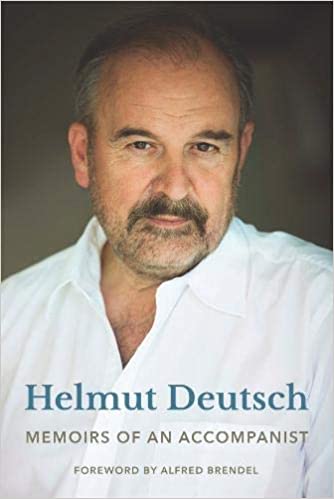
Helmut Deutsch memoirs jacket imageNew from Kahn & Averill

Helmut Deutsch

MEMOIRS OF AN ACCOMPANIST

Foreword by Alfred Brendel

Publication date: 15 September 2020

“a declaration of love – for all the many wonderful songs and cycles, and for many singers”

Robert Jungwirth, BR Klassik

During a career spanning more than 50 years, pianist Helmut Deutsch has accompanied over 100 singers, including Ian Bostridge, Grace Bumbry, Diana Damrau, Brigitte Fassbaender, Jonas Kaufmann, Angelika Kirchschlager, Christoph Prégardien, Mauro Peter, Hermann Prey, Thomas Quasthoff, Yumiko Samejima, Peter Schreier, Irmgard Seefried and Anne Sofie von Otter.

Translated from the German by Richard Stokes, professor of lieder at the Royal Academy of Music, this memoir describes, with humour, honesty and intelligence, Helmut Deutsch’s journey from unknown repetiteur to one of the most refined and sought-after accompanists of the modern era, respected by the leading singers of our time, who make music with him and revere him as a great artist and strong musical partner.

In this engaging and entertaining account, Deutsch offers fascinating insights into pianistic technique, repertoire, performance, interpersonal relationships, and the special qualities required for his profession: empathy, flexibility, sensitivity, patience and the ability to stand back in the service of others.

Deutsch is a captivating narrator, frank and entertaining. From out of tune pianos to jealous singers, his memoir teems with anecdotes and reflections on his multi-faceted life as a musician, offering readers a glimpse of unforgettable moments on and off stage without a trace of vanity.

“quite simply treasure-trove: required reading for all those devoted to Lieder, and a wonderfully tasty appetizer for those as yet unfamiliar with the genre.”

Rotary-Magazin

“Outstanding. How often does one read a book from the first page to the last without putting it down? And feel sad when one has finished?”

Ingrid Wanja, OperaLounge

“This autobiography should be on the bookshelves of every singer and pianist, and everyone for whom classical music is more than just a hobby.”

Martin Hoffmeister, MDR Kultur

Memoirs of an Accompanist is published in paperback by Kahn & Averill on 15 September 2020.

£17.95 / $26.95

Further information/order a copy


Richard Stokes, the distinguished translator of this memoir, is Professor of Lieder at the Royal Academy of Music. He has written and lectured copiously on German song, and his singing translations of Berg’s Wozzeck and Lulu, and Wagner’s Parsifal, have met with high critical acclaim. He was awarded the Order of Merit of the Federal Republic of Germany in 2012.

Image: Shirley Suarez

Who or what inspired you to pursue a career in music?

From a very early age I was surrounded by classical music. Although my parents were scientists, they were very drawn to and active in classical music. Both were enthusiastic members of concert choruses; my mother studied singing for many years and my father played piano and viola. Almost weekly there were chamber music/string quartet evenings at home and my parents read through many songs together – from Schubert to Hugo Wolf. Before I entered grammar school, I was already familiar with a large art song repertoire.

As was usual in my generation, early on I joined a children’s choir. I played the recorder for years and finally was allowed to study piano as well. As a ten  year old I first experimented with composition and at fourteen it was already clear to me that I wanted to be a musician. The question was only whether it was to be as a pianist, conductor or composer. All of them seemed equally desirable. For a while my mother suffered from my decision to follow a slightly different path. Next to chamber music, the human voice fascinated me above all else, so my passion led me to become an accompanist for singers. I have never regretted it.

I had fine teachers, but the most important inspiration/impetus came later: above all, from my friend and colleague Leonard Hokanson and from the two most important singers of my early career, Irmgard Seefried and Hermann Prey. Today I still learn a great deal from the singers I accompany, much of which is not taught in schools.

What have been the greatest challenges in your career?

I had the good fortune at a relatively young age to work with singers who were ahead of me both in age and, more importantly, in their careers. The first steps with these well known artists were always a big challenge for me. I often had the feeling that in the course of a few minutes my chosen career path could change dramatically and this was, in fact, several times the case. The first rehearsal with Irmgard Seefried, at that time a celebrated star especially to Viennese audiences, remains unforgettable because of her ‘motherly’ severity. Then there was the audition for Hermann Prey, during which my right leg shook so much with nerves that I could scarcely control the piano’s pedal. Such critical situations no longer happen, but in general every concert is a new challenge, first regarding my singing partner, but also for myself. That is a part of this occupation and one gets used to it.

Which performances/recordings are you most proud of?

I would not say that I am proud of a particular concert or recording. Some are more successful than others. There are, for example, around twenty-five songs on a CD, and it can happen that I am satisfied or even happy with some of the songs. With concerts, it is more complicated. I think one has certain ideals in performance which one attempts to reach, even knowing that they are unattainable. There are thousands of notes in any concert performance. For me, it is inconceivable that they will all sound as perfectly as I imagine. One must be satisfied with ninety percent and often a great deal less. Perhaps one can be ‘proud’ of a particular phrase or passage, but never of an entire concert.

Which works do you think you perform best?

In answer to this question, I can only say what kind of music I like best, which musical style I feel most comfortable and secure playing. That is clearly the Romantic era from Schubert to Strauss and Mahler. This is music which demands emotional depth, reflectiveness, infatuation and passion. The fact that these musical emotions, as well as the often wonderful texts, comprise most of today’s usual song repertoire, definitely influenced my career choice. In addition to the great volume of German art song, I especially love the Slavic repertoire.

What do you do off stage that provides inspiration on stage?

I do not consciously do anything in order to inspire myself on stage. Of course I listen to recordings and attend concerts. I read books about composers and their times. Sometimes I learn a lot from all this, but, in the end, the inspiration comes from the life I live and have lived: from the dreams, the fears, the anger and the frustrations which I have experienced. It comes from a wonderful evening atmosphere by a lake or on a mountaintop, from the longing, the loving, the disappointments and the happinesses I have known. Many of these are unforgettable memories and some I still experience today, thank heaven! Inspiration comes from everything which has formed my personality – in good times and in bad.

How do you make your repertoire choices from season to season?

Song recital programmes are ideally discussed and decided upon by both the singer and the pianist. At the beginning of my career, well-known and experienced singers simply gave me the programmes. Later, little by little, it became a joint decision. Today, because of my long experience, I am often asked to make up a programme or at least to make suggestions.

Creating a good programmme is not a simple matter, and there are no easy recipes to follow, rather there are warnings about what one should not do: for example, not too many multi-versed songs in a row. I admire singers and colleagues who can devise an exciting and meaningful programme in a short amount of time. I often need several days.

Do you have a favourite concert venue to perform in and why?

There are certainly many famous halls in which one is happy to perform/play: Carnegie Hall in New York, for example, the Berlin Philharmonic, the Palau de la Musica in Barcelona, and many more. But when one has grown up in Vienna, already during one’s school years, one dreams of appearing at least once in the Golden Hall of the Vienna Musikverein. This hall, opened 150 years ago, where numerous famous works have had their world premieres, where Liszt and Brahms, Bruckner, Strauss and Mahler performed, a magnificent hall which is praised for its wonderful acoustics, and which broadcasts its New Year’s concerts throughout the world, is internationally known. Even when one has often had the good fortune to play there, each appearance brings a special joy and a feeling of ‘coming home’.

What do you feel needs to be done to grow classical music audiences?

It is certainly pointless to dwell on the past, where music was actively played in homes. My generation was the last to experience this and it will not return. It seems to me more realistic to wish that music be taught in schools, starting with elementary schools and continuing through the entire educational path.

Many concert promoters have tried for years to offer programmes for children, and
have had success with this. But in general music education in schools is more and more curtailed to the point where in some places it no longer exists. It is not so much a matter of teaching knowledge, but a simple familiarisation, an introduction to great works, attending concerts together, and, in my view most importantly, choral singing. Good and enthusiastic teachers who can ‘sell’ this are necessary, but young people often find doing things together a lot of fun, and, of course, it does not always have to be classical music. Actively involving students with music – no matter what the style – can make them curious and hopefully form new audiences. I can only speak about the current poor situation in Austria and Germany. There it is, in general, pretty sad and hopeless.

What is your most memorable concert experience?

After a career of over fifty years, I am fortunate to be able to look back on many memorable concerts. Some were in small, elegant halls such as Wigmore Hall, others where the size of the hall or the enthusiasm of the audience impressed me more than the quality of the concert itself. Those include concerts at Teatro Colon in Buenos Aires or the Herodes Atticus Theatre in Athens, as well as the stages of La Scala in Milan and the Metropolitan Opera in New York.

Growing up, I was an eager concert-goer with many subscriptions to the Musikverein and the Konzerthaus in Vienn,a and many unforgettable concert experiences. One concert, however, occupies the very pinnacle of all of these, a concert at which I was neither in the audience nor was I playing: Verdi’s Requiem in the massive Theater of Epidaurus with 13,000 seats, built in the 4th century before Christ. Herbert von Karajan conducted one of his absolutely favourite works, and I sang bass in the chorus of Vienna’s Gesellschaft der Musikfreunde. In the “Lux Aeterna”, as the moon rose over the surrounding hills, I felt as if I were in a dream. No concert in my life has moved me as this one did. With a nighttime return to Athens by boat, newly in love with another
chorus member, who later became my wife, the evening came to a close – forever unforgettable.

What do you consider to be the most important ideas and concepts to impart
to aspiring musicians?

Your talent is a gift, not an accomplishment. Make as much out of it as you can!
Some success comes late, sometimes never. But do not give up too quickly! Try, with everything at your disposal, to understand what the composer wanted and fulfill that as best as you can. These were geniuses to whom we can only look up with respect and wonder. Personal vanities have no place in the music of these gods.

Imagine an exact idea of what you would like to express musically, and do not be satisfied with solutions which only approximately reach your ideal. Try to remain honest with yourself.

‘Success’ can sometimes be achieved in an amazingly cheap fashion. It is wonderful when you can make an audience happy. It should always be more important to be satisfied with yourself.

“Always play as if a master were listening!” (Robert Schumann)

“There is no end to learning!” (Robert Schumann)

Where would you like to be in 10 years’ time?

Even if it not very realistic, in ten years I would wish not only to still be alive, but, even if I am not making music, to still be able to enjoy it.

What is your present state of mind?

A continuous fluctuation between optimism and pessimism. I try to see my situation realistically, but the results are always the same: I can be very happy about some things and quite sad about others. That is probably normal for my age, but, on the whole, I must be very thankful for all the wonderful experiences I have had in my career and in my life. And there is still hope that there will be more wonderful experiences to come.

Helmut Deustch’s book ‘Memoirs of an Accompanist’, with a foreword by Alfred Brendel, is published by Kahn & Averill in September. Further information here


Helmut Deutsch ranks among the finest, most successful and sought-after song recital accompanists in the world. He was born in Vienna, where he studied at the Conservatory, the Music Academy and the University. He was awarded the Composition Prize of Vienna in 1965 and appointed professor at the age of 24.

Although he has also performed with leading instrumentalists as a chamber musician, he has concentrated primarily on accompanying song recitals. At the beginning of his career, he worked with soprano Irmgard Seefried, but the most important singer of his early years was Hermann Prey, whom he accompanied for twelve years.

Subsequently, he has worked with many of the most important recital singers and played in the world’s major music centres. His collaborations with Jonas Kaufmann, Diana Damrau, Michael Volle, Camilla Nylund and Piotr Beczala as well as the young Swiss tenor Mauro Peter are currently among his most important. Helmut Deutsch has recorded more than a hundred CDs.

In recent years, the development of young talent has been especially close to his heart. After his professorship in Vienna he continued his teaching primarily in Munich at the University of Music and Performing Arts, where he has worked as a professor of song interpretation for 28 years. He is also a visiting professor at various other universities and gives an increasing number of masterclasses in both Europe and the Far East.

Photo : Shirley Suarez

Franz Schubert – ‘Winterreise’, Temple Church, 24 July 2018

Angelika Kirchschlager, mezzo-soprano, and Julius Drake, piano

Guest review by Adrian Ainsworth

Schubert’s song cycle – surely the greatest work of its kind – sets to music a series of 24 poems by Wilhelm Müller. In the opening lines, the protagonist begins an unspecified journey on foot, leaving behind a woman who, back in the Spring, he believed he would marry. But now the affair is over. By the second song, we find out her parents have made a better match.

In the bitter, freezing night, he strives to leave the town behind him. But his route is obscure, as he encounters familiar landmarks, signposts, a village, even the post van – and most of all, throughout, he feels the effects of nature: snow, wind, water, clouds, lightning. Towards the end of the cycle, the sense that this voyage is at least partly interior strengthens. Hallucinations get the better of him: an apparently friendly guiding light, multiple suns – all symbols for what he has lost). Finally, he meets a mysterious ‘organ-grinder’, and considers joining him, to sing and play together. There are a number of interpretations of the ending out there: the one I favour – and I think I’ve come across the most – is that the figure indicates the cycle is eternal. The hurdy-gurdy goes round and round for ever, and the grinder could even be the wanderer’s future self. Or, he could, simply, be Death.

(No-one seems to think he’s just an organ grinder.)

Schubert composed the first 12 songs in the cycle in early 1827, before he even knew about the rest of the poems in the sequence. The story of his friends’ utter bewilderment on hearing them is often told in programme notes and CD booklets, so I won’t repeat it in detail here. But with all these years’ hindsight, it seems to me that ‘Winterreise’ must have sent shivers down their spines because Schubert wrote exactly the music the words demanded. There are tantalising flashes of vigour, even joy – and brilliantly robust, yet fractured piano parts that mirror so well a voice wracked with both determination and despondency – but the overall mood is poignant, downbeat and unresolved.

‘Winterreise’ might be cold to the touch, but it’s difficult to escape its icy grip. Speaking as an avid listener, I seem to gather recordings of it in an almost addictive way, constantly searching for new angles and insights.

Singers are drawn to it like moths to a blue flame. Perhaps it’s the art song equivalent of a Hamlet, or Lear – a rite of passage. Many feel the urge to visit and re-visit it. Ian Bostridge has a famously close relationship with the cycle, writing a book about it, and recently performing a semi-staged, orchestrated version against projected footage of his younger self. Mark Padmore and Florian Boesch have each recorded it twice in the last ten years (with different accompanists).

And that’s just a few of the men. However, the protagonist of ‘Winterreise’ – definitely a chap – must be an irresistible ‘trouser role’…? (It’s easy to forget that song is as visual a medium as opera – writing before recorded music was dreamt of, Schubert could only ever have imagined someone standing up, putting these songs across to a live audience.) But even though there are numerous recordings – including Brigitte Fassbaender, Christa Ludwig, Nathalie Stutzmann or one of my personal favourites, Alice Coote’s searing live disc – the opportunity to hear a woman perform ‘Winterreise’ live still feels all too rare.

On this occasion we were in Temple Church to hear mezzo-soprano Angelika Kirchschlager’s interpretation, for the first time. I’ve always found Kirchschlager’s performances of art song thrilling: as much acted as sung, and with a captivating emotional range. I was excited to hear how she would apply this over a continuous narrative, rather than stand-alone lieder. What I experienced was completely fearless, at times frustrating but always fascinating.

The venue was both friend and foe. In Temple Church, at least where my companions and I were sitting, there’s a gloriously resonant but quite echoey acoustic. I’m not a sonic scientist, but at times, it felt like the voice and piano clashed slightly because a rumble of bass notes would tumble all over each other, or a phrase would be lost (for example, in the helter-skelter ‘Rückblick’ / ‘A backward glance’). At other points, however, in slower songs like ‘Wasserflut’ / ‘Flood’ or ‘Irrlicht’ / ‘Will-o’-the-wisp’, a fantastic sustain effect was created, allowing Angelika Kirchschlager and Julius Drake to continue singing and playing with the traces of the previous note or two still fading. This really enhanced the continuous feel of the performance and lent a sinister edge that would be hard to replicate in a studio recording.

Kirchschlager’s commitment to the piece was total, and I believe she portrayed the cyclic structure of the story as much through her body language as her voice. In the opening ‘Gute Nacht’ / ‘Good night’, she was still, transfixed, even to the point where I thought she was warming up in some way, not quite in full flow yet. Almost immediately, though, she opened out and began to move. Only in the final song, ‘Der Leiermann’ / ‘The organ-grinder’, when she withdrew back into herself, adopting the same pose, staring at some phantom far beyond the audience, did I realise – thoroughly moved and disquieted – that at the start we had seen her protagonist emerge, and now disappear.

Unafraid to sound harsh or broken when the context demanded, Kirchschlager could come across at times as if the acting were leading the singing. So effective was she in the cycle’s mood swings that the intensity felt a bit like listening to a 75-minute ‘Erlkönig’, a rollercoaster ghost-train ride that kept me riveted. But this didn’t prevent the emotional high-points of the sequence – in particular, the soaring anguish of the penultimate song ‘Die Nebensonnen’ / ‘Phantom suns’, Kirchschlager’s bright, glorious tone so tragically affecting – hitting home with a devastating beauty.


Adrian Ainsworth writes for a living, but mostly about things like finance, tax and benefits. For light relief, then, he covers his obsessions – overwhelmingly music, but with sprinklings of photography and art – on the ‘Specs’ blog, which you can find at

Twitter: @adrian_specs

Adrian is a regular guest writer for The Cross-Eyed Pianist


