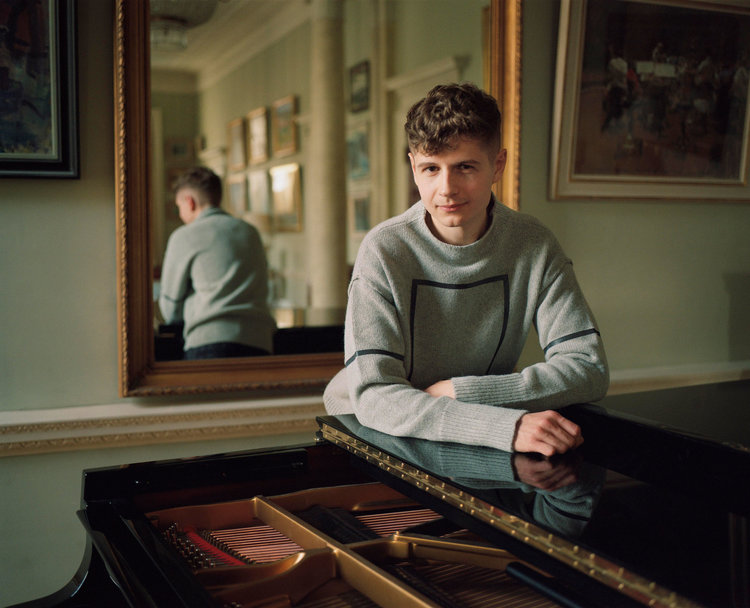
Described by superstar pianist Lang Lang as ‘A genius…The new Bach’ during his performance on Channel 4’s popular and inspiring programme The Piano, Michael Howell is a young self-taught composer, singer and pianist from a working class Caribbean-Jamaican background in west London.
Praised for his other-worldly counter-tenor voice and his ability to touch audiences with his lyrical Latin-esque operatic language and Baroque-inspired piano accompaniment, Michael’s performance in London’s Victoria Station had the audience spellbound and secured him a place in the programme’s final, where he performed his own composition, ‘Great Is The Grief’.
‘Are you telling me he’s an amateur musician? This is incredible, this is not amateur….This is a pure talent. This is really something that’s very rare. It sounds like a new Bach is born from the middle of a train station in London.’ – Lang Lang
‘It’s gorgeous. That’s gorgeous!’ – Mika, singer-songwriter and co-judge of The Piano
‘Phenomenal’, ‘Sensational!’, ‘just incredible’ – audience/viewer comments via TwitterX
Find out more about Michael in this Meet the Artist interview:
The Piano, a surprise hit for Channel 4 earlier this year in which talented amateur pianists performed in public on pianos placed in railway stations, is back for a second series – and the production company, Love Productions, is looking for participants.
Finalists from series 1
Lang Lang, Claudia Winkelman & Mika
The first series showcased amateur piano players across the UK, from major cities to rural towns. It introduced some remarkable talents, including Lucy, a blind, neuro-divergent girl who astonished and moved viewers with her expressive playing. Other participants shared personal stories where the piano and music had helped them overcome trauma or difficulties in their lives, as well as people who simply found joy in music. The series was a wonderful celebration of the nation’s favourite instrument, and the second series will continue this theme, seeking out more great amateur pianists from the around the UK. Once again, performances will be critiqued by superstar pianist Lang Lang and singer-songwriter Mika.
Applications are open to anyone who enjoys playing the piano, no matter what genre of music, be it classical, jazz, boogie woogie, pop. Essentially, as long as you are at amateur level and have a real passion and love for the piano then you are eligible to take part. Auditions/casting take place next month so you have just under a month to apply. The production company is particularly keen to receive applications from female/non-binary/people who identify as female pianists.
I admit I was prepared to hate this series on Channel 4 (and, full disclosure, I was interviewed for the programme by someone from the production company last summer). It was made by the same production company which brought us The Great British Bake Off, another series which I have come to loathe, and was billed as “Bake Off for amateur pianists”. Oh dear.
The basic premise of the series was to showcase the pianistic talents of ordinary people through their performances on street pianos at railway stations in London, Leeds, Glasgow and Birmingham. Unbeknownst to these amateur pianists, their performances were being watched by “the world’s greatest pianist” Lang Lang and one-hit wonder singer-songwriter Mika. The series is presented by Claudia Winkelman.
The programme makers wanted us to believe that these performances were completely spontaneous, but in fact the participants had to go through an audition process and were then selected for the programmes. Also, the instrument on which they played was not the usual rather beat up, out of tune street piano of the type which this article rather rudely describes, but a rather nice Boston upright from Steinway’s ‘diffusion range’.
However, none of this matters in the least because it quickly became evident that the real joy and power of this programme lay in the people, their back stories, and of course their music. Just as in Bake Off, the participants were a mixed bunch, from the young to the very old. There were some really heart-warming moments, such as a 92 year old man who played the piano to communicate with his wife who had dementia, or the young man who had found comfort in music, following the suicide of his father.
During each episode, a young professional pianist friend of mine would message me to rail at the lack of “proper classical music”, and while I too had hoped for more Chopin or a drop of Mozart, it was evident that this series was about people and their connection with the music they played, and why the piano was so meaningful or special for them.
A number of the participants had taken up the piano during the covid lockdowns as a way to fill the excruciating sameness of those long, dull days. Others had been playing all their life. Some were self-taught. But all found joy, fulfilment and personal achievement in playing, regardless of the genre of music or their ability.
In episode two we met Lucy, a blind girl with severe learning disabilities but with a remarkable natural aptitude for the piano. Her performance of Chopin’s B-flat minor Nocturne was beautifully fluent, subtly phrased and elegantly shaped. Actually, it was simply astonishing. It held the audience at Leeds station utterly spellbound, and it was quite evident that Lang Lang was genuinely moved by her performance, along with the many others who watched her playing. She was supported by her teacher Daniel, who works with a charity called The Amber Trust, which provides musical opportunities for blind and partially-sighted children, and children with more complex needs.
The final episode of the series was a special concert in which the “winners” (although this wasn’t really a competition – and certainly nothing like any talent show presented by the likes of Simon Cowell) performed at London’s Royal Festival Hall. Once again, Lucy’s extraordinary talent shone through, this time in a mesmerising performance of one of Debussy’s Arabesques. But all the performers played with commitment and emotion, which really transmitted to the audience. At the end of the concert, Lucy was awarded star player (in a lovely, low-key way) and then Lang Lang and Mika made a special announcement: each player was to be gifted an acoustic piano.
The four finalists at the Royal Festival Hall with Lang Lang, Mika and Claudia Winkelman.
Reactions on social media are a testament to the appeal and power of music, as people were genuinely moved, amazed and intrigued by all the performers in this series. The more relaxed, spontaneous way of presenting music, on a street piano, will, I’m sure, remind people that music is for everyone and one need not enter a formal concert venue to experience the wonder. And if this series inspires people to take up or return to the piano, or for young (and old) piano students to find renewed enthusiasm in their practising, then it has served an important purpose. Finally, this show must surely raise the profile of the piano, and music in general, at a time when classical music in particular is under attack – and that has to be A Good Thing.
As the various performers demonstrated, through an incredibly eclectic range of music and ability, it’s not about winning; it’s about doing something that you love and finding fulfilment, comfort, self-improvement, and above all pleasure in what you do.
The Piano on Channel 4 is inspiring, joyous, uplifting, poignant, moving and life-affirming. Do seek it out on All4.
What is it about the Goldberg Variations which gives them such an enduring appeal? Two new recordings have been released in as many months, by two leading pianists of the 21st-century, yet each quite different in their approach. Maybe it is because Bach gives few performance directions, a lack of specificity which allows performers the freedom to make personal choices about the interpretative possibilities of this music. This is certainly true of these two new recordings.
Lang Lang’s Goldbergs (DG), released in September as a double album of studio and live recordings, is bright in sound and lavish in presentation. Some of the tempi are questionable, with elastic rubato stretched just a little too far, presumably intended to convey meaning or deep emotion, and the faster variations are rather showily bombastic. Listening at home, it feels like an extrovert and spirited concert performance, occasionally just too declamatory (though one can of course turn the volume down a notch or two!), but I have to admit that overall I enjoyed Lang Lang’s Goldbergs. There’s a freshness in his approach and he manages a singing tone with a bright, colourful piano sound, and I take issue with those who have suggested that he should not touch this music, which enjoys such an elevated status in the canon of keyboard music. In my view, the music is there to be played, by anyone who chooses to play it, and Lang Lang makes a good case for being considered a serious musician, rather than a flamboyant showman (in fact, he is both) with his recordings of the Goldbergs.
At the other end of the spectrum, musically and presentationally, is the young Russian pianist Pavel Kolesnikov, whose concert performances and recordings are imbued with a special sensitivity and emotional intelligence. Modest in mannerisms and presence, Kolesnikov could not be further from Lang Lang. Rightly described as a “poet” of the piano, he can nuance his touch and dynamics in such a way that the slightest shift in sonority speaks volumes in terms of mood and narrative.
With these qualities to his playing, it is no surprise that Kolesnikov’s version of the Goldbergs is rich in intimacy, reminding us that this music was, it is said, composed as a distraction for the insomniac Baron (later Count) Hermann Carl von Keyserlingk, Russian ambassador at the Dresden electoral court. The famous opening Aria barely announces itself, gently insinuating its simple, elegant melody into the ear and the consciousness. In Kolesnikov’s hands it’s a miniature study in elegance and other-worldly serenity. A calmness flows through the music, setting the tone for the entire work. Even in the up tempo or more lively variations, where there is palpable drama and robustness, Kolesnikov still retains an underlying sense of measured thoughtfulness.
But for me it is his touch which really captivates and delights: filigree ornaments and trills, passage work in which his quicksilver fingers appear to float across the keys, yet without losing definition. His textures flicker in and out of focus – now crispy defined, now delicately veiled and muted, yet throughout there is clarity of articulation, structure and musical vision.
And there is one particular moment which really stops you in your tracks – and may have Bach purists clutching at their pearls. Did he really do that? Variation 30 segues from the one before it in a bloom of sound, the sustaining pedal creating an unexpected and intriguing extra sonic layer before fading away to allow the Aria to return like a memory of times past.
This recording is the result of Kolesnikov’s collaboration with dancer and choreographer Anne Teresa de Keersmaeker, and the spirit of the dance, which infuses so much of Bach’s music, is never far away in the delightful playfulness of Kolesnikov’s approach to Bach’s rhythms and counterpoint. This is an exquisitely tasteful and original account, recorded on a modern Yamaha grand piano on which Kolesnikov manages to recreate the softly-spoken sonorities of a clavichord or fortepiano (in preparing for the recording Kolesnikov worked on a number of different instruments “switching between them, in order to loosen up a little, to shake up my perception of sound of piano“.
What these two recordings prove – and the many, many others which exist – is that the Goldberg Variations is music without consensus: there are clichés about how Bach’s music should be played – from the period instrument zealots to the iconoclasts – and traditional views about how it should be played on the modern piano, but in fact there is no “right way”, nor who should play it, and the Goldberg Variations remain extraordinarily fertile terrain for those who choose to walk there.
The Cross-Eyed Pianist is free to access and ad-free, and takes many hours every month to research, write, and maintain.
If you find joy and value in what I do, please consider making a donation to support the continuance of the site






 The Cross-Eyed Pianist