Who or what inspired you to take up the piano and pursue a career in music?

It was my parents’ choice. One day they took me to the school of music and I had no say in it. I was even made to play violin for a while. Soon, however, it was established that violin and I were not made for each other.

Who or what were the most important influences on your musical life and career?

Rather than influence there was a fateful moment in my life when I met a musician who taught me and trained me to play the piano and by doing that determined my future life. Later on I became her husband. Her name is Aliza Kezderadze.

What have been the greatest challenges of your career so far?

Art is my profession, career is my occupation. There are two types of challenges and threats. The external ones should sometimes be ignored, at other times confronted. What comes from oneself however is different. The general principle I followed was not to chew more than I can swallow. In other words “less is more”!

Which performances/recordings are you most proud of?

These are two separate disciplines. Performance is, among other things, an act of a moment. On the recordings, all are my favourites and none is my favourite. All because of a tremendous effort that documenting music requires, none because I never listen to any of my recordings. Recently, I recorded two Beethoven Sonatas (available on IDAGIO idag.io/pogorelich). It seems I was able to express what was not expressed in that music before.

Which particular works do you think you perform best?

My loyalty goes to the composer I am occupied with. I do not have favourites.

How do you make your repertoire choices from season to season?

I learn new pieces and I also play pieces I have played in the past.

Do you have a favourite concert venue to perform in and why?

There are various. Some of them are also blessed with spectacular acoustics like Teatro Cólon, Buenos Aires or Teatro alla Scala in Milan.

Who are your favourite musicians?

Generally I am fascinated by musicians of traditional folk music, particularly singers. My favourite pianist is Art Tatum, a taste shared by Rachmaninoff who reportedly never missed an opportunity to attend his performances. I also like Oscar Peterson.

I have never heard them in concert but people of African origin have rhythmical pulse unique to them. Music sounds so spontaneous when they play.

What is your most memorable concert experience?

It actually took place after one of the very noisy successes. There was a reception and it turned out that the host, a very prominent and powerful person, had celebrated his birthday by participating in the organization of the event. The entire society of the city was in the concert hall and a good many very well known faces at the reception. There was also a piano in the room and all of a sudden someone pointed to the piano with an inviting gesture, where it became clear that I was expected to accompany the “Happy Birthday to you” tune. I was mortified as I realized that I had never played the tune. So I bravely stood up and said “I am sorry but I do not have this piece in my repertoire”. The host was elated as no one in the room could imagine that I actually did not know the music. Everyone thought that it was cute and witty and they all applauded again.

What do you consider to be the most important ideas and concepts to impart to aspiring musicians?

Unfortunately there are not as many oranges in the world as there are glasses of orange juice we drink. Equally no advice of general character is good unless it is tested in practice. With all the best intentions of all of us and each of us, life is a lottery; however general principles are the same as I believe are implied in any professional activity. Self respect, modesty, determination being led in life by a clear heart and mind, could advance a person anyway. One must never forget that life is a struggle and one has to be ready.

Where would you like to be in 10 years’ time? 

Happy to be where I am, god willing; otherwise I would love to be in Somerset on a sunny day. Although I have lived in the UK for almost 20 years, I have never been there. The name to me as a foreigner evokes fairy tales, as it is acoustically reminiscent of summer and sunset. The name sounds so musical to me.

What is your idea of perfect happiness? 

The idea of perfect happiness is not seeking it on purpose.

What is your most treasured possession?

 I believe it is my imagination.

What is your present state of mind?

Right now I am sitting and observing half packed bags, being packed for a month long stay with concerts in China and Japan. As I can see the clothes, prepared for three distinct types of weather, very cold, moderate and hot and humid, I am trying to comprehend it.

Such is the life of an artist…..

Ivo Pogorelich’s new recording of Beethoven Piano Sonatas, No. 22 in F major op. 54 and No. 24 in F sharp major op. 78 are available exclusively on IDAGIO

Ivo Pogorelich was born in Belgrade in 1958, the son of a musician. He received his first piano lessons at the age of seven and went to Moscow at the age of twelve to study at the Central Special Music School and then at the Tchaikowsky Conservatory. In 1976 he began intensive studies with the renowned pianist and teacher Aliza Kezeradze, with whom he was married from 1980 until her untimely death in 1996. Mme. Kezeradze was able to transmit the spirit and matter of the school of Beethoven and Liszt, originated in Vienna and than carried through to the Conservatory of St. Petersburg, flourishing towards the end of the 19th and the beginning of the 20th. Century. Ivo Pogorelich won the first prize at the Alessandro Casagrande Competition at Terni (Italy) in 1978 and the first price at the Montreal International Music Competition in 1980. In October of the same year he entered the International Chopin Competition in Warsaw where, when prevented from participating in the final contest as a soloist with the orchestra, a fierce controversy resulted in the renowned Argentinian pianist Martha Argerich, a member of the jury, protesting and leaving the competition, joined by other members of the jury panel, with the words “He is a genius”. This event drew the attention of the whole musical world to the young pianist.

Ever since his debut recital in New York’s Carnegie Hall in 1981, Ivo Pogorelich has created a sensation with his performances in all the great concert halls throughout the world; starting in the U.S. and followed by performances on all four continents. He has received invitations to play with numerous major orchestras such as the Berlin and Vienna Philharmonic Orchestras, all the London Orchestras, the Chicago, Philadelphia, Boston, Los Angeles, New York Philharmonic Orchestras of the U.S. and major orchestras elsewhere. Wherever and whenever he plays, his stunning interpretations of the music confirm the originality of his talent and intellect. The New York Times once wrote “He played each note exactly, with such a feeling, such expression, he was an entire orchestra– it was as if he played 200 years ahead of our time”. In this spirit Ivo Pogorelich is known today as a poet of the instrument.
More about Ivo Pogorelich


Who or what inspired you to pursue a career in music?

My parents were great music lovers and the gramophone and radio were central to my early exposure to music.  My musical guardian angel was my maternal uncle, Benjamin Spieler, who studied clarinet at Juilliard with Prokofiev’s friend and colleague Simeon Bellison (principal clarinettist in the NY Phil) and pursued studies in flute, oboe, and clarinet and saxophone at the Paris Conservatory and bassoon at Columbia in New York.  He discovered that I had absolute pitch and arranged my musical education forthwith, chaperoning me to Fontainebleau to study with the legendary Nadia Boulanger.  It is impossible for me to express adequately my debt to him.

Who or what were the most important influences on your musical life and career?

Nadia Boulanger and Sir Clifford Curzon when I was young; Felix Galimir and Rudolf Kolisch later on..

Which particular works do you think you perform best?

Let the listeners decide!  I have particular commitment to Viennese classical repertory, French music, and contemporary music, though the works I perform span the Elizabethan masters to the present.

What, for you, makes Mozart’s piano concerti special/significant in the canon of classical music?

They are operatic scenes, incorporating a breathtaking span of emotions that unfold under the guide of a masterful dramatist who perhaps is equalled only by Shakespeare.

What are the particular pleasures and challenges of Concertos 3 & 4 which you performed with Aurora orchestra as part of their Mozart’s Piano series at Kings Place?

The solo keyboard parts are written not by Mozart, but by expatriate composers living in Paris in the middle of the 18th century, together with C. P. E. Bach; Mozart supplied orchestral accompaniments, thereby transforming these movements into concertos.  It is fascinating to see how in doing this Mozart prepared himself for the task of composing instrumental concertos from scratch.  These are therefore works of apprenticeship.  From here Mozart develops the techniques of solo and tutti within aria form, transforming its structure to the domain of the instrumental concerto at the moment that he chafes against the static nature of opera seria and wants to have dramatic development WITHIN arias, not just BETWEEN them (in the recitatives, where the action typically happens in opera seria).

What is your most memorable concert experience?

There are many.  Hearing Gilels’ and Richter’s first recitals in New York.  Hearing Horowitz’s after his return to the concert platform.  Hearing Rudolf Serkin’s Hammerklavier sonata and Emperor concerto.  Hearing Curzon in solo and concerto repertoire.  Hearing Haitink conduct Bruckner 8 and Mahler 9.  And there then are my own experiences on stage—constant excitement, an endless learning curve, reveling in the exalted danger of risk-laden performances.

What advice would you give to anyone learning Mozart’s piano music?

Learn the grammar and the aesthetic, learn to discern the myriad character changes inherent in the fluid discourse, learn what is to learn, and then walk onstage and do what you must do to communicate this dizzying sensual world to an audience that will be forever changed by the message you bring to them.

What do you consider to be the most important ideas and concepts to impart to aspiring musicians?

Engagement with the musical narrative, character, drama, colour.  Be an actor—do for music what Meryl Streep does for the screen and the stage.

Mozart’s Piano, Aurora Orchestra’s monumental new five-year project offers audiences the rarest of opportunities: a complete cycle of the concertos, staged live in concert in the beautifully intimate surroundings of Hall One at Kings Place. Further information here

Pianist and Conductor Robert Levin has been heard throughout the United States, Europe, Australia and Asia. His solo engagements include the orchestras of Atlanta, Berlin, Birmingham, Boston, Chicago, Cleveland, Detroit, Los Angeles, Montreal, Utah and Vienna on the Steinway with such conductors as Semyon Bychkov, James Conlon, Bernard Haitink, Sir Neville Marriner, Seiji Ozawa, Sir Simon Rattle and Esa-Pekka Salonen. On period pianos he has appeared with the Academy of Ancient Music, English Baroque Soloists, Handel & Haydn Society, Orchestra of the Age of Enlightenment and the Orchestre Révolutionnaire et Romantique, with Sir John Eliot Gardiner, Christopher Hogwood, Sir Charles Mackerras, Nicholas McGegan, and Sir Roger Norrington.

Renowned for his improvised embellishments and cadenzas in Classical period repertoire, Robert Levin has made recordings for DG Archiv, CRI, Decca, Deutsche Grammophon, Deutsche Harmonia Mundi, ECM, New York Philomusica, Nonesuch, Philips and SONY Classical. These include a Mozart concerto cycle for Decca; a Beethoven concerto cycle for DG Archiv (including the world premiere recording of Beethoven’s arrangement of the Fourth Concerto for piano and string quintet); and the complete Bach harpsichord concertos with Helmuth Rilling, as well as the six English Suites (on piano) and both books of the Well-Tempered Clavier (on five keyboard instruments) as part of Hänssler’s 172-CD Edition Bachakademie. The first recording in a Mozart piano sonata cycle has also been released by Deutsche Harmonia Mundi.

A passionate advocate of new music, Robert Levin has commissioned and premiered a large number of works.  He is a renowned chamber musician and a noted theorist and musicologist. His completions of Mozart fragments are published by Bärenreiter, Breitkopf & Härtel, Carus, Peters, and Wiener Urtext Edition, and recorded and performed throughout the world. (source Rayfield Allied)


Who or what inspired you to take up the piano and pursue a career in music?

My parents took me a to piano recital when I was three because they couldn’t find a babysitter that night. I don’t remember the pieces the pianist played but I was fascinated by the power of music that made the audience quiet for nearly two hours. I thought that if I learned this “language” people would also listen to what I want to say and so I went to my mother after the recital and told her that I wanted to become a pianist. She wasn’t happy about this and so it took me a year to convince her.

Who or what have been the most important influences on your musical life and career?

Definitely my teachers, but also each and every collaboration with an orchestra and a conductor has given me the opportunity to learn something new and develop myself.

What have been the greatest challenges of your career so far?

Learning to say no and finding out my limits.

Which performance/recordings are you most proud of? 

All of my performances and recordings are fingerprints of certain stages in my life so far, but my recent album ‘Wonderland’ means a great deal to me. There is a lot of my heart’s blood in it.

Which particular works do you think you play best?

None in particular. Of course there are days when I feel very comfortable with a work and think that I finally understand and own it – until the next day when I suddenly realise that I am still very green

How do you make your repertoire choices from season to season?

There are so many wonderful works I want to play and programme, so I usually pick one bigger work and try to build a story around it. It also depends on what the programme of my next album is. I also of course ask colleagues and people around me for advice.

Do you have a favourite concert venue to perform in and why?

There are too many wonderful halls out there, so I can’t name just one or two. It’s not so much a matter of the country or hall I play in, it’s about the interaction between the audience and me. So wherever music unites me with the audience,  I feel “home”.

Favourite pieces to perform? Listen to?

Always the ones I am playing at that moment.

When I am off, I don’t listen so much to classical music. I love Tom Waits, Pink Floyd, Led Zeppelin.

Who are your favourite musicians?

Those who are honest and take risks in the music.

What is your most memorable concert experience?

Once I played a concert in Rio de Janeiro and there was a couple sitting in the first row, eating popcorn while listening to my performance. I LOVED that.

What do you consider to be the most important ideas and concepts to impart to aspiring musicians?

To know what happiness means to you. As long as one is not happy, he/she can not make others happy.

What is your idea of perfect happiness?

To appreciate the small things in life.

What is your most treasured possession?

I don’t own them, but I would say my family and my friends are the most essential things in my life. And I actually have quite a nice whisky collection that keeps growing

What is your present state of mind?

I just got out of a two month break. That was a wonderful thing and I am incredibly grateful to my friends who gave me so much energy and joy in this time. Now I am recharged and can’t wait to go back to work.

German-Japanese pianist Alice Sara Ott has gained critical acclaim for her performances at major concert halls worldwide and has established herself as one of the most exciting musical talents of today. The Guardian, commenting on her recent performance with the London Symphony Orchestra, said that she “gave the kind of gawp-inducing bravura performance of which legends are made”.

Alice has worked with the world’s leading conductors, including Lorin Maazel, Paavo Järvi, Neeme Järvi, James Gaffigan, Sakari Oramo, Osmo Vänskä, Vasily Petrenko, Myung-Whun Chung, Hannu Lintu and Robin Ticciati.

More about Alice Sara Ott

marianna-photoWho or what inspired you to take up the piano, and pursue a career in music? 
I was born into a musical family and was surrounded by music all the time when I was growing up. Both of my parents are musicians, therefore it was assumed I would follow the same path. They only asked me if I wanted to play piano or violin, and I picked piano. Honestly, I never regretted my choice. I started my piano lessons under my mother´s guidance, and continued until I was 17 years old, when I began my education at the Royal College of Music in London, studying with wonderful Irina Zaritskaya.

Who or what have been the most important influences on your musical life and career? 

When I moved to Spain with my family, I met the pianist Krystian Zimerman, and was inspired by his interpretations of Chopin’s Ballades and Concertos, and Liszt Sonata. I also had a chance to hear him live several times in my hometown in Spain performing with orchestra. He introduced me to music I had never heard before, and I was so stunned by its beauty that I was desperate to get those scores out and start learning. I think I sight-read everything we had at home, and it got to the point that my mother had to hide music from me, as I did not want to practice works she assigned. That was probably the time when I realized I wanted to devote my life to music. I always felt that knowing that pianist at that age was crucial for my development. Later, as I grew up, my attention shifted to other musicians. I admire Grigory Sokolov. I should not dare to say he is my influence, but he is the type of musician whose artistry resonates with me most. He fills each note with meaning when he plays, each silence has a meaning, and each note has its beginning and its end! Every single phrase is preciously delineated, well thought and deeply felt. His musicianship is so powerful that he takes control over you and is capable of hypnotizing you. He neither tries to impress, but remains authentic. I think his performances are transcendental experiences, at least for me, and he is an artist who speaks from his truest self.

What have been the greatest challenges of your career so far? 

I think everybody has to go through some challenges, but personally I tend to be quite private about difficulties I go through. What I can share, perhaps, is that I learned how to remain true to myself no matter what others think of me and expect from me. I found it quite challenging because I am a vulnerable person. When you are surrounded by many musicians and participating in competitions, the pressure grows even greater. Very often your thoughts can be scattered around in your mind about other contestants, and whether the impression you left on the jury was positive or negative. With a bit of experience I realized that all these thoughts are very distracting, they separate you from who you are, and don’t let you express yourself authentically. Eventually, during my competition performances, I was able to attain the freedom I feel when I perform any public recital.

Which performance/recordings are you most proud of?  

I am not sure the word “proud” is the most appropriate; I am a perfectionist and always feel I can do better. However, I would probably say that I am happy with my most recent album dedicated to Rachmaninoff.

Tell us more about your new recording…

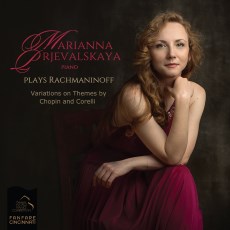
The album features Variations on themes by Chopin and Corelli. I was dreaming about this project because Rachmaninoff is a composer whose music I find very close to my heart and my soul. I have to say that I had an absolutely awesome team: I was lucky to work with an amazing producer Elaine Martone, who was extremely supportive, encouraging and inspiring during the recording sessions. Chelsea VandeDrink is a fantastic recording engineer who did her work fabulously, and Anilda Carrasquillo created a booklet I could only dream about. I felt that it was a very strong team, and it was an excellent experience to work with these people, with whom I created a strong bond and most importantly, a lasting friendship. This CD was possible thanks to the Cincinnati World Piano Competition, which I won in 2013.

What is the particular appeal of these works by Rachmaninoff for you? 

I have always felt a close relationship with this composer, and considered recording some of his compositions a long time ago, but then in my twenties discovered his Variations on a Theme of Chopin Op.22, a work that unfortunately is not often performed. I was fascinated by the incredible variety of moods and emotions Rachmaninoff reveals in this music, as well as by the way he transforms the theme throughout the composition, making it barely recognizable. It is a work with endless possibilities for a pianist to display his or her mastery.

I often think that composition’s fate grows from the roots. What I mean in this case is that the work had a very moderate reception when Rachmaninoff premiered it in 1903 in Moscow. The preludes Op.23, written during the same summer, enjoyed a bigger success, and his other major hits, like his second sonata, or the second concerto, for example, completely overshadowed this composition. Even though nowadays you may find a few recordings, I feel pianists are afraid of its length and that it might not be an easy piece for the audience. This set of variations lasts about half an hour, but isn’t the Liszt Sonata thirty minutes long? Any late Schubert sonata would be even longer! When I performed this work in the semifinals of Seoul International Piano Competition in 2008, one jury member asked me at the end of the competition why I chose this piece and told me that it is inappropriate for a competition, and that instead I should have played the second sonata. I made to the finals anyway, but am still puzzled why this composition is not appreciated. It is an actual gem in the piano repertoire!

Regarding the Variations on a Theme of Corelli I have to say that at the time I was making my decision what else would go together with Chopin variations, it happened I was working on Corelli variations, and thought both sets would work greatly together. Thirty years separate both pieces and they are incredibly different. The Corelli Variations exhibit a stylistic growth and some kind of a structural compactness: he expresses his ideas in a more concise way, somewhat similar to a mature person who prefers to speak less, but whose choice of vocabulary is very accurate. I do love this composition, but in a different way.

Which particular works do you think you play best? 

Works that speak to me emotionally. But not necessarily has to be from the same period. I played Scarlatti sonatas that were very precious to me. I felt a particular affinity with Haydn Andante and Variations in F minor that I recorded for NAXOS a few years ago, for example. My attention usually shifts to different composers at different periods of my life. There were years when I felt too attached to Chopin, but thought I would never understand Schumann for his crazy and hectic romanticism. A few years later I felt I only wanted to play Schumann, and it was never enough of him. To name a few that deeply belong to my heart: Schubert Sonatas D.845 and D.959, Schumann F sharp minor Sonata Op.11, Brahms Intermezzi Op.117, Liszt Sonata, Debussy Preludes Book II, obviously Rachmaninoff, including the second Sonata, Prokofiev Sonata No.8 Op.84, among many others.

How do you make your repertoire choices from season to season? 

I feel that every time I go through a difficult internal process before I make my repertoire choices. I always play what I want, what I like most and what I feel is right for me at this moment. What it means is that for some reason, on some kind of subconscious level, a particular piece rings my doorbell. It happens when I constantly hear this music in my head, and it does not cease until I take the score and start learning it. It is as though the piece was being chosen by itself, asking to be played. I find it very interesting. And what is even more surprising is that I usually never misunderstand the signal. If I feel the need to play a particular composition, it means I feel something very special for it, a very strong emotional connection. I should probably say I am lucky, because I usually build my own recital programs, however I wish I had the same freedom to choose concerti I want to play with orchestras.

I have also had other experiences. I forced myself to play something that did not seem the right choice, and all of a sudden, when the work began, I realized that I made a huge discovery, a work that I never thought I would enjoy became one of my favourites.

My former teacher Boris Berman told me one day: “Try to learn to love a piece you do not like.” At that time I did not understand how that was possible, I neither wanted to try. I guess now I know what he meant.

Do you have a favourite concert venue to perform in and why? 

I can name several venues where I felt particularly good. A concert hall in Malaga, Sala Maria Cristina was a very special venue where I played all Schumann recital. I loved their Steinway, and the decoration of the hall and its acoustic were very inspiring. I enjoyed immensely performing at Weill Hall in New York, as well as remember wonderful experiences performing at the Mozarteum in Salzburg and Minato Mirai Hall in Yokohama.

Favourite pieces to perform? Listen to? 

This questions is partially related to my choice of repertoire. I prefer to perform works that are emotionally intense and that speak to me most. Compositions I choose to play become my favourite pieces to perform. I do like listening to music, in fact I only listen to classical music, and I should probably feel ashamed that I do not listen to anything else. It all depends on my mood. One day I might want to hear a Baroque ensemble, another evening I want to listen to Schubert’s Lieder or Brahms, or may be Haydn’s symphonies.

Who are your favourite musicians? 

If we talk about living pianists, I would name Grigory Sokolov, Murray Perahia, Mitsuko Uchida, Radu Lupu, Evgeny Kissin, András Schiff.

What is your most memorable concert experience? 

I have several. I will never forget my experience performing Brahms d minor piano concerto with Kazufumi Yamashita and Sendai Philharmonic Orchestra in the final round of Sendai International Piano Competition in 2010. It is an exceptionally rare experience when you feel that the orchestra, conductor and yourself blend into one organic whole, and music drives you with its force somewhere beyond reality. And I give thanks to this conductor for making me feel that way. A similar experience occurred performing Chopin e minor concerto with Stamatia Karampini, she made me to forget that I was not playing alone, and with Chopin that is really dangerous, because the conductor and the orchestra have to be constantly alert, Chopin´s rubato is unpredictable and too fragile to foresee. I have also enjoyed tremendously performing with Roberto Trevino and Cincinnati Symphony, and with Carlos Prieto and David Danzmayr and Louisiana Philharmonic. My solo memorable experience was probably my Weill Hall debut and a recital I performed in Baltimore with Schubert A major Sonata D.959, a work I have a very intimate connection with; in fact all Schubert occupies a very special place in my heart. I am not sure what happened that evening, but I was watching my hands and thought I am witnessing my own playing. My intensions were shaping phrases with no effort, and music was being created in the moment. That state of mind is not something you can experience every time you go to play on stage.

What do you consider to be the most important ideas and concepts to impart to aspiring musicians? 

I think the most important advice I would give is to stay true to yourself, avoid being influenced by others and do not give up.

Where would you like to be in 10 years’ time? 

I am not sure I can answer this question. I like the idea of not knowing what is ahead in my life. I have learned not to rush things, and that everything comes at its right time. I try to enjoy living in the present moment.

What is your idea of perfect happiness? 

To feel internal harmony and see my family healthy and happy. 

What is your most treasured possession? 

The ability to feel and understand music.

What do you enjoy doing most? 

Playing the piano.

What is your present state of mind? 

I feel pretty balanced and in peace with myself.

cincinnati_disk_230Marianna Prjevalskaya’s all-Rachmaninoff CD is available now. The recording features two works for solo piano: Variations on a Theme of Chopin, Op.22, and Variations on a Theme of Corelli, Op.42. (Fanfare Cincinnati FC-008) Marianna Prjevalskaya plays Rachmaninoff

Born to a musical family, Marianna benefited from early lessons with her mother from age six, her principal mentor for more than eleven years. She continued her studies at the Royal College of Music in London with Irina Zaritskaya and Kevin Kenner. In 2003 Marianna moved to the United States where she joined the Toradze Piano Studio at Indiana University. She also holds an Artist Diploma and Master of Music from Yale School of Music, where she studied with Boris Berman. Currently Marianna is a doctoral candidate at Peabody Conservatory of Music where she studied with Boris Slutsky. At diverse festivals, she has studied with renowned pianists such as Liliya Zilbernstein, Emmanuel Ax, John O’Conor, Leon Fleisher, Choong-Mo Kang, Richard Goode, Peter Frankl and Piotr Paleczny, among others.

www.prjevalskaya.com

