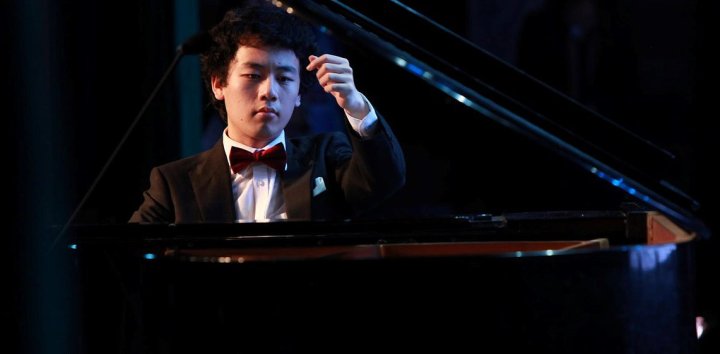
Who or what inspired you to take up piano and pursue a career in music?

Growing up, I was an avid collector of records (even cassettes, as they existed then!). I remember the first time listening to the Rachmaninoff concerti, and falling in love with the monumental scale of the music. I was also extremely fortunate to have an inspirational mentor during my early study – Emily Jeffrey, who made it possible for me to have a career.

Who or what were the most important influences on your musical life and career?

First, my teachers have been hugely important: Emily Jeffrey, as I already mentioned, and then Ronan O’Hora. I feel very lucky that both teachers allowed me to develop my own ideas. Masterclasses and performances with some wonderful masters have also been influential – in particular Richard Goode, Stephen Kovacevich, and Diego Masson. My family have also been incredibly supportive.

What have been the greatest challenges of your career so far?

I think it is the things that affects most musicians – having to learn a great deal of repertoire at short notice, keeping your artistic integrity at the forefront, and finding time to deal with the business side of the career. On a side note, learning statistics for my doctorate (examining musical memorisation) was perhaps the most unusual challenge!

Which performance/recordings are you most proud of?

I hope that all of my performances have some kind of meaning or importance. There are a few that stand out. Performing recitals on consecutive days (with different programmes!) at the Barbican and Royal Festival Hall was an exhilarating – and exhausting – experience. At the end of my postgraduate study I also performed Messiaen’s vast tone poem Des Canyons aux Etoiles with the Guildhall Sinfonia in Milton Court – an absolute privilege!

My debut album is available now, featuring the solo works of Boulez, Dutilleux and Messiaen. It’s an exciting project supported by the City Music Foundation.

Which particular works do you think you perform best?

I have an affinity for French 20th-century repertoire: Boulez Notations, Messiaen Des Canyons aux Etoiles, Dutilleux Sonata. Beethoven Sonatas are also the works I return to the most. Variety is important!

How do you make your repertoire choices from season to season?

There’s so much to choose! I generally try to pick one big work and try to build something interesting around it, often combining with some contemporary repertoire. Next up is Beethoven Op. 110.

Do you have a favourite concert venue to perform in and why?

I’m very fond of Milton Court – as it feels sort of like a second home from my study at Guildhall. The Bridgewater Hall and Wigmore Hall also.

Who are your favourite musicians?

Richard Goode, Pierre-Laurent Aimard, Oliver Knussen, Paul Simon

What is your most memorable concert experience?

Performing Stravinsky’s Les Noces in a huge barn in France with some wonderful colleagues stands out. It was so cold that everyone had to wear thick coats, and there was grain and machinery everywhere. Despite this, it was a great concert!

From a listener’s perspective, Pierre-Laurent Aimard’s performance of Messiaen’s Vingt Regards at Milton Court in 2016 was indescribable.

What do you consider to be the most important ideas and concepts to impart to aspiring musicians?

Be comfortable in your own skin, and keep learning!

What is your most treasured possession?

Friends and family.


Praised as a pianist of “huge intensity” (The Telegraph), Alexander Soares is developing a reputation as an artist of formidable technique and virtuosity, with performances of “diamond clarity and authority” (BBC Radio 3 ‘In Tune’). In 2015, his performance in the BBCSO / BBC Radio 3 ‘Boulez at 90’ celebrations received widespread critical acclaim in the press, described as a “brilliantly unbuttoned account” (The Sunday Times) and “most memorable of all” (The Financial Times). The 2014-15 season began with a BBC Radio 3 broadcast of the rarely heard piano repertoire of John Tavener, and included Alexander’s debuts at the Queen Elizabeth Hall and the Edinburgh Festival Fringe, the latter performance applauded for its “explosive sound world, pulling out a rich array of colour and texture” (The Herald). He was awarded 1st prize and Gold Medal in the prestigious Royal Overseas League Competition, and was subsequently selected as a 2015 Artist by City Music Foundation. 2016-17 highlights include returns to Wigmore Hall, St-Martin-in-the-fields, St. James’s Piccadilly, and Alexander’s debut in the USA.

Contemporary French repertoire forms a major part of Alexander’s programming. Since a U.K. première of Tristan Murail’s work in the BBCSO Total Immersion series, he has performed this repertoire in his debut recitals in the Royal Festival Hall, the Purcell Room, and the Bridgewater Hall. In 2014, he collaborated with Diego Masson performing Messiaen’s Des Canyons aux Étoiles in Milton Court Concert Hall. The following year, he performed Boulez’s Dérive with David Corkhill in LSO St. Luke’s. He worked with the renowned recording producer Andrew Keener to record his debut album of solo works by Boulez, Dutilleux and Messiaen.

A keen chamber musician, Alexander has performed on numerous occasions in the Barbican, working with notable artists such as Boris Brovtsyn and Alexander Baillie. Collaborating with violinist Mihaela Martin, he debuted in Spain at the Palacio de Festivales, Sala Argenta. He has also toured France, in venues including Auditorium St. Germain and Opéra Rouen, performing Stravinsky’s Les Noces on Pleyel’s original double grand pianos, manufactured in the late nineteenth century. Alexander has greatly benefitted from the guidance of pianists including Richard Goode, Stephen Kovacevich, Stephen Hough, and Steven Osborne.

Alexander graduated with first class honours from Clare College, University of Cambridge. He then pursued postgraduate studies with Ronan O’Hora at the Guildhall School of Music & Drama, achieving a Master’s with Distinction. In 2015 he completed a doctorate investigating memorisation strategies for contemporary piano repertoire, under the supervision of Professor Daniel Leech-Wilkinson. He is most grateful for generous support from the Guildhall School Trust, Help Musicians UK, Countess of Munster Trust, Martin Musical Scholarship Foundation, Park Lane Group and Making Music. 

www.alexander-soares.com

Who or what inspired you to take up the piano and pursue a career in music?

There are no musicians in my family. My parents enrolled me in a music school when I was five and there I started discovering this world from scratch. I chose the piano from the beginning because it was a magnificent instrument with a huge range of registers and possibilities.

Over the years, my interest for music kept growing and I started expanding my skills. I began playing the drums in a band, I learned how to play the guitar, I became an active member in several choirs and I composed. Although I was still pursuing my main musical studies in piano, all these new experiences enriched my relationship with music and allowed me to gain new perspectives that probably I wouldn’t have had if I had solely focused on a ‘keyboard’ approach.

Nevertheless, when I started my Bachelor’s degree in Mathematics I had to prioritise and I eventually ended up focusing on the piano. During my undergraduate and postgraduate studies at the Catalonia College of Music (ESMUC) and the Royal College of Music (RCM) in London, my personal commitment to performing became even stronger and determined my pursuit for a career as a pianist. However, if I have to say what really inspired me, I think that is becoming addicted to the excitement of creating a live performance on stage that is different every single time.

Who or what have been the most important influences on your musical life and career?

My musical taste has changed a lot and I have admired and worshiped artists and bands from all sorts of musical genres: rock, punk, pop, indie, funk, jazz, and of course, classical music. Playing different instruments and styles also allowed me to experience those genres from inside, and that significantly made a difference for me. With time, classical music became the main influence, but I have remained open-minded.

Glenn Gould’s distinctive recordings was one of the earliest and more determinant musical influences for me. I found it tremendously compelling that he could play so rationally, while being extremely creative and artistic. A model that pushed me to find my own voice between mathematics and music. I truly admired his originality of thought and his conviction to build a controversial but unique sound world. Another was Friedrich Gulda, and his incredible range both as a classical and jazz pianist.

However, probably the most distinctive revelation for me was to discover the masterpieces from the 20th and 21st centuries, too often neglected by the conservatoire’s tradition. A repertoire that I felt artistically closer to and that stimulated my curiosity to work and premiere new music by living composers. Each collaboration challenged and transformed my understanding of music, especially for the core repertoire.

Probably the musician that has influenced me the most and the one I’ve been studying the longest with is my piano professor at ESMUC, Jean-François Dichamp. He taught me a very solid technique and an extraordinary musicality which significantly transformed me as a performer. While studying with him, I fell in love with the music of Messiaen and Dutilleux, and, as a consequence, I started exploring further the more recent French repertoire to which I dedicated my first album ‘The French Reverie’.

My piano professors Jordi Vilaprinyó and Stanislav Pochekin were also a determinant influence and, along with Jean-François Dichamp, have been my mentors over the years.

During my Master’s at the Royal College of Music I specialised in contemporary repertoire with Andrew Zolinsky, where I had a wide range of performing opportunities that allowed me to reinforce my experience with new music. I also became acquainted with Crumb’s, Stockhausen’s and Lang’s piano music which became an important influence for me.

What have been the greatest challenges of your career so far?

There have been many, but probably one of the craziest ones was to combine simultaneously a Bachelor’s degree in piano performance and a Bachelor’s degree in mathematics at two different universities.

Which performance/recordings are you most proud of?

My first milestone as a professional musician has been without doubt the recording of my debut album ‘The French Reverie’, featuring works by Messiaen, Dutilleux, Manoury, Escaich, Ben-Amots, Järventausta and Djambazov. It has been a risky project because I chose non-standard repertoire by mostly alive composers. However, before I recorded it, I visited and played for all of them, and precisely for this it has become an exceptional and unprecedented experience.

In addition of recording, I have also been the producer and the fundraiser of the album, which was generously supported by 208 patrons from 28 countries across the five continents! Although at the beginning it was scary, it allowed me to gain a lot of insight on the music industry and which strategies work to engage an audience and the press to promote your project.

At the moment, I’m currently planning a concert tour of the countries of the composers involved: France, Finland, Bulgaria, Israel and USA, along with Spain and the UK.

Which particular works do you think you play best?

I think that what I play best is the Contemporary Classical Repertoire, especially because it is what I enjoy the most to perform. Also, Debussy, Ravel, Falla, Brahms and Bach.

How do you make your repertoire choices from season to season?

I have a huge predilection for rhythmical pieces, so I always try to include some in my repertoire. Above all, I focus on finding or selecting works that I’m looking forward to play and try to arrange them in terms of a story or a concept. I also try to link major works from the core repertoire with masterpieces from the 20th and 21st centuries.

Do you have a favourite concert venue to perform in and why?

I like to play in venues in which architecture has a strong artistic component. I think it adds an additional layer of spirituality to the performance. However, any venue with good acoustics, an enjoyable piano and a receptive audience is equally special.

Who are your favourite musicians?

Miles Davis, Hayk Melikyan, Alicia de Larrocha, Vladimir Ashkenazy, Maika Makovski, Martha Argerich, Glenn Gould, Pierre-Laurent Aimard, Grigory Sokolov, Daniil Trifonov, Ivo Pogorelich, Elliott Smith, Zoltan Kocsis, Malena Ernman, Valentina Lisitsa, Sviatoslav Richter, András Schiff, Bill Evans, Maria Callas, Evgeny Kissin, Belle and Sebastian, Cecilia Bartoli, Friedrich Gulda, Art Tatum, Jean-Guihen Queyras, Lennie Tristano, Arcadi Volodos, Hole, NOFX, Art Blakey, Murray Perahia, Pearl Jam, Muse, Ella Fitzgerald, Duke Ellington, Leonard Slatkin, William Bolcom, Pierre Boulez, Daniel Barenboim, Anna Netrebko, Renée Fleming, Simon Rattle, Joshua Bell and Isabelle Faust.

What is your most memorable concert experience?

It is really difficult to choose a single performance because each one has something special. However, maybe one of the most distinct and unforgettable experiences I had is when I performed George Crumb’s Makrokosmos I. This is a set of twelve pieces, each one dedicated to a different sign of the zodiac, meaning that you have to portray a different character in every single one. With this work you cross all possible boundaries as a performer and you create an outstanding sound world. It literally transforms you into someone else and you discover that you’re capable of leading and communicating with the audience in ways you never suspected.

As a musician, what is your definition of success?

I think that you can consider yourself successful when you don’t need to compromise your artistic aspirations to make a living. When you are doing exactly what you want, and you get a positive response. For me, success is not about money or becoming famous. It is essentially feeling self-accomplished and to have the necessary public recognition to develop your own projects.

It is also having the certainty that with your job you’re making a difference in your field in something that you feel passionate about. To be able to communicate that to others.

What do you consider to be the most important ideas and concepts to impart to aspiring musicians?

I think it is extremely important to think about why you want to become a professional musician and what could be your contribution. In other words, to be creative, to question general assumptions in your field and to find your own voice. And above all, to be patient, proactive, persistent and determined to work hard.

Where would you like to be in 10 years’ time?

Hopefully having an established career as a musician and with lots of ideas and projects in mind. Ideally, being able to travel and to work with inspiring people.

What is your idea of perfect happiness?

I tend to agree with Zygmunt Bauman when he states that happiness is the result of fighting and overcoming difficulties. Personally, I like challenges and absolutely love the feeling of accomplishment when I have been able to achieve my goals. Probably that’s why I have such a predilection for complex repertoire too. I think that perfect happiness is the result of having an enthusiastic and healthy ambition.

What is your most treasured possession?

Although it is not strictly a possession, I would say time. You can achieve anything with it and is something that money can’t buy. Everything I’m proud of and every unforgettable experience I have is a consequence of having had the time for it.


Laura Farré Rozada’s debut album The French Reverie is available now. Further information


Laura Farré Rozada is an award-winning pianist and mathematician specialised in contemporary music. She is currently based in London, where she recently completed her Master of Music degree with Andrew Zolinsky as an RCM Patrons’ Award Holder. She previously graduated with Distinction from her Bachelor and Master piano studies with Jean-François Dichamp at ESMUC (Catalonia College of Music), and from her Bachelor’s degree in Mathematics at UPC (Polytechnic University of Catalonia). She obtained several Distinction Awards in all her studies.

Read more


Who or what inspired you to take up piano, and pursue a career in music?

It all happened rather by accident. I’m from, what I like to call, an atonal family and I owe it to the music school in Gdańsk – my home city. They were looking for talented children in kindergartens and so my parents received a letter one day. A little bit like Hogwarts! I remember discussing the options with my dad before the audition. He only asked that I don’t choose the piano as it’s a big, heavy instrument that takes a lot of space. Soon enough we had to find the space…!

Who or what have been the most important influences on your musical life and career?

From a professional point of view my teachers and fellow music colleagues. I’m infinitely grateful to all the professors I came across in my life. I’m getting to know that process from the other side now and I realise every day how tricky being a teacher can be.

From the psychological or mental side, I couldn’t have done it without my parents. I guess most musicians would say the same thing.

What have been the greatest challenges of your career so far?

Freelancing! It still is. Also the post-graduation blues. I wish we’d speak about it more – how difficult it is to finish studying and to be in the world on our own, without the support of the institution behind us.

Which performance/recordings are you most proud of?

First, my recent release with Naxos called ‘A Century of Polish Piano Miniatures’. I think I managed to put together a programme of the real 20th century jewels of Polish piano literature, allowing the listener to explore all that happened after Chopin. I’m proud of that one. The biggest challenge would be Beethoven’s Hammerklavier Sonata, a recording I did last year. Because of the technical difficulties my session lasted for 1.5 hours instead of 3. That’s not enough time to play it through even twice. No space for mistakes!

Which particular works do you think you play best?

I think that would be everything from Impressionism to contemporary music. Ravel has never let me down, same for most of the 20th-century repertoire. However, I must say there’s nothing more satisfying than some good Bach.

How do you make your repertoire choices from season to season?

I aim for a selection of styles and variety of soundworlds. Something that will be good for competitions and recitals with different audiences. I usually make a list of pieces I want to continue playing and try to add works that would go well with it to create interesting programmes.

Do you have a favourite concert venue to perform in and why?

My room. Everything always works! And if I really want I can make it a performance venue. Concert is a state of mind after all!

Who are your favourite musicians?

The passionate ones. No time for accurate boredom.

What is your most memorable concert experience?

There is so many memorable experiences…It’s extremely hard to choose the one! Maybe I will go for the finals of Tallinn International Piano Competition when I performed my beloved Ravel for the first time. I felt so powerful, like nothing could stop me. There are also a lot of earlier experiences which are connected with becoming professional and finding my own identity as a concert pianist. I think that’s material for a book…

As a musician, what is your definition of success?

A balanced combination of high-quality artistic experiences and self-preservation.

What do you consider to be the most important ideas and concepts to impart to aspiring musicians?

We do it primarily for the others. We have to always remember that. We serve the audience, whoever they are. We serve the music, the composers, the beauty… It’s our duty to share the love and passion for arts – that’s the best way to make this world a better place.

Where would you like to be in 10 years’ time?

Close to the people I love most, doing what I love to do most.

What is your idea of perfect happiness?

The above, and loving your work (then you don’t have to work).

What is your most treasured possession?

My mind, nobody can read it.

What is your present state of mind?

Relaxed post-tax return!

Anna Szalucka’s latest CD, A Century of Polish Piano Miniatures, is available now


Anna Szałucka is a Polish pianist and started her musical education at the age of seven. She completed the Bachelor Degree at the Stanisław Moniuszko Academy of Music in Gdańsk studying with Waldemar Wojtal. In years 2013 – 2014 she continued her studies at the Universität für Musik und Darstellende Kunst Wien in piano class of Stefan Vladar. Currently she is studying at the Royal Academy of Music in London under the supervision of Ian Fountain. In November 2016 Anna won the 1st Prize together with The Eller, Recital, Orchestra and Estonian Museum Awards at the 3rd International Tallinn Piano Competition. She’s a prize winner of many other competitions including the 1st Prize in Young Pianists Forum in Rybnik and the 2nd Prize and The Special Prize of Jerzy Waldorff on IX Iternational Competition for Young Pianists “Arthur Rubinstein in Memoriam” in Bydgoszcz, Poland. Anna is also a laureate of the 46th Festival of Polish Pianism in Słupsk (Poland). She’s been awarded The Jacob Barnes Piano Scholarship, Musicians’ Company – Harriet Cohen Bach Prize, Kenneth Loveland Gift Prize as well as the 3rd Prize in the International Sussex Piano Competition. Her recent successes include multiple prizes: Janet Duff Greet, Walter MacFarran and Alexander Kelly Memorial Prizes, The Regency Award as well as 2nd Prize and the Audience Prize at the Sheepdrove Intercollegiate Piano Competition. She was selected by the prestigious Musicians’ Company to give her Wigmore Hall debut recital in 2016.

Anna Szałucka has given many concerts across Poland and abroad cooperating with such institutions as The National Fryderyk Chopin Institute, Wiener Beethoven Gesellschaft, The Arthur Rubinstein International Music Foundation, The Worshipful Company of Musicians as well as BBC Radio 3, BBC Radio 4 and Radio Gdańsk. The orchestra appearances include concerts with the Polish Radio Orchestra, Estonian National Symphony Orchestra, Worthing Symphony Orchestra, Sinfonia Baltica, Pomeranian Philharmonics, Górecki Chamber Orchestra and others. Anna has developed her passion for music by taking part in many piano masterclasses, among others with Aleksiej Orłowiecki, Alon Goldstein, Andrzej Jasiński, Kathryn Stott, Imogen Cooper, Dina Yoffe, Lee Kum-Sing, Paul Roberts, Joanna MacGregor, Yevgeny Sudbin and Alberto Nosè.

As the Royal Academy of Music scholar Anna is generously supported by the Thompson Family Charitable Trust. In Poland, she received a scholarship from the Marshal of the Pomeranian Voivodeship, the President of Gdańsk City and the Principal of the Stanisław Moniuszko Academy of Music in Gdańsk. She was also awarded the Ministry of Science and Higher Education Prize as well as Ministry of Culture and National Heritage Prize.

www.annaszalucka.com

Who or what inspired you to take up the piano and composing, and pursue a career in music?

I first discovered the piano at a friend’s birthday party when I was six years old. They had an upright piano in the living room, and that interesting large object immediately caught my attention as something that looked very interesting. Later, when most people were outside playing football, I remember climbing onto the piano stool and started just tinkering some notes, and realised that there was a connection between each note, and a kind of weird relationship I couldn’t quite describe – I started to slowly pick out tunes that were stored in my head from my even earlier years at nursery (tunes such as ‘Mary had a Little Lamb’, ‘Twinkle Twinkle Little Star’). It took me a while to pick out full tunes, but I was immediately aware that some of the notes fitted in the tune as the ‘right’ notes in the right order, and some notes which didn’t, and thus were ‘wrong’. I also could somehow differentiate each note in terms of pitch by an instinct – later, I was told that this was perfect pitch. My friend’s mum was impressed, and later phoned up my own mother and told her that she didn’t know I was taking piano lessons, and wanted to know who my piano teacher was. My mother was shocked at all this, and was in confusion with pianos and piano teachers, since it’s something that never really cropped up into her life until that point! A few months later, my mum bought me my first piano (a new upright), and after playing around with the instrument, I began taking lessons.

My passion for composing music came around the same time when I picked up the piano, but it started out as improvisation – I always loved to sit at the piano and make up my own pieces and remembered having tremendous fun! When I was about eight, someone told me that it might be a good idea to start learning to write ideas and improvisations down. A music student, who was a friend of my dad’s, came round to our house and recommended we get a music notation software. I began to play around with that, and would spend hours playing on there and experimenting with different instruments, sounds and styles. I would sometimes perform them to friends and family, and got great fulfilment out of that. However, I didn’t have formal tuition until secondary school, which was a place where I had the chance to open myself up to even more kinds of styles, and refine my composition techniques as well as learning new ones – there was the beginning of my life-long search to find my own compositional voice, integrity, and individuality

Who or what have been the most important influences on your musical life and career?

My parents and my teachers – they have been very supportive with my musical passion ever since the beginning, and have always been there for me. I feel very lucky indeed.

What have been the greatest challenges of your career so far?

For me, the most difficult thing about playing music is not technique – rather, it’s finding the most musical, communicative, faithful, fresh, authentic way of interpreting music, that is true to yourself and to the composer. One of my old piano teachers always emphasised about making the music sound as natural as possible. The process of learning and performing a piece is a deeply fulfilling, but never-ending journey to find the real spirit, character, depth, and true understanding of the piece in terms of its theme and stylistic context, and then, it’s the question of how to convey all that into the interpretation, bearing in mind that, if you’re practicing the right way, every time you work on a piece, you discover something new. The greatest pianists all manage to somehow achieve this – it’s this very essence on how they express and communicate the music that can give audiences goosebumps, move them to tears, or drop their jaws and think ‘wow’. Music is one of the few things in the world that, when unleashed to its full potential, has the power to do just that – to summarise, the biggest challenge for me in music is making music! I am somewhat relieved that this process is never leisurely for me – it’s what motivates me to carry on, and is one of the soul reasons why I love music so much.

As for composition, it’s always a flow of inspiration which leads to many good ideas forming a piece to be written down – the challenge for me, however, is overcoming the self-doubt that usually follows immediately after this. I’m always questioning myself about every minuscule idea I put to paper, and then forgetting about it and continue to do what I’m currently doing. The end result has mainly been positive and gratifying for me. Of course, there’s always the challenge of rehearsing the piece with the player(s), but it’s always the feeling that you want your next piece you write to be somewhat even better than your previous piece that drives me forward, and makes me continue!

Which performances/recordings are you most proud of?

I always try to put in the same effort and concentration into each performance and recording I do. I am however, pleased with my debut album for Orchid Classics, which will be released in September this year!

Which particular works do you think you perform best?

I always strive to try and bring the same amount of justice to whatever it is I’m playing – I try to convince myself that I’m fully versatile with all kinds of works and styles.

How do you make your repertoire choices from season to season?

It always varies, and usually depends on my mood and my taste at that particularly time. I strive for a kind of variety, and try to include at least one of my own compositions.

Do you have a favourite concert venue to perform in and why?

For me, every single venue, be it large or small, has its own uniqueness and story. I try to look for the best in every venue I play, and what matters for me is how to convey the music in the best way that suits whatever venue I’m in at the time. Also, the warm receptive and enthusiastic audience matters to me more than the venue. I do, however, love venues that are architecturally stimulating.

You are also a composer…. Which musicians/composers have had a significant influence on your composing?

Practically everyone! I’m influenced by such a wide range of genres, styles and composers, that I can think of very few composers and styles I don’t like. But sometimes, I even LIKE listening to a piece just because I DON’T like it, as I find it challenging to digest in someway, which leaves me wanting more. Music that I don’t like is like a puzzle for me – I would spend time listening to it in secret to try and ‘decipher its puzzle’. I’m a big like a vacuum cleaner – everything somehow makes their way into me creative thought-process. This is also why I sometimes find it dangerous to ‘open my doors’ too wide – sometimes I get an ‘influence overload’, which can then lead to the self-doubt I was talking about earlier on. But yet, that’s also a good thing, as it expands my knowledge and makes a mark on the inspiration in my subconscious – it’s a bit of a paradox!

How would you characterise your compositional language?

I’ve always had a natural affinity to write in any style/genre required or thrown at me. I’ve enjoyed writing filmic music, pop songs, folk music pastiches, and hope to write musicals and film scores as well in the future. I have done lots of arrangements of Chinese folk songs and other well-known tunes – usually all through improvisation.

Although, for my concert music, I don’t think my style has settled down firmly yet – it’s continuing to evolve. I’ve always been more fascinated by the inspiration and concept behind a piece, and the musical ideas and how they are used, and that’s why I infrequently think about my music as being ‘tonal’ or ‘atonal’ or not. Having said that, a few years ago, I was enjoying writing music that ended up being almost inadvertently atonal or mixed tonal music, but now it’s starting to edge towards the more tonal side. I’m starting to think there is so much I can experiment and play around new ways to use tonality, and combining them both. Some may say that this is unfortunate, but I personally feel very lucky to be living in a time with so many musical languages at our disposal, and we can write whatever we want – like a painter having lots of different types of paintbrush. I feel lucky to be fluent in so many ‘musical languages’

How do you work (as a composer)?

I’m always improvising and recording myself to help generate ideas. I usually compose with pen and paper, and then put it into a notation programme. I now have several good ideas for pieces I want to write, but haven’t started yet, because I’m currently writing another piece. I try not to write several pieces at once, as I feel it clogs up my mind.

Who are your favourite musicians/composers?

Again too many to list here! I’d feel guilty mentioning someone with the worry of missing someone else out! Although there’s never really been a pianist or composer that I love 100% of everything he/she plays/writes – it’s always a few or more pieces that are my favourite interpretation, or a particular piece by a particular composer that I really love, but it doesn’t necessarily mean I love all other pieces written/played by him/her.

That said, pianists include Argerich, Sokolov, Zimmerman, Horowitz, Hoffman and Cortot to name just a very few. Apart from the great composers of the past eras, such as Bach, Mozart, Beethoven, Chopin, Schumann, Liszt, Ravel, Debussy, Rachmaninoff, Prokofiev, Bartok, Szymanowski, Stravinsky etc., more recent composers include Arvo Part, Gorecki, Oliver Knussen, James MacMillan, John Adams and many more. Film and musical composers include John Williams, Hans Zimmer, Stephen Sondheim, Andrew Lloyd-Webber and many more

What is your most memorable concert experience?

I have a few, but from the recent period, I won’t forget performing a solo piano tour in Portland, USA, and as an encore, I offered to do an improvisation on the spot – I’d ask for any member of audience to either come onstage to the piano and play any random notes (which I will base the improvisation on) and any style/composer – this rather intellectual member in the audience shouted ‘how about a piece using only notes G and F#, in the style of Weber and Oscar Peterson’! I accepted the challenge – turns out the audience liked it very much, and they gave me a very warm reception.

Here is an improvisation I did on a famous musical motif from ‘The Hunger Games’ in an Impressionist style: http://sg.abrsm.org/en/about-abrsm/abrsm-blog/article/my-musical-journey/791/

What do you consider to be the most important ideas and concepts to impart to aspiring musicians?

For me, as clichéd is it might sound, it’s about being able to see between the notes of what the composer wrote to really convey a performance that is special, memorable, moving and deeply musical. For aspiring composers, it’s important to open up your mind to as many different kinds of music as possible. Always strive to do everything in music to the very best of your ability and not to compromise your quality. Above all, enjoy it, cherish it, and allow music to take over your life!

What is your present state of mind?

Happy and contemplative.


Yuanfan Yang’s debut disc of music by Schubert, Chopin, Liszt, Philip Cashian and his own compositions is available now on the Orchid Classics label


Born in Edinburgh, Yuanfan began learning the piano when he was 6, passed Grade 8 with Distinction at the age of 8 and achieved a Diploma of the Associated Board of the Royal Schools of Music (DipABRSM) when he was 10. He was awarded the AMusTCL Diploma in Music Theory with Distinction in 2015, and is a Scholar of the Drake Calleja Trust.

Yuanfan has won numerous piano competitions. He has won 1st Prize at the Cleveland International Young Artists Piano Competition in the USA in 2015, and 1st Prize of the 4th International Franz Liszt Piano Competition in Weimar, Germany in 2014, with which he was awarded the Special Prize for Best Interpretation of a Classical Sonata, the Special Prize for Best Interpretation of Works by Liszt, the Special Prize for Best Composition and Improvisation, the Junior Jury Prize, and the European Union of Music Competitions for Youth (EMCY) Prize for Most Outstanding Contestant. In 2013 he won the 3rd Prize in the Minnesota International E-Piano Competition. He has also won 1st Prizes in the 2010 RNCM James Mottram International Piano Competition (under 19), and the 2009 Manchester International Piano Concerto Competition for Young Pianists (age 16 and under). Yuanfan is also a fluent sight-reader, having been the champion of the ongoing Michael Abraham Sight-Reading Award six years in a row, ever since he joined Chetham’s. He has also won 1st Prizes in the UK Liszt Society International Piano Prize 2015, the Royal Academy of Music’s Sterndale Bennett Prize 2015, and the 9th Grand Prix Interlaken Classics International Piano Competition 2016. He was the Keyboard Category Winner and a Grand Finalist of the BBC Young Musician of the Year Competition 2012, and won both category and overall prizes at the European Piano Teachers Association (EPTA) UK Piano Competition 2010. Most recently, as the youngest participant and top eight semi-finalist in the Cleveland International Piano Competition 2016, Yuanfan’s performances earned him the Special AAF (Alink Argerich Foundation) Prize.

Yuanfan has performed for many eminent music societies, festivals and key events throughout Britain, China, Denmark, France, Germany, Italy, Romania, Spain, Switzerland and the US, and has performed concertos by Beethoven, Chopin, Gershwin, Grieg, Mozart, Prokofiev, Rachmaninoff and Tchaikovsky with many eminent conductors and leading orchestras including the Northern Sinfonia, the Royal Liverpool Philharmonic Orchestra, the Romanian Radio National Symphony Orchestra, the Wuhan Philharmonic Orchestra, the Canton Symphony Orchestra in Cleveland, the Minnesota Orchestra, the Leeds Sinfonia, and the Manchester Camerata.

Yuanfan is also a versatile composer and an accomplished improviser. His ‘Fantasy in G’ for piano was broadcast on BBC Two in 2007 and 2008, and his arrangement of ‘Scarborough Fair’ was shown on BBC Four in 2010. His piano composition ‘Waves’ won the Overall Award in the European Piano Teachers Association UK Composition Competition 2011. This piece also won Highly-Commended in the BBC Proms Young Composers Competition 2011. His ‘Haunted Bell’ won first prize in the Junior Group of the Golden Key International Piano Composition Competition in 2012, and it was broadcast on BBC Four and BBC Radio Three. He was a finalist in the National Centre for Early Music Composers’ Award 2013, where his piece ‘Crushed Suites’ was premiered and recorded by the leading early music ensemble Florilegium. In September 2014, Yuanfan’s new Piano Concerto – ‘The Wilderness’, scored for solo piano and full symphony orchestra, was premiered in Qianjiang, China; the concerto was performed again at Wuhan University as part of his China tour in November 2014, and it had its UK premiere with the Chetham’s Symphony Orchestra in June 2015 – all the performances were enthusiastically received with critical acclaim from the press and audience. This concerto will be performed in 2017 at the Beijing Concert Hall with the Beijing National Theatre and Dance Orchestra.

Yuanfan has recently recorded his debut album for Orchid Classics, which is due for international release in mid-2017.

www.yuanfanyang.com


