Who or what inspired you to take up the piano, and make it your career?

I don’t think it was the piano specifically that attracted me as a child – I just always loved music and wanted to be involved in it in any way possible. I don’t come from a musical family, and my parents didn’t really know any classical music till I came along (I was brought up on Motown, Bob Marley, Paul Simon, Joni Mitchell, Queen…), but they’re both creative people and incredibly supportive, and recognised that I had an absolute fascination for music of all sorts from a very young age. The first ‘classical’ record I remember my parents buying for me was of David Munrow playing Mediaeval and Renaissance wind instruments, which I became quite obsessed with. As a child, I took up the recorder, piano, cello and oboe, but what I really wanted to be more than anything else was a composer. I’m not quite sure how I ended up being a pianist – I don’t remember a conscious moment of decision, and always feel the instrument chose me rather than the other way round. As for making music my career, I just never considered doing anything else, though for a long time I hadn’t the faintest idea how a career actually worked.

Who or what were the most important influences on your musical life and career?

My first piano teacher, Hilary Morrison, was a schoolteacher who lived round the corner – she’d never taught the piano before, but it’s only with hindsight that I realise what a brilliant start she gave me. I wish she was still alive so I could thank her properly. I was incredibly fortunate to study from the age of nine onwards with Joan Havill at the Guildhall School of Music and Drama, who taught me pretty much everything I know about playing the piano, pushed me to achieve things I thought I couldn’t, and inspired me to work much harder than I ever would have done otherwise. I owe her so much, and my life would have been very different without her. Many of the principles of chamber music playing which I hold dear were instilled in me by the wise guidance of Michael Freyhan at Pro Corda when I was in my teens. He showed me how to really listen – to myself and to others. There are so many other wonderful people who have had a huge influence on me, from primary school music teachers to chamber music colleagues; I can’t list them all for fear of leaving someone out, but I hope they know who they are!

What have been the greatest challenges of your career so far?

In the earlier stages of my career I had to fight hard to avoid being pigeon-holed: I played a lot of chamber music from a young age, because I’ve always loved it, and discovered at a certain point that once people see you in that box, they often assume you’re not really a ‘solo’ pianist, despite the fact that I’ve always had a busy schedule of concertos and solo recitals. Such assumptions strike me as very odd, because it seems only natural to me that a pianist exploring Beethoven (for example) should want to play his solo sonatas, duo sonatas, trios, concertos, songs and so on – everything feeds into everything else. I’ve always thrived off the variety and balance of repertoire, and I’d hate to close the door on any part of it. And I already feel that being a pianist is more of a specialism than I’d originally intended!

Which performance/recordings are you most proud of?

I’m not sure that pride is a feeling I particularly associate with, but sometimes there are wonderful, indefinable moments in certain performances (I wish they happened more often!) where everything comes together in a magical way and it feels like you’re flying, as if anything’s possible. I have so many reservations about the process of recording (not least that I miss the audience hugely when I’m in a studio), and I find it very difficult to listen to my own recordings, but I do feel a sense of achievement over my new recital disc, In Dance and Song, which contains a very personal selection of works and reflects some of my wide-ranging passions. Also, the one time I dared to listen to it, I quite enjoyed the disc of the Chausson Concert which I recorded two years ago with Jennifer Pike and the Doric Quartet – it’s a wonderful piece, full of soaring melodies (and a ridiculous number of notes for the pianist).

Which particular works do you think you play best?

Not sure if I can answer that, but I’ve always adored melodies and vocal music, so I find pieces with a lyrical bent particularly gratifying to play.

How do you make your repertoire choices from season to season?

Pianists are spoiled for choice when it comes to repertoire, and it would take so many lifetimes to explore all the great works – as time goes on, I realise more and more that it’s a waste of time for a pianist to play anything that doesn’t really grab them. I enjoy hugely (though it sometimes requires an exhausting amount of thought) coming up with interesting and (I hope) cohesive programmes. Often, however, the ones I’m most pleased with are then scuppered by promoters saying e.g., “[A much more famous pianist] is already playing most of those pieces in his recital this season” or “Can you include a barcarolle by Snosveldt to mark his 186th anniversary year?” or (and this is a genuine quote, from a much missed promoter in Ireland) “Fauré spells death at the box office”.

Do you have a favourite concert venue to perform in and why?

Among many others, I love the Holywell Room in Oxford, Kettle’s Yard in Cambridge, and the Wigmore Hall. Playing at the BBC Proms is always a huge thrill. The Spoleto Festival in Italy when Gian Carlo Menotti was around was unforgettable.

Favourite pieces to perform? Listen to?

To play – far too many to list, but here are some which I find particularly enjoyable and/or rewarding to play: Beethoven concertos (including the Triple), Brahms piano quartets, Chopin solo works, Dvorak chamber music, Fauré (lots), Grieg miniatures, Mendelssohn chamber music, Messiaen Quartet for the End of Time, Mozart (all!), Rachmaninov concertos, Ravel (lots), Saint-Saens’ Carnival of the Animals, Schubert’s Trout Quintet, Schubert and Schumann Lieder, Richard Strauss’ early chamber music, Tchaikovsky’s Piano Trio. And – stretching back to my schooldays and early jobs in hotel bars – I’ve always loved playing Gershwin, Kern, Cole Porter and the Great American Songbook. To listen to – this changes a lot, but perhaps most consistently Bach, Mozart operas, Sondheim musicals, Ella Fitzgerald’s songbook recordings.

Who are your favourite musicians?

Along with the great composers whose music I play (of whom Mozart has perhaps brought me most joy of all) and the wonderful colleagues I have the pleasure of working with (not least my dear friends in the Aronowitz Ensemble), here is a very incomplete list featuring some musicians who have greatly inspired me in some way or other, which I’ve restricted to those I don’t know personally: Leonard Bernstein, Miles Davis, Ella Fitzgerald, Emil Gilels, Fritz Kreisler, Dinu Lipatti, Radu Lupu, Joni Mitchell, Ginette Neveu, Luciano Pavarotti, Oscar Peterson, Lucia Popp, Nina Simone.

What is your most memorable concert experience?

As a listener – a concert in King’s College Chapel, Cambridge in 1999, part of John Eliot Gardiner’s Bach Cantata Pilgrimage; most specifically the final aria of BWV 159, one of the most heart-stopping moments of my life so far. As a performer – I think I have a pretty good memory, so I remember most of my concert experiences, both good and bad, quite vividly. Two experiences which I will always associate with a wonderfully heady mixture of fear and immense joy both involved Robin Ticciati and the SCO – touring with the Ligeti Concerto in 2010 (the most fiendishly difficult piece I’ve ever played, but also utterly enthralling), and playing my first Brahms 2 at three days’ notice when Pierre-Laurent Aimard cancelled. (That wasn’t actually my most last-minute stand-in: I once got off a plane at 4.30pm and, when I turned on my phone, there was a message asking if I’d play the Grieg Concerto at 7.30pm that evening. The rehearsal had already taken place, but I jumped in a taxi and somehow got through the performance unscathed, and with a curious sense of liberation on stage!) I will always remember with huge fondness my appearance in the BBC Young Musician final back in 2000, under the starry ceiling of the Bridgewater Hall. It was a big, thrilling moment for a rather naïve boy who’d always felt something of an outsider and who’d never experienced anything remotely on that scale. It also opened a lot of doors. On a non-pianistic note – and perhaps reflecting my early desires to be an actor as well as a musician – I enormously enjoyed appearing as reciter in Walton’s Façade a few years back at Aberystwyth Musicfest (where I’ve also played the swanee whistle in drag).

What do you consider to be the most important ideas and concepts to impart to aspiring musicians?

First and foremost, that music is the most important thing, and if you love it so much that you can’t be without it, then immerse yourself and go for it – but try to be flexible and open-minded about your exact path. Avoid cynics and negative people – there are a lot of them around, such as the ones who like to hover after a concert and say helpful things like, “It’s a terrible struggle, the music business, isn’t it? Must be very difficult for you.” Of course there are tricky times, but no money in the world could persuade me to switch to another profession.

Regarding education, I personally think it’s important to remember there are valid alternatives to the music school/music college route. All my schooling took place in the comprehensive system, and my first degree was at university. It dismays me when people express surprise (which they really do) that some of us in the classical music profession hail from a regular state school background; I’m also immeasurably saddened that, if music in state schools continues to be eroded and marginalised by the government, before long there may not be many aspiring musicians to pass such advice to.

Where would you like to be in 10 years’ time?

Doing pretty much what I am now. Though I’d like to have written a hit West End musical in the interim. And to have successfully campaigned (without it having taken up too much time) for the provision of free music education for all children, which would incidentally have enabled world peace.

What is your idea of perfect happiness?

To see an aardvark, moose, tapir or dugong in its natural habitat.

What is your present state of mind?

Sleepy.


Tom Poster is internationally recognised as a pianist of outstanding artistry and versatility, equally in demand as soloist and chamber musician across an unusually extensive repertoire. He has been described as “a marvel, [who] can play anything in any style” (The Herald), “an unparalleled sound-magician” (General-Anzeiger), a “young lion” (The Guardian), and as possessing “great authority and astounding virtuosity” (Est Républicain). He won First Prize at the Scottish International Piano Competition 2007, the Ensemble Prize at the Honens International Piano Competition 2009, and the keyboard sections of the Royal Over-Seas League and BBC Young Musician of the Year Competitions in 2000. 

Tom’s full biography and diary is available on his website: www.tomposter.co.uk

Interview date: 10th March 2014
Who or what inspired you to take up the piano?

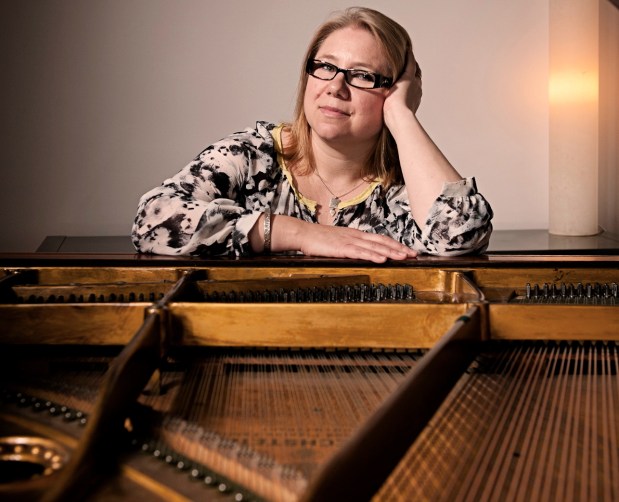
My grandfather had an upright piano in the front room of his house in Ipswich. This room was kept for Sundays and special occasions. He liked to play Methodist hymns, excerpts from Haydn and Beethoven and old music hall songs. I loved to sit next to him as he played, or leaf through the music in the piano stool, with its special antique smell and friable, crumbly pages.

There was lots of music at home when I was growing up: on the radio, LPs and from my father, who was a fine amateur clarinettist. When I was in bed, I used to listen to him practising Mozart’s Clarinet Concerto to Music Minus One: for a while I believed he had a whole orchestra in the sitting room with him!

I think I was about 5 or 6 when I started piano lessons with Mrs Scott in Sutton Coldfield. My piano was an early 20th-century Challen upright. It had lived in a conservatory for two years before it came to us and it needed quite a lot of restoration, but once overhauled it was a really nice instrument, of which I was very fond.

My parents were keen concert-goers and my love of live classical music developed in childhood. We went to many concerts at Birmingham Old Town Hall where a conductor with wild hair conducted the CBSO (this was Louis Fremaux, pre-Simon Rattle). I loved, and still do, the etiquette of concerts – the excited buzz of anticipation in the foyer beforehand, reading the programme, sinking in to the plush seats. Once a year, as a treat, I would be taken to London to go to the Proms, and we also went to the opera and ballet regularly. I was lucky enough to see/hear some of the “greats”: Ashkenazy, Brendel, Lupu, du Pre, Barenboim, Lill. I grew up thinking classical music was something everyone could enjoy and engage with (and music was readily available in state school in the early 1980s) – it felt entirely normal to me – and it was only when I went to secondary school, where my talent for music (I was tested for perfect pitch in front of my entire class, an excruciatingly embarrassing episode – and I don’t have perfect pitch!) marked me out as “different” in a school where being “a team player” was important. Music and the school music department became a place of escape and I threw myself into the school’s musical activities: I took up the clarinet so that I could play in the school orchestra, and joined the choir, recorder group and wind band.

I took all my ABRSM grade exams while still at school, and really wanted to apply for music college, but a rather throwaway comment by my music teacher that I perhaps “wasn’t good enough” to audition led to me to follow a different path into further education and I studied Medieval literature at university. I stopped playing the piano seriously at 19 and hardly touched the instrument until I was in my late 30s and my mother bought me a digital piano, urging me to start playing again. Not long after I turned 40 I had a brand new Yamaha acoustic piano and had begun teaching local school children and a handful of adults. By the time I was 50, I was preparing to take a Fellowship performance diploma, having passed my Licentiate and Associate diplomas with distinction.

Who or what were the most important influences on your musical life and career?

My parents nurtured and encouraged a love of classical music. This was enhanced by my then piano teacher Mrs Murdoch and particularly my music teacher at secondary school, an incredibly energetic and enthusiastic man who organised all sorts of wonderful musical activities in and outside of school, including trips to dress rehearsals at the Royal Opera House (where I saw Tosca, Billy Budd, Peter Grimes, La Bohème and Turandot, amongst others). In c1981, the school choir took part in a performance of Elgar’s Dream of Gerontius with massed school choirs at the Royal Albert Hall, an unforgettable experience, which has stayed with me ever since.

Since I started blogging and writing about music, encounters with other pianists and musicians all feed into my musical life and inform my approach to the piano. My study with a number of master teachers and concert pianists while preparing for professional performance diplomas has had a huge impact on my confidence and skill as a pianist, and the deep learning that is required to prepare for such qualifications enables me to pick up new repertoire without feeling daunted by its challenges.

What have been the greatest challenges of your career so far?

Convincing people that being a musician and writer is “a proper job”.

Dealing with ongoing imposter syndrome, which I think comes from not having attended music college at 18. I don’t think it’s entirely a bad thing, however, as I believe it keeps one humble.

Which performances are you most proud of?

I played Messiaen’s Regard de la Vierge from the ‘Vingt Regards’ at an event hosted by Murray McLachlan at Steinway Hall in 2011 as part of the preparations for my Associate performance diploma. It was the first time I had played a Steinway D piano and the first time I’d played the Messiaen in public. The feedback from Murray and the response from the audience was wonderful and an incredible boost to my diploma preparations and confidence.

In recent years, I have had the great pleasure of performing at a friend’s house concerts in his beautiful home in the Sussex countryside. A lovely setting, convivial atmosphere, friendly audience and a truly stunning Steinway B piano make these concerts the best I’ve ever experienced, and I was very pleased with my performance of the final movement of Schumann’s Fantasie in C, Op 17 at last winter’s house concert. I have yet to learn the other two movements of the Schumann…..!

Which particular works do you think you play best?

I recently read an interview with the pianist Richard Goode, whom I much admire, in which he said he chooses to “perform only the pieces that will be best for you and the audience” and that one should understand one’s own limits. As pianists we have a vast repertoire and one should never feel under pressure to be able to “play everything”. I used to think I was somehow failing if I did not have the requisite number of Bach Preludes & Fugues, Beethoven Sonatas, Chopin Etudes or Debussy Preludes in my fingers; now I just play what interests me and what I believe I can play well.

How do you make your repertoire choices?

I play whatever music interests me, and my tastes change constantly. More and more I am choosing to play 20th-century and contemporary piano music, and the wilder shores of repertoire – I like oddities and lesser-known works. These are often easier to play than the core canon as one is not constantly up against the weight of history and perceived “right ways” to play this repertoire.

Having said all this, Schubert remains my favourite composer; I really should play more of his piano music!

I am currently working on a programme called A Sense of Place – piano music inspired by or evocative of real or imagined places and landscapes. The pieces include movements from Alan Hovhaness’ Visionary Landscapes, John Cage’s In A Landscape, Cyril Scott’s Lotus Land and Britten’s Night Piece.

Favourite pieces to perform? Listen to?

To play, perhaps Bill Evans’ Peace Piece. I played it at a charity concert a few years ago and the audience loved its meditative atmosphere.

I get sent CDs to review all the time and listen fairly widely as a result, though I always tend towards piano music. If I had to pick a favourite recording, it would be Resonance de l’Originaire by Maria Joao Pires.

Most memorable concert experience?

It has to be Steven Osborne’s performance of the complete Vingt Regards at the Queen Elizabeth Hall – I have now heard him play this monument of 20th-century piano music twice, and on both occasions the experience has been transcendent, beautiful, moving, and incredibly profound. Talking to Steven in the bar afterwards, he simply said “one just has to go with this music”.

What do you consider to be the most important ideas and concepts to impart to aspiring musicians?

Be true to your musical self and try not to be distracted or downhearted by what others in your profession are doing. Don’t endlessly compare yourself to your peers or to others in the profession – this can lead to feelings of dismotivation, dissatisfaction and worse, depression. Navigate your own course to find your own musical identity and voice.

Live and love life fully: go to concerts, exhibitions, films, read, eat, socialise, enjoy. Everything feeds the artistic temperament!

What is your definition of success?

Seeing people come out of a concert truly touched or moved by the music they’ve hard.

Witnessing a piano student’s “lightbulb moment”

Being able to play Schumann’s Fantasie in C, Op 17 in its entirety! (one day!!)


img_228121

Frances Wilson is a pianist, piano teacher, writer and blogger on classical music and pianism as The Cross-Eyed Pianist, described by concert pianist Peter Donohoe as “an important voice in the piano world”.

Read more

franceswilson.co.uk


Who or what inspired you to take up your chosen instrument and make music your career?

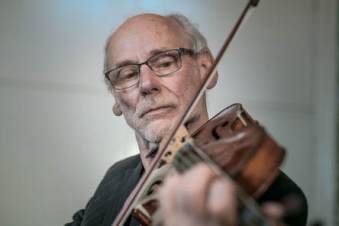
My mum and dad: Dad was a devoted brass band player, there was always music in the house (he had a gorgeous walnut radiogram, with piles of records – mostly 78s!). They fixed up violin lessons for me, made me practise, came to almost every concert I did, helped get me in the NYO, and thence to Cambridge.

Who or what are the most important influences on your playing?

My colleagues in the Fitzwilliam Quartet! But before that, our mentor, Sidney Griller and his quartet; the Smetana Quartet; the Beethoven and Borodin Quartets (for Shostakovich); violinist Alfredo Campoli (the ideal violin sound); conductors Otto Klemperer and Roger Norrington (two totally opposite approaches to Beethoven); clarinettists Alan Hacker and Lesley Schatzberger (opening my eyes to historical performance practice); Dmitri Shostakovich himself – the greatest man I have ever met, whose very presence and humility imparted a belief in what we were doing, and a confidence to press on into the future; the greatest performer I have ever heard (not in the flesh, sadly): Dietrich Fischer-Dieskau;

What have been the greatest challenges of your career so far?

Starting off and making headway in the real world as a professional string quartet; playing to Shostakovich; our New York debut – then the complete Shostakovich cycle there; re-building the quartet post- Chris Rowland (it took over twelve years!), and maintaining its profile and pre-eminence in these times of age discrimination in the music world; getting John Eliot Gardiner to observe the spirit and letter of Beethoven’s metronome marks (without seeming too cocky for my position!); getting my own playing onto a higher level, in order not to let the other three down (whilst spending a disproportionate amount of time on admin….).

What are the pleasures and pitfalls of ensemble work?

As a “team player” (which is the most satisfying role for a violist) one can achieve collective heights one could never achieve on one’s own – especially since the FSQ plays to a higher standard than I could ever reach myself! Those concerts (which happen rarely) when everyone is pulling together for the common benefit of quartet and composer, when you feel anyone can do anything, and everyone else will respond and be with each other. The pitfalls are when that doesn’t happen…. Or when individuals prioritise themselves before the group.

Which performances/recordings are you most proud of?

The Shostakovich cycle, of course – although many of them we play better now! The Franck quartet. The Brahms clarinet quintet (with Lesley Schatzberger). Wolf’s Italian Serenade – as virtuosic as we could get in the old days! Then, latterly, our first ever public performance of Schubert’s Death & the Maiden (after 42 years! – as good as I’ve ever heard it from anyone…..).

Who are your favourite musicians?

The ones I play with: my colleagues in the quartet, plus Anna Tilbrook (piano), Moray Welsh (cello), Lesley Schatzberger (clarinet), Carolyn Sparey (viola); also those influential musicians mentioned above.

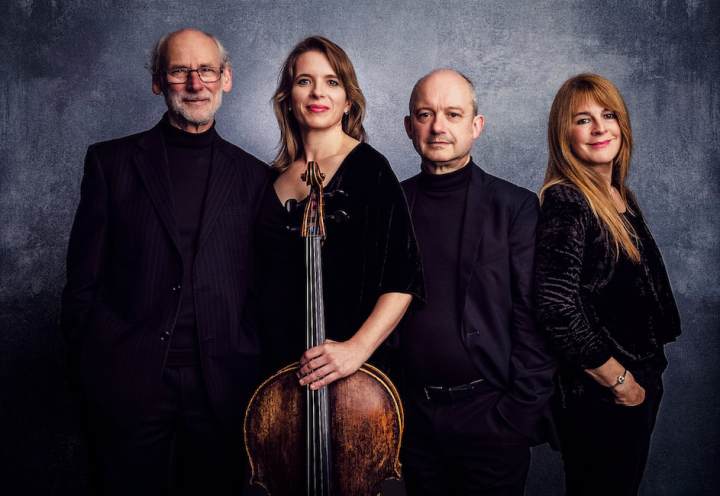
The Fitzwilliam Quartet

What is your most memorable concert experience?

16th November 1972, Lyons Concert Hall, York: packed to the rafters to witness us play Shostakovich No.13 with the composer in the audience. I have never in my life experienced such electricity in the air, or intensity of applause.

What advice would you give to aspiring musicians/students?

Don’t get in the way of the music or the composer! Be faithful to both the spirit and the letter of the score – i.e. inform yourself as to the exact meaning of the notation, the performing conventions and sound according to the period of music in question. Aim to perfect every aspect of your “craft”, in the service of both the music and your own self-expression – but never impose the latter: this would imply that your own personality is not strong enough to stand on its own. Ego is no substitute for the humility and character required to communicate with your audience.

What is your idea of perfect happiness?

Manchester United overturning the rich pretenders from Man City next year!

What is your most treasured possession?

My family, my friends, my health, my viola, a lock of my late daughter’s hair

What do you enjoy doing most?

Drinking good beer or wine, eating Italian food (or Indian), playing (now watching…) cricket, walking, cycling.

The Fitzwilliam Quartet with pianist Anna Tilbrook perform music by Hugo Wolf, Rebecca Clarke, Franz Schubert and Johannes Brahms on Sunday 8th May as part of the London Chamber Music Society’s Sunday Concerts series. More information/tickets

The Fitzwilliam Quartet

Who or what inspired you to take up the piano, and make it your career?

I was brought up by a musical mother who studied the piano with Moisés Moleiro, and sang in the choir in the premiere of the ‘Cantata Criolla’ by Antonio Estévez. Unfortunately she fell ill very young and had to abandon music. When I was 7 I was accepted as a student at the Conservatorio Juan José Landaeta in Caracas where I had the most wonderful and generous teachers. My piano teacher was Guiomar Narváez, strict and very artistic, with a great passion for the classical composers and Latin American music. At 16 I won a scholarship to come to the Royal College of Music in London, where I was assigned to Phyllis Sellick as the teacher who would carry on developing what Mrs. Barbara Boissard and Michael Gough Matthews saw in my style of playing when they heard me in the audition in Caracas. For that I am very grateful: Phyllis was an extraordinary human being who taught me the art of piano playing.

Who or what were the greatest influences on your playing?

My main teachers obviously, including Polish pianist Regina Smenzianka and Paul Badura-Skoda, and also the many concerts I went to as a child growing up in Caracas. I remember listening to Martha Argerich, Claudio Arrau, George Demus, Willhem Kempf, Yoyoma, Alicia De La Rocha, and conductors such as Charles Dutoit, Cuban Nicolás Guillén reciting his poetry, popular singers like Mercedes Sosa, the cinema of Carlos Saura, Stanley Kubrik, Herzog, Chaplin….all these wonderful true artists, giving us the best of their knowledge and gigantic talents, seeing, listening and receiving all the universal and most humane expression and energy.

Then in London I have enjoyed many concerts of classical music and jazz, plus all my friends who also play and are now the great musicians of our time.

What have been the greatest challenges of your career?

Every concert you play, every CD you make is a challenge. To teach very gifted children is also a challenge. I think we face climbing Everest nearly every day! Nothing is easy. To play phrases in the most clear of ways, respecting the intentions of the composer is a challenge. When you decide that you are a pianist you understand that the challenge is what motives you, that’s what takes you out of bed.

A big challenge we face today is that classical music has been marginalised by the media, and by the idea that fashion, cookery and frivolous cinema or football stars are more important than profound thought, creativity and art. We have to keep going, as it is now up to us to make sure that this precious legacy we have acquired through centuries survives. It is a very hard and heavy burden!

Which CD in your discography are you most proud of?

Although I have recorded about 9 hours of music from Venezuela, by Venezuelan composers, I consider them all to be very different from each other. I have also recorded one CD of music by Chopin and another one by Ernesto Lecuona, which will come out in the autumn. I am sensitive to the qualities of the piano, acoustics and sound engineer. I have produced most of my CDs and am in general satisfied with the results; perhaps sometimes I am over critical and cannot bear listening to something that is too slow (I can think of one piece that I let myself be influenced by the engineer and now I do not agree with the tempo…). I think each CD is a world of its own: they are “concepts” and represent moments of our lives.

Critics are not familiar with Venezuelan music and a few years ago those CDs represented a kind of “political statement”. What’s good now is that those critics are more receptive, less “Eurocentric” and are beginning to understand (after 500 years) that Latin America is part of western culture.

Do you have a favourite concert venue to perform in?

I love the Purcell Room, the Wigmore Hall, St John’s Smith Square, Invalides in Paris, and the Teatro Teresa Carreño and Municipal in Caracas. Any hall with a decent piano and lovely audience will be always great!

Favourite pieces to perform? Listen to?

I love every piece I play, and with each of them there really is a love affair. From Bach, Scarlatti, Mateo Albéniz, Mozart, Beethoven, Schubert, Brahms, to Chopin, Liszt, Rachmaninov, Debussy, Ravel, Gershwin, Scriabin…the list is very long. Equally I have to constantly listen to classical music, salsa and Latin American popular music.

Who are your favourite musicians?

All the musicians that show passion, love, understanding, involvement, imagination… There are millions of fantastic musicians in our planet.

What do you consider to be the most important ideas and concepts to impart to students/aspiring musicians?

I think I have answered this above, but there is a concept I have discovered recently and it is to do with sharing with the young one’s knowledge, experiences and very importantly giving these young, very talented musicians the opportunities to perform and express their ideas and art. I think experienced, successful musicians should open the path for the young. Not many people in the “business” will do it for them now days.

What are you working on at the moment?

Beethoven ‘Emperor’ Concerto, Mozart Sonatas, Villa-Lobos, Chopin, Piazzolla, exploring Colombian music…

What is your idea of perfect happiness?

Perfect happiness can be found anywhere, at any time, the thing is to be aware of this and enjoy it while it lasts.

‘Joropo’ by Moisés Moleiro

Caracas-born pianist, Clara Rodriguez studied with Phyllis Sellick after winning a scholarship from the Venezuelan Arts Council to train in London at the Royal College of Music. There she was the recipient of numerous prizes and performed as a soloist with the RCM orchestras including De Falla’s Nights in the Gardens of Spain and the Ravel Concerto in G at St. John’s Smith Square.

In Caracas she made her debut playing Mozart’s last piano concerto with the Simón Bolívar Orchestra under the baton of José Antonio Abreu at the age of sixteen; from then on Clara Rodriguez’s career as a concert pianist has taken her to perform all over the world. Her large and interesting repertoire covers works of the best known Baroque, Classical, Romantic and Modern composers; she has also intensely promoted the music of the Latin American continent.

Her discography includes CDs of the piano music of the Venezuelan composers Moisés Moleiro, Federico Ruiz and Teresa Carreño; her catalogue also includes Popular Venezuelan Music Vol. 1; El Cuarteto con Clara Rodríguez en vivo as well as the piano works by the Cuban composer Ernesto Lecuona and of Frederic Chopin late works.

Her recordings are regularly played on BBC Radio3, Classic FM, Radio Nacional de Venezuela, Radio France International, and networks from Argentina to the USA, Australia and China.

Clara Rodriguez teaches piano at the Junior Department of The Royal College of Music in London.