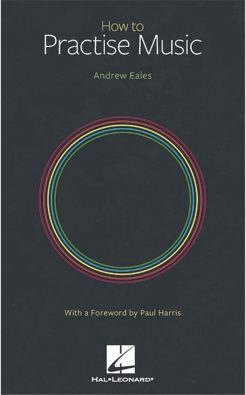
The expression “small but perfectly formed” is rather over-used, but in the case of Andrew Eales’ new book How to Practise Music (Hal Leonard) it is entirely apt. This pocket-sized volume is the perfect companion for every musician, packing a punch in less than 100 pages with its wealth of supportive, imaginative, practical and thoughtful suggestions to keep the musician, whatever their age or ability level, focused and motivated.

Practising is the musician’s “work” and too often, especially for younger or early to intermediate level players, practising can really feel like hard work. An influential music educator and piano teacher, Andrew Eales understands the challenges facing players – that the necessary rigour and self-discipline of the practice room can “potentially steal our joy and rob us of our potential” – and he responds to those challenges with this succinct guide to assist musicians of all levels and ages to become confident, self-motivated players, while also recognising the need to set realistic, achievable goals in the practice room, and to be kind to oneself.

The book is arranged in sections which cover everything from reasons for practicing and organising your practicing (it’s remarkable how many musicians, even more advanced ones, struggle to organise their practice time intelligently!) to warming up and how to practice core skills (scales and arpeggios, studies and exercises, reading music and sight-reading). Later sections give sound advice on selecting repertoire, background research, listening and “chunking” – intensive work on short sections of the music – as well as mindfulness in practising and sensible advice on how to practise for performance, including thoughts on interpretation, authenticity, memorising and managing performance anxiety. The author manages to be both authoritative and accessible in his suggestions – a rarity in a world still riven with didactic instructions and ingrained attitudes – making the text engaging and interesting to read. Throughout, there is emphasis on playfulness in practising, as well as mindfulness, reminding the player that practising need not be a chore and that one should always find joy in one’s music making – and this is the closing message in the epilogue of the book.

This nugget-filled, little book of practise wisdom is small enough to keep by your side or in your pocket as you navigate your personal path through music. You may wish to read the book from cover to cover, or to simply dip into it; either way, you will find it an invaluable resource. Teachers too will find much useful information in finding creative ways to encourage students to practise.

A valuable addition to the practice room and the musician’s resources.

Recommended

How To Practise Music by Andrew Eales is published by Hal Leonard (£7.99)


Andrew Eales is a widely respected and experienced music educator and piano teacher based in Milton Keynes UK, where he runs a successful teaching studio. He is a published composer and author, and his piano recordings have been streamed more than a million times worldwide. Andrew runs the piano website/blog Pianodao.com


 

Alan Rusbridger, journalist and former editor-in-chief of The Guardian newspaper, gave us some fascinating insights into the world of the amateur pianist in his 2013 book ‘Play It Again’ – a world hitherto regarded by many as the realm of eccentric hobbyists and ‘Sunday Pianists’ note-bashing their way through Chopin and Brahms, and old ABRSM exam books….

What Rusbridger’s book reveals is something quite different, and anyone who has attended a piano course or belongs to a piano club will have come across the exceptional amateur pianist, the one for whom “the distinction between the feats they can manage on the keyboard and that of an accomplished professional pianist is pretty negligible” (Alan Rusbridger).

Who are these exceptional amateurs and how have they achieved a standard of playing which, if presented in a blind audition, would be indistinguishable from a professional pianist?

Perhaps the most obvious distinction between the amateur and the professional pianist is simply mercantile: the professional gets paid for their performances. Aside from this, there is no reason why an amateur pianist cannot achieve the dizzy heights of a professional standard of playing

I’ve met a few exceptional amateurs myself, on piano courses and in my piano club. They are individuals whose playing one would happily pay to hear in concert, yet they have “day jobs”, perhaps the most famous being Condoleezza Rice, who served as US Secretary of State from 2005 to 2009, and who has played at Buckingham Palace for The Queen. Then there is British-Australian pianist Paul Wee, a barrister by day, with two acclaimed discs to his name, including one of Alkan’s notoriously challenging Symphony for Solo Piano and Concerto for Solo Piano, works which require an exceptional level of technical and artistic executive function, and certainly not the repertoire would one normally associate with an amateur player.

But here’s the thing: amateurs can and do play repertoire like this, and the fact that they do debunks the notion that amateurs are cack-handed dilettantes. We know exceptional playing when we hear it – and being “exceptional” does not necessarily mean the ability to play the most demanding, virtuosic music. What distinguishes these people from other amateur pianists, what makes them truly exceptional, is their ability to play at and maintain this level, piece after piece, performance after performance.

Aspiration is everything” says Julian, an amateur pianist friend of mine who plays at an extremely high level of both technical and artistic fluency. But surely the ability to play at such a level goes beyond mere aspiration: we can all aspire to play the Bach-Busoni Chaconne or Gaspard de la Nuit, or any of the other high Himalayan peaks of the repertoire. But only a handful of amateurs can do so convincingly and, more importantly, consistently.

Some exceptional amateurs have had a formal musical training, a training which ingrains in them good practice habits, how to practice efficiently and deeply, and an appreciation that one must ensure the foundations are in place on which to build technical and artistic assuredness. This includes selecting appropriate repertoire, and listening and studying around that repertoire to broaden one’s musical knowledge and place the music in the context in which it was written.

Commitment and time management are also crucial for the exceptional amateur (as indeed for anyone who wishes to improve their playing). Music is “always something I’ve made time for” says Paul Wee in an interview for Gramophone magazine. Other exceptional amateurs to whom I spoke when researching this article said the same thing, that making time to practice is very important to their pianistic development. For many, this means a regular daily (if possible) practice regime. Paul Wee admits that he blocks off several weeks to devote to his piano playing and that he is lucky that his job as a self-employed barrister allows him to do this. He also points out that this approach to practicing is often used by professional players who, because of concert and touring schedules, may not have the luxury of a daily practice regime.

While many exceptional amateurs have had a formal musical training, they have chosen a different career path while keeping music as a significant part of their life. I think this goes beyond merely “playing for pleasure”; as mentioned above, one must be willing to commit to the task and adopt the ethos of continuous improvement, with an openness to new ideas and a willingness to put one’s ego to one side, rather than wanting to “prove oneself”. But amateurs enjoy considerable freedom too: they are not bound by concert diaries, the demands of agents or promoters, and they can choose when to be exceptional – unlike the professional who is judged on every performance and who is under pressure to be exceptional all the time.

Is there really a difference between the exceptional amateur and the professional pianist? No – because they are both pianists and the same technique, musicianship and artistry applies.  


Practicing is like being in a riptide – your view of the beach is different every time and on each re-entry to the beach, you notice different or new details.

Practicing is the musician’s day-to-day work and when done well it is undertaken with the focus and concentration of an elite athlete to achieve the necessary technical and artistic facility to perform complex repertoire.

As a child, learning the piano from around the age of 5, I found practising something of a chore: the same piece of music faced me each day on the music desk of the piano, the same tedious exercises to be finessed to please my teacher at the next lesson. At that time I didn’t receive any suggestions from my piano teacher as to how to practice productively. Instead, I engaged in fairly mindless repetitions.

It was only as I matured as a musician that I began to understand the significance of deep, thoughtful practice, and how this approach would shape and secure the music I was learning. This was more than demonstrated to me when I returned to the piano in my late 30s after an absence of some 20 years and I revisited some of the repertoire I had learnt and enjoyed as a teenager; it was quite evident which pieces had been practiced more carefully for these were the ones whose notes and phrases still felt familiar under the fingers, and were the pieces most easily revived. It was a very clear indication that the body does not forget, such is the power of procedural (or muscle) memory.

Practicing should never feel like a chore. One should approach each practice session with an open, curious mind and a sense of excitement and adventure, to start each session with the thought “what can I do today that’s different?”. It’s a constant process of self-critique, reflection and adjustment. Practicing is like being in a riptide – your view of the beach is different every time and on each re-entry to the beach, you notice different or new details.

Music is complex, multi-faceted and rich in detail. For this reason, in our practicing we must be alert to its many subtleties, its highlights and its shadows. Each practice session should be, amongst other things, an exercise in revealing another facet of the music. Paradoxically, this becomes more difficult the better one knows the music: familiarity with the architecture, the organisation of the notes on the stave, the sound and feel of the music, and our physical and emotional responses to it can lead to complacency and then details are overlooked. At this point, we are deeply embedded in the music, undoubtedly a good place to be. Now we must step back, to view the beach from a distance, with new eyes and the benefit of experience, and look again at the music.

It’s remarkable how many details can be missed and how taking a long view can reinvigorate our practicing and breathe renewed life and colour into our music.


This site is free to access and ad-free, and takes many hours to research, write, and maintain. If you find joy and value in what I do, please consider making a donation to support the continuance of this site

Make A Donation

Photo by Jamie Curd on Unsplash

The first of a series of short films made in collaboration with Casio UK and Pianist magazine. In this film, Frances Wilson AKA The Cross-Eyed Pianist offers suggestions on how to make the most of limited practice time, and making practising productive and most of all enjoyable.

Find out more about the Casio Premium Grand Hybrid


Frances Wilson is a pianist, piano teacher, writer and blogger on classical music and pianism as The Cross-Eyed Pianist. She holds Licentiate and Associate Diplomas (both with Distinction) in Piano Performance, and for 12 years ran a successful piano teaching practice in SW London. She is now based in West Dorset where she teaches from her home in Portland. Further information

