By Michael Johnson

The quirky mind of composer Erik Satie continues to inspire, amuse and annoy us 100 years after his death, and musicians still cannot quite decide what to make of him. For sure, they can’t ignore him, if only because his monumental Vexations is returning from obscurity in lengthy performances and recordings by well-known keyboard artists in Europe, the United States and Asia.

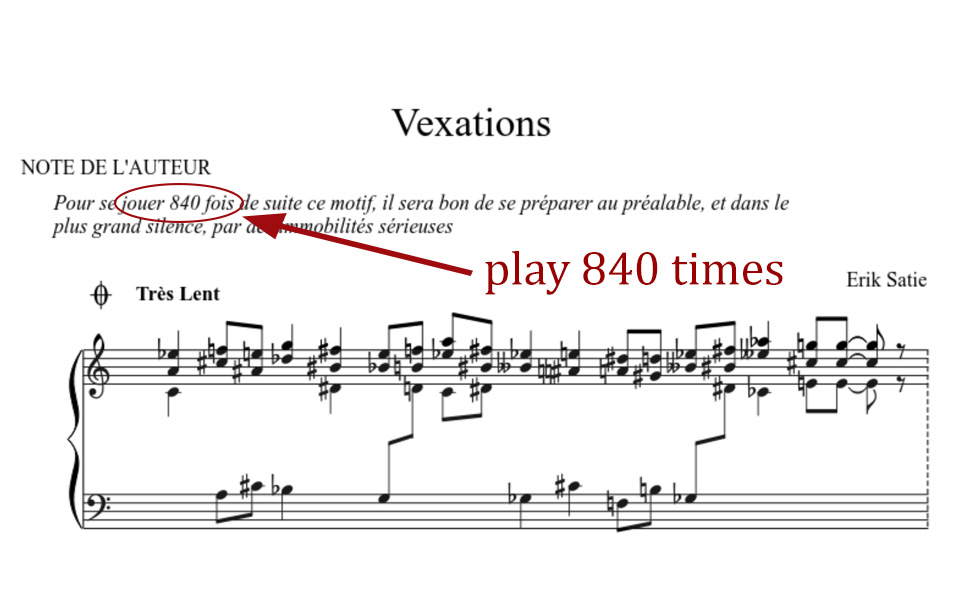
Igor Levit gave pianophiles a rare musical treat at the Southbank Centre in April 2025, leaving the hardy spectators in the audience mentally exhausted after 840 repeats of this one-page bagatelle. He took four or five short “loo breaks”, but kept himself going onstage with bottled water and a bowl of grapes. (He had previously livestreamed the work from the B-sharp studio in Berlin during the Covid-19 pandemic in 2020 in what he described as “a silent scream” to highlight the plight of artists hit by lockdowns.)

Igor Levit performing Vexations during the Covid pandemic in 2020

Levit kept his bearings during his Southbank centre performance by showing up with a bundle of photocopies of the score, discarding one at a time as he plowed through the piece. By the end, the stage floor was covered with 840 scattered copies.
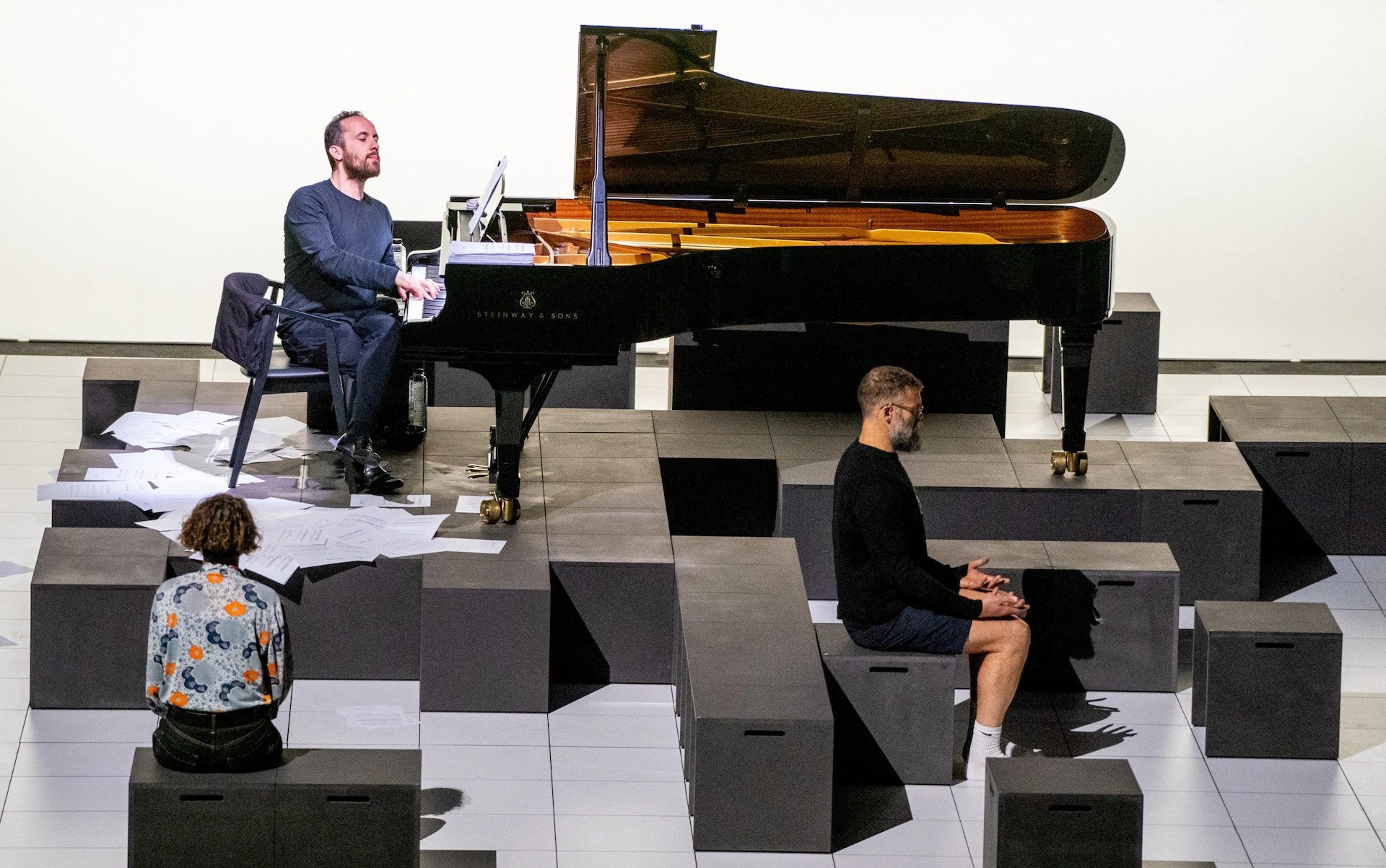
Igor Levit performing Vexations at the Southbank Centre Credit: Pete Woodhead

Here is the haunting melody Satie created :

Wrote one spectator: “ I was at Queen Elizabeth Hall just to witness his performance. It was so, so, so intense!”

A couple of years earlier, the young Italian pianist Alessandro Deljavan had sat in the studios of record company OnClassical in Pove del Grappa, filling 12 CDs in 14 hours 28 minutes. He recalled the “intense experience” for me recently. “I felt almost possessed. My mind drifted between shadowy, undefined figures and total emptiness.”

Other pianists also remember hallucinating, and one reported seeing what looked like “animals and things” peering at him between the notes on the sheet music.

One commentator on YouTube ended up deeply conflicted: “This is actually an empty song. Nothing makes sense … Illogical. Sad. Devoid of feeling. I loved it.”

An English critic found the best poetic language. It is a piece of “meandering melancholy,” he wrote. Others report a “spiritual transcendence” evolving from the strange world Satie had created.

OnClassical founder and pianist Alessandro Simonetto is in the process of completing the most extensive project ever devoted to Satie’s complete piano works. Progressively appearing online, he says, it has already reached 30 million streams on Spotify.

Simonetto, a Satie enthusiast of note, calls Vexations “arguably the most extreme and elusive work in the entire history of music”. Living and working out of Pove del Grappa in the province of Vicence, he may eventually bring out a boxed set covering Satie’s complete piano works including at least the one page sample of Vexations. At the moment the project exists only digitally.

Simonetto presided at the marathon recording session with Deljavan, recalling for me that the experience was like an Edgar Allen Poe horror story, with the“ceiling slowly lowering on the pianist’s head”.

Yet the unlikely attraction of this longest piece in piano history refuses to die. More than 20 CDs have appeared in the past few years offering Vexations in part or in full, straight or modified versions. Two prominent French pianists, Jean Marc Luisada and Jean Yves Thibaudet have performed the piece, with all repeats.

Most reviewers have judged the full Vexations experience an endurance test, a prank or a stunt that Satie just tossed off without a second thought. He was known in the creative ferment in 1020s Paris for his musical jokes. He seems to have slid it into a drawer and never heard it played.
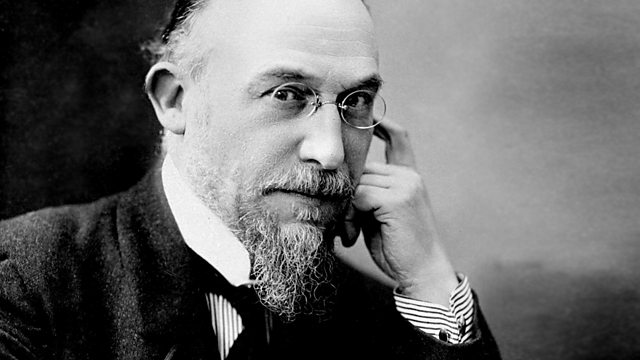
Erik Satie

It’s the mental strain of non-stop repetition that leaves today’s pianists limp as a wet rag, except for Deljavan and the remarkable Levit. Indeed, Satie advised all pianists who try the full version to devote 20 minutes of silent meditation before starting. This became a feature of many modern performances.

But about 40 years ago English pianist Peter Evans played Vexations non-stop for 15 hours, suddenly quitting at repeat No. 593, and hurriedly left the stage without explanation. He later wrote that “people who play it do so at their own great peril”. The performance was completed by another English pianist, Linda Wilson. She later wrote that with each iteration Evans felt his “mind wearing away”. Observers wrote that when he left the stage he was “in a daze”. He recalled that his mind was filling with “evil thoughts”.

A notorious and frustrating episode occurred at Leeds College of Music in 1971 when another team of pianists managed to keep going for 16 hours and 30 minutes, ending at midnight only because school regulations closed the building. One of the team players, Barbara Winrow, explained to a journalist the “real sense of frustration which we felt, and the players’ remarkable reluctance to stop” before they reached the 840 mandated repeats.

A memorable milestone was reached in 1974 in Budapest when a team of pianists played in rotation for 23 hours. The team included at least two young players who went on prominent careers and are still performing today, Zoltan Kocsis and Andras Schiff.

Tracing the chequered past of this work is a major detective job. Musicologists return to the mysterious origins periodically. The manuscript was not played in full until more than 20 years after his death. Who acquired it, when, where, how or why did it change hands? Lawyers today call it a task of establishing the “chain of provenance”.

After gathering dust for years, it came back to life in the hands of John Cage who rescued it and encouraged others to participate in rotations. He first published the one-page treatment in the magazine Contrepoints in 1949. He was the first to interpret Satie’s written instructions as meaning the 840 repeats must be played without interruption – either solo or in rotating teams of pianists.
Cage organized the first public performance of the full version with more than a dozen pianists in rotation. His spectacle in 1963 in New York put his team through 18 hours and 40 minutes of continuous repetition.

John Cage

But can it be played from memory? A vide on clip on Youtube shows Cage declaring that he was never able to memorize it. Other pianists have found it so contrary to accepted compositional norms that they could not absorb it either.

The late English music scholar Richard Toop performed the piece in its entirety several times but took care to approach each run-through with a fresh eye. But he too had a memory block. “Even after a performance,” he wrote, “I was unable to play more than a few beats from memory.”

Tracing the people who had possession of the original score, passing it from hand to hand, is impossible today due to the passage of time and the individuals involved. It is said to be with the Satie Archives in Honfleur, in the Calvados Department three hours northwest of Paris.
The great pianist Artur Schnabel famously spoke of his interest in music which was “better than it can be played”, in particular the works of Mozart, Beethoven and Schubert.

In this quote, I think Schnabel expresses why the sonatas of Beethoven, for example, represent “great” music which stands the test of time through its inventiveness, variety, complexity and expressive depth, but also that curious dilemma of being a musician: trying to decipher what the composer meant, what the composer heard in their head, drawing only on what is given on the page. The other paradox is that the honesty, intimacy and profundity of the music often sounds better in one’s inner ear, idealized and perfected in one’s imagination, than it does to the outer ear. Yet as Schnabel demonstrated through his many performances and recordings, an inspired performance can go further, deeper and higher than the inner ear, giving us a memorable glimpse of the thought, the philosophy or the breadth of emotion which lies behind and beyond the notes.

For me, it has always meant that achieving perfection in such works….and that’s one of the justifications for always being able to dig deeper into those works, and why we can keep on performing them forever and still discover new approaches to them. – Alfredo Ovalles, pianist

What Schnabel may also mean is that some pieces are simply very special, and can never be fully realised in performance, that the “perfect” version is not possible, even though some pieces truly deserve it. It is perhaps for this reason that certain repertoire holds a very significance place in the hearts and minds of pianists who are willing to continually rise to the myriad challenges that the music presents – Bach’s Goldberg Variations, Mozart’s piano sonatas, Schumann’s Kreisleriana, Chopin’s Etudes and the great concertos by, for example, Beethoven, Brahms, Tchaikovsky, Rachmaninov and Prokofiev.

Perhaps the greatest thing about this “great music” is that no matter what we do to it, it still retains its fascination. Later in his famous quote, Schnabel talks about only being interested in music that presents a “never-ending problem”. Think for a moment how many recordings there are of Beethoven’s Piano Sonatas. Numerous pianists, including Alfred Brendel, Maurizio Pollini, Annie Fischer, Andras Schiff, Richard Goode, Paul Lewis and, more recently, Igor Levit and Jonathan Biss, have released distinguished cycles, and some pianists have even recorded these works several times (Daniel Barenboim, for example), proving that this music remains endlessly captivating and intriguing.

“As a performer, I can’t take it seriously enough. I have to adopt a personal stance toward the musical texts and their creator, to find self-awareness on a higher level.” – Igor Levit

This then is the responsibility of those who choose to play music which is “better than it can be played”. That pianists like Levit, or Biss, Barenboim or Pollini can each bring their own interpretation and insight to this repertoire perhaps proves Busoni’s quote – “The task of the creative artist resides in setting up laws, not in following them.” – and confirms the ongoing greatness of this music.

Pianist Igor Levit is one of the heroes of lockdown – a “key worker”(!), if you will, who provided comfort and distraction in those anxious, early days of the pandemic. At a time when the concert halls of the world were shuttered and silent, Levit gave hauskonzerts from his home in Berlin, broadcast live on Twitter. Each day he would announce a programme and a time to tune in. He streamed more than 50 concerts, performing on a 1920s Steinway B that had once belonged to the Swiss pianist Edwin Fischer. He dressed casually and gave a brief introduction to each performance in German and English – no need for the formality and etiquette of the Wigmore Hall here. He played Bach and Schubert (a tear-jerkingly wonderful D960), Beethoven and Feldman, and people tuned in from around the world. His daily house concerts provided an anchor in a troubled sea.

Maybe for the first time do I understand what it means to speak of music as something life-keeping. It really keeps me alive. . . . I don’t care if it’s wrong or right, whatever B.S. that means….” said Levit in an interview with Alex Ross of The New Yorker. His house concerts challenged our notions of what a concert really is, reminding us that we don’t have to sit in stiff, reverential silence in plush red velvet seats to feel the power of the collective shared experience of music. Separated by a global pandemic, confined to our homes, music connected us, delighted, soothed and comforted us.

Levit’s new album, Encounter, which comes just two years after the release of ‘Life’ (my album of the year in 2018), confirms the spirit of his hauskonzerts. Here is music by Bach-Busoni, Brahms-Busoni, Reger and Feldman that seeks to comfort the soul and provide inner strength while expressing a desire for encounters and togetherness in a world fractured by a global pandemic. Like ‘Life’, it is another very personal album for Levit, the repertoire carefully chosen: these are “works in which all questions about love and death, loneliness and the possibility of real love for others are examined“. The pieces on ‘Encounter’ were those which drew especially positive comments from Levit’s online audience.

The entire album has a processional quality, leading the listener to the hushed serenity of Morton Feldman’s final work for piano – and the final work on this disc – Palais de Mari, a 28-minute contemplation, meditation, or what you will, of exquisitely-placed notes and piquant chords that fall upon the ears and mind like the softest of summer showers. It works in the same way as Bill Evans’ ‘Peace Piece’ did on ‘Life’ – the sentiments of the music match the intensity and spirituality of the works that precede it, yet it also provides a contrast in its delicate minimalist textures and hauntingly spacious pauses.

No one questions the spirituality of J S Bach, but Levit thankfully steers away from an overly-reverential approach which colours so many performances of his music. Alert to the contrasting characters of the Chorale Preludes, elegantly and occasionally flamboyantly transcribed for solo piano by Ferruccio Busoni, Levit finds vibrancy and immediacy, authority, solemnity and joy, and draws on the full range of the piano’s sound and resonance to highlight the voices and layers of this music.

Brahms’ six Chorale Preludes, also transcribed by Busoni, are rarely-heard as a set, and Levit successfully sustains the devotional, introspective nature of these pieces, almost to the point of intimacy. Reger’s transcriptions of Brahms’s Vier ernste Gesänge (Four Serious Songs) are similarly pensive, and Levit’s sensitivity of touch and musical imagination save them from becoming overwhelmed by the richness of their textures.

Reger’s Nachtlied, a sacred motet for unaccompanied mixed choir, provides the bridge to Feldman in this transcription for piano by Julian Becker. Its textures are more transparent, its mood gentler and more prayer-like, settling the listener in for Feldman’s music, which gradually retreats into its own world with a sense of closure and inner calm.

The album was recorded in May at Berlin’s Jesus-Christus-Kirche and is best heard in one sitting, as if as a recital – because here Levit manages to create a very palpable, highly concentrated musical presence throughout the recording.

‘Encounter’ is available on the Sony Classical label and via streaming services

life_cover_750x750_88985424452_enThis could be the best thing I’ve heard this year. A bold claim, I know, but listening to Igor Levit’s new recording Life (Sony Classical) literally stopped me in my tracks….



With four recordings already and glowing reviews wherever he plays, this latest offering – his first in three years – from German-Russian pianist Igor Levit was eagerly awaited. It’s very different from his previous recordings which have focussed on “big” serious works (the Diabelli and Goldberg Variations, Rzewski’s The People United Will Never Be Defeated, late Beethoven Sonatas). ‘Life’ is a classical concept album, a very personal existential reflection on life and death, prompted by the death of a close friend. Music has proven therapeutic benefits and Levit finds a way through his grief , though perhaps not a sense of closure, in a series of solemn, valedictory and deeply thoughtful works by Busoni, Bach/Busoni, Schumann, Rzewski, Wagner/Liszt and Bill Evans. There’s no flashiness here, no glittering runs or vertiginous virtuosity – that would be inappropriate. Instead we have a continuous meditative flow of music from Busoni’s Fantasie after J S Bach through the fleeting poignancy of Schumann’s Geister (‘Ghost’) Variations to Bill Evans’ Peace Piece, an unusual but entirely fitting work with which to close this wondrous recording.

Every note is considered, measured, poised but never mannered: there’s none of the pedantry other “intellectual” pianists tend towards in performance. This playing epitomises the maxim “through discipline comes freedom” – something I felt very strongly in Levit’s mesmerisingly intense concert of Beethoven’s last three sonatas at Wigmore hall last year. You could have cut the atmosphere – one of concentrated collective listening – with a knife, and Levit achieves the same palpable sense of presence, intimacy and profound communication on this recording. It’s as if you’re in the room with him, quietly observing, listening, almost without breathing, while he plays. He finds incredible delicacy in the quietest reaches of the dynamic range – technically hard to achieve and emotionally wrought – and the entire album has a compelling processional quality, felt most strongly (for me) in Liszt’s transcription of Wagner’s Solemn March to the Holy Grail from Parsifal, to which Levit brings immense control and a hushed, prayer-like quality to the magisterial architecture of this work.  The Fantasia and Fugue on the Chorale  ‘Ad nos, ad salutarum undum’,  the longest work on this 2-disc recording, is another glowing transcription, also by Liszt, demonstrating that music, like life, is subject to change. Isolde’s passionate Liebstod and Busoni’s poignant Berceuse pave the way for the final work on the recording.

Bill Evans’ ‘Peace Piece’ matches the solemnity and intensity of the rest of album but in its ostinato bass and delicate treble filigrees, so redolent of Chopin’s tender Berceuse, there is, finally, a sense of consolation. It’s beautifully played by Levit, as are all the pieces on this recording.

Highly recommended