Playing Debussy on his Blüthner

Playing Debussy on his Blüthner was a ‘head-spinning experience’ – guest article by Michael Johnson

French pianist François Dumont has still not quite recovered from ‘the excitement, the anxiety’ of playing “Clair de Lune” on Debussy’s own Blüthner piano in a remote French museum.
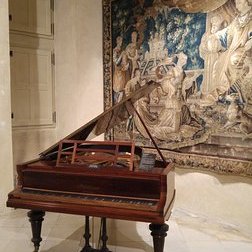
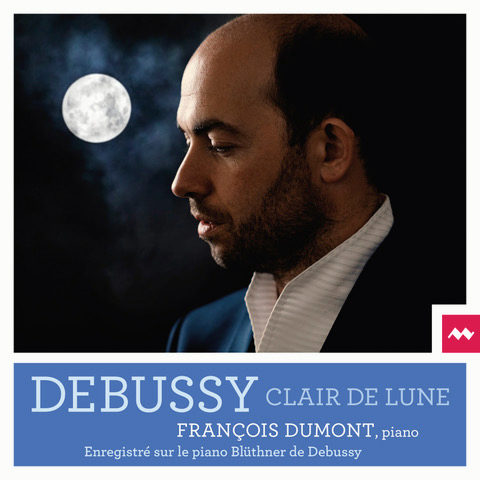
Dumont is one of the select few pianists ever allowed to touch the instrument, now fully restored and in mint condition. It was his credibility as a Debussy player that persuaded museum management to grant access.

Dumont has just released his new CD of Debussy piano music (Clair de Lune LaMusica LMU035) played on the vintage Blüthner at its resting place in the Labenche Museum in Brive-la-Gaillarde, not far from Bordeaux.

He recalled in our interview (below) how it felt to press a few keys the first time. ‘I sat down and timidly put my fingers on the keys… and it was just magical!’

The sound is indeed unique to the modern ear, a resonance intentionally soft and continuous, unlike the more glassy pedaled attacks of a Steinway grand. Dumont says changing to a nineteenth-century Blüthner is fascinating and deeply satisfying musically. Personally, I grew accustomed to his recording only after four or five hearings.

He puts the Blüthner to work on selected parts of Debussy’s Bergamasque Suite, Estampes, and Children’s Corner. His sensitive playing is as touching in the pianissimo as in forceful fortissimo. He recalled for me that he did several takes of “Clair de Lune” before he was satisfied. ‘I repeated it until I found the ethereal colours, the warmth of the melody I was looking for,’ he said.

Dumont thus joins a stellar group of established Debussy interpreters from the twentieth century and more recently performers such as Daniil Trifonov, Angela Hewitt and Steven Osborne. A busy recording artist, he has made about 45 CDs across a wide range of repertoire..

Dumont’s talent is in great demand in Europe where he maintains a punishing schedule of solo recitals and ensemble dates, as well as chamber orchestra works, in the United States, Latin America, China, Japan and South Korea.

Here are excerpts from our email exchanges about the new Debussy CD and the original Blüthner piano featured on it:

How long had this ancient Büuthner piano been idle? Shouldn’t it be falling apart?

Debussy bought the Blüthner in 1904 and kept it until his death in 1918. It was acquired by the Labenche Museum in Brive in 1989 and was fully restored, keeping the original strings and most of the original action

Are you the first pianist to be granted access to it?

There have been some others but very few. For me, it was an unbelievable privilege – a head-spinning experience – to have had access to it.

How were you chosen?

One needs to have real credibility and experience in playing Debussy to get the authorization. The museum generously offered me the use of the piano for the CD.

What is your memory of first sitting down and touching the keys? Were you nervous, excited, worried, afraid?

I will never forget that moment. I had travelled all the way from Lyon, over four hours by car, just to try the piano for an hour. I was very excited but also anxious. How would it sound, in what state would I find it? Would I feel comfortable creating my own sounds? I was afraid of being disappointed. I didn’t quite know what to expect.

It must have been a kind of electric feeling.

Yes, I sat down and timidly put my fingers on the keys… and it was just magical! I played my whole program without stopping. I was completely drawn to the originality and variety of colours.

Did you feel a spooky connection with Debussy, his ghostly presence hovering over you?

Yes, I suddenly felt I was transported to Debussy’s time, hearing the sounds as he was hearing them, playing the instrument he was playing. It is actually quite intimidating. Just imagine, some of the works on my CD, like “Children’s Corner”, were probably composed on this very instrument. A considerable amount of his music was seeing the first light of day on that Blüthner. It must have been like a laboratory for him.

How has the Blüthner design evolved since the 1850s?

The design and mechanics have indeed evolved, together with the sounds aesthetics, style and repertoire. Of course there is the question of parallel strings; now Blüthner uses crossed strings, like almost all modern manufacturers.

Why is the “fourth string” so important?

One of the specifics of the Blüthner piano is that string, called the Alicot. In the high register, instead of three strings, you find a fourth one that is not struck by the hammer. It resonates freely, by sympathy. creating a richness of color and vibration across all 88 keys.

How do you rate the Bluthner compared to the more dominant brands?

One has to remember that at Debussy’s time Blüthner was one of the most prominent brands, together with Bechstein, Erard and Pleyel. I find that Debussy’s Blüthner has a very beautiful range of colors, from bright to mellow to dark. It offers much more individuality than many modern instruments.

But isn’t it a smaller model, intended for the salon, not the concert stage?

True, when it comes to dynamic power you cannot compare it to today’s main brands. It is a chamber instrument, not even a half grand. It suits perfectly the room where it is now, surrounded by the museum’s beautiful tapestries.

What is the real value of the fourth string?

I am very seduced and intrigued by it, as it adds an element of resonance, a way of blurring the sounds, in the good sense. It is ideal for, let’s say, Romantic or Impressionistic music. I am not sure it would suit Baroque or Classical repertoire as well.

Does this fourth string alter other aspects of your playing, such as pedaling, control of dynamics or intense listening as you play?

Absolutely, many aspects are affected. Principally, you actually don’t need heavy pedaling, as you have a natural aura around the sounds. So you can keep precise pedaling, or sometimes experimentiation, to create really astonishing, impressionistic effects.

Don’t you have to work hard to control the sound you produce?

Yes, you have to listen very attentively, as the resonance is sometimes unpredictable. It is quite capricious, so you constantly need to adapt, which is artistically challenging but also very inspiring.

What musical qualities have you been able to draw from the Blüthner that you could not create with, say, a Steinway?

Well, the Steinway is so perfect, even, smooth and powerful at the same time, with absolute tone control. Debussy’s Blüthner is quite the opposite – capricious, uneven, with a very different character to each register. There is always a surprise with the Blüthner, which creates an element of risk which artistically pushes you to go further. For “Clair de Lune”, which we recorded at night, I had to do several takes till I found the ethereal colors, the warmth of the melody I was looking for. This piano has a unique vibration and warmth. You can really make it sing.

How did the piano affect your interpretations of the three Debussy cycles you chose for your CD?

I felt I was inspired to be freer, with more personal rubato and more creative with colors. On this piano you can really paint the tones.

But you cannot push it to produce, for example, the Russian School of “fast and loud”?

No, it cannot provide huge power but you can achieve many pianissimo dynamics, and subtle changes of sound and articulation. I also realised that some of colors were quite bright and contrasted, not just the pastel qualities usually associated with Debussy. This instrument taught me a different aesthetic, and pushed me toward greater flexibility and individuality.

Will other pianists be tempted to apply for access ?

Yes, I am sure that other pianists will be tempted by this wonderful adventure which brings us closer to Debussy and gives some insight into the interpretation of his works.

The Friends of Felix Yaniewicz are raising £6,000 to rescue a unique and historic instrument associated with the composer Felix Yaniewicz, and bring it to Edinburgh to celebrate his musical legacy. Yaniewicz was a Polish-Scottish violinist, composer and co-founder of the first Edinburgh music festival in 1815.

Two decades ago, a square piano dating from around 1810 came to light in a private house in Snowdonia.  Despite its dilapidated condition, it was recognised as an instrument of historical interest by Douglas Hollick, who bought it for restoration and embarked on a research project to discover more about its provenance and the link to Yaniewicz.

Above the keyboard, a cartouche with painted flowers and musical instruments bears the label ‘Yaniewicz and Green’ with the addresses of premises in fashionable areas of London and Liverpool.

Inside the piano, a signature in Indian ink has been matched with those on the marriage certificate and surviving letters of Felix Yaniewicz (1762-1848). 

DONATE here

This week I returned to the Cobbe Collection at Hatchlands Park with my friend and pianist colleague Elspeth Wyllie, to see and play a square piano which had belonged to Elgar. Elspeth has been working on and performing Elgar’s own transcription for piano of his Enigma Variations and so the visit was part curiosity (on both our parts) and part research.

The first thing which struck us on being shown the piano is its very small size, and the delicate strings and hammers. Examining this tiny piano, it was easy to imagine it in a room in the composer’s cottage in Great Malvern. The piano came into the possession of Edward Elgar’s father and uncle who together ran a piano business in Worcester, and Elgar chose it from his father’s stock. He inscribed on the soundboard the names of some of the works he composed on it, including ‘Caractacus’ and ‘Sea Pictures’. The Enigma Variations were composed in 1898-99: of course we don’t know if Elgar used this piano to work on the Variations, but in any case, the experience of playing his music on his piano was most enlightening and very touching, for both of us.

Despite its size, the piano has a remarkably colourful voice and a rich bass. In the treble there are string quartet sonorities which brought a wonderful vibrancy to the music and revealed strands of melody, sub-melody and accompaniment which are sometimes lost in the lush resonance of a modern grand piano.

Hear Elgar’s Broadwood here:


More about The Cobbe Collection

An earlier post about the ‘Chopin’ pianos at the Cobbe Collection

This week I had the very interesting and unique experience of meeting and playing some rather special pianos which reside at Hatchlands Park, near Guildford, home of the Cobbe Collection of keyboard instruments. The collection includes not just pianos (including a number with very famous and unusual connections, autographs and provenance), but also harpsichords, spinets and organs.

The collection was assembled over forty years by Alec Cobbe with the intention of bringing together instruments by makers who were highly regarded or patronised by composers, and eighteen of the instruments were actually owned or played by some of the greatest classical composers, including Purcell, J C Bach, Haydn, Mozart, Beethoven, Chopin, Liszt, Bizet, Mahler and Elgar. In 2007 it was revealed that the 1846 Pleyel in the collection was a piano which Chopin had had shipped to England for his concerts here in 1848 (more on this remarkable story here). The piano had been in Alec Cobbe’s collection for twenty years before this discovery about its history and use was made.

Chopin is said to have favoured the French-made Pleyel, praising it for its sound and describing the piano as “the last word in perfection”. I heard the famous Pleyel being played in a recital of music by Chopin at Hatchlands in July 2007, not long after its back story was revealed, (Nocturnes Op 55 and Piano Sonata in B minor) and talking to the pianist afterwards piqued my interest in the instrument, in particular the pianist’s comments about controlling the dynamic range of the instrument.

While I’m not, in general, a big fan of “period instruments”, there are good reasons for experiencing Chopin’s music on the make and era of piano he would have favoured, and for both listener and pianist it highlights several interesting aspects of his piano music which are sometimes overlooked when playing it on a modern piano. In particular, he is said to have favoured the softer, more mellow sound of the Pleyel (over the other great French piano maker, Erard). As the late Charles Rosen observed: “what interested him were subtle gradations of color, inflections of phrasing, and it was what he expected from performers.” (source: The Chopin Touch by Charles Rosen, New York Review of Books). Chopin observed that each finger had a particular characteristic and quality of touch and, therefore, sound: for example, delicate passages were played with the weakest fingers (fourth and fifth), while passages requiring a cantabile melodic line employed the strongest fingers, often one finger alone. This runs counter to the received piano pedagogy of the day – that all the fingers were equal.

In my study of a handful of the Études, Nocturnes, Waltzes and Mazurkas, and the first Ballade with my current teacher we have often discussed the issue of touch and sound quality. Also, the assertion from many of Chopin’s contemporaries and students who heard him play that his dynamic range never rose above mezzo forte, even in passages marked forte. This led me to develop a sense of “warming up the sound” rather than deliberately increasing the volume of sound: this also enables one to retain a beautiful sound, even when playing more loudly. Obviously, one cannot hope to replicate exactly the sounds and textures Chopin himself achieved, but it is possible to employ the techniques he used and taught (absolute suppleness and flexibility of hand and arm, for example, a sense of “ease” at all times).

When we hear Chopin’s music performed on a modern, concert grand piano, we sometimes forget about the subtle shadings, nuances and colours that are possible in his music – and which he probably insisted from his students (and himself when he played). And because, more often than not, we hear Chopin’s music performed in quite large venues, we may also forget that much of his output was of “miniatures” – intimate, interior pieces to be enjoyed at home or in the salon, rather than the concert hall.

The 1846 Pleyel in the Cobbe Collection is not a big piano. It is the kind of instrument one might have at home, a “parlour piano” rather than a concert instrument. Its touch, action and sound were akin to my teacher’s Blüthner (early 20th century). There was a fractional delay between depressing the keys and hearing sound, which was slightly disconcerting at first (as is evidenced in the rather hesitant opening measures in my recording of the Nocturne Op 62 No. 2), but overall this was an “easy” piano to play. It felt quite effortless, in comparison to the Erard (autographed by Thalberg) which was really quite hard work, in particular in trying to achieve a very smooth, singing legato in Liszt’s Sonetto di Petrarca 47.

Since Chopin was said to revere Bach, I felt it was appropriate to play some Bach on the Pleyel (the ‘Adagio’ from the Concerto in D minor after Marcello). In this piece, I really enjoyed the delicate tone of the instrument. Minimal pedal was used throughout and the light action of the piano enabled me to keep the ornaments soft and floating.

The Liszt Sonetto is very much work in progress, but it was nonetheless interesting to attempt to play this, and the Sonetto 104 (from my LTCL programme) on a piano contemporary with their composer. I found the Erard really quite “effortful” (particularly compared to the Pleyel): it seemed one had to work for every single note.

I am very grateful to Alec Cobbe for granting me special access to these interesting pianos (normally reserved for scholars and performers rehearsing for concerts). Visitors to the house, which is managed by the National Trust, can view the collection of keyboard instruments, and also hear some of them in concert. Please see the links at the end of this article for further information.

The Cobbe Collection

Hatchlands Park

Further reading:

Charles Rosen on Chopin (New York Review of Books)

Chopin’s Pedagogy: A Practical Approach (transcript of a presentation given by David Korevaar, University of Colorado)


