Guest post by Adrian Ainsworth

We’re coming up to the first anniversary of a slightly unusual and unexpected musical event – or to be more accurate, ‘music business event’. On 17 November 2017, the record label ECM made virtually all of its catalogue available on streaming services for the first time.

For anyone unfamiliar, ECM is a Munich record label, founded almost 50 years ago – and still run – by producer extraordinaire Manfred Eicher. Initially the focus was on modern jazz music, but in the mid-eighties Eicher established the parallel ‘ECM New Series’ imprint to cover classical music.

It may be because the boss is a producer that ECM Is famed for exceptional recording quality and detail. It’s tempting to think that the New Series seemed at once boldly contemporary (featuring composers linked to minimalism, like Arvo Pärt and Steve Reich) and wilfully archaeological (the exquisite early choral recordings of Trio Mediaeval or the Hilliard Ensemble), because these ‘extremes’ of classical music particularly benefited from such finely-wrought clarity.

This wide variety means that while there isn’t an ‘ECM sound’ as such, there’s definitely an ECM aesthetic. As well as making the records sound gorgeous, the label’s sleeve design – even into the CD era – has a largely abstract austerity that totally fits its musical output: enigmatic yet welcoming, arty, classy, attractive, open to wide interpretation.

This strong identity is arguably what kept ECM away from streaming platforms for as long as possible: the physical object, played on the best equipment you can muster, is part of their ideal. However, the fact that Eicher and co have now given in means you can at least explore a remarkable range of beautifully documented music at great leisure (and little or no cost) – hopefully on a ‘try before you buy’ basis, as a shelfful or so of ECM releases is a truly joyful sight.

Perhaps treating all of its artists with the same sonic respect, whatever the genre, is the engine behind another distinctive feature of ECM’s output: inspired collaborations. Eicher seems to delight in bringing musicians on the label from both jazz and classical camps together, resulting in highly rewarding joint releases, without compromising the spirit of their individual recordings.

This is a key theme in my very personal ECM playlist. There’s a run of three tracks where Norwegian saxophonist Jan Garbarek first plays with a group of Pakistani musicians, followed by a selection from his celebrated partnership with the Hilliard Ensemble – then we hear the Hilliards on their own performing a striking contemporary piece in contrast to their original ‘early music’ idiom.

Latterly, the Trio Mediaeval have recorded an album with trumpeter Arve Henriksen – a record that, while very different, seems to rejoice in a similar spirit, and a choice from this starts the whole playlist off. Bringing proceedings to a close is John Surman – another versatile saxophonist who can career from furious hard bop to drones/electronica and all points in between. However, his two albums with a string quartet are real jewels in ECM’s crown, as I hope ‘At Dusk’ proves.

Along the way, I’ve tried to bring in some of ECM’s most arresting characters. There’s Stephan Micus, who seems to learn and compose on a different array of instruments from all over the globe on each release, yet here foregrounds his own voice. Or Nik Bartsch, a Swiss pianist who describes his work as ‘ritual groove music’ (about four minutes into the playlist track, you’ll hear why). He records mainly with two bands, Ronin – who feature here – and Mobile, depending on the configuration of musicians the material needs. The distinctive, unhurried and wonderfully delicate piano of Marilyn Crispell, followed by the atmospheric vocalising from Susanne Abbuehl.

And much more… I could have carried on and on but thought I had better stop at 20 tracks (and 2 hours)! As you will find if you explore ECM further for yourself, I could have gone off at so many tangents: used Ralph Towner as a springboard to fellow guitarists John Abercrombie, Pat Metheny or Terje Ryphal; or followed Alexei Lubimov into the label’s roster of esteemed classical pianists (including Sir Andras Schiff). Keith Jarrett’s recordings alone must provide more than 100 hours of listening (some 90 recordings, including a few multi-disc sets).

I hope you enjoy this rather focused selection, then, and feel inspired to find ‘your ECM’ among the label’s near-limitless riches.

Adrian’s ECM playlist


Adrian Ainsworth writes for a living, but mostly about things like finance, tax and benefits. For light relief, then, he covers his obsessions – overwhelmingly music, but with sprinklings of photography and art – on the ‘Specs’ blog, which you can find at

Twitter: @adrian_specs

Adrian is a regular guest writer for The Cross-Eyed Pianist


Guest post by Elaine Chew

As a child, having supra-ventricular tachycardia meant that, due to extra electrical pathways in my heart, a simple trigger such as an early heartbeat could double my heart rate at any time. The early beat is often hard to feel, but the delayed beat that follows was unmistakeable—a big thump! that would jump start the doppio movimento. (For an example of doppio movimento, Professor John Rink has kindly suggested the beginning of Chopin’s Piano Sonata No. 2 in B-flat minor, Op. 35; see a performance by Ivo Pogerelich.) Another thump would end the tachycardia episode as abruptly as it began, which was as likely to be three seconds, thirty minutes, or three hours later.

Doubling the heart rate is fine and good when one is at rest, say seated and reading; twice 60 beats per minute (bpm) would only be 120 bpm, still within a normal range. But rate doubling can be problematic when exercising, like when swimming, where doubling the heart rate of 120 bpm results in a breathless 240 beats per minute and seeing stars if standing upright, the only recourse at this point being lying horizontal and waiting for the episode to pass.

This non-deadly but troublesome arrhythmia was cured through a minimally invasive procedure called radio frequency ablation, which burns the dysfunctional tissue in the heart. The scar tissue that forms can no longer conduct electricity, and the circuit is thus broken. For a long time afterwards, every skipped heartbeat would still cause my muscles to tense and my breathing to pause in anticipation of tachycardia that never materialised, making me realise how unconsciously arrhythmia had impacted my life. I was thus blissfully arrhythmia free until atrial fibrillation hit.

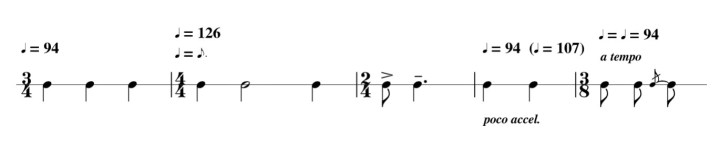
The rhythms of tachycardia were rapid and regular, but atrial fibrillation was irregular in both musical rhythm and pacing. It is also associated with increased risks of mortality if allowed to progress unchecked. My heart started making its own funky rhythms like the following:

which was meticulously transcribed from the inter-beat intervals in the electrocardiogram (ECG) recording from a Holter monitor:

This is not unlike the kinds of rhythms musicians are used to reading. A minor adjustment to the well-known Siciliano, the middle movement from the Flute Sonata in E-flat major (BWV 1031) by J. S. Bach, readily produces an exact fit to the transcribed rhythm:

See the video with audio playback of the modified Bach Siciliano. Readers interested in the gnarly details of the transcription process and its precision can refer to this Music & Science article on notating temporal deviations in music and arrhythmia.

AF is a fast growing global epidemic; statistics show that the condition afflicts over two million people in the UK alone. The inefficient blood flow through the heart in AF increases the risk of blood clots that can lead to stroke. Many people with AF are unaware that they have the condition, but I was amongst those doctors euphemistically describe as very symptomatic. Another ablation procedure—this time with freezing balloons (cryo-ablation)—created barriers in my heart, rings of scar tissue around the pulmonary veins, to contain the errant electrical activity, thus curing the condition.

When the consultant cardiologist came by the ward to ask if I had any questions, I asked for ECG data that I could use for musical analysis and experimentation. This has led to a number of computational projects, mostly scientific in nature, but the first of these was a growing set of piano pieces called the Arrhythmia Suite. With the help of three research partners at the Radcliffe Institute for Advanced Study at Harvard, the inter-beat durations were extracted from the ECG traces and the rhythms carefully transcribed. I then cannibalised existing music to make collage pieces based on these rhythms. See the video on the making of the Arrhythmia Suite. When performed, the pieces make visceral the rhythmic experience of arrhythmia.

On Tuesday, 20 November 2018, at 1pm, I will perform these pieces in Heart & Music at the Octagon (Queen’s Building, 327 Mile End Road, London E1 4NS) at Queen Mary University of London, as part of the Being Human Festival. The concert programme will feature music made from stolen rhythms, including the ones taken from ECG traces of cardiac arrhythmias. Professor Pier Lambiase, the consultant cardiologist who led the clinical team on both ablation procedures, will give a short introduction to arrhythmia research at the Barts Heart Centre before the performance. Admissions to Heart & Music, which kicks off the all-day Keyboard Evolutions event is free, but booking is recommended.

Other pieces on the recital programme include Cheryl Frances-Hoad’s Haydn’s Stolen Rhythm (2009), in which the composer assigns new pitches to the third movement (Finale) of Haydn’s Sonata in E-flat, Hob XVI:45, keeping intact Haydn’s original rhythms; Practicing Haydn (2013) is a transcription of my sight-reading of the same Haydn sonata movement complete with hesitations and repetitions—this was a collaboration with composer Peter Child and conceptual artist Lina Viste Grønli that premiered at the grand opening of the Kunsthall Stavanger; Intermezzo (2015) was written by Jonathan Berger for pianist Pedja Muzijevic’s Haydn Dialogues; and, compositions based on J. S. Bach’s A Little Notebook for Anna Magdalena and Kabelevsky’s 30 and 24 Pieces for Children (2016) were created by a computer programme called MorpheuS, written by Dorien Herremans as part of her Marie Skłodowska-Curie Fellowship in my lab.

Following the concert, at 2:30pm, an interactive workshop will enable free-form Q&A with Profs. Lambiase, Peter Taggart, and myself on the preceding presentations as well as our ongoing study on cardiac response to live music performance. Abnormal heart rhythms can often be linked to strong emotions or mental stress. Because music is a powerful idiom through which to evoke strong emotions, this study uses music to induce mild tension in patient volunteers with biventricular pacemakers or ICDs to better understand the connections between emotion response and heart rhythms.


Elaine Chew is Professor of Digital Media at Queen Mary University of London, where she is affiliated with the Centre for Digital Music. She is recent recipient of a European Research Council Advanced Grant for the project COSMOS: Computational Shaping and Modeling of Musical Structures, which will start in January 2019. COSMOS aims to study musical structures as they are created in performance and in recordings of cardiac arrhythmias.

About COSMOS — https://erc-adg-cosmos.blogspot.com

About Elaine’s research — https://elainechew-research.blogspot.com

About Elaine’s piano activities — https://elainechew-piano.blogspot.com

About the Music, Performance and Expressivity lab — https://mupae.blogspot.com

Guest post by Michael Johnson

I have just dusted off ‘The Writer’s Brush’, a book in my chaotic library that reproduces the artwork of 200 well-known novelists and essayists. Looking over their paintings, I can almost hear them letting out sighs of relief as their images took shape on the canvas. Writers often turn to painting for relief from the tyranny of words. It’s a form of therapy — the visual arts provide immediate respite.

Pianists seem to be perfect candidates for this same escape yet finding them and making them talk about it is like pulling teeth. I have identified a handful of pianist-painters and captured some of their thoughts, and my hunt continues, but it might be in vain. Composer-critic Virgil Thomson wrote in one of his better polemical pieces, “The music profession is more secret than most … No other field of human activity is quite so hermetic, so isolated.

Some of my pianist friends will even admit that too much time at the keyboard is ultimately bad for the soul. They are weary of working on muscle memory. It’s the endless repetition of notes penned by someone else that rankles them most. The late Charles Rosen once told me he dealt with this dilemma by propping a book of detective stories on his piano to read as he repeated tricky passages a hundred times. Is that art?

True artists seek self-expression, artistic adventure. They feel the urge to own their work, and written music strictly limits departures from notation. Some musicians eventually realize they are mere messengers, but of what messages? (Deciphering Chopin’s detailed dynamic markings, they ask themselves, “Why did he insist on such constraints?”) If they stray too far, their teachers steer them relentlessly back to the page.

My advice to pianists is to grab some pots of paint and start splashing. Painting has a “touch of the miraculous” about it, one artist told me recently. Of all the arts, painting will grant you the most license for creative release.

I have been collecting samples of musicians’ artwork for the past year or so, and have been surprised at how committed some of them became, often mounting

their own exhibitions and publishing their visual creations, at least on the internet.

Moreover, I find similar urges among academics, business executives, and even one magician, David Blaine.

Alexander Motyl, a novelist and political science professor at Rutgers University, Newark, N.J., finds painting a release from the straightjacket of words – much as musicians fight the constraints of music. “There are no words, no speech, no ‘thinking’ in my painting,” he tells me. “It’s just lines and colors and spaces and visual creations. Stuff happens and, suddenly, you realize, gosh, this is really good.

Somewhere among the painters I find myself, once a struggling pianist, then a working journalist, now a successful portrait painter. I get chills of the “miraculous” when one of my portraits seems to speak to me. My first book of music-makers’ ecstatic faces * has just appeared and my recent one-man show of 70 watercolors in Bordeaux attracted press coverage and a few commissions.

While frustration has driven some leading musicians to the drawing board, reasons of course vary. Among those who turned to the pot-and-brush are Felix Mendelssohn, John Cage, Morton Feldman, Arnold Schoenberg, George Gershwin, former Juilliard professor David Dubal, the British polymath Stephen Hough, the Argentine virtuoso Ingrid Fliter, Boston’s Russell Sherman, British composer-pianist Richard Rodney Bennett, the Israeli pianist Ilana Vered, The German composer-painter Heiner Goebbels, and the early work of Alfred Brendel. Some Chopin drawings are on display in Warsaw. Ferruccio Busoni, Edward MacDowell, Charles T. Griffes, and Enrique Granados all left visual art among their legacies. Even Mozart doodled funny faces in the margins of his scores.

Stephen Hough tells me in an email exchange that he finds painting more release than relief – a way to explore a different branch of creativity. In playing the piano, he says, “sounds evaporate into the air… but a painting stands as a thing, complete.” As he put it in a separate interview, “I’ve always felt that playing the piano just by itself was not enough.” Painting allows him to find a further outlet. “I feel like I need to move in other directions,” he said.

David Dubal, pianist, broadcaster, pedagogue and accomplished abstract artist, believes that drawing and painting are things we should experience “all the time”. It would “make for a more peaceful world”, he tells me. “Painting and drawing have taught me to see and remember. The hand moving on any surface with brush or pencil is a major activity of the unconscious and conscious mind. One must be absolutely ready to let the hand activate its power. It is an adventure and a gamble.”

He quotes designer William Morris as writing to his painter friend Edward Burne-Jones, “If any man has any poetry in him, he should paint …

This slideshow requires JavaScript.

In one of the quirkiest cases of backward cross-fertilisation, John Cage was so inspired by Robert Rauschenberg’s “white painting” (blank canvasses that Cage called “mirrors of the air”) that later the same year he composed his most famous work, 4’33”, at which a pianist sits quietly at the keyboard but does not touch it.

Left-handed violinist Paul Klee was talented in music and art. He ultimately embraced art, dropping the confines of music altogether and becoming a leading avant-garde painter.

Like Hough, I too find release in painting, sometimes spontaneously. I am often seized by the impulse to sketch a player when I see him or her emotionally high in public. Musicians’ faces and body language provide great material for the artist, inspiring my approach to their portraits — joyful, tragic or just deep concentration.

There is a peculiar pleasure in portraiture. The artist must take an intimate, even intrusive, approach to detail, exploring the eyes, noses and lips – their crinkles, wrinkles and folds — to make the subject come alive. An expressive face can reveal something of the individual’s inner life, and that is what I seek. It takes time to study these faces. The English painters John Singer Sargent and Lucian Freud were known for their multiple false starts in oils, scraping away the face and starting over and over. Leonardo da Vinci invested five years, off and on, in his “Mona Lisa”.

Conductors are some of the most emotive performers in public. Yutaka Sado, Kent Nagano, Paul Daniel, and of course Leonard Bernstein lose themselves in the music. I have seen Bernstein leap so joyfully that both feet left the podium at the same time.

Studying faces puts the artist in a spooky symbiosis with his or her subject. I know I have captured the pianist when I can hear the music or see the subject come to life. I stop short of a related spookiness, however, in the very spiritual conductor Seiji Ozawa who also gets that “miraculous” chill. Intensive study of an orchestral score eventually gives him the feeling that it is his music, that he composed it.

Music can get inside you that way.


* My collection of portraits of musicians is available at Amazon


Michael Johnson is a music critic with particular interest in piano. He worked as a reporter and editor in New York, Moscow, Paris and London over his writing career. He is the author of five books and divides his time between Boston and Bordeaux.


Guest post by Michael Johnson

Perhaps enough time has passed since the death of the French pedagogue Nadia Boulanger to step back and question her musical sainthood. She was, after all, only human.

My elder musician friends recall her as a brilliant analyst of composition yet as a person she tended toward the tyrannical, impatient and cantankerous. Composer Philip Glass, who studied with her for two years, wrote that she tried to be kind but “stayed pretty much in the range between intimidating and terrifying”.

She was like a lot of piano teachers, one might add. Fanny Waterman used to crack the knuckles of her young students with a ruler if they missed a note or dragged a tempo.

Nadia, who died in Paris in 1979, moved in the best circles of 20th century music. Leonard Bernstein often visited her in Paris. On one occasion, when he was already established as a composer and conductor, he recalled being made to feel small when he played one of his compositions for her. She objected to a certain b-flat. He recalled later, “I am 58,” but suddenly “it was like I was a child.…”

One musician friend of mine in Paris who studied with several of her students goes further, accusing her of “castrating” them (especially the males) by constant criticism and tedious exercises that had them “jumping through technical hoops for hours, years, on end”. Some of the exercises she wrote for her charges were “soul-destroying”, he says.

Nadia knew she had a mixed reputation and was comfortable with that. She maintained that musical training without rigor cannot be of value. Virgil Thomson wrote that she had a “no-nonsense approach to musical skills and a no-fooling-around treatment of anyone’s talent or vocation”. She once turned down a young girl applicant, exasperated, saying she would never find the patience to work with her. Fortunately, she added, her father was soon transferred to another country and the family left France.

I have just read an extraordinary collection of Nadia’s opinions and memories as assembled by Bruno Monsaingeon and published in 1980 as ‘Mademoiselle’ (Editions Van de Valde). Long out of print, I found a dog-eared, mildewed French copy in a bookstall and have studied it minutely. It is a portrait of a complex lady who describes herself as “pitiless” in her treatment of students, adding that she was just as rough on herself.

Originally an aspiring composer, she said that “if there is one thing I am sure of … it is that my music is useless”. Some listeners today would agree while others don’t. Her blandness and lack of originality seem evident to me. She admitted that she realized early on that she “had absolutely nothing to say.”

A student of Gabriel Fauré, Nadia gave up composition after the death of her beloved sister Lili, the more talented of the two sisters. Lili died of an affliction now known as Crohn’s disease, at 24, in 1918. Broken by Lili’s death, Nadia threw herself into teaching, inviting students from throughout the world to come to her Paris apartment and be forced into her straightjacket. There she taught conducting, analysis, harmony, counterpoint and composition as well as piano performance.

Some of the most important musicians of the 20th century worked under her harsh regime: Aaron Copland, Elliott Carter, Walter Piston, Pierre Schaeffer, Igor Markevitch, John-Eliot Gardiner, Daniel Barenboïm, Dinu Lipatti and others. Her list of students has never been completed but I should add the jazz composers Quincy Jones and Donald Byrd. The list goes on – Jean Françaix, Roy Harris, Peter Hill, Ralph Kirkpatrick, Michel Legrand, Gian Carlo Menotti, Jeremy Menuhin, Emile Naoumoff, Soulima Stravinsky.

Nadia was particularly critical of her American students who queued up to suffer under her rigorous demands. About 600 Americans took lessons from her in the 1920s to the 1970s. She found some of them brilliant but many, she said, lacked fundamentals or even a good ear. “The truth is that the study of the basics makes you understand that to be a good musician you must be a good grammarian.”

Conductor Igor Markevitch, who studied with her, recalled that she went out of her way to assert herself, even wearing a pince-nez to appear professorial. This, he said, helped her advance in a world then dominated by men.

She could be so harsh as to leave students stunned. Glass recalled in his recent autobiography ‘Words Without Music’ that while recuperating after a group class studying Bach chorales, the students would sit down at a café for coffee or beer. The Boulanger experience, he remembered, “invariably left us shaken and silent”.

Confused by the contradictory opinions in the air today, I turned to one of my main interests, portraiture, to try to get a better feel for the person behind the mask. Portraits can afford the artist a good opportunity to study a subject up close. In her case, I found nothing but severity — a strong jaw, narrowed eyes, arched eyebrows, a hard, thin mouth, and body language that students such as Glass found intimidating.

Watching her come to life on the page, I had to turn away. I felt fear. As a student, I would not have lasted an hour with her.

The Monsaingeon book is the most comprehensive account of Nadia’s views on music. He directed a television documentary on her 90th birthday and produced a book-length compilation of some five years of meetings and conversations with her. For easy reading, he reordered the material as an interview – inserting questions among her monologues.

I have produced this edited and translated version of Monsaingeon’s work, capturing the most pertinent extracts for a modern audience.

Aaron Copland described you as the most famous professor of composition alive.

Allow me to doubt the veracity of that statement. I believe a professor is dependent on the quality of the students. The professor’s role is less grand, less omnipotent, than one might think.

When did you discover music?

As a child, I could not stand the sound of music. It almost made me sick. I screamed. My sobbing could be heard in the street. The piano was a monster that terrorized me. Then one day I heard a fire truck passing by, siren blaring, and I sat down and found those notes on the keyboard. Suddenly I had discovered music with a passion. I can still hear my father saying, “What a strange little girl we have here.”

Your father was a French music professor and you mother was Russian?

Yes, my father was totally French and my mother Russian (Princess Michesky). We never spoke Russian in the home because she did not want the family language to be one that my father did not understand.

Do you believe your Russian ancestry has been important for you?

It has been very important … but I do not like to talk about personal background. There is no point talking about me all day long because it would interest no one and certainly not me!

Is it true that at the age of twelve you knew Bach’s Well-Tempered Clavier by heart?

It was an obligation. I was instructed to learn one prelude and one fugue per week. But you know, let’s not exaggerate. One prelude and one fugue per week is not so much… After this kind of training, though, one has a good basis in mind.

It is said that you already had an encyclopedic knowledge of music when you began teaching.

You know, people say all kinds of things, few of which are true.

How did you end up at the American Conservatory of Fontainebleau?

Walter Damrosch founded the school and Francis Casadesus was the first director. I was brought in to join the faculty. I spoke two words of English, “Hello” and “Goodbye”. My first student was Aaron Copland. After Robert Casadesus, other directors followed, including Maurice Ravel, Charles-Marie Widor, and I succeeded Casadesus in 1946.

I understand that the conservatory was founded after World War I for American troops but after the war, what happened?

The Fontainebleau school became very important for the Americans. They had brilliant schooling and were very gifted but they lacked fundamentals in many cases; their musical ear was underdeveloped and they had bypassed the everyday details of music education. Why? Because — it was believed — one must not overwork the children.

What were your basics in the curriculum?

I had to insist on the fundamentals – hearing, looking, listening and seeing.

You trained a large number of Americans. There must be hardly a city in North America that doesn’t have one of your students.

Yes indeed, I had a great number of American students. One must remember that fifty years ago there was no such thing as American music. An immense change has happened since – Monsieur Copland, Monsieur Bernstein – their works are performed all over the world. The term “American musician” is no longer something unusual.

Didn’t you bring Aaron Copland to the attention of the American public?

A. Yes, in September 1938 I encouraged Walter Damrosch and Serge Koussevitzky to program his Symphony for Organ and Orchestra. Damrosch conducted it in Boston (in 1938) and was probably disturbed by the modernity of it. He turned to the audience as said, “Ladies and gentlemen, if a man of 23 can compose such a work, he will be capable by the age of 30 of murdering his own parents.” He was laughing but he was serious too. Naturally there was a reaction and agitation among the public but Copland’s reputation was made. Copland’s piece seems tame by today’s standards.

Music goes through phases of popularity. Is this a problem?

I am tormented by the phenomenon of fashion in music. Since I am an old fusspot, I don’t much like change. Of course change for reasons of necessity can be marvelous. But change because one does not know where to go next is fatal and destructive.

What about new voices in music?

Rather than deepening one’s understanding, we see too many people chasing discoveries as an end in itself — finding that unknown masterpiece at any cost. The less these people understand, the more enthusiastic they are. I recently heard a piece that made me wonder if the composer was ill, on drugs, or victim of a serious mental disorder.

How important is music in your life?

I am an absolutely mad consumer of music. I call it a sickness because even when I am exhausted after eight or nine hours of teaching, my first move – to the annoyance of the household – is to switch on the radio and listen. I am insatiable. I love listening (to music).

You say you can appreciate the good and bad elements of a work. What are your criteria for a masterpiece?

I have no idea. I don’t say they don’t exist but I have no idea.

And yet listening to a masterpiece you seem to be certain of your judgment.

It comes down to faith, to belief. Just as I accept the existence of God, I accept beauty, I accept emotion and I accept a masterpiece… Exactly what makes up a masterpiece escapes me… I can analyze anything. But a page, a line, a measure of Schubert, I have no idea.

How much training is necessary to appreciate great music?

One can be totally without training and yet feel the senses penetrated by melodic emotion – this is perfectly respectable.

How do you balance rigor and creative freedom?

I hope my teaching has influenced students to appreciate the need for rigor, for order. But in the area of style, I have never intended to exert any influence. If I am working with a foreigner and I try to make him or her into a French person I am sure to fail.

Isn’t it possible to list composers in a hierarchy of importance?

The seems very difficult to me.

Still, one could rank Beethoven against Max Bruch, for example.…

There you are falling into the abyss. You compare the Himalayas with Butte Montmartre. Really, I must say that I honestly almost never think about Max Bruch whereas hardly a day passes that I don’t think about Beethoven.

How would you sum up your role as a professor?

I know my job. I am someone who can help students acquire a basic technique, to listen, to hear, to transpose, to practice, to memorize. The role of the professor seems to me to be modest.


Another version of this essay-interview originally appeared on factsandarts.com

Michael Johnson is a music critic with particular interest in piano. He worked as a reporter and editor in New York, Moscow, Paris and London over his writing career. He is the author of five books and divides his time between Boston and Bordeaux.


Illustration by Michael Johnson