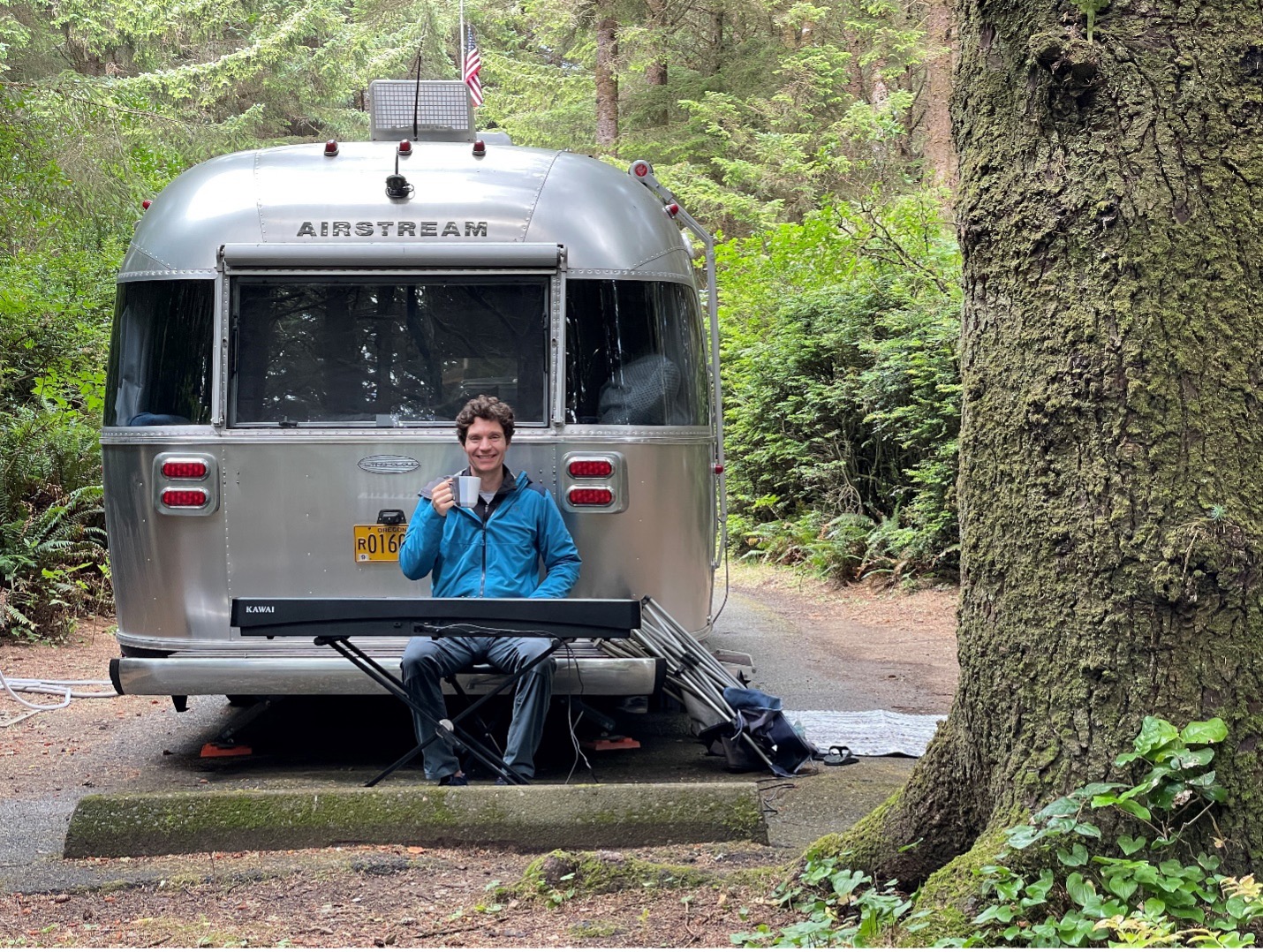
Guest post by Dakota Gale, the latest article in his series aimed at amateur adult pianists


I clearly remember the first time I rode Tyler’s, a popular bike trail near me. I walked some rocky uphill ramps, awkwardly landed jumps, and generally hacked my way down it like a noob.

I still had a hell of a fine time.

These days, I’ve ridden Tyler’s dozens of times and know every major feature. I fly down that sucker.

But is Tyler’s more fun, exciting or fulfilling now versus my first time? 

In general, is there a way to develop appreciation and deeper comprehension rather than boredom for a repeated experience?

Travel to the same places. Hobbies we’ve done for years. Meals we’ve made for a decade.

Or piano pieces!

Navigating the creative gamut

Like a new bike trail, the first time I play a piano piece my brain scrabbles to survive, jamming the notes into my brain. I’m walking super rocky sections and scoping out switchbacks, one measure and phrase at a time.

Take Schubert’s Serenade, a song I’ve always loved that I started playing. In my initial efforts, I pushed through the technical challenges of the piece and could “play” it. Then I tabled it for a month, letting the music sink into my synapses. Cue round two, with more nuance and expression…and yet I was barely getting started.

Bridging that gap between what I CAN do and what I WANT to do is the hardest part. With any new piece, I listen to recordings and think, “yup, do that, fingers!” Then I sit down and create some monotone pabulum akin to playing bongo drums with wet laundry. *sigh*

The gap between my expectations and my abilities is frustrating sometimes. Like some truculent kid, I want to play it like a pro, now now now!

After I turn my pre-frontal cortex back on, I can (usually) reframe things. Because truly, I find this so motivating: I’m going to grow not just with new pieces, but enjoy a deep satisfaction revisiting piano works for the rest of my life. Something fresh to discover, to experience.

And dang it, I AM making progress. Even if I’m no master, there’s magic in the journey and daily satisfaction in the learning. I don’t need to be pro to have fun. (Maybe it’s more fun not worrying about earning a living with it?)

Plus, pushing myself on challenging songs pushes me to greater heights on those I already play. It’s the same thing that happens when I ride technical trails on my bike. I may not slip effortlessly through the toughest moves, but that difficulty makes other trails feel even more cruisier in comparison.

Unlike during piano pieces, sometimes I pause mid-climb on a bike to eat…

As piano, as life

I love how this mindset so easily translates to other endeavors or pastimes. We’re different people when we revisit a city or national park, reread a book, or play an old song. Depth, additional context, a slower pace…it all modifies the experience and likely results in a deeper appreciation.

With all this in mind, I’m continuing to actively push myself to share not-perfect work like my beginner drawings and music recordings. (Sharing my writing on my blog starting a decade ago was an early effort in that arena.) 

It’s tough because I want the work to be better, to make insane progress overnight. Sometimes I shake my head at how hard it is to take what’s in my brain and put it on paper or piano.

Whatever. There’s a reason every book on creativity decries perfectionism and Ira Glass from This American Life talks about “The Gap,” that space between what we envision and what appears in reality. I’ll probably always find blemishes and wish-it-were-different aspects of ANYthing I create.

The good news? It creates constant motivation to keep improving, growing, seeking.

That’s a beautiful thing.

As for Schubert’s Serenade? Maybe it’s not perfect, but I’m looking forward to a lifetime of it evolving beneath my fingers.

And if I get frustrated, I can always go rip down Tyler’s on my mountain bike.


When he isn’t playing piano, Dakota Gale enjoys exploring the great outdoors, learning languages and drawing. He also writes about reclaiming creativity as an adult and ditching tired personal paradigms in his newsletter, Traipsing About. He can often be spotted camping and exploring mountain bike trails around the Pacific Northwest.

Guest post by Frances Jones

I’ve never found it easy to keep New Year’s resolutions. Often, they are admirable but just not sufficiently motivating and are inevitably dropped before ever really achieving anything. Last year, though, I decided I would practice the piano more often and also give a concert, however low-key, for my students, most of whom were under the age of 10. One of the pieces I re-learnt and performed was Germaine Tailleferre’s Impromptu, a wonderfully spirited piece with an oft-repeated motif that ducks and dives through many keys before finally coming to rest with a ritardando and arpeggiated passage alighting on the tonic.

Rediscovering this piece led me to think of Tailleferre’s First Piano Concerto. I say rediscovering because Germaine Tailleferre’s music was the subject of my undergraduate thesis, back in 2005. It wasn’t long before I was listening to the concerto, now much more easily available on Youtube, and recalling an afternoon spent poring over the score in the dimly lit depths (or so it seemed to me) of the British Library.

Tailleferre wrote her first piano concerto in 1924 and, in a departure from the Romantic style of her earlier pieces for piano, embraced the neo-Classicism that had been emerging in France in the early years of the 20th century and that she had deployed in her string quartet of 1919. As far as I’m aware, there has been just one recording to date, by the University of California Santa Cruz Orchestra:

The first movement is in sonata form, but foreshadows the neo-Classical style of Stravinsky in his Dumbarton Oaks Concerto with its similarity to concerto grosso. The instrumentation, too, is reminiscent of earlier times, with strings, trumpet, horn, oboe, bassoon, flutes and timpani. The piano and orchestra start together in the first bar, and the musical themes are shared in a joyful back and forth full of counterpoint and syncopation. The opening theme, a descending melody with a repeated rhythm, is heard over a staccato bass which really bounces along and immediately conjures up a sense of exuberance. Later on, the harmonies are more Romantic and the piano is more obviously accompanied by the orchestra, but the melody is still propelled by a driving rhythm. The joyous, energetic character returns as the opening material is repeated, exchanging fragments of melody, overlapping and answering, until the final bars.

The second movement has a different feel. Indeed, when I was researching this work for my thesis, I was so struck by the similarity of the slow movement to the slow movement in Ravel’s Piano Concerto in G, that it led me to consider the influences that this concerto may have had upon Ravel. (Ravel wrote his concerto in 1934, and the two composers were good friends). This is a subject for another time, but it makes for an interesting discussion. The movement starts with solo piano, and a continuously evolving melody which defies a clear sense of beat and only becomes clearer when the flute enters in bar 4. This emphasis on melody harks back to the earlier style of her piano works, in which melodies evolved over a more static bass line. It’s a beautiful movement, wistful and yearning; it builds to heavy chords, anguish almost palpable in each, and subsides, the strings accompanying the piano to resolve onto a major chord, the sun shining again on the rain-soaked pavement (if you’ll excuse the weather analogy).

We return in the third movement to the uplifting character of the first and indeed, to a more obviously neo-Classical style. But it’s not without its individualism. The themes are characterized by off beat rhythms that cut through the texture but there is lyricism, too, always urgent, pushing forward, both orchestra and soloist involved in an intense communication. There’s a joyful, ascending

piano melody, followed by a conversation with the flute and oboe and, finally, a cadenza where the pianist emerges into the limelight. However it’s the interweaving of the melody through the orchestral parts, specifically flute, oboe and trumpet, that I really enjoy in this movement. Towards the end, the syncopated motif is shared around the orchestra, the soloist running up and down the piano in scalic passages until the trumpet breaks through the texture to end with a triumphant flourish.

Tailleferre’s Piano Concerto was premièred in London by Alfred Cortot in 1924. Although performed many times in the decade following its publication in 1925, the work has not since achieved a fraction of the commercial success enjoyed by other 20th century concertos. It perhaps just doesn’t quite have that level of virtuosity attained by other composers, such as Ravel in his Piano Concerto in G, or Shostakovich in his First Cello Concerto. Its neo-Classical style and lack of a really prominent part for the soloist may also have contributed to its gradual disappearance from the concert platform. However, the more I (re)listen, the more I’m drawn to this work which appears like a burst of musical sunshine from the Paris of the 1920s. I’d love to hear it performed live. Perhaps now, 100 years on, might be the time for its renaissance.


Frances Jones read music at York University, followed by a PGCE at Cambridge. She is Music Lead at a school in West London and also teaches piano. 

Guest post by Dakota Gale. The latest article in Dakota’s series Notes from the Keyboard, aimed at adult pianists


I recently attended a piano performance, during which I spoke with a 92 year old woman sitting next to me. She’d played and taught piano for decades. When I mentioned that I take lessons online, her eyes widened. “ONLINE lessons? But…that is the most amazing thing!”

She’s not the only one surprised. “Wow, you take lessons online?” is a common response from most people, even after the nuclear proliferation of pandemic Zoom meetings.

Yep, ever since I began taking lessons in spring of 2021, I’ve done them online. My teacher, Antonio, is located in southern Brazil; I’m in the Pacific NW in the U.S, thousands of miles away. And it’s not just me; plenty of people do it, including:

  • Those looking for specific expertise (e.g. Chopin etudes from a professional)
  • Those being careful while going through chemo or with a disease affecting their immune system.
  • Those who travel a lot (tougher if you’re flying, obviously)
  • If you have a favoured, dear teacher, but one of you moves, going online allow you to continue lessons.

Me and Online Lessons

For me, initially I took online lessons because of two things: to save money and to avoid COVID.

Since then, I’ve seen additional benefits. For one, they’re much more time efficient. No travel across town! For parents, I imagine this would be a huge benefit since you’d avoid shuttling kids around. (Actually, one of my friend’s kids is taking lessons with Antonio.)

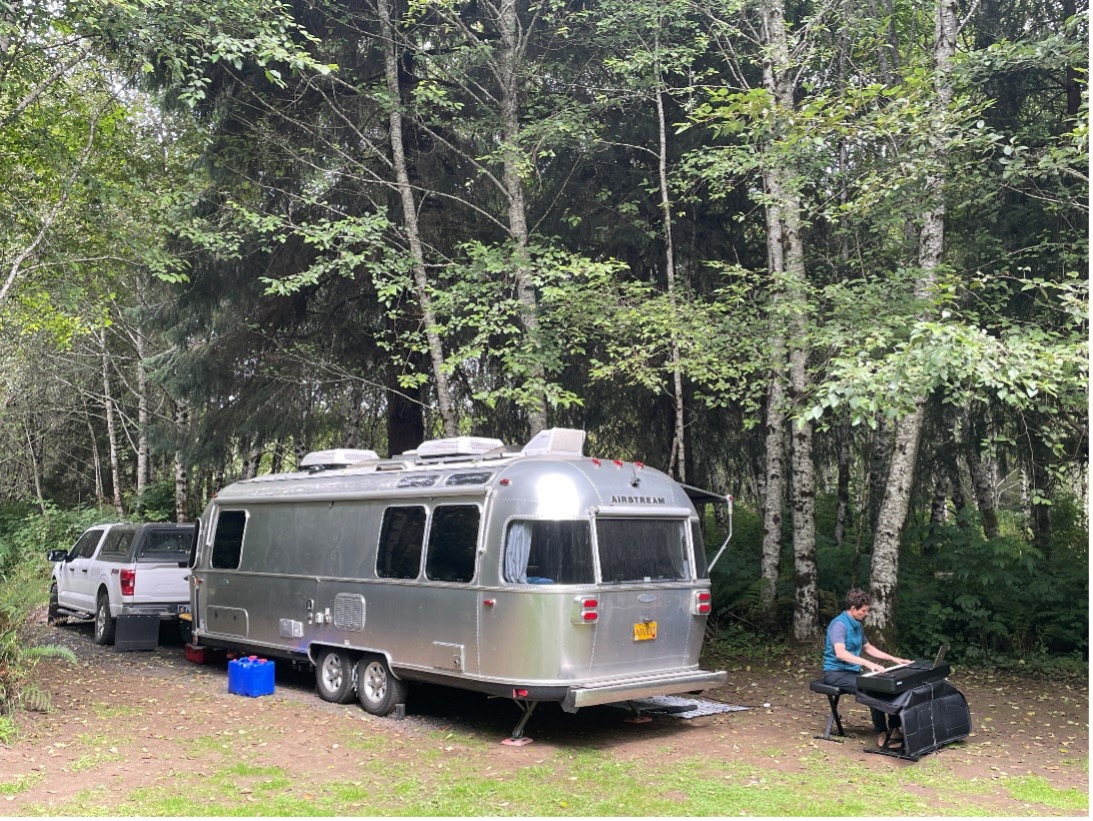
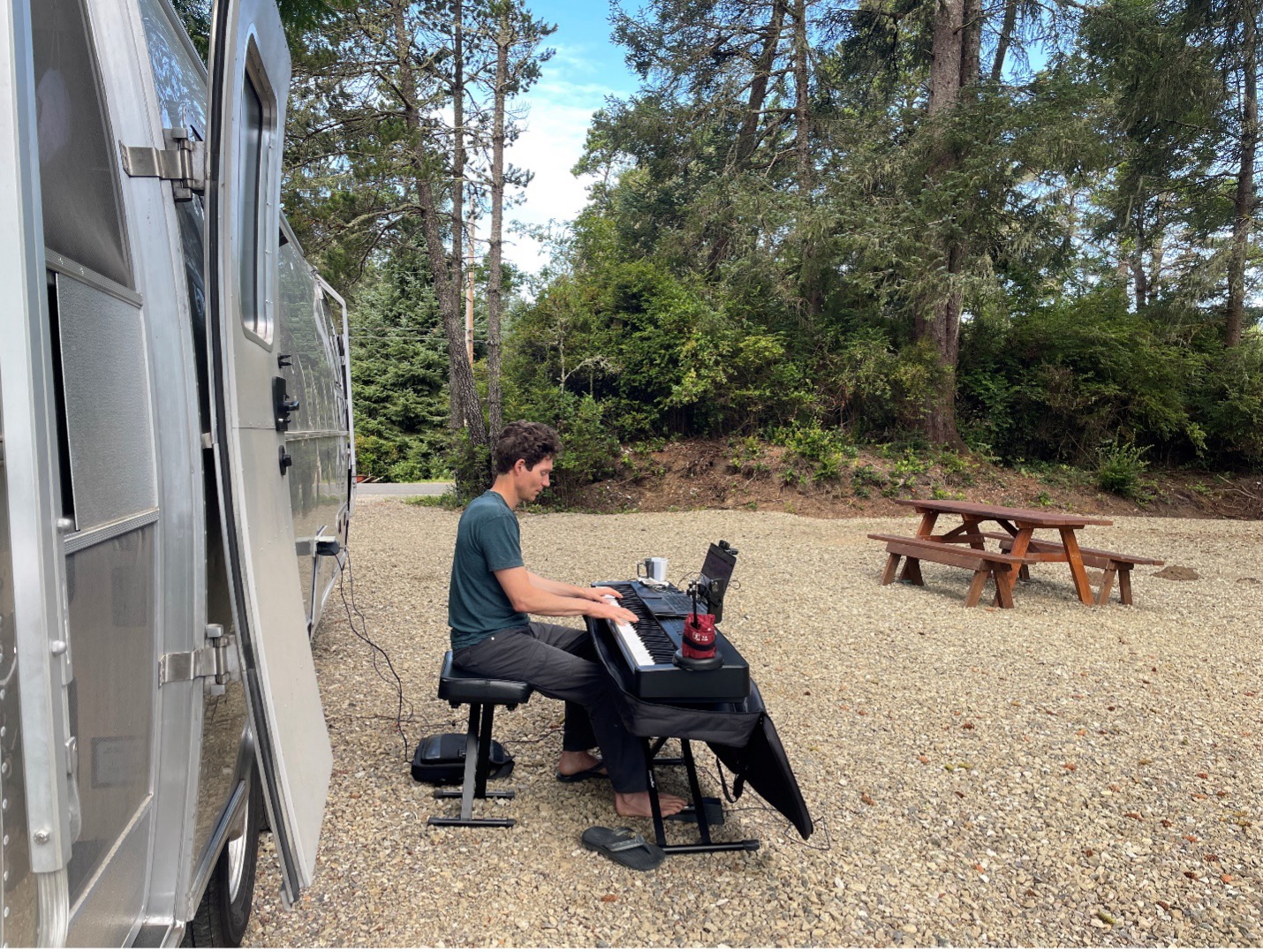
I travel fairly often and like to keep lessons going. In fact, I’m currently rolling around the Pacific NW with my wife for three months in a Airstream travel trailer. Between mountain bike rides, hikes, and hanging with friends, I’m both continuing to play consistently and still taking my weekly lesson. Courtesy of Starlink satellite internet and a digital Kawaii piano, I’m not skipping a beat.

When my teacher is on vacation, I’ve also taken lessons with professionals such as Grzegorz (Greg) Niemczuk, who I found on YouTube. You might be surprised how many YouTubers offer lessons (a friend takes lessons with the popular Heart of the Keys YouTuber.)

You know what makes piano better? Playing outside!

Beyond all those boring logistical things, Antonio being Brazilian brings a fun perspective to my experience. (I’ve learned a few choice phrases in Portuguese, for one!) I’ve also learned about (and love!) Brazilian music that I would otherwise not know, including tangos, the music of Tom Jobim and Ernesto Nazareth, and folk songs arranged for piano.

It inspired me to start a listening quest of different genres and international composers that has deepened my relationship to piano. Perhaps a local teacher would have provided that, but certainly it would have been different.

The nuts and bolts of online lessons

For those wondering how this is possible, allow me to describe the situation:

  • Antonio uses a Yamaha grand piano to teach. On it, he has four cameras for his face, top down on his hands, sideways on his hands, and another on his pedal. He even uses software that allows the camera to track his hands (AI magic!).
  • The sound quality is quite good–the nuances he can hear and comment on astonish me.
  • For my setup, I use a different system depending where I am. At home, it’s my computer with a webcam plus my phone on a stand looking straight down at my hands. While traveling, I just go with my phone on a small tripod set up to the side and occasionally my laptop in front of me. It works great.

The benefit of all this: the only time I’ve missed a piano lesson is when I’ve taken bikepacking trips. I challenge you to carry a full-size digital piano through the mountains…no thanks. A pianist needs to take a break from the keyboard SOMEtimes!

Resources:

To find an instructor, just type “piano lessons online” into any search engine. A few popular services: Superprof or Wyzant; a fellow traveler I met on this trip used Preply to find her ukelele instructor. (If you want to work with Antonio, just ping him on Whatsapp at +55 48 9181-9164.)

Cheers to piano on the road!


This site takes many hours each month to maintian and update. If you find value and pleasure in what I do, why not

Following one of those wonderfully serendipitous encounters on the internet, I am delighted to present “Notes from the Keyboard”, a series of articles for adult amateur pianists, by Dakota Gale, chronicling his own experiences of learning the piano as an adult.


Four years ago, my wife surprised me with a digital piano for my birthday. I’d mentioned my desire to learn a few times and, ever the muse, she called my bluff.

I couldn’t read music. Finding middle C was a quest. I was a B-E-G-I-N-N-E-R.

And yet…she was right. At 38 years old, I tumbled rapturously into the world of piano. 

Four years later, the honeymoon phase is over, and yet I remain motivated to play every day and am still loving the journey. (<–understatement: I’m head-over-heels for it.)

I even do stuff like learning to do portraits by drawing musicians! (My wife tells me that’s eccentric…) 

I’m playing pieces by Chopin, Debussy, Beethoven, Liszt, and other famous composers that I thought were a decade off. Even facing the inevitable frustrations of piano study, I’m finding joy in piano every.single.day.

Learning piano transcends fun – I feel like I’ve unearthed a gift, a path to access some of the most beautiful music ever written. Accessing the pieces revealed a fountain of satisfaction that isn’t tied to money or achievement, a much-needed oasis of play as an adult.

In fact, I’ll often drop into a flow state for 30 minutes and be surprised when my timer goes off. Where else do we get that feeling once we’re done playing with Legos or mud pies?

You, mega-savvy adult reader, can do it too!

Adults CAN learn to play piano

I share my achievements not to brag (many pianists young and old far outshine my abilities), but to offer hope to adult learners. If you’re telling yourself, “Oh, I could never learn to play” or “I’m not musical” or “only kids can learn piano,” let me persuade you otherwise.

I’m shocked how many people tell me only children can learn. Well, kids are “naturals” at learning because:

  1. They don’t over-complicate things, focusing on foundational blocks that are small and approachable. (Be it music, language, or other skills.)
  2. Kids are able to practice more undistracted hours because an adult provides housing, food, and does their laundry. Their job is to be curious sponges; our Adult Role is often yawn-tastic Tuesdays, repeated.

Adults lack those luxuries. We put pressure on ourselves, try to play songs that are too hard for us, question if the time investment is worth it, and simply don’t have as much time to practice.

I’m an adult. (It snuck up on me.) On top of all the typical adult stuff, I have far too many hobbies. Sometimes friends do annoying things like interrupt my piano reverie to invite me to dinner or on bike rides. *sigh* The inconsiderate louts, I must practice!

And yet by carving out time each day to study piano, in a few months I reached a deeply satisfying level of proficiency that kept me coming back. After four years, I’m frankly astonished sometimes at what my fingers can do.

As a bonus, it’s beautiful for people to listen to (or so they pretend). A skill I’ll enjoy and develop for a lifetime, long after I’m done taking irresponsible risks on my mountain bike.

Beyond that, I’m fired up! I look forward to enjoying creating music the rest of my life and only wish I’d started earlier.


Dear reader, welcome to “Notes from the Keyboard: Adult Piano Chronicles” on The Cross-Eyed Pianist. This will be an ongoing series about my journey learning piano as an adult. I’ll share my journey (ups and downs!) and headaches with pieces and how I resolve them. I promise to absolutely not take myself too seriously—after all this is a hobby, not a vocation.

If you have ideas for topics you’d like to hear about from a dedicated amateur student of classical piano such as myself, please don’t hesitate to reach out. I’m looking forward to sharing this journey with you!


Dakota Gale

When he isn’t playing piano, Dakota Gale enjoys learning languages (especially Italian) and drawing. He also writes about reclaiming creativity as an adult and ditching tired personal paradigms in his newsletter, Traipsing About. He can often be spotted camping and exploring mountain bike trails around the Pacific Northwest.


This site is free to access and ad-free, and takes many hours to research, write, and maintain. If you find joy and value in what I do, why not