“Every time you play a great piece of music there is a new discovery. Every time.”
Mitsuko Uchida, pianist
“I am interested in music as ecstasy, as something that transports you away from the everyday to another place.”
Terry Riley, composer
“Perhaps many a composer of the past would be astonished at how over-cautious we are when we play their works.”
Helmut Deutsch, pianist
“Be open to the possibility of your ears and soul being challenged, be curious about how that may be done, be hungry for new sounds, be thirsty for what you don’t know yet”
James MacMillan, composer and conductor
“The purpose of art is the gradual, lifelong construction of a state of wonder and serenity.”
Glenn Gould, pianist
“Schnabel said Mozart is the most inaccessible of the great masters because with the fewest number of notes, he accesses the deepest levels of human awareness and experience.”
Leon Fleischer, pianist
“As you grow up, communicate more with scores than with virtuosi”
Robert Schumann
“At every concert I leave a lot to the moment. I must have the unexpected, the unforeseen. I want to risk, to dare. I want to be surprised by what comes out. I want to enjoy it more than the audience. That way the music can bloom anew.”
Arthur Rubinstein, pianist
“If you play music with passion and love and honesty, then it will nourish your soul, heal your wounds and make your life worth living. Music is its own reward.”
Sting (Gordon Summer, pop musician)
“Keep searching for that sound in your head until it becomes a reality” – Bill Evans, jazz pianist
Glenn Gould claimed to “detest” audiences, regarding them as “mob rule” and “a force for evil” (he retired from performing in public at 31), but most performers take a far more positive and generous attitude towards audiences.
Audiences – real living, breathing audiences – have been much missed over the past year with concert halls, opera houses and theatres closed for months in response to the coronavirus pandemic. Seeing performances from empty venues like London’s Wigmore Hall are a poignant reminder of how important audiences are; they’re an integral part of the concert experience and without an audience a performance isn’t really a “concert” in the truest sense of the word.
Glenn Gould had a good reason for his dislike of audiences: he suffered from stage fright and saw the public concert as a “gladiatorial” experience, the audience a hostile force, hungry for evidence of weakness or errors on the part of the performer. The fear of making mistakes in front of other people – a natural human instinct – is very common amongst performers, professional and amateur, and is one of the main drivers of performance anxiety.
We don’t want to mess up in front of other people, of course we don’t. We want our performances to be as close to perfect as possible, with just the right amount of technical assuredness combined with artistry to draw the audience into the music’s soundworld, transport them, excite and enthrall them. But perfection is a human construct, an idealas opposed to a quantifiable reality, and as such it is an impossibility. We are all human – even the most incredible musicians who enjoy almost god-like reverence – and we are all fallible. Accepting this is one of many ways we can better understand and manage performance anxiety.
Audiences don’t come to concerts hoping to see the performer fail. They are not there to spot errors or imperfections in performance; they have paid for tickets because they want to hear the musicians perform. They are there because they want to be there, to hear the music, and because they enjoy the concert experience and admire the performers.
Performing is about connection not perfection. As musicians, we want to connect with our audience to communicate and share our music with them. It’s a sympathetic, almost supportive relationship, as the audience create atmosphere and a sense of occasion in the concert hall – and also affect the acoustic of the venue. That special relationship between musicians and audience has been much missed over the past year, and almost every musician I know cannot wait to be back in the concert hall performing to a real live audience once again.
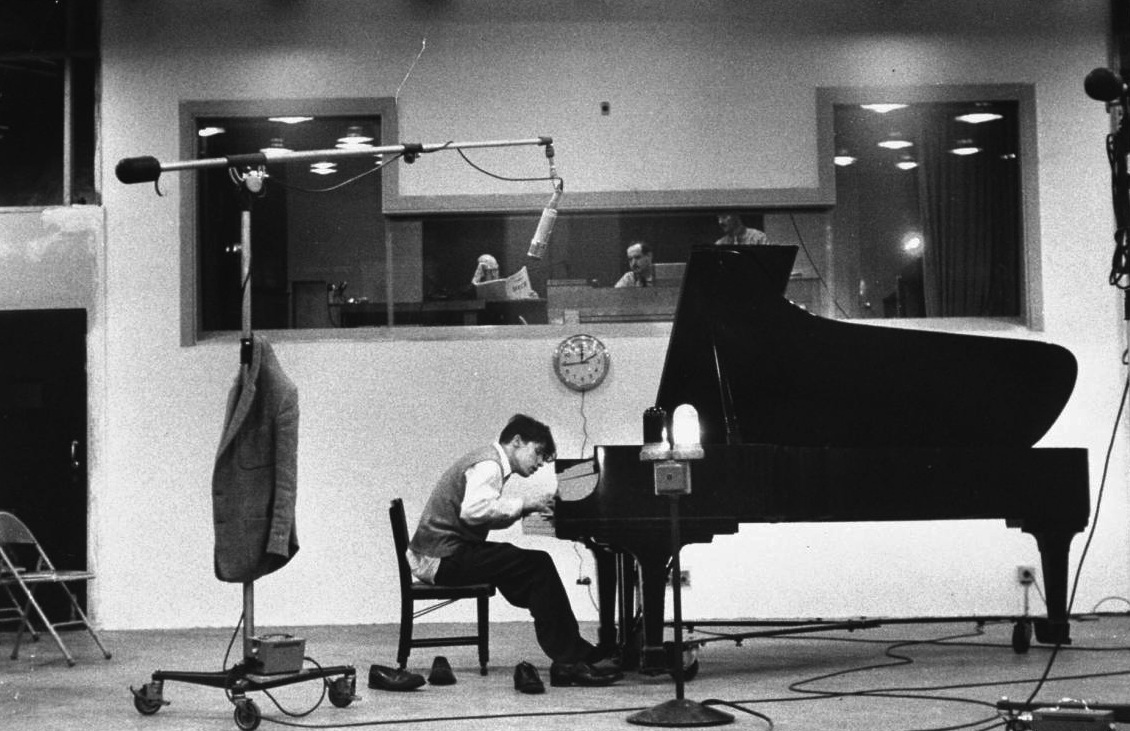
Glenn Gould in the recording studio as a young man
The late great Canadian pianist Glenn Gould made two significant and highly-acclaimed recordings of Bach’s Goldberg Variations, the first in 1955 when he was just 22, the second a quarter of a century later in 1981 when he was nearing the end of his life. Both recordings stand as benchmarks and both offer fascinating insights into the music and Gould’s approach to it. These recordings have never been out of print – a mark of their status and the respect they command in the canon of Bach recordings. The 1955 recording was Gould’s debut disc for Columbia Records and was something of a risk for the record company since at the time the Goldbergs were regarded as one of the obscurities of the repertoire, while the performer was unknown. The 1955 recording is often described as a young man’s recording, full of the exuberance of youth in its extreme tempi and avoidance of some of the repeats. In fact, the swiftness of the playing is partly due to the constraints of the vinyl format and the need to bring the recording within a certain time-frame. No matter: Gould’s Goldbergs became an instant hit, launching both pianist and the work, which entered the standard repertoire of pianists and remains widely performed and recorded to this day.
When Gould re-recorded the Goldbergs in 1981, recording technology had advanced considerably (stereo and Dolby surround sound had been invented and digital recording/editing could be used for mainstream recordings). This gave the artist greater flexibility, with the possibility of multiple takes to create a recording with which he was entirely satisfied. Gould had been unhappy with the tempi in the first recording and felt there was no sense of cohesion or narrative flow between the individual variations. The 1981 recording is undoubtedly that of a mature artist: the tempi are thoughtful, almost autumnal, and there is much greater expression throughout the variations. There is elegance and nobility rather than swooning, nervous energy.
Gould’s two recordings of the Goldberg Variations demonstrate something profound – that two different approaches to the same notes say a great deal about how one ages and how tastes change over time.
The weather changes. The admirable impetuousness of youth usually yields to a more considered view
– John Humphreys, concert pianist
A recording is a snapshot in time, yet preserved forever, unlike a live performance which is a one-off, never to be repeated. Many artists are dissatisfied with their recordings because they know that they never play the same thing in exactly the same way and no sooner has a recording come out, than they wish they had done things differently. As amply demonstrated by Gould’s Goldbergs, the passage of time allows one to reflect on one’s repertoire and how one plays it. One’s perception of the music changes with time and so it makes perfect sense to re-record from a different, more mature perspective.
Other notable “repeat” recordings include Daniel Barenboim’s Beethoven Piano Sonatas. Barenboim was a young man when he recorded his first cycle (between 1966 and 1969), and like Gould’s 1955 Goldbergs, there’s an excitement and spontaneity in these readings. He re-recorded the sonatas for Deustche Grammophon in 1981-84 and two decades later Decca released the audio soundtracks of DB’s live performances of the sonatas (performed and filmed in Berlin’s Staatsoper unter den Linden and issued by EMI on DVD). Like Gould’s Goldbergs, these make for fascinating listening, offering one the opportunity to chart the performer’s artistic and interpretative development and maturity, resulting in new or renewed approaches to the music.
That artists choose to re-record works is a mark of how one develops as an artist: one does not and should not stand still artistically. Our responses to our music change with time, experience, growing maturity, and when we return to music we should always find something new within it. For some musicians, capturing the artistic changes that happen across their careers is an important goal and re-recording certain works is a way of marking these changes. In other instances, musicians respond to pressures from a record label: when an artist moves to a new label, they may be encouraged to re-record works to match the success of a previous label.
The best re-recordings don’t recreate, they reinvent. And while listening to them, we try to discover what motivations and inspirations stand behind them.
If there’s any excuse at all for making a record, it’s to do it differently, to approach the work from a totally recreative point of view… to perform this particular work as it has never been heard before. And if one can’t do that, I would say, abandon it, forget about it, move on to something else. – Glenn Gould
R is for “robbed”. R is also for “rhubarb”. And, aged four, sat on a plump cushion, on top of my teacher’s piano stool, having just played the Minuet in G from the Associated Board’s edition of Eighteen Selected Pieces from ‘A Little Notebook for Anna Magdalena Bach’ with about as much feeling as the Honda production line in Swindon, I first came across what I initially thought was a portmanteau of the two. (By the way, I wouldn’t have known, then, what a “portmanteau” was, either. And I still have the very same music perched on my piano, today: such is the rustiness of the current state of what I laughingly refer to as my “technique”.)
“Technically, that’s excellent,” said Mr Bury (or words to that effect); “but it could do with some rubato…” – and then, of course, he went on to explain and demonstrate, beautifully, what that was. And, although I have hunted it ever since, Snark-like: at such a tender age, my emotional range was narrowly-focused. All I could see were Boojums.
My personal definition of the word Rubato is aural; rather than written or visual. Listen to the two (fantabulous) recordings of Bach’s Goldberg Variations which (the fantabulous) Glenn Gould made at each end of his career. The first, from 1955, <https://itun.eslasts 38:34, and is a demonstration of pure technical genius. The second, from 1981 – at 51:18 – lasts exactly one-third longer – and transforms each variation from what could easily be a mechanical Baroque exercise (see above) to something of a romantic, yet contrapuntal, serenade: particularly the opening (and closing) Aria. The difference, I believe, is not in the time taken – although there is a definite contributory effect from the time taken between making the two recordings. Subtract the first from the second – although I have to admit, given my word limit (and being, ahem, robbed of time), this is a little simplistic (and may be over-egging the pudding a little): there are a few more repeats, as well… – and what you are left with (IMHO) is the very essence of rubato.
The tempi are not so much “robbed”; as generously donated. Or, as Michael Kennedy so wisely states in the 1980 edition of The Concise Oxford Dictionary of Music (which also sits atop my piano), rubato is…
A feature of performance in which strict time is for a while disregarded – what is ‘robbed’ from some notes being ‘paid back’ later. When this is done with genuine artistry and instinctive musical sensibility, the effect is to impart an admirable sense of freedom and spontaneity. Done badly, rubato merely becomes mechanical.
…and I’m sure you can easily evoke your own guilty parties with regards to that last comment. In fact, I wouldn’t be too surprised if you disagreed with my exemplar, above. (I’m sure Chopin would.) But, surely that’s what rubato is really all about – the individual, “instinctive” subjectivity (hopefully dredged up from your very soul, and bypassing most of your mind) that you can bring to any piece of music: whether it be from your emotions; or even from a desire to stress a melody hidden deep within a morass of complex notes (see, for instance, Prokofiev’s Second Piano Concerto).
In other words, rubato – whether applied to one note, or a thousand – is simply a symptom, an expression, of one’s own interpretation.
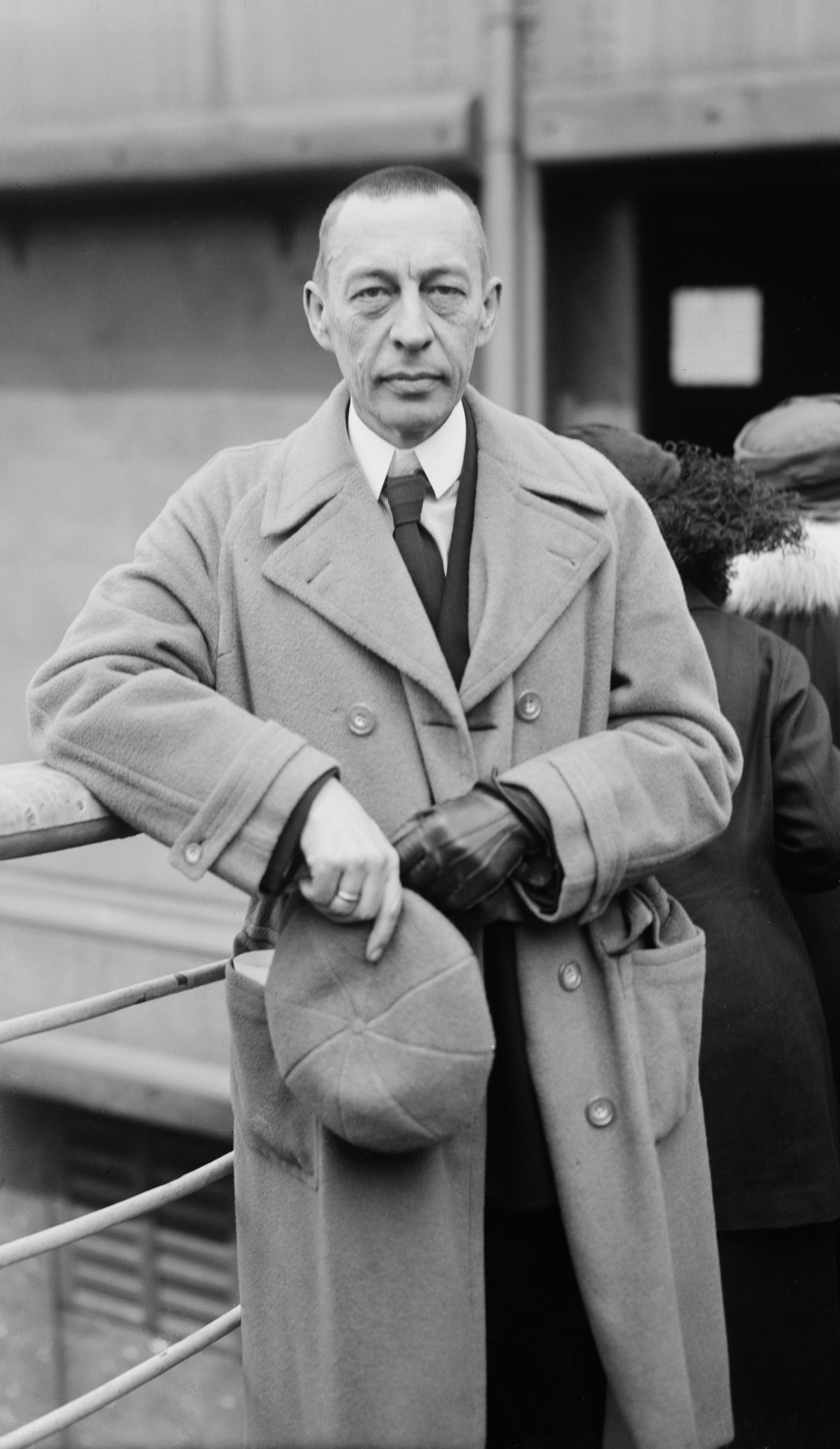
Up, up in the highest echelons of the pianistic pantheon sits Sergei Rachmaninov….
Regarded as one of the greatest pianists of the twentieth century, Rachmaninov had legendary technical facilities and rhythmic drive, and his large hands were able to cover the interval of a thirteenth on the keyboard. Today, his piano music remains amongst the most well-loved and widely-performed in the standard repertoire, yet in the 1950s the Grove Dictionary of Music and Musicians dismissed it as “monotonous in texture….. consist[ing] of mainly of artificial and gushing tunes….”. He was composing at a time when music was undergoing huge sea-changes (atonality and the development of the 12-note tone row, for example), yet he remained true to his own compositional vision and his music is unashamedly Romantic, full of sweeping melodies and rich textures. Even in his miniatures (for example, the Preludes, Moments Musicaux, Études-Tableaux) his music seems to express the vastness of the Russian landscape. It has a visceral and deeply honest quality.
“A composer’s music should express the country of his birth, his love affairs, his religion, the books which have influenced him, the pictures he loves…My music is the product of my temperament, and so it is Russian music”
Sergei Rachmaninov
Here is Sviatoslav Richter in the Prelude in G-sharp minor, Op 32, no. 12
Many of his piano works enjoy legendary status, and are performed around the world by the famous and the lesser known, such is their beauty, appeal and scale of challenges. Take the Third Piano Concerto, by his own admission his “favourite” of all his piano concerti – “I much prefer the Third, because my Second is so uncomfortable to play”. Due to time constraints, Rachmaninoff could not practise the piece while in Russia, and instead he practised and memorised it using a silent cardboard keyboard that he brought with him while sailing to the United States. It was premiered in New York on 28th November 1909 by Rachmaninov himself, and was dedicated to the pianist Josef Hofman, whom Rachmaninoff regarded as the greatest pianist of his generation, though Hofman never actually performed the Third Concerto.
The opening theme of the Third Piano Concerto
Monumental, treacherous, gorgeous, its fearsome technical difficulties reflect the composer’s own transcendent prowess at the keyboard. For the pianist it is forty-five minutes of almost continuous playing, the equivalent in energy expended to shovelling three tons of coal just to move the keys – and this excludes the emotional and intellectual energy used. For the audience, when played well it, it encompasses the full range of human emotions in its towering virtuosity.
The Cross-Eyed Pianist is free to access and ad-free, and takes many hours every month to research, write, and maintain.
If you find joy and value in what I do, please consider making a donation to support the continuance of the site

 Up, up in the highest echelons of the pianistic pantheon sits Sergei Rachmaninov….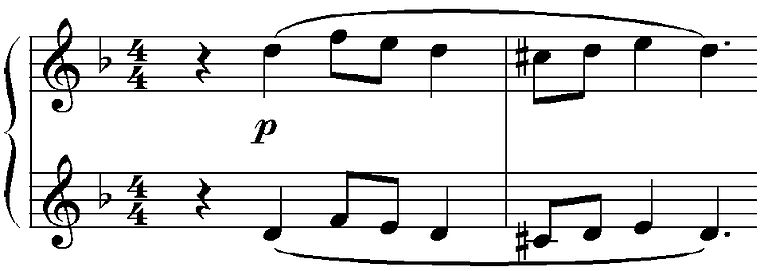




 The Cross-Eyed Pianist