ABSOLUTE

J.S. Bach: Lute Suites BWV 996-998Transcribed for piano and performed by Eleonor Bindman

All my transcriptions are motivated by the desire to play my favourite music on the piano. – Eleonor Bindman

A lifelong love of J S Bach has led pianist Eleonor Bindman to produce a number of important transcriptions for solo piano and piano duo of his music for other instruments, including the evergreen Cello Suites and the Brandenberg Concertos.

In addition to recordings demonstrating ‘Bach playing of the highest order’ (Pianodao), Eleonor has also produced sheet music and anthologies of her transcriptions, primarily aimed at amateur pianists and piano teachers. Her two-volume ‘Stepping Stones to Bach’ features intermediate piano arrangements of the Baroque master’s most famous tunes, including the Gavotte from the Violin Partita, No.3, and the Badinerie from the Orchestral Suite, No. 2. In making these transcriptions, she is following in the footsteps of the master himself: Bach regularly transcribed his own and other composers’ music and created different instrumental versions of the same piece.

The resulting musical statement may be a faithful reproduction …, a transformation beyond recognition or something in between. Regardless of the outcome, the original source is of such exceptional depth and appeal that for the past three centuries it attracted a steady stream of pilgrims, ready to sacrifice their time and energy for the joy of communion.

Eleonor Bindman

In her latest project, she has turned her attention to works originally composed for the lautenwerk or lautenwerck (lute-harpsichord), one of Bach’s favourite instruments, similar to the harpsichord, but with gut (or nylon today) rather than metal strings, which results in a more mellow tone. Generally performed on harpsichord, lute, and guitar, Eleonor’s new recording of the Lute Suites brings a fresh perspective on these rarely-explored masterpieces, showcasing their intricate structures, rich textures, and emotive character on the modern piano.

Eleonor Bindman’s Bach pianism is all about clarity and order. Her strong and assertive fingerwork complements her firmly centred rhythm

Gramophone magazine

Highlights include BWV 997 and 998, featuring stunning fugues with ornate middle sections unlike typical keyboard fugues, and a heartfelt arrangement of “Betrachte, meine Seele” from St. John’s Passion, which serves as a moving conclusion to the album.

Fans of Eleonor Bindman’s previous transcriptions – such as The Brandenburg Duets and The Cello Suites – will appreciate this latest addition to the pianist’s catalogue, recorded on a Bösendorfer piano which truly captures the remarkable richness of Bach’s writing.

Eleonor Bindman writes, ‘Transcriptions can revive interest in original compositions, and I am hoping that a piano version of Bach’s Suites BWV 996, 997, and 998 will increase their popularity. Just like Bach’s other solo collections, these suites present a technical and musical tour de force for their performers and deserve their rightful place alongside Bach’s suites for keyboard, violin, and cello.’

Eleonor Bindman celebrates J S Bach’s 340th birthday and launches her new CD with a special concert at the 1901 Arts Club, London’s most stylish small venue, on Sunday 23 March at 3pm. Tickets/info here

ABSOLUTE is released on Friday 7th March on the Orchid Classics label. Available on CD and via streaming. Pre-order here

eleonorbindman.com

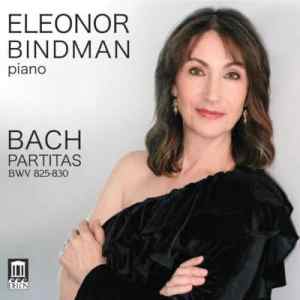
J S BACH – PARTITAS BWV 825-830, 2 CDs

Release date: 6 May 2022 on the Delos label

Eleonor Bindman, piano

‘Bach playing of the highest order – Andrew Eales/Pianodao.com

Bach’s six keyboard Partitas have long been regarded as one of the most important milestones of the Baroque keyboard repertoire and remain amongst Bach’s most popular works for pianists and listeners alike, with their wealth of invention, drama, intimacy, wit and emotion.

Praised for her musical sense and appreciation of the majesty in Bach’s music, Latvian-American pianist Eleonor Bindman follows her critically-acclaimed recordings of her own transcriptions of Bach’s Brandenburg Concertos for piano-four-hands and the Cello Suites for solo piano, with her latest release of the complete keyboard Partitas.

Bach published the six keyboard Partitas himself in 1731 as his “Opus 1,” clearly indicating that he was satisfied with his work. The keyboard Partitas follow a similar template to his English and French Suites, with a succession of popular Baroque dance movements which also appear in all six Partitas. But unlike the French Suites, each begins with a form of Prelude with a different title for each of the six (for example, Sinfonia, Fantasia, Praeambulum and Toccata), demonstrating Bach’s flexibility and personality. With the inclusion of a diverse selection of dance movements, the Partitas are the most varied and cosmopolitan of Bach’s keyboard suites.

Eleonor Bindman’s experience of working with the complex counterpoint of the Brandenburg Concertos, which she transcribed for piano-four-hands, as well as with the expressive possibilities of a single melodic line of the Cello Suites (her most recent transcription for solo piano), results in some fresh interpretive insights in the Partitas – for example, in the choice of pace and tempi to allow listeners the opportunity to enjoy the emotional connotations of rhythm, harmony, counterpoint and ornamentation, and in the creative treatment of repeats.

Eleonor explains:

‘I find the variety of keys and the character (largely implied by the opening movements of course) of each suite gratifying. I also believe that the Partitas, as an oeuvre, include some of Bach’s most diverse, ingenious and intimate writing for the keyboard (aside from the Well-Tempered Clavier to an extent, of course). They deserve a lot more attention than the Goldbergs, in my humble opinion.  Rather than a series of exercises in canons, they are in fact a kaleidoscopic representation of Bach’s genius.  The incredible sincerity and communicative warmth of the Allemandes from Suites 4 and 6, the jazzy Courante from No. 6, the comical Aria and Burlesca from Partitas 4 and 3, respectively, the scintillating Praeambulum of Partita 5 and the challenging fugues or Capriccio of Partita 2 as endings – these are unique emanations of Bach’s personality. In the Partitas there isn’t a single even semi-boring page.  The aforementioned Allemandes are my favourite keyboard playing experiences.  Bach doesn’t even try to disguise them into dance form, save for the titles.  Playing the Allemande from Partita No. 4 in D major brings me into a state which I can only – inadequately and clumsily – describe as “participating in a revelation of truth.”’ 

Produced, engineered and edited by Sam Ward Recorded Dececember 20-21, 2020, and January 9-10, 2021 at President Street Studios, Brooklyn, NY

Instrument: Bösendorfer #48862


About Eleonor Bindman

Praised for her “lively, clear-textured and urbane” Bach performances and her ”impressive clarity of purpose and a full grasp of the music’s spirit,” New York-based pianist, chamber musician, arranger and teacher Eleonor Bindman was born in Riga, Latvia, and began studying the piano at the E. Darzins Special Music School at the age of five. After her family emigrated to the United States, she attended the High School of Performing Arts in New York City while studying piano as a full scholarship student at the Elaine Kaufman Cultural Center. She received a BA in music from New York University and completed her MA in piano pedagogy at the State University of New York, New Paltz, under the guidance of Vladimir Feltsman.

Ms. Bindman’s recital appearances have included Carnegie Hall, The 92nd Street Y, Merkin Hall and Alice Tully Hall; concerto appearances have included engagements with the National Music Week Orchestra, the Staten Island Symphony, the Hudson Valley Philharmonic, the New York Youth Symphony, and the Moscow Radio and Television Symphony Orchestra. Classical Archives declared: “Prepare to be surprised” when encountering Ms. Bindman’s vast range of activity.

In the past few years, she has been focusing on the music of J.S. Bach. Her Brandenburg Duets, a new arrangement of the six Brandenburg Concertos for Piano-four-hands, with pianist Jenny Lin, was declared 7 “breathtaking in its sheer precision and vitality” by Pianist Magazine, while the Cello Suites for Piano, an accurate transcription of Bach’s iconic set, made its debut at #7 on the Billboard® Traditional Classical Charts. Both recordings were best-selling releases for Grand Piano Records in 2018 and 2020. A recording of Ms. Bindman’s arrangement of the Orchestral Suites, also for Piano-four-hands, is forthcoming.

eleonorbindman.com


For further press information, review copies and interviews, please contact Frances Wilson frances_wilson66@live.com

In this wide-ranging conversation Frances Wilson (AKA The Cross-Eyed Pianist) talks to pianist, recording artist and teacher Eleonor Bindman about the world of the amateur pianist, the pleasures and frustrations of being an amateur pianist, how teaching adult amateurs presents interesting unique challenges for teacher and pupil alike, and much, much more…..


“Bach first became my beacon when I was about 10 years old. I remember sneaking a peek at my piano teacher’s notebook and seeing the words “plays Bach well” under my name. That vote of confidence shaped my musical identity…”

Eleonor Bindman, pianist


The Six Solo Cello Suites are some of the most celebrated and much-loved works in the classical repertoire, and they continue to fascinate and inspire performers and audiences alike. In this brand new transcription for solo piano, Eleonor Bindman pays tribute to this music’s enduring allure. The Cello Suites project grew out of Eleonor Bindman’s ‘Stepping Stones to Bach’, arrangements of orchestral and choral music which aimed to help amateur pianists play Bach successfully. The 2-volume collection includes transcriptions of some of Bach’s most popular music, including the ‘Badinerie’ from the Suite BWV 1067, the chorale prelude “Wachet Auf”, “Erbarme dich, mein Gott” from the St Matthew Passion, and three movements from the Cello Suites. Inspired by how gratifying it felt to play those, Eleonor researched existing piano versions of the complete Cello Suites and was surprised not to come across any that were really true to the original.

The only straightforward piano transcription of any movements of the Cello Suites, dating from 1914, is by Russian pianist and impresario Alexander Siloti (1863-1945), a student of Franz Liszt. Siloti’s transcription gave Eleonor the resolve to pursue this project and arrange the complete 36 movements as closely to the original as possible. Playing through other variously enhanced piano versions, including an arrangement of all six Suites by Joachim Raff (c.1869-71) and of Suites 2, 3 and 5 by Leopold Godowsky (1924), Eleonor became convinced that the Suites didn’t need any “improvement.”

In her transcription, Eleonor has made a number of adjustments due to the different capabilities of the instrument, including slightly faster tempi especially in the Sarabandes, which also help make the harmonic structure more discernible. Here too she endeavoured to imitate the cello sound most closely, which would not have been possible without the marvellous baritone register of her Bösendorfer piano on which her recording was made. Some transpositions have also been necessary, and a variety of embellishments in repeats, some conventional and some more original. The transcription offers scope for some adventurous interpretation, particularly in the wonderfully playful pairs of Minuets, Bourrées and Gavottes.

The Cello Suites are the essence of Bach, a meditation which mysteriously connects us to ourselves and to the universe at once. My new transcription of this beloved set shows a refreshing perspective to a pianist, unencumbered by counterpoint and zooming in on the individual line, patterns, tone quality, and the great composer’s vocabulary. I find the experience of playing the Suites on the keyboard not only aesthetically satisfying but also relaxing and joyful. We could all use an opportunity to enjoy our music-making without unnecessary stress, especially in current times. I am also eager to bring these 36 pieces to many pianists and students because they are immensely beneficial for working on tone and finger technique.” –Eleonor Bindman

The recording of Eleonor’s transcription, made on her own Bösendorfer piano, is released on 9 October 2020 on the Naxos Grand Piano label, and the sheet music is also in preparation. This is aimed primarily at amateur pianists (intermediate to early advanced level) who relish the opportunity of playing music other than Bach’s works specifically for keyboard and who would like to be free of the rigours of complex counterpoint. Like the works included in her ‘Stepping Stones to Bach’, Eleonor has provided pianists with yet more repertoire to explore, and her elegantly, meticulous transcriptions shine a new light on this wonderful music while also remaining true to the original.

To listen to sample tracks or pre-order, click here

For press information about Eleonor Bindman’s Cello Suites for Solo Piano, please contact Frances Wilson

