Guest post

PianoMe: The Smart Way to Share Rehearsal Spaces and Earn Money with Your Music Room

What can you do when rehearsal rooms and instruments stand empty for hours or even days?

The answer is simple: share them through www.piano.me/en and turn unused space into income.

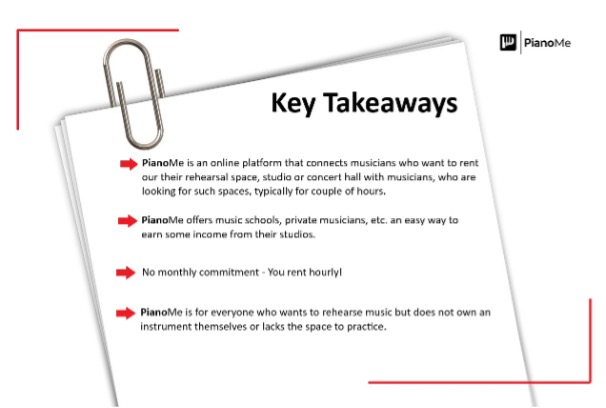
PianoMe is a growing online platform that enables musicians, music schools, studios, churches, and private hosts to rent out rehearsal spaces with instruments by the hour. At the same time, musicians can book affordable practice rooms exactly when they need them—no long-term contracts, no unnecessary costs.
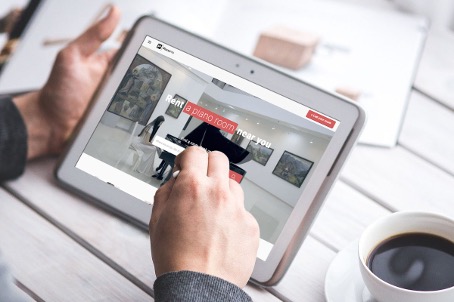
Rehearsal Spaces Sharing Community – Built by Musicians for Musicians

PianoMe was created by musicians who experienced the same problem many artists face: finding a suitable place to practice is often difficult, expensive, and inflexible.

The idea behind the platform is based on the sharing economy: if a room and an instrument are not in use, they can be shared with others.

This creates a classic win-win situation:

  • Hosts generate additional income from otherwise idle rooms
  • Musicians pay only for the time they actually use
  • Cities benefit from a reduction in rehearsal room shortages

Traveling musicians, in particular, appreciate being able to book a nearby practice room within minutes, whether for an audition, an exam, or a recording session.

Monetize Your Empty Rehearsal Room

If you own a rehearsal room or a studio that is not used 24/7, PianoMe offers an easy and secure way to earn money.

Creating a listing takes only a few minutes:

  • Upload photos
  • Set your availability
  • Define your own rental rules and cancellation terms
  • Start receiving bookings

All processes—from request to payment—are fully digital and automated, which means no paperwork and minimal administrative effort.
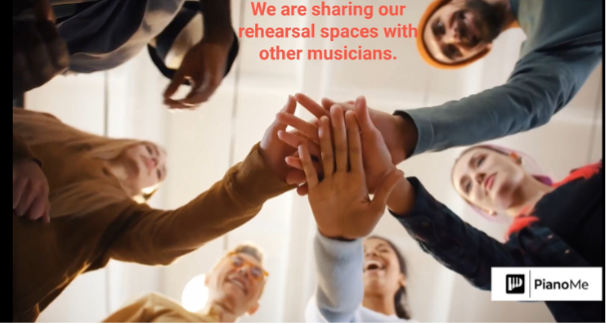
A Lifeline for Music Schools

Music schools are facing increasing financial pressure due to rising costs and reduced public funding. PianoMe helps them:

  • Generate additional revenue from unused rooms during off-peak hours
  • Digitize and automate their rental processes
  • Reach new target groups such as freelance teachers, ensembles, and choirs

For some institutions, hourly room sharing has already become a second financial pillar that helps stabilize operations.

Flexible Solutions for Music Teachers

Freelance music teachers benefit from a highly flexible, on-demand room model:

  • No long-term rental contracts
  • No deposits
  • Hourly bookings based on actual teaching needs
  • Easy cancellations within the respective host’s policy

This supports the growing agency model in music education, where teachers operate independently and require adaptable teaching spaces.
Growing Demand and a Diverse Rehearsal Space Marketplace

The response on social media has been overwhelmingly positive. The general consensus is clear: without PianoMe, many rehearsal rooms would remain unused for hours or even days, generating costs instead of value. With PianoMe, this situation is reversed. As one private host wrote in a Google review, their grand piano used to be played only on weekends, but thanks to the platform, both the instrument and the room are now actively used during the week as well.

As the PianoMe network continues to expand, the range of available spaces is becoming increasingly diverse. Today, the platform offers far more than single piano practice rooms. Musicians can find studios equipped with drum kits, electric guitars, or even full recording setups. Room sizes vary widely—from small attic spaces and basement studios to full concert halls and modern event venues with stage and seating.

Browsing PianoMe feels like discovering the hidden musical infrastructure of a city. Many users are surprised by how many rehearsal rooms and instrument-equipped venues exist behind the scenes—places they would never have found without the platform.

Despite this wide selection, choosing the right room remains simple. User reviews provide real insights into the quality of the space and the instruments. In addition, each listing includes detailed information such as available equipment, room size, hourly price, capacity, concert suitability, rental conditions, and real-time availability.

The platform is used not only by professional musicians but also by hobbyists. And it is no longer limited to pianists—singers, amateur bands, choirs, violinists, composers, and many others are now part of the growing PianoMe community.

Free Music Event Promotion and Digital Tools for Musicians
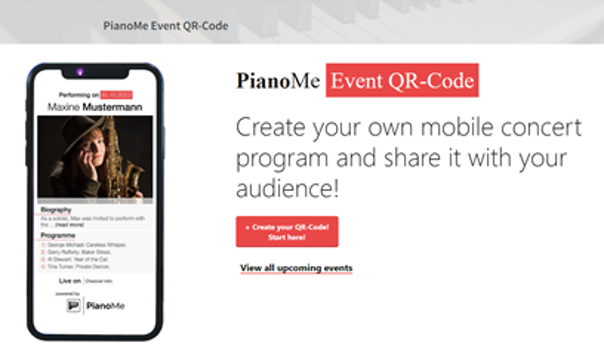
Every musician wants to perform live—and ideally to a full audience. PianoMe makes this easier by allowing users to promote their music events completely free of charge. The platform’s event promotion page, together with its integrated event QR code feature, has recently been expanded with additional functions. Event announcements can now be created on any device within minutes and shared directly across social media channels.

For those who prefer physical promotion, PianoMe also offers a one-click poster generator. Users can design, download, print, and display posters without needing external design tools. Concert programs can be distributed digitally via QR codes, enabling audiences to access them instantly on their smartphones—saving both printing costs and large amounts of paper.

By combining rehearsal spaces with digital promotion and content sharing, PianoMe goes far beyond room booking. It creates a connected ecosystem where musicians support each other, exchange ideas, and present their work.

Read PianoMe’s interview with Frances Wilson (The Cross-Eyed Pianist)
Guest post by Alexandra Westcott

This article about learning the piano, the skills and the memories was lovely, and jogged my own memories of myself both as student and teacher.

I was about 6 when I used my sister’s books to learn the piano – they had photos for hand positions and finger numbers and that seemed all I needed (I’ve no idea to this day how I learned the rhythm and counting; I don’t remember reading about it but I must have!). I raced through the books and started fiddling with any music floating around, which was a fair amount as my Mum was a singer and also played the piano. I remember having the C major Mozart sonata at home and learning two pages during each holiday when home from boarding school at around 8 or 9. At this point Mum asked me if I wanted lessons, and because all my friends hated it (they hated the
practice); I said no because I loved playing, but she obviously ignored me and I ended up with a teacher I adored with whom I became very close.

I played the piano in all my spare time to the extent my reports used to say ‘she spends a lot of time at the piano’ and during prep, having done my homework as fast as possible, would skip off to the music rooms. I was fussy even then about the piano I played, and only the teachers’ or the grand in the assembly hall would do! None of the awful practice pianos for me!

During my time at school with this wonderful teacher, me and a group of friends would be taken away for a weekend each term to him and his wife at his amazing ancient cottage. He was the church organist and ran the church choir so we ate well on local Devon produce that he was given by local friends and members of the church. At times we also had breakfast in bed (often sugar on toast!), It was all very idyllic and I stayed in touch with him and his wife until they died.

For the 6th form I left there and went to a college local to my home, so I changed teacher and went to a local music school during my A levels. A completely different teacher and one the parents were scared of but the pupils loved. We did Sunday concerts at her house, always with cake, and a large concert once a year at the 6th form college at which she got her advanced students to do a movement of a concerto with her school orchestra. I did the first movement of the Schumann. I never wanted to be a concert pianist but this was good experience and I later had the chance to play on a few occasions with another orchestra, and for one of the concerts performed the whole of the Schumann. It brought back many memories.

I had another teacher for my degree, and then had a break in formal lessons before returning to a commitment to my own playing in my 20s. I had a local teacher for a year but then met Nelly Ben Or and knew I had to learn with her.

Nelly Ben Or

I studied with Nelly for many many years undoing my bad habits in order to acquire new and better ones and becoming a much better pianist, and a better teacher for that. I would often have lunch along with my lessons, and, again, house concerts and other performances enhanced the lessons. And, yes, you guessed it, always with accompanying food and drink.

As a teacher myself I became the sort of teacher I had grown up with; I had close bonds with my students, always had house concerts and local concerts both with tea parties afterwards, usually some chocolate for after lessons, and often would become close friends and either take them out for tea when young, or stay in touch later on.

Piano teachers, or any instrument teacher, hold a particular place in the life of a child. Such a close bond is formed and often many confidentialities shared. There needs to be trust for something that is hard to learn and something that needs self expression in execution. It is maybe not surprising that the bond becomes a firm friendship (and, often, one that needs physical as well as sustenance)!

I often wonder about my students’ memories of their time with me and whether they have similar memories as I do about my own mentors. I hope they hold the same  happy and cherished memories in their hearts for all the hours we spent and fun we had together as I do for my own teachers.

Alexandra Westcott is a piano teacher based in north London who specialises in understanding the piano in the light of the Alexander Technique, as studied with Nelly Ben Or, and encourages all areas of learning in a creative way. Find out more here

If you would like to share your piano memories, whether you are a teacher or pianist, or bothm, please get in touch


This site is free to access and advert-free. If you find joy and value in the content of this site, please consider making a donation to support its continuance, and to ensure it remains free to read.

I admit it, I’m a fervent auto-didact, a “self-teacher” whose answer to “how do I do that?” is to either reach for a book or more likely these days, look it up on Google or YouTube.

For me, self-teaching goes hand-in-hand with mastery as both require a willingness to stick to the task with a deep sense of purpose and intent.

Self-teaching – the process of educating oneself without the guidance of a formal teacher or instructor- is a powerful tool that can be used to acquire new skills, deepen existing knowledge, and pursue personal interests. One of the main benefits of self-teaching is that it allows for a customised learning experience. Traditional music education often follows a one-size-fits-all approach, which tends not to treat each student as an individual, with their own strengths and weaknesses. With self-teaching, you have the freedom to choose the materials, resources, and speed of progress that work best for you. This can make the learning process more engaging, effective and, importantly, interesting.

Why is self-teaching important for the musician? Self-teaching can be a great way to build self-motivation and self-discipline. When you take responsibility for your own learning, you develop a sense of ownership and pride in your achievements. This can be a powerful motivator and can lead to increased confidence and self-esteem. More importantly, self-teaching encourages creative thinking, problem-solving, and curiosity – all useful skills for the musician.

My own experience of self-teaching has been extremely positive and motivating. When I moved away from London five years ago, I left behind several very important teachers and mentors, who had supported, encouraged, and inspired me while I was studying for professional performance diplomas, having returned to the piano after an absence of nearly 25 years. Having studied with two master teachers for nearly 10 years and received mentorship from several other significant pianist-teachers, I felt ready to “go it alone” and cease piano lessons altogether. I would not have felt sufficiently confident to do this had my teachers and mentors not instilled in me a sense of trust in my own musical instincts, secure technique, and a strong awareness of my own interpretative choices and artistry as a musician. Thus, I had firm foundation on which to continue my musical studies on my own.

It may take me longer to work out certain technical issues at the piano, but the process of self-teaching encourages one to find a way through a problem, which in itself becomes a useful learning tool. I also feel liberated from the sense that there is a “right way” to play certain repertoire; interpretative choices are down to my own knowledge and appreciation of the music.

Self-teaching does come with its own set of challenges, one of the biggest being staying motivated and on track. Without the guidance of a teacher, it can be easy to lose focus or become discouraged. To overcome this challenge, it is important to set clear goals, create a practice schedule, and seek out trusted friends and colleagues who can provide feedback and encouragement.


This site is free to access and ad-free, and takes many hours to research, write, and maintain. If you find joy and value in what I do, why not