
I first encountered the piano music of British composer Peter Seabourne in 2016 when he kindly sent me the scores and recordings of his Steps Volumes 2, 3, 4 and 5. Conceived and organised as “a pianist’s Winterreise”, the music is remarkably varied yet highly accessible and recalls the piano music of Debussy, Janacek, Prokofiev and Messiaen in its piquant harmonies, lyricism, and rhythmic adventurousness. Seabourne describes the series as “a compositional travelling companion” and the collection works more like a cycle rather than a progressional series such as Bartok’s Mikrokosmos.
Although composed over ten years ago, the pieces which comprise Steps Volume 1 have now been released (on the Sheva label), performed by Korean pianist Minjeong Shin. The first volume is not intended as a cycle, but rather a set of pieces in the manner of Grieg’s ‘Lyric Pieces’ or Janacek’s ‘On An Overgrown Path’, for example, and the works have evocative titles, many of which are drawn from poetry by Emily Dickenson, Sylvia Plath, Rilke and Swinburne. The range of expression, character and emotional power of these pieces is impressive, hinting at a lively, inquisitive and all-encompassing attitude to creating music (as the composer says himself, “I am with Mahler: music should contain all of life!“), and the broad scope of the music, together with its inherent expressivity, lyricism and romanticism, makes it immediately appealing. There are atmospheric etudes, aphoristic miniatures, expansive character pieces, and intimate, poetic preludes. Minjeong Shin’s sensitive response to the shifting moods and myriad soundscapes reveals the music’s astonishing variety and virtuosity.
The CD’s comprehensive booklet was written by the composer himself and contains detailed programme notes for each work, together with biographical information on performer and composer.
In Steps Volume 1, and indeed in the other volumes in the cycle, Peter Seabourne has created contemporary piano music which is accessible and appealing to professional and amateur pianists alike (he has also made the score readily available via his website), and it is most gratifying to have such a varied contribution to the ever-growing repertory of new music for piano.
Recommended.
Review of the other volumes in the Steps series
 ‘Stations of the Cross’, a new work for solo piano by British composer and pianist Simon Vincent, was inspired by a visit to Jerusalem in 2015 and by William Fairbanks’ installation in Lincoln Cathedral. Entitled Forest Stations, the installation is a series of sculptures in wood and reflects Fairbanks’ love of timber and his concern about the preservation of forests and trees. The sculptures tell the story of Christ’s death, the ‘Stations of the Cross’ being the places on the route to the place of Crucifixion where Christ is said to have stopped. For the faithful, each station, or stopping point, provides a point of prayer and meditation on the Passion of Christ.
 Xenakis
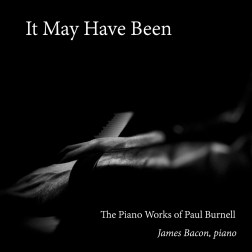 This new album celebrates the piano music of British composer Paul Burnell, spanning 30 years. Paul had recorded and produced previous albums himself, but in this instance he decided it was time to work with another musician, the pianist, composer and recording engineer James Bacon who runs the Piano Recording Studio. The music was recorded on a Bosendorfer Phoenix Imperial 290, fitted with the Phoenix agraffe system pioneered by Richard Dain at Hurstwood Farm Pianos, which gives the piano greater sustain and clarity of sound, especially in the high registers. This makes it ideal for Burnell’s piano music, much of which explores the timbre and sonic possibilities of the piano rather than melody per se.



 The Cross-Eyed Pianist