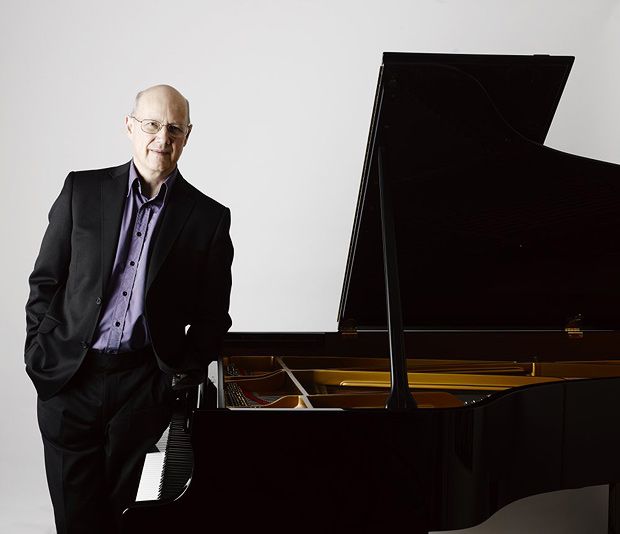
Who or what inspired you to take up the piano and pursue a career in music?

My parents couldn’t afford a babysitter, so I was attending concerts at the Belgrade Philharmonic from the ripe age of three months with a milk bottle – thus food became an important part of my musical life later on.

My older brother and sister already played violin and cello respectively, but it was in one of the concerts that I heard the Prokofiev Third Piano Concerto (as you see, a certain modernity was always a necessity for me) and I decided I was going to be a pianist, to the utter dismay of our neighbours who then had to endure the practicing of three instruments.

Who or what were the most important influences on your musical life and career

Bach, Beethoven, Brahms, Boulez, Thomas Mann, Rembrandt, all sharing a strength of disciplined thought and lack of self-indulgence.

What have been the greatest challenges of your career so far?

My country (former Yugoslavia) was in multiple wars in the 1990´s. Having moved from the Curtis Institute of Music in Philadelphia to Cologne, I lost all concert bookings, the opportunity to travel freely and, most importantly, all financial help in the form of scholarships. Everything was annulled as sanctions were imposed on Serbia. My life subsisted on a couple of hundred Deutschmarks a month, working strange jobs, having not more then handful of concerts in almost a decade, eating once a day for prolonged moments of studying and traveling with considerable difficulties due to visa issues.I have never practiced as much as in those years.

But the question of changing the profession was a daily one. I worked but my work was not used – and for me not being useful is close to a sin.

Some years later I was offered series of concerts with Pierre Boulez’s Second Piano Sonata, which I had to learn, and it became my inspiration, the re-start of a career and a source of energy for now more then 15 years – the mix of courageous, revolting, poetic and young energy in this piece transformed me and gave me the hope that my talent could be useful.

Which performance/recordings are you most proud of?

Playing all Boulez piano works in a series of recitals in the USA, and traveling with my husband and 6 month-old baby was a tour de force like none other. Performing all 6 Bach Partitas in one evening in Germany, or Messiaen’s Turangalila Symphonie 10 times on 10 consecutive days are high on my list of excitements. Seeing Maestro Brendel giving me a standing ovation in London still gives me shivers. Accompanying Matthias Goerne were experiences with an intensity and beauty that is unmatchable.

My CD of Bach/Bartok (available online) is where I have produced the truest portrait so far of what is close and true to me as an artist.

Which particular works do you think you perform best?

The unpretentious ones that have a considerable complexity on all levels – emotional, structural, aural – and that represent a huge amount of challenge as well as surprise.

Bach, Boulez, Stockhausen, Ives, Szymanowski for the moment.

How do you make your repertoire choices from season to season?
In constant dialogue with organisers as it shouldn’t be about me, but teamwork between my given curiosity, possibilities of the instrument, hall, timing of the season and openness of the public for a given evening. Thankfully I have a wise agent who after 17 different programmes does ask if it is not just maybe a little bit too much of repertoire for one season.

Do you have a favourite concert venue to perform in and why?

Kolarac in Belgrade, loved by Richter as well.

Who are your favourite musicians?

The uncompromising ones – John Eliott Gardiner, Harnoncourt, Boulez, Richter, Oistrakh, Annie Fischer, Rosalyn Tureck, Matthias Goerne, Salonen.

What is your most memorable concert experience?

Hopefully the next one…..but recently having Maestro Pollini come to my recital in La Scala.

What do you consider to be the most important ideas and concepts to impart to aspiring musicians?

Think about what the role of a musician is today and how you can be at best useful for today’s society – for me certainly not playing only older repertoire, but thinking how to link music of all times and span it to extraordinary creations of today. Challenge yourself by not copying someone else’s path, and be more open to creation of today then re-creating old career structures. In short, less image more substance.

Where would you like to be in 10 years’ time?

Admiring my, then, teenage son, finishing a literature degree and gaining a driver’s licence, completing all ashtanga yoga series.

What is your idea of perfect happiness?

Health

What is your most treasured possession?

My son

What is your present state of mind?

Gratefulness


Known for captivating interpretations of a wide repertoire, Tamara Stefanovich performs at the world’s major concert venues including Carnegie Hall New York, Berlin Philharmonie, Suntory Hall Tokyo and London’s Royal Albert and Wigmore Halls. She features in international festivals such as Lucerne, La Roque d’Antheron, Ravenna, Aldeburgh, Salzburger Festspiele, Styriarte Graz, Klavier-Festival Ruhr and Beethovenfest Bonn.

Highlights of the current season include her return to the Philharmonia Orchestra with Esa-Pekka Salonen, performances of Szymanowski’s Symphonie concertante on tour with the National Youth Orchestra Great Britain and the presentation of Quasi una fantasia and the Double concerto with the Ensemble Asko|Schönberg and Reinbert de Leeuw at Amsterdam’s Muziekgebouw as part of ECM’S complete recording of Kurtág’s works. She will give recitals at International Piano Series London, Musikfest Berlin, Milano Musica, Vienna’s Konzerthaus and Antwerp’s De Singel performing Stockhausen’s Mantra with Pierre-Laurent Aimard.

Tamara is cofounder and curator of the newly created festival “The Clearing” at Portland International Piano Series that will see her perform in recitals and work with young pianists and composers. Her appearance at the festival will be surrounded by recitals in Ithaca and Bellingham.

Recent engagements have included Tamara’s debut with the Sarasota Orchestra and performances with the Symphonieorchester des Bayerischen Rundfunks, MDR Symphonieorchester Leipzig, WDR Symphonieorchester Köln, Chamber Orchestra of Europe and Iceland Symphony Orchestra as well as an extensive US recital tour marking the 90th birthday of Pierre Boulez garnering exultant reviews such as that of The New York Times: “Ms. Stefanovich’s performance of Boulez’ second piano sonata was staggeringly brilliant”.

Stefanovich has appeared with orchestras including The Cleveland and Chicago Symphonies, London Symphony, London Philharmonic, Bamberger Symphoniker, Britten Sinfonia, Deutsche Kammerphilharmonie Bremen, Swedish Chamber Orchestra and London Sinfonietta.

Tamara Stefanovich has collaborated with conductors such as Vladimir Ashkenazy, Pierre Boulez, Osmo Vänskä, Susanna Mälkki, Vladimir Jurowski as well as leading composers including Peter Eötvös and György Kurtág. She regularly leads educational projects at London’s Barbican Centre, Philharmonie Köln and at Klavier-Festival Ruhr such as innovative online project of interactive pedagogical analyses of Boulez’ Notations: www.explorethescore.org

Her discography includes the Grammy-nominated recording of Bartók’s Concerto for Two Pianos, Percussion and Orchestra with Pierre-Laurent Aimard, Pierre Boulez and the London Symphony Orchestra for Deutsche Grammophon. Stefanovich has also recorded for the AVI and harmonia mundi labels, featuring new piano solo works by Thomas Larcher. Her latest recording of Hans Abrahamsen’s concerto for piano and orchestra and 10 studies for piano with WDR Symphonieorchester Köln released by Winter & Winter. In 2015 she recorded Kurtág’s ‘Quasi una Fantasia’ and the Double Concerto with Asko | Schönberg Ensemble and Reinbert de Leeuw for ECM.

Taught by Lili Petrović, Tamara Stefanovich became the youngest student at the University of Belgrade at the age of 13. As well as music, her broad university education encompassed several other disciplines – psychology, education. She also studied at the Curtis Institute with Claude Frank, and subsequently with Pierre-Laurent Aimard at the Hochschule Köln.

(Photo: Marco Borggreve)

Who or what inspired you to take up the piano and pursue a career in music?

My parents couldn’t afford a babysitter, so I was attending concerts at the Belgrade Philharmonic from the ripe age of three months with a milk bottle – thus food became an important part of my musical life later on.

My older brother and sister already played violin and cello respectively, but it was in one of the concerts that I heard the Prokofiev Third Piano Concerto (as you see, a certain modernity was always a necessity for me) and I decided I was going to be a pianist, to the utter dismay of our neighbours who then had to endure the practicing of three instruments.

Who or what were the most important influences on your musical life and career

Bach, Beethoven, Brahms, Boulez, Thomas Mann, Rembrandt, all sharing a strength of disciplined thought and lack of self-indulgence.

What have been the greatest challenges of your career so far?

My country (former Yugoslavia) was in multiple wars in the 1990´s. Having moved from the Curtis Institute of Music in Philadelphia to Cologne, I lost all concert bookings, the opportunity to travel freely and, most importantly, all financial help in the form of scholarships. Everything was annulled as sanctions were imposed on Serbia. My life subsisted on a couple of hundred Deutschmarks a month, working strange jobs, having not more then handful of concerts in almost a decade, eating once a day for prolonged moments of studying and traveling with considerable difficulties due to visa issues.I have never practiced as much as in those years.

But the question of changing the profession was a daily one. I worked but my work was not used – and for me not being useful is close to a sin.

Some years later I was offered series of concerts with Pierre Boulez’s Second Piano Sonata, which I had to learn, and it became my inspiration, the re-start of a career and a source of energy for now more then 15 years – the mix of courageous, revolting, poetic and young energy in this piece transformed me and gave me the hope that my talent could be useful.

Which performance/recordings are you most proud of?

Playing all Boulez piano works in a series of recitals in the USA, and traveling with my husband and 6 month-old baby was a tour de force like none other. Performing all 6 Bach Partitas in one evening in Germany, or Messiaen’s Turangalila Symphonie 10 times on 10 consecutive days are high on my list of excitements. Seeing Maestro Brendel giving me a standing ovation in London still gives me shivers. Accompanying Matthias Goerne were experiences with an intensity and beauty that is unmatchable.

My CD of Bach/Bartok (available online) is where I have produced the truest portrait so far of what is close and true to me as an artist.

Which particular works do you think you perform best?

The unpretentious ones that have a considerable complexity on all levels – emotional, structural, aural – and that represent a huge amount of challenge as well as surprise.

Bach, Boulez, Stockhausen, Ives, Szymanowski for the moment.

How do you make your repertoire choices from season to season?

In constant dialogue with organisers as it shouldn’t be about me, but teamwork between my given curiosity, possibilities of the instrument, hall, timing of the season and openness of the public for a given evening. Thankfully I have a wise agent who after 17 different programmes does ask if it is not just maybe a little bit too much of repertoire for one season.

Do you have a favourite concert venue to perform in and why?

Kolarac in Belgrade, loved by Richter as well.

Who are your favourite musicians?

The uncompromising ones – John Eliott Gardiner, Harnoncourt, Boulez, Richter, Oistrakh, Annie Fischer, Rosalyn Tureck, Matthias Goerne, Salonen.

What is your most memorable concert experience?

Hopefully the next one…..but recently having Maestro Pollini come to my recital in La Scala.

What do you consider to be the most important ideas and concepts to impart to aspiring musicians?

Think about what the role of a musician is today and how you can be at best useful for today’s society – for me certainly not playing only older repertoire, but thinking how to link music of all times and span it to extraordinary creations of today. Challenge yourself by not copying someone else’s path, and be more open to creation of today then re-creating old career structures. In short, less image more substance.

Where would you like to be in 10 years’ time?

Admiring my, then, teenage son, finishing a literature degree and gaining a driver’s licence, completing all ashtanga yoga series.

What is your idea of perfect happiness?

Health

What is your most treasured possession?

My son

What is your present state of mind?

Gratefulness


Known for captivating interpretations of a wide repertoire, Tamara Stefanovich performs at the world’s major concert venues including Carnegie Hall New York, Berlin Philharmonie, Suntory Hall Tokyo and London’s Royal Albert and Wigmore Halls. She features in international festivals such as Lucerne, La Roque d’Antheron, Ravenna, Aldeburgh, Salzburger Festspiele, Styriarte Graz, Klavier-Festival Ruhr and Beethovenfest Bonn.

Highlights of the current season include her return to the Philharmonia Orchestra with Esa-Pekka Salonen, performances of Szymanowski’s Symphonie concertante on tour with the National Youth Orchestra Great Britain and the presentation of Quasi una fantasia and the Double concerto with the Ensemble Asko|Schönberg and Reinbert de Leeuw at Amsterdam’s Muziekgebouw as part of ECM’S complete recording of Kurtág’s works. She will give recitals at International Piano Series London, Musikfest Berlin, Milano Musica, Vienna’s Konzerthaus and Antwerp’s De Singel performing Stockhausen’s Mantra with Pierre-Laurent Aimard.

Tamara is cofounder and curator of the newly created festival “The Clearing” at Portland International Piano Series that will see her perform in recitals and work with young pianists and composers. Her appearance at the festival will be surrounded by recitals in Ithaca and Bellingham.

Recent engagements have included Tamara’s debut with the Sarasota Orchestra and performances with the Symphonieorchester des Bayerischen Rundfunks, MDR Symphonieorchester Leipzig, WDR Symphonieorchester Köln, Chamber Orchestra of Europe and Iceland Symphony Orchestra as well as an extensive US recital tour marking the 90th birthday of Pierre Boulez garnering exultant reviews such as that of The New York Times: “Ms. Stefanovich’s performance of Boulez’ second piano sonata was staggeringly brilliant”.

Stefanovich has appeared with orchestras including The Cleveland and Chicago Symphonies, London Symphony, London Philharmonic, Bamberger Symphoniker, Britten Sinfonia, Deutsche Kammerphilharmonie Bremen, Swedish Chamber Orchestra and London Sinfonietta.

Tamara Stefanovich has collaborated with conductors such as Vladimir Ashkenazy, Pierre Boulez, Osmo Vänskä, Susanna Mälkki, Vladimir Jurowski as well as leading composers including Peter Eötvös and György Kurtág. She regularly leads educational projects at London’s Barbican Centre, Philharmonie Köln and at Klavier-Festival Ruhr such as innovative online project of interactive pedagogical analyses of Boulez’ Notations: www.explorethescore.org

Her discography includes the Grammy-nominated recording of Bartók’s Concerto for Two Pianos, Percussion and Orchestra with Pierre-Laurent Aimard, Pierre Boulez and the London Symphony Orchestra for Deutsche Grammophon. Stefanovich has also recorded for the AVI and harmonia mundi labels, featuring new piano solo works by Thomas Larcher. Her latest recording of Hans Abrahamsen’s concerto for piano and orchestra and 10 studies for piano with WDR Symphonieorchester Köln released by Winter & Winter. In 2015 she recorded Kurtág’s ‘Quasi una Fantasia’ and the Double Concerto with Asko | Schönberg Ensemble and Reinbert de Leeuw for ECM.

Taught by Lili Petrović, Tamara Stefanovich became the youngest student at the University of Belgrade at the age of 13. As well as music, her broad university education encompassed several other disciplines – psychology, education. She also studied at the Curtis Institute with Claude Frank, and subsequently with Pierre-Laurent Aimard at the Hochschule Köln.

(Photo: Marco Borggreve)
william-howard-plays-sixteen-love-songs-for-piano-lst198567

Love, in its infinite variety, was in the air at Hoxton Hall on Wednesday evening for a concert of newly-written love songs for solo piano, performed by British pianist William Howard. The event was the first of three marking the culmination of William’s Love Song Project, which began with the release of William’s album of romantic songs without words, Sixteen Love Songs, in June 2016. Having commissioned and performed music by living composers throughout his career, William wanted to explore the possibility of creating a contemporary version of his Sixteen Love Songs, modern songs without words on the theme of love which would connect to the composers featured on the Sixteen Love Songs disc. From an idea discussed while hill-walking with composer Piers Hellawell, the Love Song Project came to be and was met with great enthusiasm by the composers whom William initially approached.  Alongside the commissioned pieces by leading British composers including Robert Saxton, Judith Weir, Bernard Hughes, Cheryl Frances-Hoad and Howard Skempton, William launched a composing competition which yielded 526 entries, of which we heard the first, second and third prize winners in the under 25 and over 25 categories.

The subject of love is, of course, the major preoccupation of pop songs and composers of the Romantic period, but has rather fallen out of favour amongst modern and contemporary composers whose focus seems to be more abstract or concerned with the big issues of the day such as climate change or political upheaval. In his introductory talk, William explained that this  “very indulgent” project had revealed a great variety of compositional languages, imagination, moods and character. Many of the works are very meaningful, or highly personal, are easy to relate to and travel far beyond the confines of the strictly defined genre of “classical music”. What the works share is their brevity, and “an overwhelming tenderness for the piano” (Piers Hellawell), and reveal the infinite lyricism and resonance of the piano.

Aside from the championing of contemporary composers, the project has produced a wonderful body of new repertoire for solo piano to suit all tastes.

The audience was invited to give feedback and select favourites from the programme of 12 pieces, but it would be hard to choose one stand-out piece from such a broad range of very fine music. The winning competition entries had clearly been selected with thought, the judges careful to avoid imposing their own stylistic agenda on the pieces, and these were interleaved with commissioned works to create a programme of great charm and variety. The works reflected the myriad facets of love – from tender pieces written for babies or children (‘Camille’ by Joby Talbot, ‘Daniel Josiah is Sleeping’ by Simon Mawhinney) or a partner (‘For Teresa’ by Robert Saxton, which quotes Beethoven’s ‘Fur Elise’, another love song for piano, and is redolent of Schumann’s heartfelt outpourings to Clara in its melodic lines and rich textures). Other works focussed on more abstract aspects of love, or love other than the human kind (‘Arbophillia’ (love of trees) by Samuel Cho Lik Heng, third prize winner in the under 25 category). The programme ended with Cheryl Frances-Hoad’s ‘Love Song for Dusty’, which pays homage to both Dusty Springfield (“a temporary obsession of mine when I discovered that other types of music existed other than ‘Classical’“) in its song structures (verses, choruses, bridges) and pop-infused harmonies, and also to the nineteenth century composers of sweepingly romantic piano solos and songs without words such as Mendelssohn and Liszt. It had a wonderful warmth suffused with wit and humour. William’s sensitive, graceful playing brought to the fore the individual characters of each piece, not an easy task when one is moving between very short pieces of contrasting mood and style.

This was a really delightful evening, made more so by the number of friends and supporters in the audience who together created a very friendly and convivial atmosphere: it felt like a concert for friends and amongst friends – the best kind of music making – and pianists can look forward to the opportunity to explore some wonderful new repertoire.

The Love Song Project concerts continues at Leighton House Museum and Cheltenham International Music Festival in May and June, and include music by Judith Weir, Howard Skempton and Nico Muhly. Details here

I first encountered the piano music of British composer Peter Seabourne in 2016 when he kindly sent me the scores and recordings of his Steps Volumes 2, 3, 4 and 5. Conceived and organised as “a pianist’s Winterreise”, the music is remarkably varied yet highly accessible and recalls the piano music of Debussy, Janacek, Prokofiev and Messiaen in its piquant harmonies, lyricism, and rhythmic adventurousness. Seabourne describes the series as “a compositional travelling companion” and the collection works more like a cycle rather than a progressional series such as Bartok’s Mikrokosmos.

Although composed over ten years ago, the pieces which comprise Steps Volume 1 have now been released (on the Sheva label), performed by Korean pianist Minjeong Shin. The first volume is not intended as a cycle, but rather a set of pieces in the manner of Grieg’s ‘Lyric Pieces’ or Janacek’s ‘On An Overgrown Path’,  for example, and the works have evocative titles, many of which are drawn from poetry by Emily Dickenson, Sylvia Plath, Rilke and Swinburne. The range of expression, character and emotional power of these pieces is impressive, hinting at a lively, inquisitive and all-encompassing attitude to creating music (as the composer says himself, “I am with Mahler: music should contain all of life!“), and the broad scope of the music, together with its inherent expressivity, lyricism and romanticism, makes it immediately appealing. There are atmospheric etudes, aphoristic miniatures, expansive character pieces, and intimate, poetic preludes. Minjeong Shin’s sensitive response to the shifting moods and myriad soundscapes reveals the music’s astonishing variety and virtuosity.

The CD’s comprehensive booklet was written by the composer himself and contains detailed programme notes for each work, together with biographical information on performer and composer.

In Steps Volume 1, and indeed in the other volumes in the cycle, Peter Seabourne has created contemporary piano music which is accessible and appealing to professional and amateur pianists alike (he has also made the score readily available via his website), and it is most gratifying to have such a varied contribution to the ever-growing repertory of new music for piano.

Recommended.


Buy Steps Volume 1

Review of the other volumes in the Steps series