St John’s Smith Square announces OCCUPY THE PIANOS Festival 2018 
Friday 20 -Sunday 22 April 2018
Celebrating two themes: Protest and The Journey Within 

Including more than a dozen world premieres, a led meditation, a queer concert and Radulescu’s Icons in SJSS’s crypt (pianos laid on their sides with their action removed) 

St John’s Smith Square is delighted to announce its third full Occupy the Pianos festival curated by pianist and composer Rolf Hind. The numerous concerts from 20-22 April are studded with many freshly-written works and radical takes on music and concert-giving, with new and radical piano music at its core.

The two themes this year are Protest (from the feminist angle in Maxwell Davies to the words of prisoners in Rzewski, from a plea for compassion to animals to radical rethinking of music making from a queer angle) and The Journey Within. These themes don’t merely relate to the music chosen but the manner of presentation: so the second main day – The Journey Within – will gradually dissolve into audience participation with everyone ending up downstairs in the cafe together, by way of a concert conducted as a led meditation with Eliza McCarthy.

Rolf Hind says of this year’s festival:

St Johns’s Smith Square is only a stone’s throw from Parliament Square, site of protest and agitation for hundreds of years. In keeping with our name, this year’s programming considers politics and protest. At the same time – reflecting the beautiful, serene space in which we find ourselves in this church, the festival’s 2nd day will move towards spirituality and the journey within, offering new ways for the audience to encounter music and their experience of it.

There will be more than a dozen new works over the weekend, placing the focus on future directions for the piano, a focus also highlighted by the appearance of the extraordinary Magnetic Resonator piano in Rolf Hind’s Friday night recital. There has been a Call for Scores (Occupy the Pianos received over 100 new pieces in the past) and the weekend begins with a workshop on writing for the piano, with further pieces dropped into the weekend as surprises.

Increasing the sense of fluidity between events there will be two of Radulescu’s Icons housed in the crypt. These Icons are grand pianos laid on their sides which have had the action removed and are then played in unique ways.   At the end of the festival there will be a chance for members of the public to improvise on these instruments themselves.

Don’t miss the concert “On a Queer Day” on 21st April at 4pm, where several pieces will be introduced by an investigation of what it means to play Bach queerly and later that evening at 7.30pm there is Kagel’s Staatstheater, a surreal theatre piece, funny, disturbing, and politically engaged, which takes apart the whole concert hall experience, and doesn’t really put it back together again!

Also on the 20th there is a must-see performance of Peter Maxwell Davies’ extraordinary glimpse into the mind of a mad, wronged woman – uniquely in this case the role of Miss Donnithorne is shared by two of our most exciting vocalists, Elaine Mitchener and Loré Lixenberg.

The musicians involved in Occupy the Pianos are hand-picked by Rolf Hind: creative, multi-faceted and collaborative.

As well as being wonderful players they are thoughtful and curious about repertoire, and willing to take part in different elements of the weekend which gives it a joyful, collegiate feel. In each festival new players are added to the mix, fascinating young players often at the beginning of their careers. Not necessarily the “prize-winners” but brilliant musicians with a distinctive edge and profile.

At the festival’s heart is an ever-growing team of brilliant musicians whose approach is outwardlooking, unconventional and curious. The collegiate communal spirit of that group has made Occupy the Pianos such an adventure. An adventure that continues…

– Rolf Hind


For more information & tickets please visit

www.sjss.org.uk/otp2018


Source: press release/ Jo Carpenter Music PR Consultancy

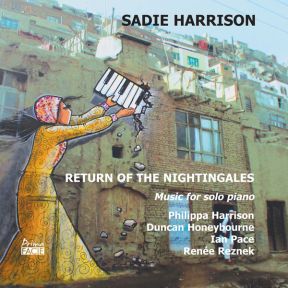
0712396065227_600When I put ‘Return of the Nightingales’ (Prima Facie records) into my CD player, my cat Monty immediately dashed into my office and up onto my desk to find the birds that sing so sweetly at the start of the title track of this new disc of music by Sadie Harrison. The piano enters, delicately yet brightly, imitating the twittering birdsong before moving into a lively, rhythmic passage. Ian Pace, the pianist for this track, is very much at home in contemporary and new music for piano, and it shows in the ease with which he handles technical difficulties and his vivid, immediate sound.

The variety of writing in just a few minutes of this piece signals the theme for the entire disc: it’s a wonderful example of Sadie’s compositional breadth and rich imagination and a lovely introduction to her colourful and accessible music. Not only does the disc demonstrate the range of Sadie’s compositional palette but it also showcases the talents of four excellent pianists – Ian Pace, Renée Reznek, Duncan Honeybourne and Philippa Harrison, all of whom have considerable experience in this type of repertoire and who bring myriad colours, timbre and musical sensitivity and individuality to each work on the disc.

Composed between 2011 and 2017, the pieces on this disc reveal the many contrasting styles within one composer’s output, reflecting Sadie’s wide-ranging musical and cultural influences, including the music of Bartok, Berg, Chopin, and Debussy, jazz legends Bill Evans, Fats Waller and Thelonius Monk, Methodist hymns, vintage film music, her passion for the cultures of Persia and Afghanistan (Sadie is Composer-in-Association of the Afghanistan National Institute of Music), and the natural world. In ‘Return of the Nightingales’ (the title is drawn from the translation of a Persian poem), near-Eastern folk idioms are woven into the starkly modernist suite of pieces Par-feshani-ye ‘eshq (played by Renée Reznek), while in Lunae ‘Four Nocturnes’ Duncan Honeybourne sensitively and sensuously illuminates the tender, intimate lyricism and delicate traceries of these delightful and arresting miniatures (I purchased the sheet music on the strength of this performance in order to learn the pieces myself). Philippa Harrison brings the requisite vibe and swing to the Four Jazz Portraits, capturing the style of each jazz great to whom they are dedicated; while in Shadows ‘Six Portraits of William Baines’ Sadie takes small quotations from Baines’ piano works and reflections on his diary entries to create intriguing miniatures, masterfully presented by Duncan Honeybourne. The Souls of Flowers recalls Chopin in its long-spun melodic lines and shimmering trills, while Northern Lights uses harmonies and idioms redolent of folksong and hymns. The final work, Luna…..for Nicola, is a tiny yet meaningful hommage to Nicola le Fanu, with whom Sadie studied for three years, and was written in response to hearing the premiere of Nicola LeFanu’s orchestral work ‘The Crimson Bird’. in February 2017.

The song of the nightingale is the unifying thread on this disc – in the third of the four Lunae, the evocation of Alabiev–Liszt’s ‘Le Rossignol’ as played by William Baines, and in the fluttering wings of Par-feshani-ye ‘eshq, but also less obviously in the use of trills, sparkling runs, chirruping note clusters and tremolandos.

This is wonderfully rewarding, varied and enjoyable disc, proof that contemporary piano music can be tuneful, attractive and entirely accessible. There is much to delight and challenge the pianist too: the pieces are generally within the capability of the intermediate to advanced player, and are available to purchase as scores (from University of York Music Press). I particularly like Sadie’s treatment of melodic fragments and her jazz-infused harmonies.

Highly recommended

Yuanfan Yang – Watercolour (Orchid Classics)

Nicholas McCarthy – Echoes (Leftnote Records)

Andrew Matthews-Owen – Halo: Music for Piano (Nimbus)

5060189560738At just 20, Yuanfan Yang is already a promising pianist and young composer. Winner of keyboard final of the 2012 BBC Young Musician, he has been a prizewinner in many other international piano competitions. The works by Schubert, Chopin and Liszt on his debut disc represent the kind of mainstream showpiece repertoire one expects from competition participants, and the music played is well-mannered and attractive, rather than attention-grabbing. Schubert’s ever-popular B-flat Impromptu has the requisite lyricism and grace, while the opening of Chopin’s darkly-hued Fantasie in F minor, Op 49 is ponderous rather than portentous. The ‘Winter Wind’ Etude and Liszt’s ‘La Campanella’ are despatched with the kind of youthful gusto one would expect from a musician of this age who has been on the competition circuit for several years now: fleet and pristine fingerwork but rather bloodless in interpretation. La Vallee d’Obermann feels too restrained and lacks the grandeur and spaciousness to really recall the profound majesty of the Alps. Far more interesting are the works composed by Yuanfan himself, colourful programmatic pieces inspired by watercolours, whose titles link them to the pieces by Liszt on this disc and also to Philip Cashian’s ‘Landscape’ and Peter Maxwell-Davis’ ‘Farewell to Stromness’, the final work on the disc, which again feels too polite – a little more Scottish lilt would be welcome. Overall, a nicely-presented “recital” disc showcasing Yuanfan’s developing talents as both pianist and composer.


500x500Left-handed pianist Nicholas McCarthy presents an altogether more mature and convincing performance on his new album ‘Echoes’, which features repertoire by Bach and Rachmaninov which he first explored as a pianist in the early part of his career, all in fine transcriptions for the left hand alone. The final track on the disc is Paul Wittengenstein’s transcription of Bach’s evergreen Prelude in C. Like McCarthy, Wittengenstein was a left-handed pianist (he lost his right arm following an injury in the First World War). If you have seen Nicholas McCarthy in concert you will know that as a left-handed player he is incredibly athletic, utilising the entire range of the keyboard. Nicholas is no novelty act pianist; he is a serious concert pianist whose superb technical ability and musicality enable him to create a rich palette of sounds, colours and shadings, from full-bodied fortissimos to delicate pianissimos, and elegant, lyrical cantabile playing (try the Andante from Rachmaninov’s Cello Sonata Op 19 or Bach’s Prelude in C for particularly lovely examples of this). The album begins with a robust and entirely convincing transcription of Rachmaninov’s Prelude in G minor. It loses nothing being played with only one hand, and the same is true for all the pieces on this disc. You would never guess that this music is played with the left hand only, such is the quality and clarity of Nicholas’s sound. The album was recorded on a Yamaha CFX concert grand and the sound quality is direct but never strident with a warm resonance, particularly in the bass. Recommended.


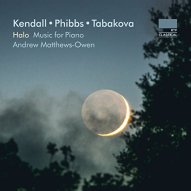
51wyuc5onpl‘Halo’ is Andrew Matthews-Owen‘s first solo disc. A highly sought-after collaborative pianist and song accompanist and noted champion of contemporary music, Matthews-Owen showcases his affinity for this repertoire in this rewarding recording of contrasting works by Joseph Phibbs, Dobrinka Tabakova and Hannah Kendall. Phibbs’ Preludes (2016) were dedicated to Matthews-Owen and are short aphoristic works whose spare simplicity, delicate melodic fragments and piquant harmonies are redolent of Schoenberg’s Kleine Klavierstucke. Matthews-Owen’s directness and clarity allows these short works to speak for themselves. Dobrinka Tabakova’s ‘Modétudes’ – brief “studies” based on the main modes (Dorian, Lydian, Phrygian etc) – are characterful miniatures whose individual musical personalities Matthews-Owen delineates with delicacy and precision, alert to their ever-shifting moods. They are folksy in their idioms and immediately accessible to the listener. Hannah Kendall’s ‘On a Chequer’d Field Array’d’ is a work in three parts, inspired by a game of chess: again, Matthews-Owen is always sensitive to the contrasts and switches of emotion in this music. Tabakova’s ‘Nocturne’ is delightful, delicate and songful, while her ‘Halo’, evoking a lunar halo seen one summer’s night, is powerfully atmospheric (the second movement, ‘To blinding shine’ for example, begins with bright rapidly repeating notes, interjected with a hymn-like motif, somewhat reminiscent of Hovhaness’s Visionary Landscapes, before moving into far more dramatic territory). This disc is a splendid advocate for contemporary piano music from a performer whose understanding of and affinity for this music is clear from the very first note to the last.

Recommended.


Guest CD review by Adrian Ainsworth

This is a solo piano album of austere wonder. Composer and performer Mark Deeks hails from Northumberland, and in tribute to his home patch, the eight original pieces here are named in the county’s old dialect (the album also includes a cover version of John Ireland’s ‘Sea Fever’). A water theme runs through the record like a river, with tracks named for waves, floods, showers, ice… so we have, in some ways, a tone poem: a suite of works that, over its running time, builds a picture of the North Sea coastline in audio.

To do this successfully, there would have to be a starkness to underpin the picturesque, and MD achieves that balance perfectly – the music is beautiful throughout, but favours sparse reflection over ‘prettiness’. I think listeners of Glass, say, or Satie would find much to enjoy in these pieces: that’s not to simplify and say that MD is ‘like’ those composers – more that he also prizes the effects of a rhythmic pattern, the power of a silence, and the value of unhurried contemplation.

While the album sustains a coherent mood, close and repeated listening reveals the individual personalities of each track, the way they embody their liquid titles. For example, opening track ‘Wǽg’ (‘Wave’) features an undulating rhythm in the bass, perhaps unsurprisingly – but above that, the melody not only turns about itself in an ebb and flow movement, the chords cut across the bassline as if ‘breaking’ onto the shore. While later in the sequence, ‘Scúr’ (‘Shower’) moves the initial, insistent rhythm into the right hand, as if the rain is starting to pitter-patter onto the ground.

The superb ‘Flódas’ (‘Floods’) moves along with a more hyperactive, unpredictable gait, and ramps up the intensity until the melody almost breaks – bursts its banks. While the serene ‘Gyrwe’ (‘Wetlands’) – for me, one of the album’s absolute highlights – allows its left-hand to glide calmly while the restrained, delicately-judged interventions of the right-hand conjure up the momentary drips and breeze-driven disturbances from the reeds and grasses.

I was completely won over by this record’s confident restraint: give it time and drift through its space.

It’s also worth mentioning that, perhaps due to its steady pace and focus on melodic ambience, much of the suite sounds accessible to fellow pianists – and sure enough, Mark Deeks has produced a very limited run of sheet music for the album, available to buy alongside the CD. To buy either – or, let’s not be coy, both, you can visit the artist’s Bandcamp page for the album here.


Adrian Ainsworth writes for a living, but mostly about things like finance, tax and benefits. For light relief, then, he covers his obsessions – overwhelmingly music, but with sprinklings of photography and art – on the ‘Specs’ blog, which you can find at http://www.adrianspecs.blogspot.co.uk

Twitter: @Adrian_Specs