
Who or what inspired you to take up composing, and pursue a career in music?
My parents and especially my granddad have always been very supportive and encouraging. My granddad always wanted to be able to play the piano and compose, but he wasn’t offered any opportunities to learn when he was younger. I think that’s what drove him to encourage me: he saw that I enjoyed it, and made sure I took all the opportunities I could.
Who or what were the most significant influences on your musical life and career as a composer?
It may sound obvious, but my parents. I couldn’t have been offered the opportunities I have been today without their help and support.
What have been the greatest challenges/frustrations of your career so far?
I think it’s important to learn how to fail ‘productively’. As a freelance composer you are never going to get every single opportunity you put yourself forward for. It’s important to try and remain positive. Take criticism on board where you think it’s fair, but remember that your music should ultimately be defined by you. There have been times when I have felt it was right to reject criticism. Knowing when to do this can be tricky to navigate when you’re starting out.
With every performance you get better at communicating the music in your mind’s ear to an audience. This process is a very personal one. It operates on many levels between transcription and translation. No-one can tell you whether it has been successful other than yourself. Do not be too self-critical when you make a mistake, because that’s how you learn.
What are the special challenges/pleasures of working on a commissioned piece?
It’s great when you can shape a piece around a specific group. I always try to feed off the energy and enthusiasm of an ensemble when I write.
What have been your favourite aspects of working with London Music Masters as part of your award over the last year?
I think the performance of my piece “Flutter” in Festival Hall was very exciting. I loved seeing the faces of the children after they had performed the piece, they looked like they had enjoyed performing it, and that was very satisfying for me.
Can you tell me a little bit more about how the piece came about?
I had the idea of using pieces of foil on the strings, to make the piece a bit more fun for the very young performers. This came from the idea of music’s transformative power which has the possibility to effect change in people’s lives. The piece was written for beginner string players and a choir, so this idea became part of the chorus: “Music is a butterfly, filling the air with something you can’t buy, because
it makes my heart-beat flutter”.
What feedback did you receive from the piece?
Well it was lovely to hear that the piece had been well received by the LMM teachers who said that it was aimed at just the right level without being too simplistic. I also had a few parents come up to me to thank me after the concert. One mother said that her child had been singing it all the time, so I apologised as you may expect! When I was writing it I structured the whole piece around the simplest part (just using open strings) and built it up from there. I think this approach worked well rather than taking the hardest part and working back.
You’ve also been writing for a YCAT artist as part of the award, can you tell us who it is yet?
Yes, it’s the trombonist Peter Moore. I was very excited to have the opportunity to write for such a talented performer.
What have you written for him?
The piece is called ‘Three After-Dinner Pieces’. It’s in three movement and each is based on a different type of cheese.
Cheese? Tell us more about this….
I am a big fan of cheese in all it’s different variety. I work part time in a cheese shop in Cardiff called “Madame Fromage” and I thought it would be a unique way of structuring a piece. My ideas have come both from the physical form and taste of the cheese, and its country of origin. For example, in the first movement (Stilton) the mouldy striation reminded me of unsynchronised fanfares, which have become part of the texture of the work. Similarly the viscosity of Epoisses has allowed an exploration of glissandi effects in the trombone part.
Which cheeses did you select for your piece?
Stilton, Caerphilly and Epoisses, the last of these being my favourite.
Are you pleased with the piece?
Yes, I haven’t written for the trombone as a solo instrument before, and Peter is such an excellent performer with an amazing expressive range that I wanted to write something to show this off. I will be looking forward to the premiere very much.
When is the premiere and where will it be performed after that?
27th September in Colston Hall, Bristol, with the first London performance on October 3rd, in Wigmore Hall. I am also lucky to be able to conduct some workshops around this performance in association with LMM. We will be visiting schools to talk about the writing of the piece.
What are you working on at the moment?
I have been commissioned to arrange a recording of Satie’s “Parade” for National Dance Wales, in a performance about the Russian revolution. BBC NOW are recording the piece in early September so I will have my work cut out for me to get everything ready in time for the performances on 25th Oct in Wales Millennium Centre, Cardiff and the 29th in Pontio, Bangor.
Of which works are you most proud?
I love the recording of my BBCSO orchestral piece ‘Digital Dust’. Also, the multi-part choral piece ‘Islands (Ynysoedd)’ I wrote for what became a celebration of Sir John Tavener’s life in Southwark Cathedral, following his death. More recently I wrote a piece for Côr Aduniad called ‘We Have No Right To The Stars’. This is a translation of a poem by Hedd Wyn, and I think it’s one of my favourite choral settings to date.
How would you characterise your compositional language?
I like to describe my style as emotional and accessible. When I was first getting inspired by music I used to get the ‘tingle factor’ (when the hairs on the back of your neck used to stand up) when I listened to music I loved. I have tried to find a compositional language which allows others to feel a strong emotional attachment to my work.
How do you work?
I like to write straight into the computer if I am working on a piece. I usually work at a piano to sketch ideas, and when I am happy with them, notate them straight away.
Who are your favourite musicians/composers?
Kaija Saariaho, Jonathan Harvey, Michael Tippett, John Tavener, Benjamin Britten, Tori Amos, Björk.
What is your most memorable concert experience?
I can’t remember the exact details but I watched Vaughan Williams’ ‘Fantasia on a Theme by Thomas Tallis’ when I was very young. I can remember the music having a profound impact upon me.
What do you consider to be the most important ideas and concepts to impart to aspiring musicians?
Learning how to listen is probably the most important part of becoming a musician. It takes time to develop and is fundamental to your success in all areas of the business.
Where would you like to be in 10 years’ time?
In a studio which would make Hans Zimmer jealous!
What is your idea of perfect happiness?
Being truly grateful for everything you have.
What is your most treasured possession?
My piano.
What do you enjoy doing most?
Laughing.
What is your present state of mind?
Upbeat.
Jack White studied music at Somerville College, Oxford. His postgraduate studies have been undertaken solely at Cardiff University where he has recently finished his PhD in composition. His research interests are in electroacoustic composition and the combination of this media with traditional ensembles in ‘live’ performance. He is also interested in the scoring methods used by electroacoustic composers and the relationship between such methods and a work’s identity.
Jack White is the recent recipient of a London Music Masters award
Jack White’s website

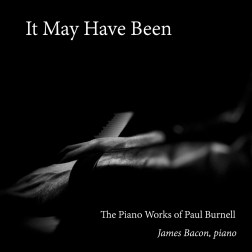 This new album celebrates the piano music of British composer Paul Burnell, spanning 30 years. Paul had recorded and produced previous albums himself, but in this instance he decided it was time to work with another musician, the pianist, composer and recording engineer James Bacon who runs the Piano Recording Studio. The music was recorded on a Bosendorfer Phoenix Imperial 290, fitted with the Phoenix agraffe system pioneered by Richard Dain at Hurstwood Farm Pianos, which gives the piano greater sustain and clarity of sound, especially in the high registers. This makes it ideal for Burnell’s piano music, much of which explores the timbre and sonic possibilities of the piano rather than melody per se.
 The latest release from pianist




 The Cross-Eyed Pianist