“There is no word to describe it because all the work, all the sacrifices, all the things you put into it, it’s just unbelievable.” (Mo Farrah, double Olympic gold medallist)

You won the gold medal, you achieved the ultimate accolade, you revelled in the euphoria of success, the attention, the adoration of the crowd. You worked hard for this, every day for weeks and months, maybe even years. It’s everything you’ve strived for. You ascend the podium, bow your head to receive the medal on its purple ribbon. You lift the gold medal to your lips and kiss it as a thousand flashbulbs go off all around you…..

During the London 2012 Olympic Games we have witnessed many moments like this, from athletes of all nationalities, who have been successful in their chosen field, and whose hard work and dedication has been rewarded and recognised. But how does it feel the day after the ceremony, and the day after that, a month down the road? The euphoria of winning, of achieving such dizzying heights, soon wears off as you contemplate that early morning start on the track, in the dark, in the rain. As British rower and four-times Olympic gold medal winner Matthew Pinsent admitted in a programme on BBC One ahead of the closing ceremony, after the euphoria has worn off comes the question “what next?”.

Musicians understand and experience these feelings too: the euphoria of live performance is matched by a special kind of depression compounded by a profound tiredness after the event. In the last days and hours before a concert, just like the distance runner or the sprint cyclist, everything you do is geared towards the single-minded responsibility of the main event, a super-human organisation of physical and emotional resources.

A vast amount of energy – mental and physical – is expended in the experience of the performance, and the excitement of the concert fills your every moment in the hours leading up to it. And then, suddenly, it is all over. (Sometimes, when performing, you lose all sense of time passing. I was astonished, when I checked the clock on my mobile phone after my Diploma recital last winter, that a full 45 minutes had passed: it felt like no time at all. And yet, the moment in the Liszt Sonetto when I had a minor memory lapse felt like a lifetime……)

After a performance, you feel drained, your mind is completely out of breath, your body physically depleted. You’re ready for your bed, but you’ve still got to do the PR thing post-concert: meet people, sign programmes and CDs, give interviews. But there’s no time for exhaustion: you have work to do tomorrow – and work is the best antidote to these feelings of depression and tiredness.

“At this low point, we have only to let music itself take charge. For every challenge we can possibly want lies before us in the vast and inexhaustible repertory that cannot but replenish our spirit. For true musicians, depression is temporary because their music is permanent.” (Seymour Bernstein, from ‘With Your Own Two hands’)

For the athletes, there’s not just the next Olympic Games to train for, there are any number of trials, competitions, and world championships to prepare for. The winning of a medal or medals has endorsed all those hours of training, and may even encourage a shift of focus, an adjustment to a tried-and-trusted regime. And for the pianist, there’s the next concert. There’s no future in looking back, going over what has been (a promise I made with myself immediately after my Diploma recital was “no post-mortem!” – I refused to analyse what had happened in the exam room, errors, memory slips, etc., at least not until I received the report and could set any of these issues in context). As performers, we’re only as a good as our last performance, and if that was less than perfect, the best thing is to move on and plan the next performance. We draw strength from our love of the repertoire, our excitement about our individual pieces and the prospect of putting them before an audience. Like the runner on the track, the rider entering the show-jumping arena, the swimmer poised to dive, the performance is what endorses all the hours of practice and preparation, and a fine performance will erase the memory of a bad one.

(a future blog post will focus on performing)
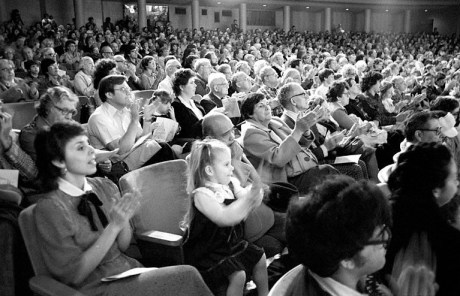
Recently, The Guardian published an article by Leo Benedictus on the subject of badly behaved audiences at theatre, film, concerts, and similar events. The article included a sort of ‘manifesto’ for audiences, with tips and advice on how not to behave. It is both amusing and true. I ran an informal poll amongst Twitter and Facebook followers, asking for people to submit their particular “audience irritations”. The best ones follow below:

People who sit behind and scratch their knees… An odd one I know, but sat in a tiered theatre their knees are at ear level!

Flash photography when one is performing – very distracting!

People talking through overtures is my worst bugbear. I was at South Pacific in Cardiff recently and it was so noisy throughout the overture, and the chap behind me constantly was singing and humming along to most of the songs and making comments….

At a Proms concert once, I saw a Prommer reading a John Grisham novel while Abbado conducting the Bruckner’s 9th symphony provided some no doubt pleasant background music.

Child unwrapping sweets during a Bach Suite… grrrrrr!

People who go to a concert with a cold! Sniffling every other minute. So distracting, inconsiderate and unhygienic!

Re. hummers, I remember childhood carol services at church where every year, without fail, one old man who couldn’t sing in tune to save his life would persist in joining in with the solo first verse of Once in Royal. Pity whichever poor child had been given that dubious privilege…

I was at a Chopin recital where the man next to me hummed tunelessly throughout Chopin’s last Piano Sonata (indeed, throughout the entire concert!). It reminded me of a sketch from ‘Alas Smith & Jones’ in which a certain concert-goer (Smith) hums throughout the performance. Another (Jones) becomes very irritated by this and starts shushing the hummer, only to be told by others around him: “Would you please be quiet? We have come here tonight specifically to hear Mr Smith humming!”

Because of the average age of its audience (very elderly), the Wigmore auditorium is often a cacophony of whistling hearing aids, snuffling, stentorian snoring, and – particularly at lunchtime recitals – satisfied, fruity farting (the sign of a good lunch in the Wigmore restaurant!)

My father’s first visit to Carnegie Hall was marred by a man in front of him who conducted, from his seat, with full score, throughout a Beethoven Symphony.


Please feel free to share your own particular “audience irritations” via the comments box!

Read Leo Benedictus’ article in The Guardian here

This afternoon is my annual student concert. On one level, this is simply a happy gathering of children, parents, family and friends, and an opportunity for my students to share and show off the music they have been studying recently. The programme, as always, is selected by my students, resulting in an eclectic mix of music, and an indication of the wide variety of repertoire we study. Each performer has chosen pieces which reflect his or her particular tastes and skills – surely the basis for any musician’s selection of repertoire?

On another level, the concert is about sharing music. A professional pianist, who I interviewed some years ago, described performing as “a cultural gift”: a gift to oneself and a gift to those who love to hear the piano and its literature, a sharing of the music between soloist and audience. As a performer, one enjoys a huge responsibility, and privilege, rather like a conservator or curator, in presenting this wonderful music to others.

Performing is a very special experience, and one which I have come to relatively late in my musical career. As a pianist at school I was sidelined, encouraged to learn an orchestral instrument, and to recede into the relative anonymity of first desk clarinet. My then piano teacher never organised concerts for her students, and I only played one festival in my teens (an excruciatingly awful experience). At the last school concert before I left to go to university, I was allowed to play the first movement of a Mozart piano sonata. Apart from that, ‘performing’ was limited to taking piano exams. My current teacher gave me the confidence and self-belief to perform, starting with the informal concerts which she hosts at the end of her twice-yearly piano courses. While not as nerve-wracking as playing in a ‘proper’ concert hall, these concerts have their own special atmosphere and attendant anxieties, but the nicest part is the sense that the audience is there because they love to hear piano music, and at every concert I’ve played at Penelope’s house, I’ve felt this important communication between performer and audience.

Of course, performing is not just about playing pretty pieces to other people. To be a performer, one needs to hone a stage personality which is different from the personality which encourages disciplined, focused practising day in, day out, to prepare repertoire for the performance (pianist and teacher Graham Fitch has blogged about this in detail – read his post here). While one’s onstage personality should never obscure the music, one should be able to present oneself convincingly to the audience – and not just through the medium of the music.

There are all sorts of ‘rituals’ involved in performing: travelling to the venue – by car, train or taxi; the clothes one wears; waiting in the green room (whether an elegant space such as at Wigmore Hall, or a dreary municipal cubicle); then waiting to go on stage, behind a door, or a plush velvet curtain, just offstage, pulse racing, real fear now passed, only excited anticipation, and enough adrenaline coursing through the veins to propel one onto the stage. Then the door opens, the curtain swings back, and the adventure of the performance has already begun as one crosses the stage. Applause: the audience’s way of greeting one, and, in return, a bow, one’s way of acknowledging the audience. And now, isolated at the keyboard, the full nine feet of concert grand stretched before one, ready to begin, the brief moment before starting a work resembles nothing else. One has a sense of the awesome formality of the occasion, the responsibility, the knowledge that, once begun, the performance cannot be withdrawn. It identifies the music, singles it out for scrutiny: it is irrevocable. All these things combined are the ‘adventure’ of performing.

Whether my students will have a sense of this ‘adventure’ this afternoon I am not sure. I know some are very nervous: one of my students has never performed in one of my concerts before, and to help with her anxiety, I have placed her near the start in the running order, so she can play her piece and then sit back and enjoy the rest of the occasion. Others, who have been learning with me almost as long as I’ve been teaching, betray no nerves and seem to actively enjoy the chance to ‘show off’ to family and friends. Some play with real chutzpah and flair, others prefer to simply play the notes, but each and every performance will be unique, special and memorable. I should probably remember to take some tissues!

Normansfield Theatre, Teddington, where I hold my student concerts

Here are the ten posts which received the most traffic on this blog in 2011. Enjoy – and Happy New Year!

Describing music – in words and sound

Guest post: FLOW – Transforming Your Practice

Desert Island Discs

Playing the Beethoven Piano Sonatas

Should You be Practising Right Now?

Music Apps for iPhone and iPad

Cross-Rhythms Without Fear

Maurizio Pollini plays Beethoven’s Last Sonatas

The Top 10 Classical Music Composers

Review: Mahan Esfahani Plays the Goldberg Variations

I’d love more guests posts in 2012. If you are interested in contributing to this blog, please contact me via the comments box on this post, or Facebook or Twitter (@crosseyedpiano).

Many thanks to all my readers.


