The penultimate weekend in March saw me in London for two exceptional concerts in particularly lovely settings. The experience was enhanced by the company of friends and a delicious meal with a wonderful view across Smithfield (former meat market, now the new site for the Museum of London) to St Paul’s cathedral.

A Season to Sing is a reimagining of Vivaldi’s evergreen The Four Seasons for mixed voices by British composer, vocalist and music director Joanna Forbes L’Estrange. A co-commissioning project between the composer, The Royal School of Church Music (RSCM) and over 50 choirs around the world, A Season to Sing was written to mark the 300th anniversary this year of Vivaldi’s The Four Seasons.

The London ‘launch concert’ took place on Saturday 22nd March at historic St Bartholomew-the-Great, a beautiful ancient church in the City of London. Luminosa Music, an exceptional amateur choir (who impressed with their pitch-perfect timing and exquisite, colourful sound) performed the music, the first half comprising choral pieces by Joanna, her husband Alexander L’Estrange, and works by Monteverdi and Thomas Morley, all with a seasonal theme. This set the scene nicely for the second half and A Season to Sing.

The Four Seasons is a perenially popular work, and this is is not the first time it has been ‘reimagined, Max Richter’s Recomposed, being the most famous example. But A Season to Sing is the first time this music has been reimagined for voices. As Joanna says in the concert programme notes, ‘...re-imagining in no way diminishes our respect for the original compositions. On the contrary it offers a new perspective….’ – this latter point being the most striking and magical thing about A Season to Sing.

Think you know The Four Seasons? Think again! Here, the orchestral version is transformed into a colourful extravaganza of sound which makes full use of the human voice (and other parts of the body) to bring Vivaldi’s seasons vividly to life – from whistled birdsong in Spring to “body percussion” to evoke the storm, a bagpipe’s drone and even some Swingle-style wordless ‘scat’ (Joanna was music director of The Swingle Singers for seven years, and the middle movement is dedicated to the group’s founder, Ward Swingle). New details from the original orchestration are revealed by the choir, such as interior lines and textures, and the entire piece feels as fresh as a spring shower. It’s full of affection too, and wit and warmth. It’s a wonderful tribute to this much-loved music.

The Four Seasons is the first piece of classical music I remember listening to as a child. I have very vivid memories of dancing around the room to the 3rd movement of Autumn

Joanna Forbes L’Estrange, composer

A Season to Sing is being performed around the world by the choirs who took part in the commissioning project (find details of all performances here). The score will be published by the Royal School of Church Music on 1st June (pre-order here).


Sunday afternoon and another concert at a lovely venue, this time the 1901 Arts Club, London’s most stylish and convivial small venue. This was a special concert to celebrate the 340th birthday of J S Bach and to launch American pianist Eleonor Bindman’s new album ABSOLUTE – her own transcriptions for piano of Bach’s Lute Suites BWV 996-998.

A lifelong love of J S Bach has led Eleonor Bindman to produce a number of important transcriptions for solo piano and piano duo of his music for other instruments, including the evergreen Cello Suites and the Brandenberg Concertos. In this latest addition to her catalogue, Eleonor has turned her attention to works originally composed for the lautenwerk or lautenwerck (lute-harpsichord), one of Bach’s favourite instruments, similar to the harpsichord, but with gut (or nylon today) rather than metal strings.

The small size of the music salon at the 1901 Arts Club lends itself to “haus konzert” style performances (such as Bach might have known) and the ambiance at this concert was warm and friendly.

Like Joanna’s reimagining of The Four Seasons, Eleonor sees transcriptions as a vehicle to “revive interest in original compositions”, shine a new light on the original work and “increase their popularity”. And just as in A Season to Sing, new details of dynamics, texture, counterpoint and more are revealed in this transcription for solo piano.

But for me the most satisfying aspect of Eleonor’s concert was her ability to bring so much colour and nuance to the music. Her range of sound was impressive, but never too much nor too little. Perfectly balanced to suit the small size of the venue, she brought both intimacy and grandeur (we can thank Bach for that!) to the music. I don’t think I have ever heard the Steinway at the 1901 played better!

The following day I met Eleonor for a most enjoyable, leisurely lunch, replete with much ‘piano chat’ and conversations about food.

ABSOLUTE is out now on the Orchid Classics label and on all major streaming platforms.
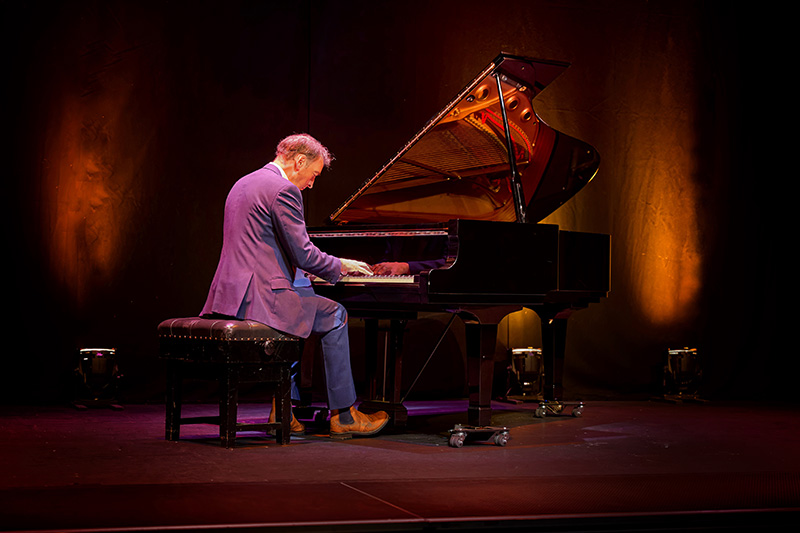
BAFTA award winning comedian, impressionist, actor and pianist Alistair McGowan shares his thoughts on what drew him to the piano, the pleasures and challenges of practising, the inspiration of other pianists, and how the piano has enriched his life…..

What are you first memories of the piano?

My mother was always playing the piano when I was young. She was the accompanist at the Evesham Amateur Operatic and Dramatic Society and was always practising the score for their latest Rodgers and Hammerstein or Gilbert and Sullivan. She also played a few classical pieces which I would often ask her to play to get me to sleep. 

My older sister, Kay, learnt to Grade Eight. She didn’t touch the piano after her final exam. She is making noises about playing again and I really hope she does go back to it. She was very good!

Did you have piano lessons as a child?

I did two years and passed two grades but stopped when I was 9. I regretted it for the rest of my life and finally took up the piano again for a couple of years in my 30s until my TV show, ‘The Big Impression ’ got in the way. 

Clearing out my mother’s things after her death, I came upon my breakdowns of my Grade exams hoping there would be mention of ‘shows great promise’ but sadly they just talked of a lack of rhythm and expression!

I have really thrown myself at it again since 2016. I first conceived and performed a show about Erik Satie, then from 2018, toured with ‘The Piano Show’ (15 short pieces interspersed with stand-up routines and impressions) and released two CDs, the first of which through Sony Classical somehow briefly, in 2017, got to the top of the classical chart!

And now, I’ve put together the inaugural Ludlow Piano Festival. I’m not sure which has been the hardest but all have been incredibly rewarding !

What kind of repertoire do you enjoy playing, and listening to? 

I’ve always been drawn to Satie and Debussy; I keep finding new Debussy pieces I want to play. I just love losing myself in those chords and those incredible sound worlds he creates. I do like a good tune as well though! I am constantly writing down the names of pieces I hear on Radio 3 – Poulenc, Hahn, Scott, Bowen, Rachmaninov. And I adore John Field’s Nocturnes. 

Alistair McGowan

How do you make the time to practise? 

At first, it was a struggle fitting things in around other work. But I watch less television in general with no regret and play less sport too. Partly because my body doesn’t let me now!

Do you enjoy practising? 

I have to force myself to do scales and arpeggios and Hanon exercises but otherwise, yes. I had some very good advice from fellow comic, Rainer Hersch, who suggested putting a watch by the piano and making sure that every fifteen minutes you change what you’re practising. I try to do that. 

But, generally, I get so lost in hearing a piece come together that it’s never a chore. 

Have you participated in any masterclasses or piano courses? 

I have attended weekend courses with Paul Roberts in Sussex. And I went on his week-long piano course in France and then attended four courses in subsequent years with James Lisney and latterly Charles Owen at the delightful La Balie (in south-west France, now, sadly, no longer happening). I’ve also recently done week in West Cork with James at Castle Townshend

As well as learning from such inspirational players and teachers, it’s great to meet other amateur pianists who share your passion. 

What have you gained/learnt from this experience?

I do feel I’ve enriched my life and my soul. And I have been a little surprised by how much I have enjoyed regularly turning my back on the modern world.

As an adult amateur pianist, what are the special challenges of preparing for a performance? 

Not letting the occasion distract you from listening to the sound you are making with every note. I have moments of being very focused but often hear myself or my late mother saying ‘What on earth do you think you’re doing?’. If you can keep that voice out of your head, you will generally be fine!

Also, if you breathe and practise breathing it practise, it helps. As does a touch of lavender under the nose. 

Most importantly, if you think of wanting your audience to hear the piece of music you’re playing and not to hear how well you play it, it takes your ‘self’ out of the equation and some how makes things less nerve-wracking. 

How did you prepare the pieces featured on your recordings? 

I worked very hard, bringing each of them to the boil in turn with my mentor Anthony Hewitt practically conducting me. I also went to listen to a good few pianists in concert and learnt a lot from hearing James Lisney, Lucy Parham, Viv McLean and, of course, Anthony. 

Recording yourself to see what you’re getting wrong – and what you’re getting right – is also a great help these days. 

And how did you find the experience of recording the music?

It was like a lesson, an exam, a recital and the greatest pleasure all at the same time – immensely draining and yet utterly thrilling to hear the music I had learnt and loved coming out of the best pianos in the world!

It was also terrifying knowing that this was the one chance to get each piece recorded. I read a wonderful book called ‘Piano Notes’ by Charles Rosen which has a very helpful chapter on the challenge of recording and refers especially to the need to not worry about mistakes. They can be covered. My teacher/mentor, Anthony Hewitt, was wonderfully helpful (and still conducting!) at the recordings. My producer, Chris Hazel, was unbelievably supportive, helpful and strict!

I had to pinch myself after each recording. I couldn’t believe what I was being allowed to do.

What advice would you give to other adults who are considering taking up the piano or resuming piano lessons? 

I think learning how to learn is as important as learning how to play; it’s important to get the most from your playing time. Setting goals is also important. Perhaps organise small recitals at home, before friends, in order to give yourself a deadline.

If you could play one piece, what would it be? 

Ah! That changes all the time. I have an eye on Debussy’s ‘Ballade Esclave’ – but think that’s still a few years away!

Alistair McGowan’s new show ‘3-in-1’, combining music, poetry and impressions, is at London’s 1901 Arts Club on Wednesday 22 January. Info/tickets here.


This site is free to access and ad-free, and takes many hours to research, write, and maintain. If you find joy and value in what I do, please consider making a donation to support the continuance of this site

Make A Donation

ArtMuseLondon is a sister site of The Cross-Eyed Pianist, focusing on reviews of art exhibitions and music written by people with a keen interest and an intelligent, honest and accessible approach. ArtMuseLondon covers exhibitions, concerts, opera and chamber music, CD and book reviews, and general cultural musings. The quartet of reviewers are selective about what they see and hear and don’t “review everything”. Instead, they choose to write about the exhibitions and music which interest them personally.

Recent highlights include reviews of this season at Opera Holland Park, exhibitions at Tate Modern, Tate Britain, the Royal Academy of Arts and the Barbican, and the world premiere of a new choral work by composer Richard Blackford in Poole.

Do take a look at the ArtMuseLondon website if you enjoy intelligent, longform writing on art and culture, and follow the site to receive new articles direct to your email inbox.

ArtMuseLondon is also on Twitter at @ArtMuseLondon


Meet the ArtMuseLondon team

DSCN0143

Jacky Colliss Harvey has worked in museum publishing for over 20 years, and speaks and lectures regularly on the arts and their relation to popular culture. She is the author of the best-selling RED: A History of the Redhead, and The Animal’s Companion.


Karine Hetherington

Karine Hetherington is a teacher and writer of novels, who also blogs on art and music. Her two published novels, The Poet and the Hypotenuse and Fort Girard, are set in France in the 1930s and 1940s. Karine promotes singers and musicians performing in the fast-growing Kensington and Olympia Music and Arts Festival. When she is not writing about music, she likes to sing in her local choir or tackle piano sonatas, some of which are far too difficult for her.


1085-6365-nm_photo Nick Marlowe studied Art History at the Courtauld Institute of Art and History at Cambridge University. After working for thirty years in the book trade he is now a freelance writer and artist. Formerly a reviewer for OneStopArts, a spin-off from Bachtrack.com, Nick has also reviewed for US-based art and culture site CultureVulture.net.


FranceFrances Wilson pianist and writers Wilson is a pianist, writer and blogger on classical music and pianism as The Cross-Eyed Pianist. A keen concert-goer, she writes music reviews for her blog and is a regular writer for classical music website InterludeHK. She also curates playlists for classical music streaming service IDAGIO, and has written for Pianist Magazine, The Schubertian (journal of the Schubert Institute of the UK), Bachtrack.com and Classical Music Magazine.

Franz Schubert – ‘Winterreise’, Temple Church, 24 July 2018

Angelika Kirchschlager, mezzo-soprano, and Julius Drake, piano

Guest review by Adrian Ainsworth

Schubert’s song cycle – surely the greatest work of its kind – sets to music a series of 24 poems by Wilhelm Müller. In the opening lines, the protagonist begins an unspecified journey on foot, leaving behind a woman who, back in the Spring, he believed he would marry. But now the affair is over. By the second song, we find out her parents have made a better match.

In the bitter, freezing night, he strives to leave the town behind him. But his route is obscure, as he encounters familiar landmarks, signposts, a village, even the post van – and most of all, throughout, he feels the effects of nature: snow, wind, water, clouds, lightning. Towards the end of the cycle, the sense that this voyage is at least partly interior strengthens. Hallucinations get the better of him: an apparently friendly guiding light, multiple suns – all symbols for what he has lost). Finally, he meets a mysterious ‘organ-grinder’, and considers joining him, to sing and play together. There are a number of interpretations of the ending out there: the one I favour – and I think I’ve come across the most – is that the figure indicates the cycle is eternal. The hurdy-gurdy goes round and round for ever, and the grinder could even be the wanderer’s future self. Or, he could, simply, be Death.

(No-one seems to think he’s just an organ grinder.)

Schubert composed the first 12 songs in the cycle in early 1827, before he even knew about the rest of the poems in the sequence. The story of his friends’ utter bewilderment on hearing them is often told in programme notes and CD booklets, so I won’t repeat it in detail here. But with all these years’ hindsight, it seems to me that ‘Winterreise’ must have sent shivers down their spines because Schubert wrote exactly the music the words demanded. There are tantalising flashes of vigour, even joy – and brilliantly robust, yet fractured piano parts that mirror so well a voice wracked with both determination and despondency – but the overall mood is poignant, downbeat and unresolved.

‘Winterreise’ might be cold to the touch, but it’s difficult to escape its icy grip. Speaking as an avid listener, I seem to gather recordings of it in an almost addictive way, constantly searching for new angles and insights.

Singers are drawn to it like moths to a blue flame. Perhaps it’s the art song equivalent of a Hamlet, or Lear – a rite of passage. Many feel the urge to visit and re-visit it. Ian Bostridge has a famously close relationship with the cycle, writing a book about it, and recently performing a semi-staged, orchestrated version against projected footage of his younger self. Mark Padmore and Florian Boesch have each recorded it twice in the last ten years (with different accompanists).

And that’s just a few of the men. However, the protagonist of ‘Winterreise’ – definitely a chap – must be an irresistible ‘trouser role’…? (It’s easy to forget that song is as visual a medium as opera – writing before recorded music was dreamt of, Schubert could only ever have imagined someone standing up, putting these songs across to a live audience.) But even though there are numerous recordings – including Brigitte Fassbaender, Christa Ludwig, Nathalie Stutzmann or one of my personal favourites, Alice Coote’s searing live disc – the opportunity to hear a woman perform ‘Winterreise’ live still feels all too rare.

On this occasion we were in Temple Church to hear mezzo-soprano Angelika Kirchschlager’s interpretation, for the first time. I’ve always found Kirchschlager’s performances of art song thrilling: as much acted as sung, and with a captivating emotional range. I was excited to hear how she would apply this over a continuous narrative, rather than stand-alone lieder. What I experienced was completely fearless, at times frustrating but always fascinating.

The venue was both friend and foe. In Temple Church, at least where my companions and I were sitting, there’s a gloriously resonant but quite echoey acoustic. I’m not a sonic scientist, but at times, it felt like the voice and piano clashed slightly because a rumble of bass notes would tumble all over each other, or a phrase would be lost (for example, in the helter-skelter ‘Rückblick’ / ‘A backward glance’). At other points, however, in slower songs like ‘Wasserflut’ / ‘Flood’ or ‘Irrlicht’ / ‘Will-o’-the-wisp’, a fantastic sustain effect was created, allowing Angelika Kirchschlager and Julius Drake to continue singing and playing with the traces of the previous note or two still fading. This really enhanced the continuous feel of the performance and lent a sinister edge that would be hard to replicate in a studio recording.

Kirchschlager’s commitment to the piece was total, and I believe she portrayed the cyclic structure of the story as much through her body language as her voice. In the opening ‘Gute Nacht’ / ‘Good night’, she was still, transfixed, even to the point where I thought she was warming up in some way, not quite in full flow yet. Almost immediately, though, she opened out and began to move. Only in the final song, ‘Der Leiermann’ / ‘The organ-grinder’, when she withdrew back into herself, adopting the same pose, staring at some phantom far beyond the audience, did I realise – thoroughly moved and disquieted – that at the start we had seen her protagonist emerge, and now disappear.

Unafraid to sound harsh or broken when the context demanded, Kirchschlager could come across at times as if the acting were leading the singing. So effective was she in the cycle’s mood swings that the intensity felt a bit like listening to a 75-minute ‘Erlkönig’, a rollercoaster ghost-train ride that kept me riveted. But this didn’t prevent the emotional high-points of the sequence – in particular, the soaring anguish of the penultimate song ‘Die Nebensonnen’ / ‘Phantom suns’, Kirchschlager’s bright, glorious tone so tragically affecting – hitting home with a devastating beauty.


Adrian Ainsworth writes for a living, but mostly about things like finance, tax and benefits. For light relief, then, he covers his obsessions – overwhelmingly music, but with sprinklings of photography and art – on the ‘Specs’ blog, which you can find at

Twitter: @adrian_specs

Adrian is a regular guest writer for The Cross-Eyed Pianist

