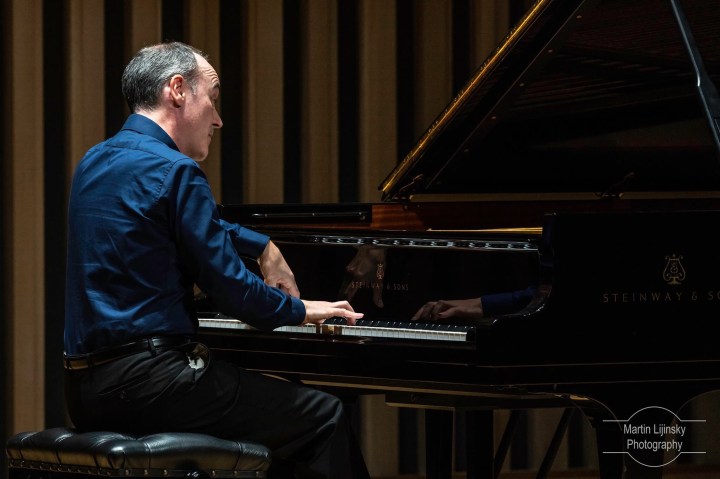
When is a piano not a piano?

When it submits to the dizzying, audacious Musica Ricercata. The Wigmore Steinway found new voices – drums, horns, tinkling bells and great bellowing bass rumbles – in Roman Rabinovich’s mesmerisingly theatrical and witty performance of Ligeti’s eleven-movement musical algorithm. Based on the Baroque ricercar, the set of pieces are linked by a gradual reveal of pitches and structural progression, culminating in a fugue. This was an ambitious and, for some, uncompromising opening to a concert which also comprised music by Bach and Schubert. As befits this musician who is also an artist, Rabinovich drew myriad colours from the instrument, all infused with a rhythmic bite and vibrant sparkle which took full advantage of the crisp tuning of the piano.

That same rhythmic bite and richly-hued sound palette found a different voice in Schubert’s piano sonata in c minor, D958. Composed in 1828 and completed shortly before the composer died, this is his hommage to Beethoven, and the unsuspecting listener could easily be forgiven for mistaking this for one by the old radical himself. Yet Schubert’s more introspective nature is always there, in the shifting piquant harmonies and mercurial volte-faces of emotion and pace. Those who favour the “Schubert knew he was dying” approach to the last three sonatas would have been disappointed: Rabinovich’s performance proclaimed “Choose life!”, particularly in the rugged (but never earnest) orchestral vigour of that deeply Beethovenian opening movement, and the rollicking, toe-tapping tarantella finale (which had a woman across the aisle from me air-pedalling frantically while jiggling up and down in her seat). The second movement was a hymn-like sacred space of restrained elegance and mystery, oh so redolent of Beethoven in reflective mood, yet unmistakably Schubert in its intimacy and emotional breadth.

The Bach Partita, which came between Ligeti and Schubert, tended towards romanticism (no bad thing – I play Bach with a romantic tendency), while the bright sound of the piano afforded some delightful filigree ornamentation.

Based on what I heard last night, I look forward to hearing Rabinovich’s new Haydn piano sonatas recording (the second of which is in production).


Wigmore Hall, Friday 25th January 2019

Ligeti
Musica Ricercata
Bach
Partita in D, BWV828
Schubert
Piano Sonata in C-minor, D958

Roman Rabinovich, piano


Meet the Artist – Roman Rabinovich

On Artistic Process

If you enjoy the content of this site, please consider making a donation towards its upkeep:

Buy me a coffee

Part of the generous line up of concerts at this year’s London Piano Festival, Pavel Kolesnikov’s afternoon recital was entitled From Grandeur to Intimacy and featured music by Couperin and Schumann.

At first sight one might struggle to find connections between these composers, but Kolesnikov successfully demonstrated that the common thread is an ability by both composers – refracted through the lens of Kolesnikov’s sensitive, committed playing – to create profound intimacy and emotional depth – so much so that it borders on grandeur.

Kolesnikov’s approach is understated, idiosyncratic, mature and elegant. Limiting physical gestures to an occasional hand lifted gracefully from the keyboard, his physical stillness allows one to fully appreciate the beauty and natural poetry of his soundworld – at times so delicate, so tender, that I felt close to tears.

Couperin’s Suite in G minor felt unexpectedly modern with its crunchy harmonies and colourful dissonances, highlighted by some lovely, carefully-placed “finger legato” and overholding of certain notes – a technique drawn from harpsichord playing, which, combined with judicious pedalling, brought a wonderful range of tonal nuances on a modern piano. The short dances which comprise the suite were graceful and introspective, often improvisatory in character, thanks to the pianist’s fresh take on these courtly miniatures, and Kolesnikov sustained an incredible, almost tangible build up of tension with his restrained, concentrated approach. This was carried into the opening of Schumann’s great Fantasie in C, Kolesnikov allowing only a fractional pause before commencing this piece. Now, in the impassioned opening measures of Robert Schumann’s musical love missive to his beloved Clara, the tension released for a moment to allow this personal outpouring of emotion to flow and swell. Here is love in all its aspects – from breathless excitement to heart-skipping joy or whispered tenderness and introspection. Intentionally improvisatory in its structure and approach, the three-movement format of the work was indicated but the transitions between the movements so subtly and elegantly handled that there was never any interruption to the narrative flow, and Kolesnikov capitalised on this to present a reading which was deeply romantic, rich in expression and emotional breadth, and also highly personal.

Not yet thirty (and he looks much younger), Pavel Kolesnikov plays with an impressive maturity and individuality of approach of a musician twice his age, something which strikes me every time I hear him. Do seek out his recordings (on Hyperion) or hear him in concert. Definitely a “great” in the making.

(Picture credit: Viktor Erik Emanuel / Kings Place)

The second evening of concerts at Chetham’s featured musicians of the next generation and an established international concert artist.

The Ronald Stevenson Memorial recital is given in honour of one of the greatest composer-pianists of modern times, and was established in 2015 with generous funds donated by the Stevenson Society. Stevenson, who died in 2015, was a visitor to the Chetham’s Summer School. He wrote highly attractive, virtuosic and engaging music inspired by the landscape, heritage and culture of Scotland where he made his home. His large and varied post-Romantic oeuvre also includes music written for children, which is sophisticated and characterful.

In this concert, students from Chetham’s School of Music performed works by Stevenson, including his Scottish Folk Song Settings for Piano and the quirky Six Pensees sur des Preludes de Chopin, Stevenson’s clever combining of Preludes by Chopin to create miniatures which are witty and imaginative. It was wonderful to see young people, one as young as 9, performing with such poise and confidence. In addition, their individual sound and range of pianistic colours and moods was impressive, and this concert was both a celebration of Stevenson’s genius and these young musicians.

***

Leon McCawley’s concert was one of those occasions where the reviewer’s role is rendered largely redundant! What can I say about a performance of Mozart’s Piano Sonata K279 whose outer movements sparkled with wit and good humour, contrasting with an Andante of understated operatic drama and elegance? Or Richter’s favourite Schubert Sonata, the genial D894, performed with such taste, clarity and sensitivity that we never lost sight of the overall arc of this long sonata. So many little details – of melody, rhythm and harmony – were deftly managed to create a compelling and fluent musical narrative that was expansive yet also highly intimate. McCawley caught Schubert’s fleeting moods, his unexpected volte-faces (often signalled by “distant” harmonies or rests), with lyricism and grace.

Franz Schubert – ‘Winterreise’, Temple Church, 24 July 2018

Angelika Kirchschlager, mezzo-soprano, and Julius Drake, piano

Guest review by Adrian Ainsworth

Schubert’s song cycle – surely the greatest work of its kind – sets to music a series of 24 poems by Wilhelm Müller. In the opening lines, the protagonist begins an unspecified journey on foot, leaving behind a woman who, back in the Spring, he believed he would marry. But now the affair is over. By the second song, we find out her parents have made a better match.

In the bitter, freezing night, he strives to leave the town behind him. But his route is obscure, as he encounters familiar landmarks, signposts, a village, even the post van – and most of all, throughout, he feels the effects of nature: snow, wind, water, clouds, lightning. Towards the end of the cycle, the sense that this voyage is at least partly interior strengthens. Hallucinations get the better of him: an apparently friendly guiding light, multiple suns – all symbols for what he has lost). Finally, he meets a mysterious ‘organ-grinder’, and considers joining him, to sing and play together. There are a number of interpretations of the ending out there: the one I favour – and I think I’ve come across the most – is that the figure indicates the cycle is eternal. The hurdy-gurdy goes round and round for ever, and the grinder could even be the wanderer’s future self. Or, he could, simply, be Death.

(No-one seems to think he’s just an organ grinder.)

Schubert composed the first 12 songs in the cycle in early 1827, before he even knew about the rest of the poems in the sequence. The story of his friends’ utter bewilderment on hearing them is often told in programme notes and CD booklets, so I won’t repeat it in detail here. But with all these years’ hindsight, it seems to me that ‘Winterreise’ must have sent shivers down their spines because Schubert wrote exactly the music the words demanded. There are tantalising flashes of vigour, even joy – and brilliantly robust, yet fractured piano parts that mirror so well a voice wracked with both determination and despondency – but the overall mood is poignant, downbeat and unresolved.

‘Winterreise’ might be cold to the touch, but it’s difficult to escape its icy grip. Speaking as an avid listener, I seem to gather recordings of it in an almost addictive way, constantly searching for new angles and insights.

Singers are drawn to it like moths to a blue flame. Perhaps it’s the art song equivalent of a Hamlet, or Lear – a rite of passage. Many feel the urge to visit and re-visit it. Ian Bostridge has a famously close relationship with the cycle, writing a book about it, and recently performing a semi-staged, orchestrated version against projected footage of his younger self. Mark Padmore and Florian Boesch have each recorded it twice in the last ten years (with different accompanists).

And that’s just a few of the men. However, the protagonist of ‘Winterreise’ – definitely a chap – must be an irresistible ‘trouser role’…? (It’s easy to forget that song is as visual a medium as opera – writing before recorded music was dreamt of, Schubert could only ever have imagined someone standing up, putting these songs across to a live audience.) But even though there are numerous recordings – including Brigitte Fassbaender, Christa Ludwig, Nathalie Stutzmann or one of my personal favourites, Alice Coote’s searing live disc – the opportunity to hear a woman perform ‘Winterreise’ live still feels all too rare.

On this occasion we were in Temple Church to hear mezzo-soprano Angelika Kirchschlager’s interpretation, for the first time. I’ve always found Kirchschlager’s performances of art song thrilling: as much acted as sung, and with a captivating emotional range. I was excited to hear how she would apply this over a continuous narrative, rather than stand-alone lieder. What I experienced was completely fearless, at times frustrating but always fascinating.

The venue was both friend and foe. In Temple Church, at least where my companions and I were sitting, there’s a gloriously resonant but quite echoey acoustic. I’m not a sonic scientist, but at times, it felt like the voice and piano clashed slightly because a rumble of bass notes would tumble all over each other, or a phrase would be lost (for example, in the helter-skelter ‘Rückblick’ / ‘A backward glance’). At other points, however, in slower songs like ‘Wasserflut’ / ‘Flood’ or ‘Irrlicht’ / ‘Will-o’-the-wisp’, a fantastic sustain effect was created, allowing Angelika Kirchschlager and Julius Drake to continue singing and playing with the traces of the previous note or two still fading. This really enhanced the continuous feel of the performance and lent a sinister edge that would be hard to replicate in a studio recording.

Kirchschlager’s commitment to the piece was total, and I believe she portrayed the cyclic structure of the story as much through her body language as her voice. In the opening ‘Gute Nacht’ / ‘Good night’, she was still, transfixed, even to the point where I thought she was warming up in some way, not quite in full flow yet. Almost immediately, though, she opened out and began to move. Only in the final song, ‘Der Leiermann’ / ‘The organ-grinder’, when she withdrew back into herself, adopting the same pose, staring at some phantom far beyond the audience, did I realise – thoroughly moved and disquieted – that at the start we had seen her protagonist emerge, and now disappear.

Unafraid to sound harsh or broken when the context demanded, Kirchschlager could come across at times as if the acting were leading the singing. So effective was she in the cycle’s mood swings that the intensity felt a bit like listening to a 75-minute ‘Erlkönig’, a rollercoaster ghost-train ride that kept me riveted. But this didn’t prevent the emotional high-points of the sequence – in particular, the soaring anguish of the penultimate song ‘Die Nebensonnen’ / ‘Phantom suns’, Kirchschlager’s bright, glorious tone so tragically affecting – hitting home with a devastating beauty.


Adrian Ainsworth writes for a living, but mostly about things like finance, tax and benefits. For light relief, then, he covers his obsessions – overwhelmingly music, but with sprinklings of photography and art – on the ‘Specs’ blog, which you can find at

Twitter: @adrian_specs

Adrian is a regular guest writer for The Cross-Eyed Pianist