a select group that is superior in terms of ability or qualities to the rest of a group or society
The word “elite” has been frequently heard during the fortnight of the 2016 Olympic Games in Rio. Athletes and sportspeople at the top of their game are regularly described as “elite”, and afforded an elevated status. And rightly so: these people are at the peak of their fitness, they’ve trained long, hard and meticulously to prepare for the games, and the medals and approbation are the visible badges of their great achievements. They are truly “elite”. We have no problem in applying this word to our sporting champions and when we use it it is replete with respect, admiration and awe.
It’s a rather different scenario when the word is used in relation to classical music. In this case it suggests exclusivity, inaccessibility, snobbery, and describes an art form which is regarded as the preserve of the few not the many whose practitioners are aloof, stuffy and out of touch.
You wouldn’t say that about Jessica Ennis, Mo Farah or Bradley Wiggins would you?
But of course classical musicians are elite. Look at how they train, the meticulous way they approach preparation, fitness, mental attitude. The mindset and physical preparation of the musician is very similar to that of the athlete, and many comparisons can – and should – be drawn between sporting elite and musicians.
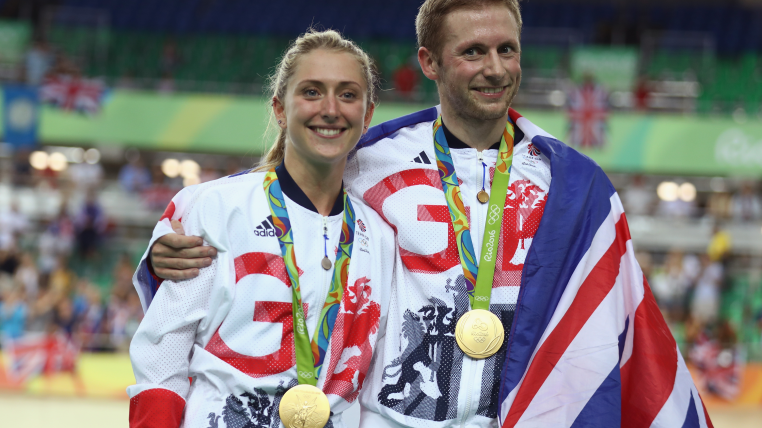
Multiple gold medal-winning British track cyclists Laura Trott & Jason Kenny (source: BritishCycling.org.uk)
These days many musicians look to sport and more specifically sports psychology to inform their musical training and preparation (cf The Inner Game of Music which came from “inner game” sports training which has been used successfully by top tennis players). Musicians, like sportspeople, require discipline, dedication and commitment to put in the many long hours of training to do what they do and do it well, and many make huge sacrifices to achieve this. And just like elite athletes, musicians undergo a very rigorous training which includes much repetitive physical activity (practising) and psychological conditioning. We admire our elite athletes for their physical prowess, their stamina, their grace and strength – and we praise them for their dedicated, meticulous training. And we should admire the same attributes in our musicians.
Musicians, unlike sportspeople, last longer: those who’ve been elevated to the dizzy heights of “elite” (aka “world class”, “internationally renowned”, “legendary” etc) can continue a career well into their 80s (Paul Badura Skoda, for example). A few know when it’s time to step back to let the younger players through (notably, Alfred Brendel). Others cling on determinedly, even if their playing does not match their revered status.
Sportspeople, meanwhile, are judged more objectively by their results and they usually know when it’s the right time to quit. They retain their special status and enter the hall of fame for others to aspire to and emulate. The greatest sportspeople go out at the top of their career (Bradley Wiggins, for example, who eschewed the big salary to concentrate what he enjoys and does well – track cycling; also Sir Chris Hoy, Boris Becker and Victoria Pendleton). These people know that they have reached a point in their professional career where there is nothing left to add and that now is the time to stand down. This is partly because of the physical demands on the body, motivation, the punishing lifestyle, and the recognition that better, younger people are coming through. Many turn their attention to coaching, sharing their wisdom and experience to support and inspire the next generation of elites.
An elite musician – pianist Daniil Trifonov (source: Intermusica)We want our musicians to be elite: by adopting a mindset and training regime akin to that of the elite athlete, musicians are able to produce performances which are consistently impressive, technically assured, absorbing, moving, exhilarating, inspiring…… These are the traits we admire in our elite musicians and for this reason we should celebrate their superhuman talents, in just the same way that we lionise our medal-winning athletes.
Stephen Hough’s recent comments about changing the length and format of classical music concerts by ditching the interval and perhaps starting concerts earlier or later in the evening has generated a lively discussion. And rightly so, because those of us who care about classical music should be concerned about keeping this wonderfully and incredibly varied art form alive and kicking. In his article for the Radio Times, Hough expresses his concerns about attracting a younger audience to classical music and notes that there is no one simple solution to attract more people to concerts.
It strikes me that whenever young people are mentioned in the context of classical music, a whole host of commentators immediately respond by saying that “it’s all about education“. They cite the woeful provision for music education in our state primary and secondary schools (true), the fact that music lessons are often the preserve of the better off (also generally true, sadly) and that our children need to be educated to understand and appreciate classical music.
As I’ve mentioned several times before on this site, I was fortunate in that I had a very good musical education as a child, initiated first by my parents, who were keen concert-goers and music lovers, and subsequently through excellent music provision and teachers at both primary and secondary school (both state schools). My enjoyment and interest in classical music was inculcated at a young age and has stayed with me: I have not, as one friend suggested, grown to love classical music as I’ve got older, only that my tastes change as I explore more repertoire. I was very very lucky – privileged, in fact – in my musical education.
The debate about music provision in our state schools is ongoing and no one seems to have the solution. Various musical celebrities such as Nicola Benedetti and James Rhodes have initiated projects to try and right this terrible wrong, and I applaud anyone who cares enough to encourage our children to enjoy classical music, in and out of school. And Stephen Hough’s ideas should not be dismissed out of hand, just because they might run counter to established ways of doing things in classical music.
But we need to be careful how we frame “educating young people to like/enjoy/appreciate classical music”. As a Twitter colleague of mine said in response to Stephen Hough’s article:
Too often, whenever people start saying “Education” is the important factor, it sounds coercive
We should not seek to “programme” people, whatever their age, to like classical music. Let us not forget that the word “teach” comes from the Old English tæcan which means to “show”, “present” or “point out”. As a music teacher, I agree with my colleague and fellow blogger Andrew Eales, who suggests in his post in response to Stephen Hough’s comments, “When it comes to generating enthusiasm for classical music (and any other genre for that matter) the responsibility truly lies with those who perform and teach it.”. Andrew then goes on to offer some simple and creative ways in which to engage young people with classical music and which do not involve sitting a bunch of 6 year olds in a classroom and force-feeding them Beethoven and Bach.
It’s very easy – and lazy – to blame the young for all the ills in our society, and debates such as music education are too often, in my experience, loaded with a sense of entitlement or superiority – that the role of educators is to produce people who think and do things our way, rather than exploring ways to engage young people. Maybe one of the first things we need to do is shift the vocabulary from “tell” to “show”, “present” or “point out”……
I don’t have all the answers either. But in my very small way as a private music teacher, and via this blog and my other musical activities, I hope I am making a contribution, albeit a tiny one…..
Further reading
No More Loo Breaks – Stephen Hough’s original article in the Radio Times magazine (PDF file)
1. a public musical performance in which a number of singers or instrumentalists, or both, participate.
2. a public performance, usually by an individual singer, instrumentalist, or the like; recital:
As regular readers of this blog, and friends and colleagues will know, I go to a lot of concerts, at least one a week, and sometimes two or three. I also occasionally give my own concerts or perform in recitals organised by others.
Earlier this year, I took part in a concert for a medical charity. It was held at the intimate and convivial 1901 Arts Club close to London’s Waterloo station. I’ve performed there are couple of times, and it is also where the South London Concert Series events usually take place. On this occasion, the audience was almost entirely comprised of medics. Plied with champagne before the concert, when people came down to the music salon for the concert, one had the sense of them relaxing into their seats, happy to enjoy whatever we presented to them. The programme was varied with performances by a soprano, a violinist, piano solo and piano 4-hands, and included works by Debussy, Gershwin, Saint-Saens, Rachmaninov, Grainger and Ravel. During the interval and after the concert, members of the audience expressed their delight at the music making and congratulated us on our performances. Throughout the evening, there was a very palpable sense of a shared experience and that the audience had really enjoyed the evening’s entertainment.
Which set me thinking……. Are concerts purely for “entertainment” or do they serve another more serious or different purpose or purposes?
Of course, “entertainment” needn’t be something amusing or funny (though the word is more commonly associated with humour). Entertainment is a form of diversion, an agreeable occupation for the mind, or something affording pleasure. People (including me) gain enormous pleasure from live concerts, and for many concerts offer a wonderful escape from the humdrum, the every day and the mundane. Take this a step further, and for some a concert offers something more transcendent, a near-religious experience (even for the non-religious). A concert can take the listener on a journey outside themselves, it can uplift and even heal.
Since time immemorial, people have got together to make and share music. That sense of community, of belonging, of a shared experience remains very important today. There’s a feeling of collaboration between performer, music and audience which is infectious and absorbing: witness people at the Proms – you can see the sense of engagement and absorption in their faces as they listen to the music (and of course without an audience, a “concert” would cease to be).
Live music can be really really exciting: a live concert is a “one-off”, and that excitement, spontaneity and sense of risk is what makes concerts so compelling – and something one can never truly get from a recording. I love the sense of the music being created “in the moment” (of course, I understand that the performer has in fact spent many careful hours preparing the music). The composer Helmut Lachenmann says of concerts: “Some people go bungee-jumping or climb a mountain to have an existential experience – an adventure. People should have this same experience in the concert hall.” How performers create this sense of “adventure” is discussed later in this article.
Nor do I do believe there is such a thing as a truly “bad concert”, for we each take from the performance something personal and unique, and while I may not have enjoyed a certain performance, others have and who I am to tell them they are wrong? The meaning of music is different for each individual listener, and whether it merely “entertains” or offers something deeper, it is the way music “speaks” and communicates that makes it so magical. This sense of magic is heightened when one hears live music.
For musicians, concerts are in integral part of their raison d’etre and an opportunity for them to share their musical vision with the audience. (One pianist friend of mine describes giving concerts as “a compulsion and a rather beautiful narcotic”.) Music was written to be shared and the audience share their appreciation of what is coming from the performer, thus making a concert a collaborative experience. Performing should have less to do with ego and more the musician’s desire to share the music with others.
Bringing spontaneity to one’s performance can be tricky, especially if one is playing the same programme over a series of concerts. As the British pianist Stephen Hough put it in a programme about practising for the BBC, one needs to be a “perfectionist” in the practise room to allow one to be “bohemian” on stage. By which he means if one is very well-prepared, one has the confidence to “let go” when one performs. Often the best and most memorable performances are from performers who understand the balance between being perfectionist and bohemian. At other times, it is the sense of intense concentration and profound understanding and affinity with the music which can create a moving and memorable performance. I have occasionally been moved to tears on such occasions, crying quite spontaneously at the end of the piece (notably in Messiaen’s Quartet for the End of Time and a complete performance of the Vingt Regards. On both occasions, the pianist was Steven Osborne.)
On a more prosaic/commercial level, concerts can be used to promote a new CD or related material, or launch of a recording label or similar. And for composers, concerts provide a means of getting their music out there, heard, appreciated and reviewed.
Finally, the late great Claudio Arrau on the subject of concerts:
“I don’t know what will happen, but I trust it will be wonderful”
I have a confession: as long as I can remember, I have been a musical snob. When I was a teenager, I dismissed Richard Clayderman as an amateur after listening to Daniel Barenboim’s recording of Beethoven’s ‘Waldstein’ Sonata, ‘Why does Clayderman only have one tempo for all the pieces that he play?’ I recall asking my teacher. I considered the French electronic keyboard pioneer Jean-Michel Jarre a waste of time because in my opinion a ‘musician’ (in the truest sense of the word) should be able to do more than just play a few easy tunes on the electric keyboard (amidst the entire eye distorting laser and lighting effects). Furthermore, as nice as Richard Marx’s number one hit single ‘Right Here Waiting’ was, the entire song only consists of four (if not at most, five) chords; musically, this just wasn’t sophisticated enough for me. I also have very little interest in all these so called musical talent show on prime time television. In fact, I find it highly amusing that these programmes often include two contrasting personalities as part of the jury members: a softly spoken and sympathetic character, the ‘Mister (or Missus) nice guy’ alongside someone who seems to be the Devil reincarnate. Unlike his/hers colleague this particular member of the jury will do their utmost best to ridicule and mock the contestant, extraordinary when the entire show is televised. However, what bothered me was not so much the behaviour of the judges (which I believed to be staged for the purpose of increasing television ratings) but what the panel conceived as ‘musical’ or ‘talented’. I was told from an early age that in order to be successful one has to, firstly, work hard, and, secondly, be prepared to make sacrifices that other people are unwilling to make. Being an overnight musical sensation because you are either a schoolgirl who happens to sing an opera aria badly or a mobile phone salesman who can just about sing on pitch just doesn’t quite qualify for me. While we are on this point: If someone owns a beautiful Fazioli grand piano in their house but doesn’t know how to utilise the instrument’s potential, do we consider the owner of such an instrument ‘talented’ or ‘musical’?
Perhaps it is partially due to my love for the female physique, but I have always had a fetish for the female voice. I recall listening to Mozart’s ‘Der Hölle Rache kocht in meinem Herzen’ and was completely mesmerised by the soprano’s top Fs (this is regardless of what I thought of Milos Forman’s cinematic direction to draw a direct line between the composer’s mother-in-law and the Queen on the Night). Furthermore, this particular love of mine is not only confined exclusively to Classical music. I am also an admirer of the likes of Eva Cassidy and Sarah Mclachlan, as well as some of the early Jewel Kilcher; along with having a particular soft spot for Audrey Hepburn’s rendition of Henry Mancini’s ‘Moon River’.
Like all teenagers, I would work part-time for extra money, and one of my favourite pastimes was to spend a small part of my monthly pay check (which was small enough as it was) on building up my CD collection. I recall being immensely proud of myself having bought Sviatoslav Richter’s recording of Rachmaninov’s Second Piano Concerto and Radu Lupu’s performance of Brahms’s late piano pieces. That was the day when I thought the sun would never set as I marvelled at the sheer genius of interpretation. So imagine my astonishment when I did my usual end of the month routine in the Classical Music section of HMV Oxford Street (which stocked the most comprehensive Classical CD collection before the age of social media and internet downloads) and discovered the world of Classical Crossover and operatic pop: Sarah Brightman, Charlotte Church, the ‘Opera Babes’ (Karen England and Rebecca Knight) to name but a few. In more recent times, there is Katherine Jenkins – also known for her eye-catching concert dresses and glamorous looks and Susan Boyle, one of the beneficiaries of the English television’s Britain’s Got Talent.
As I listen to my favourite operatic arias being transposed, transcribed and recomposed. I cannot help but find myself recalling Rudolf Serkin’s famous quote ‘The composer is always right!’ and start to question the musical integrity of these performers. Here is an example: The Opera Babes’s ‘Lakmé H20’ involves the re-imagination (if there is such a word) of Delibes’s original ‘Flower Duet’ with the addition of electronic synthesised effects and gamelan-like accompaniments. And if this isn’t trivial enough, I also believe that the chemical symbol of ‘H20’ in the title is a rather weak attempted reference to the river in the composer’s opera where Lakmé and her servant Mallika go to collect flower. The only silver lining I can think of is that the Opera Babes were not the first to make a complete mess of this beautiful piece of music, this unfortunate honour fell to the British Airways commercial team. Growing up, I was told by each and every one of my teachers that the musical text is sacred and we as performers have ‘no business’ to try and rewrite the original score. Likewise, I also believe that the musician in all of us started our instrumental studies aspiring to the likes of Artur Rubenstein and Montserrat Caballe. Selling our soul to the musical equivalent of Mephistopheles for the fame and wealth whilst trivialising a unique art form is surely the last thing on all our minds. So what are the motivations behind the musical exploits of these crossover performers?
Katherine Jenkins
Classical music (when I use the term ‘Classical’, I meant the entire spectrum of Western art music as oppose to just musical works that were composed within the middle part of the 18th century and the early part of the 19th century known as the Classical Era) consists of certain structural and compositional parameters that denotes its own uniqueness and exclusivity. Classical music as a genre has never been the entertainment for the masses, one can argue that this is due, firstly, to the fact that the majority of the public cannot relate to its form, in other words, Classical music is just – in the layman’s term – ‘too f**king long’ (I must confess that there are certain justification to this criticism, as even a purist I find that some compositions to be a little over indulgent). This is further exaggerated by the fact that we now live in an age of instantaneous gratification where everything is available at the click of a button – think of information and social media, such is today’s technology that you can search for (almost) any information on (almost) anyone in the world on Google. In other words, we live in an age which expects immediate outcomes and results with the least amount of effort. To use this simple analogy: why go to gym five times a week and exercise when you can lose weight by just staying at home, watching television whilst consuming some miracle fat-burning pill? Musically speaking, you have to be either ‘mad, lost, sick or a martyr’ (if I am allow to borrow the words of a recent Ivo Pogorelich’s recital review) to practise the piano for 25 years with the view of becoming a consummate musician when prime time television shows such as Idols and Britain’s Got Talent offers a much more direct and easier route to being one. Secondly, and closely related to the problem of structure, is Classical music’s emotional content. The emotional subtleties of an Italian operatic aria or Schubert lieder is much less direct and obvious than that of a pop song, and there is always the problem of the language. Finally, there has always been a perceived snobbishness attached to Classical music. This situation isn’t helped by the fact that music scholars and academics have often written highly technical articles which are (at times) beyond the understanding of their peers (in the authors defence they have to meet the scholarly requirements in order for their work to be published). Composers like Varese, Stockhausen, Berio and Boulez have also written some incredibly technical, and at the same time musically inaccessible, compositions – sweeping statement perhaps, but works such as Varese’s ‘Ionisation’ or Stockhausen’s ‘Gruppen’ owes more to the conception of ‘organised sound’ (which falls into an entire different category) than music. In the concert hall, there are a certain set of rules that are attached to musical performance and concert etiquette. The traditional view is that as a performer, we are expected to play from memory (even though this has become less and less of a practice). We are also expected to dress conservatively smart (Ms Wang Yuja would challenge this); and usually in black and white as it is – first and foremost – the composer’s musical intention that is meant to ‘do the talking’; the performer, after all, is only the mediator. As the audience, we are not allowed to talk during the musical performance, in fact, we have to restrain our coughs and discomfort for the momentary breaks between movements, and the standard procedure is that we reserve our gratitude for the performer (and the composer) only after the performance of a complete work, clapping in between movements of a musical work is generally prohibited, along with eating, drinking, and the use of any electronic devices.
By momentarily disregarding significant factors such as a performer’s interpretive ability, the rational part of me argues that perhaps it is Classical music’s own inflexibility and rigidness that contributed to the rise of Classical crossover and operatic pop. After all, crossover performers will always use the age-old adage that they are ‘bringing Classical Music to the masses’, and they are correct in a way: the likes of Sarah Brightman and Katherine Jenkins will always attract more audience than the likes of Claudio Arrau and Krystian Zimmermann. And just like doing a minimum amount of exercise is better than no exercise at all, the eternal optimist in me whispers that at least the admirers of Ms Brightman and Ms Jenkins (and there are a lot to admire in the latter, if you are prepare to disregard most things musical) will at least be able to hum some of the greatest melodies ever written, and that perhaps, just perhaps, after one of these concert someone in the audience might even go to listen to the entire opera from which ‘O mio babbino caro’ comes (along with other Puccini’s operas) or the original version of Schubert’s ‘Ave Maria’ (along with other Schubert Lieder).
Unfortunately, the snobbish side of me tells me that I am wrong: consistent with the age of instantaneous gratification, the audience of classical crossover and operatic pop wants nothing more than their favourite Classical melodies broken down into bite-size chunks and coated with (at least) three tablespoons of sugar with the optional helping of maple syrup on the side. These audiences are not interested to sit through the entire ‘Turandot’ just so they can listen to ‘Nessun dorma’; I challenge most people to know the composer of ‘Nessun dorma’, let alone the meaning of this aria; and this is in spite of this work being synonymous with the 1990 Football World Cup in Italy. Furthermore, these audiences have less of an interest in musical works which do not have a ‘nice melody’. Perhaps this is the reason why Wagner or Richard Strauss have never ‘made it’ into the repertoire of operatic pops artists. For such audiences, the principal purpose of Classical music is to be easy on the eyes and the ears, both in terms of its presentation and accessibility. They enjoy Strauss Waltzes and Handel’s ‘Hallelujah Chorus’ but have very little – and at times no – interest in the grotesque, dark and serious side of Classical music. A sweeping statement maybe, but such audience certainly will not be seen at a performance of a Brahms piano concerto, a Beethoven string quartet, or a Mahler symphony. They are the musical equivalent of a movie-goer who only watches Hollywood blockbusters and ‘feel good’ movies but is totally oblivious to the gulf in the quality of movie-making between ‘Fifty Shades of Grey’ and ‘There will be Blood’.
Strange though this may sound, it is the presence of such an audience that explains to me why Classical crossover artists do what they do. It is all very well aspiring to be the next Daniel Barenboim or Yo-Yo Ma, but the truth is that few of us are. I am no expert on statistics, but many university and conservatory graduates who studied music at a tertiary level end up pursuing an entirely different profession, one which has nothing to do with music. One can argue that many graduates studied music at university not because of a ‘calling’, but because they are unsure of which career path they will pursue. Music is therefore a sensible option, because playing an instrument has always been something they have been successful at doing and something that they enjoy. Unfortunately, these students soon find out that whilst they were the big fish in the small ponds of primary and secondary school education, the pond has since increased in size and they are in company of other fish who are just as big if not bigger. And to put everything into context, how big exactly is the pond of tertiary education when compared to the entire music world? On the other hand, those of us who heed our Künstlerberufung may well be the slightly bigger fish at university, but we soon find ourselves swimming alongside those who are either bigger, slicker or faster, and occasionally we find ourselves besides someone who has all three. Make no mistake, the performing world of Classical music can be a very cold, objective, unforgiving and (at times) cut-throat industry, its competitive nature growing in inverse relation to the ever-decreasing performing opportunities. Unless you play a string instrument, the logistical disadvantage of being an aspiring orchestral performer is that there is only a maximum of two (sometimes three) positions per section. So what exactly does one do if you cannot manage to get onto the performing circuit? Do you persist and keep on auditioning until something comes your way? This could work if you have parents or sponsors who will bank-roll your musical ambition, but otherwise what will you do in terms of living and finances? Mitsuko Uchida made the point that the most crucial time for development of any aspiring artist is between the ages 20 and 30, because that is when all of us need the most support, both financially and emotionally. There surely also comes a time when one’s ego can only accept so much rejection, which brings me to the next point: it is not uncommon for performers who failed to get onto the performing circuit to go on to become teachers. As, George Bernard Shaw observed, ‘Those who can do, those who cannot, teach’. It is my opinion that this is not often the wisest career move as performing and teaching are two entirely different art forms – one is self-centred whereas the other is selfless, and there is every chance of the frustrated performer becoming even more frustrated by the student’s lack of ability or effort. Perhaps this also helps to explain the abundance of bad teachers. Apart from music education, there may be other positions such as music administration or management, but I find it hard to imagine any serious-minded performer contemplating doing anything else after having invested thousands of hours practising their instrument during their student days.
So imagine if an opportunity arises for a musician who – for whatever reasons technical, musical or political – cannot get onto the performing circuit thus far but now has the chance to make a name of themselves by performing Classical crossover and operatic pop. Should they overlook such an opportunity? Of course they shouldn’t! However, the only slight drawback for the performer is that on this occasion they won’t be playing – or singing – the composer’s original text, but who on earth cares anyway? Those who come to Classical crossover and operatic pop concerts won’t be able to tell the difference, let alone know what the original sounds like in the first place. And even though what is performed might not be the composer’s original work, the chances are that the audience will ultimately enjoy it more than the original. Furthermore, there is the importance of finances. Let’s not be coy about this, the material luxuries of being a musician are few and far between, so only a fool would turn down the opportunity to get paid more for performing a work that requires less rehearsal time than to get paid less to perform something that requires more preparation. No matter how you look at it from a purist or Romantic point of view, the basic necessity of any grown-up is to be financially independent. In other words, at the end of the day all that matters is that you put ‘bread on the table’, either for yourself or for your family. Does it really matter if you do this by performing a rearranged version of Fauré’s ‘Pie Jesu’ or Schubert’s ‘Erlköning’? In fact, I would argue that your family and partner will love you more for doing the former as it is financially more rewarding.
The only thing that I think may stop any classically trained performer from attempting Classical crossover is the sense of artistic integrity. Classical musicians tend to have a sense of responsibility to their art. It is our duty not only to be true to the composer’s musical intentions, but also to educate (and hopefully enhance) the public’s love for Classical music. Mozart and Schubert died in poverty because they truly believe in what they wrote, so who are we – the performers – to claim that we know better? Without ever going down the syrupy path trodden by Classical crossover or operatic performers, I believe some sort of compromise can be reached between the purist performer and the (largely uneducated) audience. For example, depending on the nature of the recital or the audience, it would be unsympathetic of the artist to repeat the exposition when performing a piano sonata – especially when the work in performance is one of the lengthier musical essays such as some of Schubert’s last sonatas. Furthermore, it is possible for the artist to put together a programme which consists of the classics as well as the less well-known works (especially contemporary composers), in this instant the audience will have something on the programme to look forward to. I recall when I started going to concert in my early teens, there was nothing worse than sitting through a whole evening of music you don’t recognise. The artist should also try to say something about the music he/she is performing, especially if the audience is unfamiliar with the programme. Not only will this further personalise the performance, but more importantly it will help to dissolve the barrier between performer and audience. Last but not least, there is absolutely nothing wrong with playing a popular number as an encore. Front-rank musicians such as Itzhak Perlman and Yo-Yo Ma have done their respective performing career no harm at all by performing soundtracks to Hollywood blockbusters or delighting audiences in the ‘lighter’ repertoire. Similarly Anna Netrebko and Kiri Te Kanawa showed the world what it is like to sing Andrew Lloyd Webber with sentiment, but without sentimentality. And even though I have never been Lang Lang’s greatest fan, the pianist gave a very commendable account of Tan Dun’s piano score to the 2006 film ‘The Banquet’ (‘Ye Yan’).
I will never forget the winter of the year 2000 when I sat down for dinner with Graham Fitch in a small Oriental restaurant situated in London’s Bayswater area. Having been the person responsible for my development as a musician and a pianist since I was a teenager, Graham spoke about the year ahead as I was to embark on my postgraduate studies at the University of Cape Town in South Africa. As we parted company that evening I will never forget feeling a mixture of emotions: excitement – because I was about to start a new chapter in my life; anxiety – because no one can see the future, and also sadness – because I know that I will be moving on and (inevitably) lose touch with numerous friends (it was not until Facebook that I manage to reconnect with most of them). However, what will stay with me forever was what Graham said during the evening’s dinner, ‘Michael, when it comes to a career in music, every one of us fits in somewhere along the line, regardless of whether you are Evgeny Kissin on one end or someone without any qualification trying to teach an instrument on the other.’ The Classical music industry has never been big enough to accommodate all its graduates, but I would like that believe that many of my colleagues do not have a career in music not because they fail to make the grade, but simply because they chose not to. Perhaps more importantly, the musical training that all of us received throughout our musical life is not just for the sole purpose of playing our instrument or the understanding of music theory, but are essentially a set of skills that will equip us for life after graduation. I recall meeting a violist who held a senior position in a corporate firm telling me that the musical skills she acquired whilst playing chamber music during her student days helped her to listen more intently during board meetings. Likewise, for those of us fortunate enough to be involve in music, our sole purpose should be to inspire and educate, for some of us this might be performance, for others it might be education, but for most of us it will be the combination of both. It has taken me a very long time to accept Classical crossover and operatic pop artists for what they do. As a movie fanatic, I can only equate these performers to the cinematic equivalent of the big Hollywood blockbusters such as the Marvel movies or the Transformers franchise. Just as there will always be an audience for the Marvel movies and Transformers, there will always a demand for the Classical crossover and operatic pop. These performers are very much part of the Classical music industry, but while I may be happy to pay money to see the theatrical showing of any of the X-Men or Alien sequels, I am rather reluctant to do the same to the concerts of Sarah Brightman, Katherine Jenkins and the self-proclaimed ‘Fliegende Holländer’ – André Rieu (The case of Rieu is an interesting one: though he may essentially be a ‘Classical’ artist in the works that he performs, his interpretations tend to sound like those of a crossover artist). And although the musical snob in me may find it hard to even buy a ticket for a Gilbert and Sullivan operetta, the human side of me tells me that I am a complete idiot should I ever turn down the opportunity to have dinner with one of its beautiful leading ladies.
Michael Low
May 2015
As a teenager, Michael studied piano under the guidance of Richard Frostick before enrolling in London’s prestigious Centre for Young Musicians, where he studied composition with the English composer Julian Grant, and piano with the internationally acclaimed pedagogue Graham Fitch. During his studies at Surrey University in England, Michael made his debut playing Tchaikovsky’s First Piano Concerto in the 1999 Guildford International Music Festival, before graduating with Honours under the tutelage of Clive Williamson. In 2000, Michael obtained his Masters in Music (also from Surrey University), specialising in music criticism, studio production and solo performance under Nils Franke. An international scholarship brought Michael to the University of Cape Town, where he resumed his studies with Graham Fitch. During this time, Michael was invited to perform Tchaikovsky’s First Piano Concerto for The Penang Governer’s Birthday Celebration Gala Concert. In 2009, Michael obtained his Doctorate in Music from the University of Cape Town under the supervision of Hendrik Hofmeyr. His thesis set out to explore the Influence of Romanticism on the Evolution of Liszt’s Transcendental Etudes. Michael has also worked with numerous eminent teachers and pianists, including Nina Svetlanova, Niel Immelman, Frank Heneghan, James Gibb, Phillip Fowke, Renna Kellaway, Carolina Oltsmann, Florian Uhlig, Gordon Fergus Thompson, Francois du Toit and Helena van Heerden.
Michael currently holds teaching positions in two of Cape Town’s exclusive education centres: Western Province Preparatory School and Herschel School for Girls. He is very much sought after as a passionate educator of young children.
The Cross-Eyed Pianist is free to access and ad-free, and takes many hours every month to research, write, and maintain.
If you find joy and value in what I do, please consider making a donation to support the continuance of the site


 As I listen to my favourite operatic arias being transposed, transcribed and recomposed. I cannot help but find myself recalling Rudolf Serkin’s famous quote ‘The composer is always right!’ and start to question the musical integrity of these performers. Here is an example: The Opera Babes’s ‘Lakmé H20’ involves the re-imagination (if there is such a word) of Delibes’s original ‘Flower Duet’ with the addition of electronic synthesised effects and gamelan-like accompaniments. And if this isn’t trivial enough, I also believe that the chemical symbol of ‘H20’ in the title is a rather weak attempted reference to the river in the composer’s opera where Lakmé and her servant Mallika go to collect flower. The only silver lining I can think of is that the Opera Babes were not the first to make a complete mess of this beautiful piece of music, this unfortunate honour fell to the British Airways commercial team. Growing up, I was told by each and every one of my teachers that the musical text is sacred and we as performers have ‘no business’ to try and rewrite the original score. Likewise, I also believe that the musician in all of us started our instrumental studies aspiring to the likes of Artur Rubenstein and Montserrat Caballe. Selling our soul to the musical equivalent of Mephistopheles for the fame and wealth whilst trivialising a unique art form is surely the last thing on all our minds. So what are the motivations behind the musical exploits of these crossover performers?




 The Cross-Eyed Pianist