Completed by Michelle Fleming, 2nd Violin of the Carducci Quartet

The Carducci Quartet are

Matthew Denton, Violin

Michelle Fleming, Violin

Eoin Schmidt-Martin, Viola

Emma Denton, Cello


Who or what inspired you to pursue a career in music?

I think we were all inspired by family members really. 

Emma comes from a rather musical family and her grandmother, Anita Hewitt-Jones, who was a cellist, teacher and composer, began teaching Emma cello from the age of three. 

Eoin was inspired by his grandfather, who was an traditional Irish fiddler. 

I was inspired by my older siblings, who were all learning the violin – I think my parents got good value out of those little violins as all five children had their turn playing them!

Matthew’s parents were music teachers but he was particularly drawn to the violin when he heard the sound a busker was making on the street one day.

When it came to making a decision to make quartet playing our careers, Eoin and I were hugely influenced by the Vanbrugh Quartet, who were quartet-in-residence at University College Cork when we were growing up. We had, and still have immense admiration for them. For Matthew and Emma, studying in London and working closely with the Amadeus and Chilingirian Quartets while they studied in London was a very inspiring time. They had been playing in a quartet together since their early teens and those years in London really developed their love of the genre.

What have been the greatest challenges of your career so far?

I think that the years immediately following graduation from music college are tough. We had come together from the Royal Academy, Royal College and Royal Northern College of Music and so we didn’t immediately have the strong support of any institution. Shortly afterwards, we became Bulldog Fellows and then Richard Carne Fellows at Trinity Laban and with the help of those managed to launch our career by winning the Kuhmo Chamber Music Competition in Finland and the Concert Artists Guild International Competition in New York. 

We had made a decision to only work as a quartet and avoid taking on freelance work individually and so the pressure was on to make a living as a quartet. As we are two married couples, we had no other income except for the quartet work so we were highly motivated!

Which performance/recordings are you most proud of?

A particular highlight for us was our Shostakovich15 project, in which we performed 10 complete cycles of Shostakovich’s 15 Quartets all around the world in 2015. It was very rewarding and absolutely fascinating to have Shostakovich as such a focus throughout that year. We still love each and every one of the quartets and always relish the opportunity to perform them.

Aside from that, we have had some wonderful opportunities to perform at some of the best chamber music halls in Europe and further afield and those are always exciting events…Carnegie Hall, Concertgebouw, Wigmore Hall etc…each of them has a very special atmosphere.

Recordings wise, we have done some lovely recordings for Signum in the last few years. We are really proud of our Shostakovich disc and are looking forward to recording the next instalment soon. We have had a wonderful time recording with some amazing musicians too – Nicholas Daniel, Julian Bliss, Emma Johnson, Gordon Jones and others.

Which particular works do you think you perform best?

Because of our immersion into the Quartets of Shostakovich a couple of years ago, we do feel an affinity for that music. We also play a lot of British and contemporary music and have been lucky enough to have had some fantastic works commissioned on our behalf. We do feel lucky to play a huge variety of repertoire though. We enjoy all sorts. We have always held Beethoven’s cycle up as the pinnacle of the quartet repertoire and find the works endlessly fascinating.

How do you make your repertoire choices from season to season?

We have our own wish list which we combine with special requests we receive from concert organisers. It means we end up with quite a diverse mix of repertoire, and we do enjoy that.

Do you have a favourite concert venue to perform in and why?

We have some favourites, but they are quite varied – Highnam Church in Gloucestershire has an interesting history as it was Parry’s family’s church and we hold our annual festival there. Matthew and Emma were married there almost 20 years ago so it holds particularly fond memories for them. We always enjoy Wigmore Hall…the acoustic there has to be our absolute favourite and the audience is so warm and enthusiastic about string quartets.

Who are your favourite musicians?

It is difficult to choose! We have been influenced by so many from the past and from the present! We do feel honoured to collaborate with some older musicians whom we use to listen to as students.

What is your most memorable concert experience?

I think it has to be 9 August 2015, the 40th anniversary of Shostakovich’s death, when we performed all 15 of his quartets at the Sam Wanamaker Theatre, Shakespeare’s Globe in London. We had four concerts with no more than an hour in between each and the same audience with us from 11am until we finished at about 9pm. It was indescribable really – the intensity, the special rapport the audience had with us, the support, the elation and the fatigue at the end of it all! I think it took us about a week to get over it! We will never forget it and even now, two years on, we meet people who say, “I was there, at the Sam Wanamaker Theatre for Shostakovich15!”, and there is a connection there, as if we are forever kindred spirits!

What advice would you give to aspiring musicians?

Like every other area, the arts are becoming increasingly competitive and it isn’t easy to know how to get where you want to be. I suppose our advice would be to look at your strengths and think about all the possible paths you can take in order to make your career a success. Think outside the box. You will quite likely end up including many different elements to be a good musician. For us, the combination of performing, recording and educating provides us with a wonderful variety.


Described by The Strad as presenting “a masterclass in unanimity of musical purpose, in which severity could melt seamlessly into charm, and drama into geniality″, the Carducci Quartet is recognised as one of today’s most successful string quartets.

www.carducciquartet.com

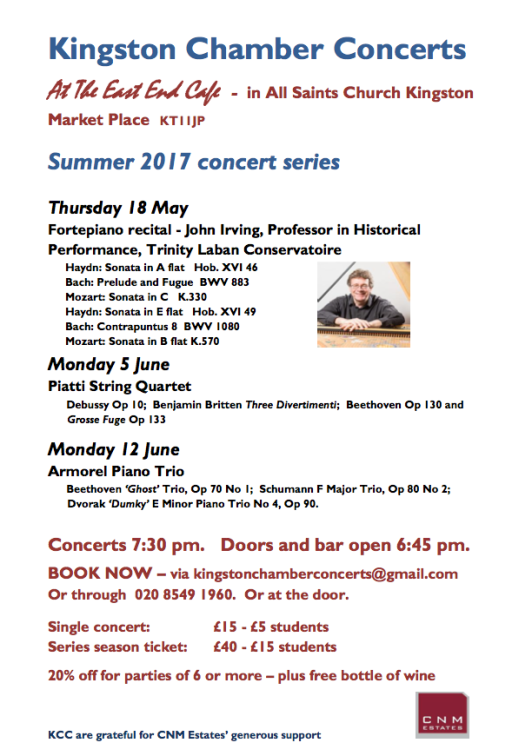
Launched in May with a fine performance by noted fortepianist and academic John Irving, the first tranche of Kingston Chamber Concerts (KCC) closed last night with a recital by the Armorel Piano Trio, who performed works by Beethoven, Schumann and Dvorak.

The KCC formula is quite simple: quality chamber music performed by young professional artists and local musicians in the convivial setting of the East End Café at All Saints’ Church, right in the heart of Kingston-upon-Thames and its historic market place. Tables are set out salon style and the bar serves good wine at a fraction of the cost of a glass of house white at the Wigmore Hall. You can take your drinks to your table and share a bottle with friends, as I did last night.

OLYMPUS DIGITAL CAMERA

The Armorel Piano Trio comprises Kathy Chow (piano), Lucia Veintimilla (violin) and Sebastian Kolin (cello). Their programme, opening with Beethoven’s ‘Ghost’ Trio, Op 70/1 and closing with Dvorak’s ‘Dumky’ Trio, Op 90, B 166, with Schumann’s Op 80/2 the middle of the triptych, demonstrated the development of the piano trio genre, from the strictly classical three-movement structure of Beethoven, though already showing the forward-pull of Beethoven’s vision in its eerily dramatic middle movement which connected it, in this concert, to Schumann’s sweeping romanticism, to the freedom of Dvorak’s six-movement ‘Dumky’ which feels more like a suite than a trio in its organisation highly  contrasting moods and textures.

This was a very committed performance by all three musicians, and extra credit must go to the young players who had had their final recitals for their post-graduate studies at conservatoire the same day: they must have been shattered but they hardly betrayed this, and their playing really came alive in the Dvorak which was replete with folk idioms and fine solos from cello and violin, with vivid colouration from the piano, in particular in the third and final movements. The Schumann was genial, laced with a bitter-sweet poignancy (the work was written in 1847, the year of the deaths of the Schumanns’ son Emil and Felix and Fanny Mendelssohn), and Armorel really caught the fleeting mercurial moods of this music.

The Beethoven, meanwhile, provided drama of a different kind, with much boisterous dialogue between violin and cello in the first and final movements, and colourful interplay between the piano and the other instruments. The slow movement was freighted with Gothic gloom, with its fragmented themes, uncertain harmonies and eerie tremolos in the bass of the piano. This was a movement of great tension, rich in quasi-orchestral textures.

This was a fine end to the first three concerts in KCC’s six-concert first season and the sizeable audience prove the series is already off to a very good start. The series resumes on Saturday 16 September with Ceruleo, an early music ensemble, whose concert entitled ‘Love and Betryal in the music of Handel and Barbara Strozzi’ includes performances on harpsichord, theorbo and Viola de Gamba.

For further information about Kingston Chamber Concerts/join their mailing list, please contact kingstonchamberconcerts@gmail.com, or telephone 020 8549 1960

dsc9240
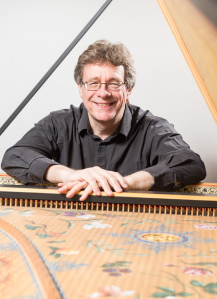
John Irving, fortepianist

A new chamber music series launches in Kingston-upon-Thames on Thursday 18 May at All Saints Church, Kingston Marketplace.

The opening concert features keyboard music by Haydn, Bach and Mozart performed on a replica fortepiano very like the type of instrument Haydn and Mozart would have known and played. The concert is given by John Irving, Professor of Historical Performance at Trinity-Laban Conservatoire in Greenwich.

Future concerts in the series include the Piatti String Quartet in music by Debussy, Britten and Beethoven, and the Armorel Piano Trio, who will perform Beethoven’s ‘Ghost’ Trio together with works by Schumann and Dvorak.

The concerts will have a relaxed format, with audience seated salon style around small tables to create a convivial atmosphere and as a reminder that chamber music was written to be enjoyed in this way.

Tickets cost £15 (students £5) for a single concert or £40 for the whole series.

Further information and booking via kingstonchamberconcerts@gmail.com / tel. 020 8549 1960

Venue: All Saints Church, Kingston Marketplace, Kingston-upon-Thames KT1 1JP

Joseph Haydn: ‘London’ Trio in F Hob XV no 17

Bohuslav Martinů: Trio

Josef Suk: Elegie, Op 23

Jean-Michel Damase: Sonate en concert

Just five minutes’ walk from Camden Town tube station, tucked up a side street off Camden High Street, is the relatively new arts venue of The Forge. Custom-designed as a flexible arts space, bar and restaurant, The Forge squeezes a lot into its small site: the airy recital space can accommodate around 100 people, and has a good reverberating acoustic, thanks to hard and reflective surfaces. The Steinway Model B grand piano is just right in this size of venue. The Forge is run by a husband and wife team who juggle their baby daughter while welcoming guests. The atmosphere within the venue is friendly and relaxed, and if you come to a Sunday morning ‘Keys and Coffee’ concert, as we did, you can take your coffee into the recital space.

Metier Ensemble is a flute, piano and ‘cello trio, comprising Claire Overbury (flute), Elspeth Wyllie (piano) and Sophie Rivlin (‘cello). They met while studying at the Royal Academy of Music and the University of Oxford, and all three have won prizes and awards for their playing. They perform solos, duos and trios, and this mix of instrumentation allows them to explore a wide range of repertoire, as was evident from the programme for their concert at The Forge. The musicians introduced each piece, engaging our interest before they had played a single note.

The concert opened, appropriately, with one of Haydn’s ‘London’ Trios (Hob. XV, 17). This is unusual amongst Haydn’s trios of the time as it has only two movements (in fact, Haydn originally billed it as a sonata for piano with flute or violin). The first movement Allegro is sprightly and, after the opening piano solo, the flute takes prominence, with the ‘cello in a supporting role. Claire Overbury played with a sweet, bright tone, combined with crisp articulation. The development section is dramatic, foreshadowing Beethoven, with some unusual modulations, before the cheerful opening motifs return. There were some lovely ‘conversations’ between piano and flute in this first movement, underpinned by some rich ‘cello support from Sophie Rivlin. The second movement is marked ‘tempo di Minuetto’, though it feels more like a proper finale, and was, like the opening movement, executed with humour, grace and evident enjoyment on the part of the musicians.

Martinů composed his Trio for flute, piano and ‘cello in 1944, a highly productive year for the composer, who was by now resident in America. It is a largely extrovert work, full of Eastern European folk motifs and nostalgic resonances of his homeland (former Czechoslovakia). The outer movements are imbued with boisterous, holiday moods, while the middle Adagio reveals the composer’s homesickness in a yearning hymn-like theme, expressively played by Elspeth Wyllie. As in the Haydn, the interplay between all three instruments was colourful, precise and lyrical.

Suk wrote his Elegie, op 23, in memory of the Czech poet Julius Zeyer, and the subtitle to the work, “Under the Impression of Zeyer’s Vysehrad,” is a reference to the writer’s epic poem based on elements of Czech mythology. The music is nostalgic rather than elegiac, full of rich, warm melodies, striking chromaticism and harmonic shifts, and an aching passion, all sensitively executed by Metier Ensemble.

The concert closed with an effervescent trio by Jean-Michael Damase (b. 1928). Damase chose not to follow his contemporaries Messiaen and Boulez into new, experimental realms of composing, and instead continued to explore the possibilities of the kind of elegant French musical language set out by Debussy and Ravel, and later Poulenc. The Sonate en Concert is organised in the manner of a Baroque suite, with contrasting movements based on different dance rhythms. The music is uplifting in mood, melodic and tonal, though containing some unusual harmonic complexities. The flute and piano carry the main interest in the work, with the ‘cello providing a Baroque ‘basso continuo’. There are several recapitulations based on the stately, expressive opening motifs, including a beautiful ‘Aria’, interspersed with livelier movements. The ‘Sicilienne’ had a delightfully relaxed lilt, while the presto ‘Gigue’ crackled with excitement, the sparkling glissandi in the piano accompanied by the happy gurgling of The Forge owners’ baby daughter. The entire work was pulled off with elan, humour and yet more obvious enjoyment by the musicians.

This was a really charming concert: a programme guaranteed to refresh and delight everyone, combined with the relaxed, convivial atmosphere at The Forge made for a thoroughly enjoyable morning.

www:metierensemble.co.uk

Pianist Elspeth Wyllie featured in my Meet the Artist series. Read her interview here

More about The Forge here: www.forgevenue.org