Critically acclaimed British pianist Brenda Lucas Ogdon returns with her new album ‘Ravel que J’Aime’ (released 1 October 2021).

The album marks only the most recent chapter of Brenda’s rich musical history. Having been awarded the Gold Medal from the Associated Board for the highest marks in any Practical Subject throughout the British Isles, Northern Ireland, and Eire, Brenda has since gone on to perform amongst the London Symphony Orchestra, BBC Scottish Orchestra, Royal Philharmonic Orchestra, and across the US, Australia, the Soviet Union, Hong Kong, and more.

Brenda Ogdon has announced that her royalties from the album will be donated to Shelter – the UK homeless charity. This act follows in the spirit of the artist’s previous charity work. In 1993, Brenda established the John Ogdon Foundation – a foundation which completely funded three scholarships for gifted young musicians allowing them to pursue romantic and contemporary piano to a post graduate standing. The initiative was founded in honour of Brenda’s late husband concert pianist John Ogdon who died in 1989.

[source: press release]

In this Meet the Artist interview, Brenda Lucas Ogdon talks about her influences and inspirations and the experience of travelling and performing with her husband when he was still alive.

Who or what inspired you to pursue a career in music?

I was inspired by the lovely, glamorous pianist Eileen Joyce. Not only by her amazing pianism but by her elegant changes of beautiful dresses during her recitals. I was also inspired by the recordings of the Beethoven Sonatas/Concerti by the great pianist Artur Schnabel.

What has been the greatest challenge of your career?

The sudden, unexpected death of my husband, John Ogdon. I was a widow at the age of 53 and my life was turned around. After performing the duo piano works with John for at least 12 years, I had to revive my solo career. It took some time but eventually it happened.

Of which performances/recordings are you most proud?

I am very proud of the send recording we made of the two Rachmaninov Suites for 2 pianos. EMI amalgamated these with other recordings we made for them of Debussy, Bizet, Arensky, Khachaturian, Shostakovich, in a two-CD set, still available on the Warner label. I am also proud of my solo discs of The Well-Tempered Clavier Book 2 by J. S. Bach, released in 2018 on Sterling Records.

Which particular works do you think you perform best?

I really do not have a view on that question. At the moment I am releasing a double album of Ravel “Ravel Que J’Aime”, so I am hoping that it is Ravel.

What do you do off stage that provides inspiration on stage?

I am always listening to other musicians which gives me a lot of inspiration. My daughter Annabel and I listen frequently to the Berlin Philharmonic Orchestra via their website.

How do you make your repertoire choices from season to season?

I do not tour or give live concert performances anymore as I am 85 years old and those glory days are not possible for me physically. I have always loved recording so that is what I am happy to do now. The Ravel is for the charity Shelter – I am donating all my royalties to this charity, which I feel passionate about.

What is you favourite concert venue and why?

The Wigmore Hall in London. It is just such a perfect recital hall.

What do you feel needs to be done to grow classical music audiences?

More funding for primary education in instrumental tuition in state schools. The rest will follow.

What is your most memorable concert experience?

Difficult to pin down one experience against another: several memorable Promenade [Proms] concerts with John; a travel nightmare to give a concert in Spain when the French air traffic controllers were on strike so we missed the date. We eventually travelled and arrived in Malaga in the middle of the night. We played the concert a day late and when we walked on stage the audience erupted in the loudest applause I have ever heard! It was quite memorable and great fun.

As musician, what is your definition of success?

Success is when everything that you have worked and prepared for clicks into place at the right moment.

What advice would you give to young or aspiring musicians?

For performing musicians it is a tough world at the moment. Competition is strong and standards are very high – for example, the recent Leeds International Piano Competition where really amazing pianism was evident. Young musicians should listen to performances by major artists. They should try to accept the fact that there will be disappointments as well as triumphs in the life ahead of them and deal with that in a calm manner.

What is your most treasured possession?

My Yamaha Model C6 Piano

Brenda Lucas Ogdon’s latest album ‘Ravel que J’Aime’ is released on 1 October 2021, preceded by two singles of Miroirs: II. Oiseaux Tristes and À la manière de Borodine. All royalties from the album will donated to the homeless charity Shelter. 


Brenda Lucas Ogdon graduated with honours from the Royal Northern College of Music, where she met her future husband, John Ogdon.  She embarked on a world-wide solo career and a piano duo partnership with John.  This took them to almost anywhere in the world where grand pianos existed.  Brenda has appeared at the Cheltenham, Aldeburgh and Edinburgh Festivals, and also Sintra in Portugal and Maine in the U.S.A.  She has recorded for several major labels including EMI & Decca and her work has frequently been broadcast.  She has appeared with major orchestras throughout the UK, Australia and the U.S.A.
Read more

Who or what inspired you to pursue a career in music and who or what have been the most important influences on your musical life and career? 

My parents foremost – there was music around the house at all times, and my mother had a beautiful voice and sang often with my father accompanying. Then my first teacher, from age 5, Barbara Boissard. Then Kathleen Long, a natural pianist and musician with a beautiful sound. I stayed with her until I was 12 when I went to study at the Paris Conservatoire for 6 years. By then my mind was firmly made up – but these people were good early influences who would have helped my resolve to be a musician grow. 

What have been the greatest challenges of your career so far? 

In my younger years, there was an injury or two which involved some important last minute cancellations, which I hated being obliged to do. You have to keep faith that you will heal completely, which of course I did. However emerging from the pandemic is really challenging – planning impossible and great flexibility needed, as well as zen-like qualities. 

Of which performances/recordings are you most proud? 

It depends on which period of my life. The Philips recordings of Lieder with Wolfgang Holzmair were very special for me. As were the Schubert Live recordings from South Bank Centre a little over a decade ago. They were tough days, the rehearsal was recorded, as was the concert, with a patch session until late into the night. Each was a real marathon. 

But my set of recordings for Chandos have been, still are, a wonderful journey – all done at the amazing Snape Maltings with an excellent team. I have a particular fondness for the Liszt/Wagner recording, as well as for the Beethoven Diabelli Variations and “Iberia y Francia” , a lovely mix of French and Spanish masterpieces, large and small. 

Which particular works/composers do you think you perform best? 

It’s not really for me to say. I don’t take up any work if I am not 150% convinced by it, and feel that I have something really personal to express through a piece. I guess that Schubert and Schumann are particularly close to me. 

What do you do off stage that provides inspiration on stage? 

Get away from music! Read, be in the great outdoors, preferably walking..

How do you make your repertoire choices from season to season?

Dominated either by practicalities (recordings, requests from promoters, festival themes) or, simply by a movement of the heart that impels me to such and such a composer..

Do you have a favourite concert venue to perform in and why? 

There are so many. The Wigmore Hall is particularly dear to me as to so many of us – but also Spivey Hall near Atlanta GA in the US, Severance Hall in Cleveland, the Recital Hall in Melbourne, the Concertgebouw in Amsterdam…I hate to leave any out, but am obliged to!

What do you feel needs to be done to grow classical music’s audiences?

I would like to think that the amount of filming of concerts on the web during the pandemic, and their easy availability, might entice new audience members when venues open up more. If only newly interested viewers could realise what an even richer experience it is sitting in a hall sharing an amazing musical experience with others – the synergy between platform and audience…There is honestly nothing like it.

What is your most memorable concert experience? 

One was certainly the first time I played the last three Schubert Sonatas together in one concert, a marathon if ever there was one. It was in the hall at Westminster School, on a freezing cold night – a packed audience sat huddled up in their coats and listening so attentively. It was a two hours-and-ten concert, and I was like a rag doll at the end, but proud to have stayed the course..

As a musician, what is your definition of success? 

When I see that the music for which I have been a vessel has really reached the depths of people’s hearts and souls and that they are the better, or the wiser, for it. It is like speaking a message that has been clearly heard. If music-making is not about that, then for me it is not about anything. This has nothing to do with commercial success which is another story. 

What do you consider to be the most important ideas and concepts to impart to aspiring musicians? 

Be humble about your ambition, whilst keeping your vision and goals clear. Be patient. And work work work – it is never enough. 

Where would you like to be in 10 years? 

Alive!

What is your idea of perfect happiness? 

Walking in the Italian countryside in spring, with the prospect of a simple meal with friends at the end of the day. 

What is your most treasured possession? 

My house and garden.

What is your present state of mind? 

Sane, mostly. 

Imogen Cooper performs at this year’s Petworth Festival on 24 July, playing music by Schubert, Liszt and Brahms. More information/tickets


Regarded as one of the finest interpreters of Classical and Romantic repertoire, Imogen Cooper is internationally renowned for her virtuosity and lyricism. Recent and future concerto performances include the Berliner Philharmoniker and Sir Simon Rattle, Sydney Symphony with Simone Young and the BBC Scottish Symphony Orchestra with Ryan Wigglesworth.

Read more

(Photo credit: Sim Canetty-Clarke/Askonas Holt)

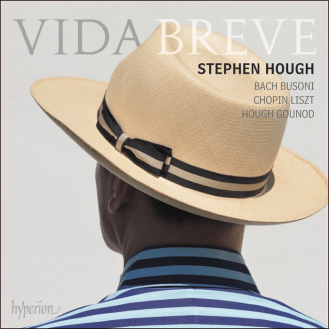
034571282602‘Vida Breve’ (Short Life) – Stephen Hough, piano (Hyperion CDA68260)

It seems fitting that Stephen Hough’s new album ‘Vida Breve’, featuring music on the theme of death, should be released while we are still in the thrall of the coronavirus. But this album is not a response to the pandemic and was in fact conceived and recorded long before any of us had heard of coronavirus or COVID-19.

Yet its theme is highly relevant to our Corona times when death dominates the news, from the daily tally of COVID deaths and grim predictions from scientific and medical experts. Despite this, as Stephen Hough says in the CD’s liner notes, we are still reluctant to talk about death, a reluctance which has increased over the past 50-odd years during which medical science has made it possible for people survive better and for longer and has led to a greater disassociation from and hyper-sensitivity to discussions about death.

For artists, writers and composers death has always been a central preoccupation, resulting in some of the most extraordinary, exultant and emotionally profound expression in painting, literature and music – amply demonstrated in the works on Hough’s new album. In the nineteenth century people were far closer to death than we are today, and for Chopin (whose short life was dogged by ill-health), Liszt and Busoni, composers whose music is included on this CD, death was understood and accepted as part of the natural course of life.

As a Catholic, I suspect Stephen Hough has a fairly robust attitude towards death, perhaps more closely aligned to that of the composers featured on his new disc (and remember Liszt was a devout Catholic). Hough’s faith teaches us not to fear death but to accept it as the only certainty in life, and his own piano sonata ‘Vida Breve’, the work which lends its title to the disc, explores the brevity of life, a reminder that our allocated time is short. An abstract, introspective work constructed of five tiny motivic cells, which interact contrapuntally and include a quotation from the French chanson En Avril à Paris, made famous by Charles Trenet, ‘Vida Breve’ lasts a mere 10 minutes, a comment on the transient, fleeting nature of life, its passions and turmoil.

Bach’s mighty Chaconne from the D minor violin Partita opens this recording, in Busoni’s glorious, romantic transcription for solo piano. This epic cathedral of sound is an awe-inspiring, emphatic opener (Hough played it at his Wigmore Hall livestream concert in June 2020), and here Hough gives it an authoritative, multi-layered, orchestral monumentalism. It’s opening is dark and sombre, yet the processional nature of this piece, with its sense of building, dying back, then increasing again, brings a remarkably uplifting atmosphere to this music, and of course its final cadence, a Picardy Third, ensures that it closes with a clear sense of positivity.

After the towering majesty of the Chaconne, Chopin’s Piano Sonata No. 2 is fleet and turbulent, its anxious intensity tempered when Hough lingers over the more lyrical Nocturne-like passages in the opening movement and the Scherzo, or when he allows the essential nobility of the music to shine through over disruptive bass motifs. Like the Chaconne, the famous Marche funèbre is magisterial rather than simply funereal, while the tender, dreamy middle section lends an other-worldliness to the music’s atmosphere before the tolling bass and mournful theme return.

In addition to the thematic associations between the pieces, there are musical connections too: the dark rumbling bass octaves in the Bach/Busoni Chaconne are reiterated in the Marche funèbre – a plangent left hand accompaniment which, in the reprise of the famous theme dominates, with a dark tolling grandeur. And this figure is later heard again in the opening of Liszt’s Funerailles, to which Hough brings an ominous darkness, its slow-march meter suggesting the dead weight of a bier on the shoulders who carry it, before a more reflective, wistful section. The other piece by Liszt, the Bagatelle Sans Tonalité, is a musical gargoyle with its wayward harmonic language and grimacing, dancing rhythms.

The remaining works on the disc are encores of a sort – a reminder that this final recital is not quite over….. Busoni’s Kammer-Fantasie über Carmen uses familiar melodies and motifs from Bizet’s opera and transforms them into a witty concert piece, to which Hough brings a warm romanticism. His own transcription of Arirang, a traditional Korean folksong, is gentle and contemplative, its lyrical melody singing out over a flowing accompaniment. It leads naturally into Gounod’s recasting of Bach’s Prelude in C into Ave Maria (also transcribed by Hough), a popular work at funerals, perhaps because it is both perfect music for the transit to the afterlife and for reflections on life and the inevitability of its end. Death, now where is thy sting?

This album is masterly is its programming; stimulating and provocative, it’s a superb recital disc and, being Hough, the music is thoughtfully chosen and impeccably played.

Highly recommended

FW


‘Vida Breve’ is released by Hyperion on 29 January 2021. 

This review first appeared on The Cross-Eyed Pianist site

Piano music commissioned and recorded during lockdown to support musicians struggling during the Covid-19 crisis

There have been many initiatives to keep the music playing and support musicians during these difficult times. What all of these initiatives demonstrate is that musicians are, despite straitened circumstances, determined to keep playing and to continue to share their music with audiences. It also sends a powerful message to government that the industry is determined to survive, to let the music play, come what may.

I have a personal interest in this wonderful project by pianist Duncan Honeybourne: Duncan and I are friends, and also colleagues – together we run a lunchtime concert series in Weymouth.

During the UK lockdown, Duncan decided to offer short video recitals from his home every day. He called them ‘Piano Soundbites’. The series proved very popular and within a few weeks, Duncan had the idea to approach composers to ask them to write new piano pieces for him, to be premiered as ‘Contemporary Piano Soundbites’ in his video recitals. Alongside this, Duncan set up a Just Giving page to raise funds for Help Musicians UK (formerly the Musicians’ Benevolent Fund). The response was incredible – the project, which was ranked in the top 10% of Just Giving fundraisers nationally during April 2020, has already raised well over £2000 for Help Musicians UK, supporting musician colleagues struggling in the current situation.

‘Contemporary Piano Soundbites’ celebrates the diversity of styles embraced by a broad cross-section of professional composers working today. Featured composers include Sadie Harrison, Graham Fitkin, John McLeod, David Lancaster, Francis Pott, Luke Whitlock and John Casken, as well as younger and emerging composers, and each piece is no more than 6 minutes long at the most. These piano miniatures represent an important contribution to the ever-expanding repertoire for the instrument, to be enjoyed by amateur, professional and student pianists alike.

pianist Duncan Honeybourne

“….it was an invigorating experience to record an entire disc of pieces which hadn’t existed less than four months earlier! Especially stimulating and exciting is the juxtaposition of several leading senior composers with some of their most gifted younger colleagues. Several young composers make their first appearances on disc.

My objective, as I stated in my invitation to composers, was fourfold: to imaginatively harness the zeitgeist of our present situation: to bring comfort and enjoyment to a large ready-made audience stuck at home, to aid musicians badly affected by the “cultural lockdown” and to add to the contemporary repertoire, creating an artistic keepsake of this extraordinary phase in our history.

My long term plan is that, as well as helping our colleagues at a time of need, the collection will provide a snapshot of reflections and musings by some of the finest and most distinctive composers of our time at a unique and unprecedented moment in our history. I hope the disc will make for a refreshing, enriching, stimulating and quirky listening experience too!”
Duncan Honeybourne, September 2020

The music was recorded in late July 2020 in the new Gransden Hall at Sherborne Girls School, Dorset.

The disc is released on the Prima Facie label and is available to order now

For review copies, sample tracks, interviews with Duncan and other press information please contact Frances Wilson


Meet the Artist interview with Duncan Honeybourne


This site is free to access and ad-free, and takes many hours to research, write, and maintain. If you find joy and value in what I do, please consider making a donation to support the continuance of this site

Make A Donation


