Following the critical success of ‘The Mountebanks’, John Andrews’ recording of Sullivan’s late opera ‘Haddon Hall’ with the BBC Concert Orchestra, BBC Singers and a cast featuring Sarah Tynan and Henry Waddington was released at the weekend.
En Pleine Lumière volume 1– Sandra Mogensen, piano
This first album in the “en pleine lumière” project features 10 composers born in the mid-19th century, including Mel Bonis, Cecile Chaminade, Germaine Taillferre and Amy Beach.
Howard Skempton is one of the UK’s most engaging and distinctive composers. Now in his seventies, he has produced a large and varied body of more than 300 works. Amongst these are over 100 pieces for solo piano, which he describes as the ‘central nervous system’ of his work. It is a treasure trove for both amateur and professional pianists, in which most of the pieces are very approachable from a technical point of view (in contrast to a great deal of contemporary piano music) whilst being at the same time hugely rewarding to explore and perform.
Almost all of Skempton’s piano pieces have been written for friends and colleagues or for special occasions. They are predominantly short, tonal and sparingly composed, with very few notes to the page. Many of them look very simple and are, in fact, quite easy to sight read, but, in my experience the only time these pieces are ever easy is when you are sight-reading them. As soon as you start practising them the challenge begins. Their apparent simplicity is deceptive, a conclusion reached in an excellent programme on BBC radio 3 recently called The Simple Truth, in which Tom Service explored the subject of ‘Simplicity in Music’. Commenting on one of Howard Skempton’s short piano pieces, he said “Simple, isn’t it…well, you try composing it!”. I would add “try playing it!”.
One of my favourites is Solitary Highland Song, which he wrote in 2017 for a collection of love songs for solo piano that I commissioned. When the piece first arrived, I immediately read it through and found it deeply moving. In fact, I couldn’t get it out of my head for days. It consists of a simple and haunting eight bar tune, repeated six times, each time slightly differently. The dynamics start at pp, progress to mp and return to pp. Nothing complicated here. And yet I remember practising the piece for hours and hours before I gave its first performance, and I still practise it a lot before a performance. Why? The simplest answer that I can give is that it takes time to really hear the music. Skempton’s musical language is so distilled and pared down that every note, chord and musical gesture must be perfectly calibrated. Quite apart from the question of mastering total control of touch and voicing, the performer must seek out the essential character of each piece by learning to be open to what is interesting within the music, rather than trying to make the music sound interesting. There are no short cuts in this process. Skempton deliberately gives only minimal performance instructions, so that performers are invited to participate in the music and develop their own awareness of subtle changes and shifting patterns. The more I play Solitary Highland Song, the more I become aware of the genius behind every choice the composer has made: the subtle changes of register, for example, or the distribution of notes in chords and unexpected changes of harmony and rhythm. For me the piece is an enduring delight, and, I think for others too, since it has recently achieved the wonderful landmark of being heard over a million times on streaming platforms.
An example of an even sparser piece would be the third of the Reflections, a collection of eleven pieces that Skempton wrote for me between 1999 and 2002. It consists of four two note chords, a ninth or tenth apart, which are repeated in a different order eight times. The only performance instructions given by the composer are that the chords should all be played approximately two seconds apart, ppp and pedalled throughout. Where is the challenge here? Well, for a start, it is not easy to sustain molto pianissimo playing with a consistent sound, even for just over a minute. The more you play the piece, the more your listening becomes tuned in to the slightest blemish, or bumped note. And the more you listen, the more you start to become aware of the harmonic resonance shifts in different ways as the order of the chords change. By the time I came to record this piece, my ears were highly sensitised to the point where the tiniest imbalance in a chord would sound like a catastrophe. But it became very clear in the recording sessions that what brings a performance to life for the composer are the tiny unexpected or unplanned things that happen and the way a performer responds to them. In his characteristically gentle and encouraging manner, Howard Skempton decided that what we might have called ‘blemishes’ should be referred to as ‘involuntary refinements’! For him, the most important thing is to keep the music alive at every moment rather than aim for clinical perfection.
I recommend this repertoire strongly to fellow pianists at every level of ability. You will find pieces that are hauntingly beautiful, others that are quirky and playful; they are always imaginative, beautifully crafted and unpredictable. As well as giving a huge amount of pleasure they can teach us a great deal about our relationship to the keyboard and about how we listen to ourselves. Having totally immersed myself in Skempton’s music recently, I find that all the other repertoire I am coming back to sounds new and refreshed to my ears.
Scores are easy to obtain. Oxford University Press have published three volumes of Skempton’s piano pieces, which are reasonably priced. Most recently Howard Skempton has taken on the challenge of writing 24 Preludes and Fugues, an intriguing cycle of miniatures covering all 24 major and minor keys, written last year and lasting barely 23 minutes. These will be published by OUP in the coming months.
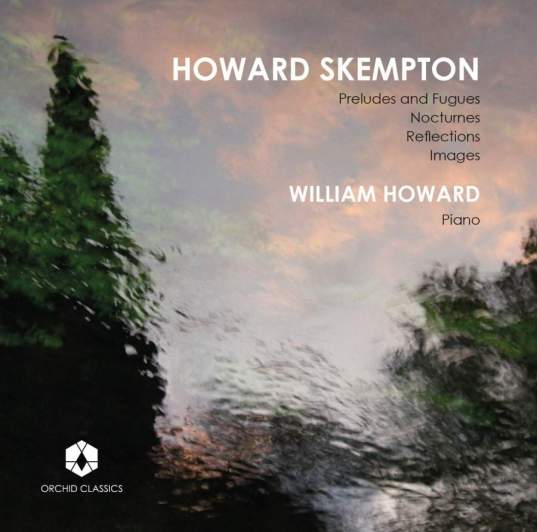
William Howard’s recording of Howard Skempton’s 24 Preludes and Fugues (2019), Nocturnes (1995), Reflections (1999-2002) and Images (1989) will be released on Orchid Classics (ORC100116) on 14th February. Pre-order here.:
Anyone who pre-orders the album can enter a prize draw to win one of five copies of Solitary Highland Song, signed by the composer. Please forward your order confirmation email to mail@williamhoward.co.uk before 14th February.
The album will be launched with a recital by William Howard at Kings Place on Wednesday 12th February at 7.30pm in which he will play works by Bach, Schubert and Howard Skempton. Tickets and further details here
Who or what inspired you to take up composing, and pursue a career in music?
I started composing of my own accord at about the age of 8, without anyone particularly inspiring me or suggesting I do it. I just started writing things down on bits of manuscript paper lying around the house. I remember making up a key signature which combined sharps and flats and showing it to my father, who said there was no such key signature. I didn’t understand why that was, or why I wasn’t allowed to make up my own key signature. As to making a career from music, that was never intended. Most people who write music stop at some point, and I just never stopped.
Who or what were the most significant influences on your musical life and career as a composer?
I had an wonderful music teacher called Gwynne Lewis when I was about 10. He didn’t especially inspire me to compose, but he communicated a love of music and the joy of being involved in music and I carry that with me. I also learned a lot about commitment and integrity from the composer Param Vir. Apart from my teachers the inspiration above all has been Igor Stravinsky. I didn’t discover his music until the shockingly late age of 16 or 17, but once I heard the Rite of Spring I never looked back in my devotion to his music. First hearing the Symphony of Psalms was an unforgettable experience.
What have been the greatest challenges of your career so far?
As with all composers, the challenge is to have your music heard. In this I have been pretty lucky, but every composer wants more and higher profile performances and commissions.
What are the special challenges/pleasures of working on a commissioned piece?
Having a particular occasion or performed in mind can really help to shape a piece. When the requirements of the commission and you are aligned it is really fun: writing my narrator-and-orchestra piece ‘Not Now, Bernard’ was one such – I realised it was a story I loved to tell, and that the music could add to.
What are the special challenges/pleasures of working with particular musicians, singers, ensembles and orchestras?
I’ve been lucky to work quite often with the BBC Singers over many years, including on an album of my music released in 2016. The fun of writing for them is also the danger – they can sing anything and make it sound good, but if you push the boat out too far no one else will ever sing it.
How would you characterise your compositional language?
My musical language changes with each piece I write, so I don’t have a personal style as such – although I am sure there are recurring tricks if you look for them. Writing a piece is finding a solution to a problem, and when the initial restrictions vary, so does the end result. But when I write a piece like ‘Not Now, Bernard’, which is very tuneful and ‘accessible’, I don’t think of it as any less a ‘proper piece’ than my more avant-garde pieces – they are all aspects of my compositional voice.
As a composer, how do you work?
On a practical level I move between the keyboard, handwritten music notation and the computer. They each have their role within the process – although often first ideas come when I’m on my feet, either walking round my neighbourhood or in the shower. I like the handwritten element because you can trace your ideas back archaeologically if you change your mind. But I also love the opportunity the computer offers to check things like pacing, and complex harmony that is beyond my fingers.
Which works are you most proud of?
It would have to be the two large-scale pieces written for the BBC Singers. ‘The Death of Balder’ in particular, is an original conception – a ‘radio opera’ for choir on a Norse myth – and I am happy with how it turned out, after a great deal of uncertainty while composing it. I also had the opportunity to write an orchestral piece in 2012 called ‘Anaphora’ which again caused me a lot of grief in the creation but which I am in retrospect very proud of.
Who are your favourite musicians/composers?
As mentioned above, I am a huge Stravinsky fan, and always will be. Of contemporary composers, I really love Judith Weir’s music – she is also an extremely kind and generous person and it was a pleasure working with her on my album Not Now, Bernard and Other Stories, which features the premiere recording of her piece ‘Thread!’ alongside my own music. My current enthusiasm is for a French composer called Guillaume Connesson, who is very little known in this country but I think is brilliant and deserves much wider programming.
What is your most memorable concert experience?
I was lucky enough, as a child living in Berlin in the 1980s, to be taken to hear the Berlin Philharmonic a few times. The two occasions I particularly remember were hearing Mendelssohn’s Violin Concerto and – the first time I went – Mozart’s Piano Concerto no 21. I was about 10 and both completely blew me away, just the sound of the orchestra, and I still love both pieces. I also remember, at one of those concerts, the second half being a Shostakovich symphony, which I hated; Shostakovich symphonies still don’t do it for me.
What advice would you give to aspiring musicians and composers?
I think it is a responsibility of composers to listen widely, and to music that is not necessarily instantly amenable. I think too many people, young people in particular, are too narrow in their range of listening. In one sense there is no excuse for not listening widely – my excuse as a youngster was that it was difficult to access music, apart from Radio 3 and my local library’s cassette collection. But the flip side is that there is so much music available now that it can be difficult to wade through it all. But it is important for composers to have open ears.
In my Meet the Artist interview posted here on June 13th 2018, in response to the question “Who or what inspired you to take up composing, and take up a career in music?”, I mentioned three teachers who had helped me during the years I was a pupil at William Ellis School in Highgate, North London. The third of these was Julian Silverman, who, I discovered recently, and to my immense shock and sadness, died on Boxing Day 2016, shortly after his 80th birthday.[1]
Julian Silverman
Julian taught me A-level Music, having been appointed as a part-time teacher at William Ellis School in 1967. It soon became clear to me that he was an exceptionally gifted and knowledgeable musician. A superb pianist and a fine horn player as well as an accomplished composer, his musical tastes were exceptionally broad, and he possessed an encyclopaedic knowledge of the repertoire.
He was an inspiring teacher, and we immediately established a firm rapport. I was very pleased when he offered to give me private piano and composition lessons. After a while, the teacher-pupil relationship broadened into friendship, and I began to spend time at weekends and school holidays at Julian and his wife Erika’s large Victorian house in Kentish Town, a short journey on the Northern Line from my parents’ home in North Finchley. Surrounded by scores, books and instruments we would discuss not just music, but a wide range of topics, including art, literature and politics. I was a shy and somewhat awkward teenager, and very much appreciated the warmth and kindness shown to me by Julian and Erika. Sometimes, I would make music together with Julian and his friends, even giving the occasional concert. I remember playing trio sonatas at the Arts Lab in Drury Lane – not maybe the sort of venue normally associated with this repertoire.
I remained in touch with Julian after I left school. Julian himself handed in his notice a year or so later, and began working as a theatre MD. In August 1972, while a BA student at the University of Sussex, I was in the band performing Julian’s haunting and effective music for Yevgeny Schwarz’s The Dragon at the old Half Moon Theatre in Alie Street, Aldgate.
By the time I finished my degree at Sussex, Julian and Erika had moved to Switzerland and were living on the outskirts of Zürich. In the Summer of 1973, my then girlfriend and I hitch-hiked from Rome to London via Zürich. Julian had assured me that we would both be welcome there, and, initially, we had a very pleasant time. I wrote some short duos for flute and horn, which we played together. Erika, it soon turned out, was less pleased to see us, as we were the latest in a constant stream of visitors from London who had descended on them at Julian’s invitation, and we left after a few days.
Julian and Erika returned to London and, by the late 1970s, Julian was working as Classical Music editor for Time Out magazine. I was a struggling freelance musician, trying to make a living from proof-reading, music editing and suchlike. On several occasions, Julian offered me work writing photo captions for the magazine. The captions were only about a hundred words long, and the pay was good, so I was naturally very grateful to him for this.
I was also very pleased when, in 1982, music by Julian and me appeared in the same programme, when the newly-formed duo of trumpeter Jonathan Impett and pianist Michael Blake commissioned works from both of us for their debut concert at the Purcell Room.
It was at this time that it became obvious from our increasingly infrequent conversations and correspondence that Julian was not entirely happy with the direction my work was taking. I had got to know Brian Ferneyhough when I was working at Peters Edition in the late 1970s, eventually studying with him in Freiburg from 1981 to 1982, so my music was associated in some quarters with the “New Complexity”. Julian was himself at one point intrigued by this tendency. Dizzy Spells, the piece he wrote for Jonathan Impett and Michael Blake, was apparently influenced by Michael Finnissy. He clearly became disillusioned with it, as is obvious from his somewhat dismissive review of the “New Complexity” issue of Contemporary Music Review (1995) (to which I had contributed an article) in the July 1996 edition of Tempo.
This review, which appeared some years after we eventually lost contact, was the last time my and Julian’s lives converged. I was saddened by its tone, and am still sorry that I never had the chance to discuss it with him. Ironically, his last years were spent living within walking distance of my parents’ home. My overwhelming memories of Julian are positive, though. I will never forget his wisdom, his guidance and the kindness he showed me, and, to this day, I will be listening to a piece of music and suddenly think, “Ah, I remember talking about this piece with Julian”.
An update from James Erber (August 2020)
Towards the end of 2019, shortly after I wrote my original post about Julian Silverman, Julian’s widow, Erika, contacted me and asked if I could help find a new home for Julian’s compositions and writings on music. I am very pleased that, after a lengthy delay due to the lockdown, Roger, Julian’s brother, and I have finally been able to deliver them to the Bodleian Library, where they await cataloguing. The library is the obvious place for them to be lodged. During the mid-1950s Julian had studied Music at Oxford and, together with composers such as Peter Sculthorpe and Gordon Crosse, had made a strong impact on the New Music scene there.
Erika, Roger and I are most grateful to the two people who made this possible: Martin Holmes, the Bodleian’s Music Librarian, and Margaret Jones, Music Collections Supervisor at Cambridge University Library, who suggested the Bodleian Library as the recipient of Julian’s papers, and offered to intercede with Martin about them.
James Erber was born in 1951 in London. Having gained Music degrees at the Universities of Sussex and Nottingham, he spent a year studying composition with Brian Ferneyhough at the Musikhochschule, Freiburg-im-Breisgau. He has worked in music publishing and education.
His music has been widely performed and broadcast throughout Europe and in the USA, Australia and New Zealand by many eminent soloists and ensembles. It includes Epitomaria-Glosaria-Commentaria for 25 solo strings (1981-84), The ‘Traces’ Cycle for solo flute (1991-2006), two string quartets (1992-94 and 2010-11), Das Buch Bahir for 9 instruments (2004-2005), The Death of the Kings for 11 instruments (2007) and Elided Dilapidations for piano (2013-14).
Matteo Cesari’s recording of The ‘Traces’ Cycle and three other shorter works for solo flute is available on Convivium Records. Other works can be found on NMC, Metier and Centaur Records (USA).
The Cross-Eyed Pianist is free to access and ad-free, and takes many hours every month to research, write, and maintain.
If you find joy and value in what I do, please consider making a donation to support the continuance of the site

 Arthur Sullivan, Haddon Hall
 En Pleine Lumière volume 1 – Sandra Mogensen, piano






 The Cross-Eyed Pianist