Who or what inspired you to take up composing, and pursue a career in music?
Myself. But then Bernard Rands my tutor and Bill Colleran at Universal Edition (London/Vienna).
Who or what were the most significant influences on your musical life and career as a composer?
Bruno Maderna, Luciano Berio, Messiaen. Historically: J.S. Bach, Webern, and late Mahler.
What have been the greatest challenges/frustrations of your career so far?
They were the 4 major works written for the BBC Symphony Orchestra. I have at least 4 new works still waiting on first performances. But I remain patient.
What are the special challenges/pleasures of working on a commissioned piece?
Time. I work slowly and with painstaking care. My music is sometimes complex and it is crucial that performers receive as near perfect copy of performance materials as is possible. I do my best and I have a fine copyist. UE taught me this, way back in 1972.
What are the special challenges/pleasures of working with particular musicians, singers, ensembles and orchestras?
The pleasures are being there for rehearsals. Some conductors are exceptional (Sir Andrew Davis), some work seriously hard (Martyn Brabbins), others you may never wish to see again. New Music Ensembles, string quartets and solo performers have been the most satisfying to work with. Lifelong friendships are made.
Of which works are you most proud?
“WULF” for 24 voices (amplified) and 24 instrumentalists – yet to receive a first performance; “The Attraction of Opposites” for 2 pianos; the orchestral trilogy, “Vixen”, “Qibti” and Phoenix”; “Hey Presto!” written for BCMG conducted by Diego Masson, happiest of all.
How would you characterise your compositional language?
Proudly European but, like Bartok, drawing on cultures further afield and from the distant past.
How do you work?
In my music barn, composing, still, on manuscript paper. However, most work has been carried out in Sicily. The climate, the food and wines kept me going, and going well, so producing the goods. I also found plenty of time to read, to feed my imagination.
Who are your favourite musicians/composers?
Musicians such as Melinda Maxwell – oboe, Simon Limbrick – percussion, Rolf Hind – piano, BCMG, The Arditti Quartet. Composers I already listed as influential on my work. Still living? The works of Birtwistle, Ferneyhough, Tom Ades, David Sawer, Julian Anderson and Sam Hayden interest me.
What is your most memorable concert experience?
Experiences: Simon Rattle conducting all Mahler and some Messiaen with the CBSO, Symphony Hall, Birmingham.
What do you consider to be the most important ideas and concepts to impart to aspiring musicians?
Feed your imagination and let it run. I always ask myself the question “What if?” Be your own best critic and bin a lot.
Where would you like to be in 10 years’ time?
Where I am now.
What is your idea of perfect happiness?
Being with the right person and being amongst friends.
What is your most treasured possession?
It is my 40-year-old Pavoni, brass and copper, coffee machine.
What do you enjoy doing most?
Walking the hills.
What is your present state of mind?
Pensive.
Born in Yorkshire in 1945, Vic Hoyland’s earliest interests were in painting, calligraphy and architecture, but after completing an Arts degree at Hull University and a prize winning work was submitted to the BBC, he decided to concentrate on music. Wilfrid Mellers invited Vic to undertake a doctorate at the then new music department at York University where his tutors were Robert Sherlaw Johnson and Bernard Rands. From 1980-1984 he was Haywood Fellow at the Barber Institute, then after two years at York University he returned to Birmingham as a full-time lecturer responsible for MDD, an interdisciplinary programme between music, drama and dance. He was subsequently Professor in Composition at Birmingham until his retirement in 2011. In 2015 he was made Emeritus Professor, in recognition of his longstanding and valued contribution to the University of Birmingham.
Commissions have come from many festivals – Aldeburgh, Almeida, Bath, Cheltenham, Warwick and Stratford, Huddersfield, South Bank and York – from organisations such as the BBC Symphony Orchestra and ensembles such as Lontano, the Arditti Quartet, Lindsay Quartet, BCMG, Endymion and Vocem. Works prior to 1994 are held by Universal Edition (Vienna). Works after 1994 are held by Composers Edition. Works include In transit for large orchestra which, together with Vixen, was recorded by the BBC Symphony Orchestra for NMC records. Most of Vic’s music has been broadcast on BBC Radio 3. The Other Side of the Air and Token are also available on NMC records. The second work in his orchestral triptych, Qibti was premiered at the Barbican on 18 December 2003 and conducted superbly by Sir Andrew Davis.
Who or what inspired you to take up composing, and pursue a career in music?
Probably many things. I remember sitting at home at the piano, playing (I use the term loosely) Bach’s Preludes and Fugues, trying to work out how the hell he did it. Also my parents, teachers at sixth form and university: Martin Read, Michael Zev Gordon, Vic Hoyland and then Diana Burrell at GSMD.
What have been the greatest challenges/frustrations of your career so far?
Unfavourably comparing myself to other composers and artists. It’s so easy to descend into a Facebook-style Scroll of Shame where every successful and sparkly new thing makes you panic and think ‘I should be doing that!’ It is challenging to learn how to be influenced by other people’s ideas and techniques without feeling you have to follow their path.
What are the special challenges/pleasures of working on a commissioned piece?
First of all, commissions are fantastic. Everyone should commission composers AS MUCH AS POSSIBLE! Pieces often take ages to write and there won’t be much decent new music that defines and enriches our time and culture if people don’t commission it.
It is also incredibly motivating to have that deadline and the vision of a future audience at the first performance anticipating your new work.
What are the special challenges/pleasures of working with particular musicians, singers, ensembles and orchestras?
I write for a variety of people and situations, from professional singers and ensembles to school or community groups who have to learn things quickly and have fun doing so. Learning what works in what context is a tough skill. It takes a long time to master. I love writing for voice and I’ve been working a lot with solo singers recently. It’s great to have their voice in your head as you write and to think about the shape of the text, the breathing, the pacing and the drama of it.
Of which works are you most proud? My two recently commissioned song cycles, ‘Woolf Letters’ and ‘Early Stroll Songs’, which set Virginia Woolf’s letters to her sister and Ian McMillan’s Early Stroll tweets. I’m also very proud to have produced three performances of my opera ‘The Hidden Valley’ at St George’s Bristol this year, working with an incredible team of artists – I did, however, need a very long lie down in a darkened room afterwards.
How would you characterise your compositional language?
I like to think it’s an English sound, rooted in nature, often starting from melody and the voice.
How do you work?
I work best early. I have a lot of ideas doing other activities (gardening, showering etc.) as it gives space and time for the brain to process ideas. When I was writing ‘Early Stroll Songs’ I got into a routine of starting composing first thing (6.30-ish) for a few hours: At the keyboard, with pencil, Manuscript paper, black tea. I could usually complete 1 short song each day or two. My wife often acts as an editor, offering a second pair of ears to help me hear the music from an audience’s perspective. Later in the day, if not teaching, I would do computer / admin-type work: Typesetting, emails, checking twitter too much, grappling with a labyrinthine funding application etc.
Who are your favourite musicians/composers?
Starting out, my heroes were Bach, Stravinsky, Messiaen, Britten and Steve Reich, but I’ve recently been more drawn to the vocal music of Purcell and Handel, Mozart’s Symphonies, Schubert’s song cycles and the music of David Lang and Laurence Crane. I’m always interested in opera composers and I enjoyed Tansy Davies’ Between Worlds at ENO and Fairy Queen at Iford recently.
What is your most memorable concert experience?
When I was 16 or 17, I went to a performance of Britten’s War Requiem in Southampton. We sat right at the back. After the concert, walking out into the car park, I couldn’t speak. It was such a visceral experience.
What do you consider to be the most important ideas and concepts to impart to aspiring musicians?
Listen to and interrogate lots of good music. Like what you write. Befriend performers. Don’t follow advice too much.
Richard Barnard is a composer based in Bristol. He studied at Guildhall School of Music and Drama and University of Birmingham. He has written operas, song cycles and choral works for Welsh National Opera, Opera North, BBC Singers, Bristol Ensemble, Juice Vocal Ensemble, Siân Cameron and others. He has composed music for dance and theatre, and his chamber pieces have been performed internationally by groups including Delta Saxophone Ensemble, Juice Vocal Ensemble and Kungsbacka Trio.
Richard curated the acclaimed new music series Elektrostatic at Bristol’s Colston Hall and Arnolfini for five years. He has taught orchestration and composition at University of Bristol and is one of the UK’s foremost composition workshop leaders, working with WNO, CBSO, London Sinfonietta, Sir Peter Maxwell Davies, Philharmonia Orchestra and Eighth Blackbird.
Who or what inspired you to take up composing, and pursue a career in music?
My parents were both professional violinists, so the likelihood is that I was an embryo even as my mother played in the midst of all the instruments- quite an introduction to music! In addition my aunts were also musicians and so it seemed that music was the stuff of life.
To be a composer was the earliest desire I recall having for myself, although after that I tried many other ambitions as a growing adolescent, including going into politics.
I think a turning point came when I discovered Mahler at age 16, that’s when I understood what music can be more fully than before. Then when I went to study at the Royal College of Music, I was introduced to the avant garde of that time, i.e. Stockhausen etc, and I saw how music can be at the cutting edge. Since then I have attempted to redefine the cutting edge as once again melodious and to rededicate music to what it does best – the expression of emotion.
Who or what were the most significant influences on your musical life and career as a composer?
I would cite the late romantic era as the single greatest influence – the grandeur and vision combined with the emotional intensity are hall marks of that era.
But as a child of the mid 20th century I was also deeply influenced by film music Bernard Hermann, John Barry, John Williams, Ennio Morricone – and of course these were in turn influenced by the late romantic.
I would also mention the great American musicals
Amongst people who have influenced me, firstly my parents who provided an environment in which music making was like the air I breathed, whether it was my parents accompanying one another on violin and piano or playing the Bach double for two violins or my father playing the accordion, or both with my aunts on piano or violin not forgetting my brother on drums, or my older cousin Paul Lewis who is a distinguished composer of TV and film music and now increasingly of concert music. Then I should mention my extraordinary piano teacher in Brighton, the late Christine Pembridge. She taught at Roedean girl’s public school and privately at home in Port Hall.
A remarkable musician and teacher, she transmitted her passion for music with a northern directness. It was she who animated my ability to play and through her I gained direct exposure to the great music of Bach Beethoven Schubert Debussy and Rachmaninov. Among her other pupils, before me, was composer Howard Blake of ‘The Snowman’ fame. Her fine teaching prepared me for the Royal College of music which was my next great field of influence. Here I met contemporaries and great friendship with William Mival, now head of composition there. William was a devoted connoisseur of new music and introduced me to Tippett, Stockhausen and Boulez. I would later go on to rebel against the atonal establishment as I came to see it, but the initial stimulus of exposure to its heartlands and the decade I then spent exploring and writing in its styles was the essential formative experience that made my later enlightenment possible.
Once this rebellion happened I was in trouble but almost immediately found a distinguished friend in the form of the great Estonian composer Arvo Pärt. I was introduced to him in the mid 90s by his publisher and we got on immediately. I believe he identified with my struggle having had a struggle himself to escape the Soviet Union. He liked my music and gave me very direct help by splitting a commission fee with me to write music for the 900th anniversary of Norwich Cathedral. He wrote ‘The True Vine’ and I wrote my Missa Brevis. A remarkable man of vision and personal humanity.
Then a few years later, while working with South Bank Sinfonia I discovered their patron was the legendary Vladimir Ashkenazy when he came to conduct them. I asked for and was given an introduction. We found affinity immediately on the issue of tonality and he wrote to me positively about the music I was writing for the orchestra. Within a couple of years he arranged for my Symphony ‘Elixir’ to be recorded and released on Naxos. He remains a great friend and support.
Another great friend was the actor the late Corin Redgrave of the Redgrave clan.He produced my opera Manifest Destiny at the Tricycle Theatre and Ralph Steadman designed the sets. Corin, an activist campaigner along with his sister Vanessa Redgrave and wife Kika Markham( my close friend) have all supported my sometimes controversial pathway. Without them it would have been much more difficult and lonely.
What have been the greatest challenges/frustrations of your career so far?
For the first decade of my career broadly my twenties i ran an ensemble for the performance and commission of new works, The Grosvenor Group. We made some radio 3 recordings and were well supported by various trusts. Then as I approached 30 I underwent a Road to Damascus type conversion to Tonality as I began to compose more full time myself.
Simultaneously I understood that the unmitigated tonalism of my works would not be acceptable to the new music establishment as serious new music and thus began the greatest challenge of my career.
The establishment view was – and remains – based in the atonal paradigm. To challenge this is the same as challenging any establishment- very dangerous.
I felt that I needed not only to produce the work but at the same time to speak out- or even demonstrate. In particular I became involved in a group who booed a Birtwistle opera in 1994.This produced the most incredible outcry and rumble in the press that went on for years
This was captured on television here
and eventually led me to have to sue News International for libel which I did successfully in 2000.
The in 2003 I wrote with playwright Dic Edwards my opera ‘Manifest Destiny’ about suicide bombers who renounce violence and become peace makers. The press nevertheless accused me of glorifying terrorism , a serious criminal offence. Again I sued this time the Daily Mail Group. I won in the High Court but was defeated at Appeal and bankrupted by Associated Newspapers Ltd
What are the special challenges/pleasures of working on a commissioned piece?
Knowing that it will be performed and I will be paid.
What are the special challenges/pleasures of working with particular musicians, singers, ensembles and orchestras?
Having the opportunity to work within a dialogue in which changes and adjustments can be made as part of the working process
Of which works are you most proud?
I would have to cite first ‘Manifest Destiny’. This is a work which aspires to reflect and process the current geo-politics and translate then into a convincing human drama and then transmute the content onto a higher plane of transcendence. In this regard the opera seems to serve its purpose having had over 30 performances and several productions. With Dic Edwards the librettist we also managed to produce a work which has proven prescient to this day.
Also ‘The Year’s Midnight’, a meditation on the Holocaust which was broadcast on radio 4 on the first Holocaust memorial day in 2001; my music in memoriam the 51 people who drowned in the Thames in the Marchioness river boat disaster of 1989, Requiem for the Young; and my music in memoriam the former Leader of the Labour Party John Smith, ‘A Live Flame’ .
How would you characterise your compositional language?
Super Tonal
How do you work?
I type straight into the computer like writing a letter, with no sound, just hearing in my head
Who are your favourite musicians/composers?
Prince, Miles Davis, John Barry, Eminem, Mahler, Bruckner, Wagner, Bach, Elgar, Rachmaninov, Debussy, Mozart, Schubert, Schumann, Brahms, Scriabin
What is your most memorable concert experience?
Karl Bohm conducting the last three Mozart Symphonies with the Vienna Philharmonic in the Royal Festival Hall in 1978 – life changing visionary experience.
What do you consider to be the most important ideas and concepts to impart to aspiring musicians?
Music is a unique portal into the human soul
Keith Burstein was born in Brighton, England. He came from a musical family; both parents were classical violinists who played for Sadlers Wells Ballet, The Royal Philharmonic Orchestra, the BBC Ulster Orchestra and the Halle Orchestra as well as for the Royal Opera House. (Originally of Russian-Jewish extraction, the family name had been anglicised to Burston). Burstein held two scholarships at the Royal College of Music in London where he studied composition with Bernard Stevens and John Lambert. Post-graduation, he continued his composition studies with Jonathan Harvey. This was a period of great discovery for him.
John Pitts’ somewhat unusual book How to Play Indian Sitar Raags on a Piano is designed for adventurous pianists. Indian raags have an extraordinary musical heritage dating back several centuries (from the area that is now India, Pakistan and Bangladesh) – a truly unique musical genre of fascinating melodic beauty and rhythmic intricacy – freely combining elaborate composed melodies with carefully rehearsed improvisation. But now the amazing world of Indian raags has been opened up in a sympathetic but thorough reinvention for piano solo (or duet or two pianos) by an award-winning British composer.
In this guest post, John explains how his fascination with Indian raags began, leading eventually to his new book…..
My fascination in Indian raags (also spelled raga/rag) was sparked back in 1994-95 during a gap year in Pakistan before going on to study Music at Bristol and Manchester Universities. I had the great pleasure of several late night music sessions in a rural farming village in the Punjab, with local amateur musicians and a visiting classically-trained and highly accomplished ‘radio singer’, known to me only as ‘Ustaad’ – an Urdu term of respect. He accompanied himself on a harmonium – a little equal-temperament reed organ with the bellows pumped by his left hand. Drone notes were held down in the mechanism and his right hand loosely doubled some of his sung melody. Our generous host, a keen music enthusiast, provided the percussion layer on a pair of tabla. It was enthralling music, exotic to my youthful ears, gradually developing from a slow and atmospheric exploration of a tiny handful of notes to fast and frantic, highly rhythmic, full of passion and energy and intoxicating vocal virtuosity. The following year I had a few sitar lessons with Baluji Shrivastav in London – on an instrument I’d bought in Lahore’s music bazaar.
Both as pianist and composer I found an affinity with this music. There’s a peacefulness (and a certain self-indulgence) which I love – a focussed and absorbing stillness – in slowly improvising, with an evocative scale only gradually emerging, initially without the restrictions of a regular pulse. There are beautiful, richly ornamented melodies, and the organic sense of journey and destination. Then comes the thrashing rhythmic drive and the rapturous metric games, the fast and the furious. For the performer the pleasures bear many of the hallmarks of intelligent free jazz, along with a rich eastern mystique.
As composer I explored various aspects of Indian musical thinking in a number of my own pieces, in 2011 culminating in a virtuosic piano duet RaagGezellig. This sounds partly improvised but is actually through-composed within a fairly typical raag structure. While composing that duet, extensive googling of ‘piano’ plus ‘raag‘ or ‘raga‘ resulted in very little. Harmoniums have been used by Indian classical musicians for the past 150 years; pianos on the other hand have generally only gained a small foothold in Indian pop and in Bollywood film references to western classical music – but not in raags – the highest classical musical art-form of India.
The raag is a genre of highly ornate, partly-improvised music with a typical set of conventions and a typical structure. The nearest equivalent western musical term might be a cross between ‘air’ (a composition dominated by melody) and ‘sonata’ (a musical form with established conventions). The word raag literally means ‘colour’ and from that also ‘passion’ or ‘emotion’. Each individual, named raag is defined by a set of musical ingredients which determine its distinct ‘colour’. Raags are typically played by a melody instrument (or voice) accompanied by a drone instrument and rhythmic percussion, with performances lasting anywhere between a few minutes and a few hours.
Englishman William Bird published from Calcutta his “Airs of Hindustan” way back in 1789 – a collection of short keyboard pieces in a European classical style using Indian melodies (albeit largely major scale) that he’d collected. The result was European music with a slight Indian twist. Subsequently there have been plenty of other musicians – classical composers through to jazz and rock guitarists – who have found a fascination with music from the east and who have created European music inspired by features of Indian music.
But in the past very few years there has been a newly emerging development, on Youtube at least, which has quite suddenly featured a number of musicians, both Indian/Pakistani and European/American, playing classical raags on a piano – ie: using the piano as an Indian instrument playing truly Indian music – not some kind of crossover or simply one genre of music influenced by another. I’d recommend looking up videos of Utsav Lal, a brilliant young raga pianist from Scotland.
As a secondary school music teacher I wrote a simple piano version of Rag Desh in 2013to help our GCSE students develop an understanding of how raags work. From there came the idea of a bigger piano book containing a number of raags plus instruction on typical ways to improvise on the different sections of musical material. That summer, the book’s scope and size quickly grew because there are countless different and interesting raags to choose from – so many exotic scales, so many characterful motivic permutations and interesting time signatures and rhythmic cycles (talas). Now in December 2016 the finished 258-page book is a collection of 24 raags – reflecting the idea that individual raags are associated with a particular time of day. As well as the sheet music,there are loads of musical examples and a section of ‘Pick and Mix Ingredients’.
The purpose of “How to Play Indian Sitar Raags on a Piano” is first and foremost to open up the astonishing world of Indian classical music to pianists from western classical or jazz traditions who otherwise have no easy way to engage with Indian raags. The aim is to help enable you to perform a (pretty much) authentic, improvised raag, having understood the structure and having practised using, playing around with, and generally enjoying the key raag ingredients, and immersing yourself in a whole new emotional experience. I also hope that some more adventurous pianists will be encouraged to develop the raag tradition further in interesting new directions. The book is for good amateur pianists through to virtuosic professionals. It is suitable for any pianist who enjoys discovering new music, or who has an interest in music from other cultures, or who knows the pleasure of jazz noodling and wants to explore a rewarding and fresh (but centuries-old) form of improvisation.
What exactly is a raag?
At the age of 18 it was difficult for me to get my head around what a raag is, because as a concept it is really rather different to any western music. Western music is written by a composer, who chooses the notes – the pitches, the rhythms and the order they go in etc etc, it is all written down, and the completed piece of music has a title by which it is identified and copyrighted. Performers then play (more-or-less) what the composer has written. But traditional raags just don’t work like that. If ‘Raag Desh’ is listed in a concert programme, for example, all an informed audience can tell from that is that the performance is likely to contain a set of conventions and musical ideas that are historically associated with that raag – ie: improvisation using a particular scale, particular rising and falling versions of that scale, a particular set of little musical motifs etc etc. It does not specify the key, time signatures, rhythms, tempi, character, mood etc. And it probably doesn’t tell us anything that is affected by copyright laws – for instance it doesn’t tell us the name of the tune(s) being used, or who composed it. It is about as specific as saying that the performer is going to play ‘a boogiewoogie blues’
The term ‘Raag Desh’ conveys only this approximate set of historical musical ideas and conventions. This approximate set of ideas is then used by different performers as the starting point for creating a whole range of very different pieces, ie: live performances. Each of these pieces/performances is named ‘Raag Desh’ (despite frequently using completely different melodies), and on paper is distinguishable from the numerous other ‘Raags Desh’ only by the name of the performer and date of performance. To make matters worse, the pre-composed melody (the gat) rarely even has a name (unless it is taken from a song) and is not usually identified anyway, so you don’t know whether it is a variant of an old traditional melody or a newly composed one (by the performer or anyone else). Countless melodies may be associated with a particular raag. To help avoid this issue in “How to Play Indian Sitar Raags on a Piano”, as well as the Indian name I have given appropriate English titles to each of the 24 raags, which I hope my readers will find attractive and evocative. These titles have two functions – first to help you quickly capture the right atmosphere when learning the music, and second, as usual in western classical music, to give a formal identity to these particular melodies and raag adaptations – not least for the benefit of the Performing Right Society – I’ve got kids to feed!
John Pitts is a British composer who lives in Bristol, England, with his wife and four children. He composes mostly chamber music, especially for piano solo and duet, in styles perhaps best summarised as melodic, motoric, motif-driven, jazz-tinged, post-minimal impressionism. His pieces for two pianists have been performed at concerts and festivals in several European countries, Armenia, Australia, Russia, Ukraine and the USA, including in March 2015 a concert dedicated to his music in Perpignan’s “Festival Prospective 22ème siècle” by French duo Émilie Carcy and Matthieu Millischer.
His 2009 album Intensely Pleasant Music: 7 Airs & Fantasias and other piano music by John Pitts, performed by Steven Kings, was released to critical acclaim – receiving a 5 star review in Musical Opinion Magazine, several 4 star reviews including the Independent newspaper, with descriptions such as “beautiful, moving and relaxing”, “delicious”, “lovely”, “colossal… stunning and seriously impressive”, “great character and emotional integrity”, “exciting stuff all round… toes – prepare to tap.”
John studied at Bristol and Manchester Universities, under composers Wyndham Thomas, Adrian Beaumont, Raymond Warren, Geoffrey Poole, John Casken, John Pickard and Robert Saxton, and briefly with Diana Burrell in a COMA Composer Mentor scheme. He won the 2003 Philharmonia Orchestra Martin Musical Scholarship Fund Composition Prize at the Royal Festival Hall in London, and two of his chamber pieces were shortlisted by the Society for the Promotion of New Music. He has also written music for four plays and two short operatic works – “Crossed Wires” (Huddersfield Contemporary Music Festival 1997), and “3 Sliced Mice” (commissioned by Five Brothers Pasta Sauces). He writes music for Christian worship, with two hymns on Naxos CDs recorded by his eldest brother composer Antony Pitts and Tonus Peregrinus, including one in Faber’s The Naxos Book of Carols. In 2006 Choir & Organ magazine commissioned “I will raise him up at the last day” for their new music series.
John was the secretary of the Severnside Composers Alliance from its inception in 2003 until 2015, with a special interest in music for piano triet by living composers. His own first triet “Are You Going?” (“a toccata boogie of unstoppable, unquenchable verve” Jonathan Woolf, MusicWeb International) was premiered at the 2010 Kiev Chamber Music Session Festival by the Kiev Piano Duo (with Antoniy Baryshevkiy), for whom he wrote “Gaelic Faram Jig” for 2 pianos and 2 percussionists for the 2012 festival. John has conducted four Bristol Savoy Operatic Society productions, arranging Pirates of Penzance, Gondoliers and Iolanthe for small band. In January 2010 he became the Associate Conductor of the Bristol Millennium Orchestra.
In 1994 he spent a gap year in Pakistan, which led to a number of chamber pieces heavily influenced by Indian classical music, including “Raag Gezellig”, a piano duet composed as the compulsory work for the Valberg International Piano 4 Hands Competition 2011, subsequently recorded by French duo Bohêmes (Aurélie Samani and Gabriela Ungureanu) and released by 1EqualMusic/Hyperion. Hearing that virtuosic Indian piano duet performed by a number of superb duos led to the idea of writing this book – and to the desire to make Indian raags accessible to many more pianists. The sheet music for “Raag Gezellig” is available in the book “7 Piano Duets & Triets”.
The Cross-Eyed Pianist is free to access and ad-free, and takes many hours every month to research, write, and maintain.
If you find joy and value in what I do, please consider making a donation to support the continuance of the site


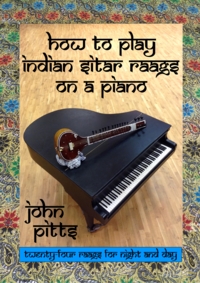 John Pitts’ somewhat unusual book How to Play Indian Sitar Raags on a Piano is designed for adventurous pianists. Indian raags have an extraordinary musical heritage dating back several centuries (from the area that is now India, Pakistan and Bangladesh) – a truly unique musical genre of fascinating melodic beauty and rhythmic intricacy – freely combining elaborate composed melodies with carefully rehearsed improvisation. But now the amazing world of Indian raags has been opened up in a sympathetic but thorough reinvention for piano solo (or duet or two pianos) by an award-winning British composer.
 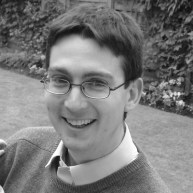 John Pitts is a British composer who lives in Bristol, England, with his wife and four children. He composes mostly chamber music, especially for piano solo and duet, in styles perhaps best summarised as melodic, motoric, motif-driven, jazz-tinged, post-minimal impressionism. His pieces for two pianists have been performed at concerts and festivals in several European countries, Armenia, Australia, Russia, Ukraine and the USA, including in March 2015 a concert dedicated to his music in Perpignan’s “Festival Prospective 22ème siècle” by French duo



 The Cross-Eyed Pianist