
Canadian pianist Angela Hewitt wittily and imaginatively coupled two of Bach’s French Suites with a handful of miniatures by Chopin, all composed in Paris, in an enjoyable lunchtime concert at London’s Wigmore Hall. Read my full review here
Concerts at Sutton House
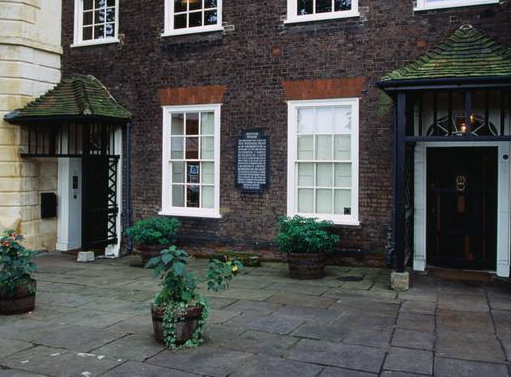
My piano teacher, Penelope Roskell, is peforming in two concerts at the delightful and intimate small venue Sutton House this month and next.
Sunday 15th May, 7pm
‘An English Summer Evening’ – Fitzwilliam String Quartet with Penelope Roskell
Artists in residence, the Fitzwilliam String Quartet, and Artistic Director of SHMS, Penelope Roskell, present a programme celebrating the work of those two quintessentially English composers, Ralph Vaughan Williams and Edward Elgar. Both the works being performed were written during war-time and are profound and intense music.
Ralph Vaughan Williams – String Quartet No. 2 (‘for Jean on her birthday’)
Sir Edward Elgar – Piano Quintet in A minor Op. 84
To reflect the English nature of the concert, there will be Pimms and Punch on sale from 6.30pm and during the interval. The bar will also be open after the concert to allow audience members to enjoy a drink with the performers.
Sunday 19th June, 7pm
‘Reason and Romance’
A solo concert by Penelope Roskell, juxtaposing the reason and intellect of J S Bach with the mercurial romance of Robert Schumann.
J S Bach – Chromatic Fantasia and Fugue
Robert Schumann – ‘Papillons’
J S Bach – French Suite No. 2 in C minor
J S Bach – Partita No. 5 in G
Robert Schumann – Piano Sonata No. 2 in G minor
Sparkling wine will be on sale with complimentary strawberries and cream in the courtyard during the interval.
Sutton House, a National Trust House in Hackney, is a really lovely venue. I was very impressed the first time I visited, two year’s ago, both by the quality of the performances, and the commitment and support of the audience.
For more information and online booking go to www.shms.org.uk
Hey, it’s only Bach!
A conversation with one of my adults students this week prompted this post. Sarah is a very confident woman in her mid-40s, who runs her own business, and who started having lessons with me, as a complete beginner, three years ago. She took Grade 1 last Spring and passed with a Merit. Spurred on by her success, she decided to study for Grade 2 and will take the exam in July. She’s worked really hard, and is playing far, far better than she was a year ago. Focussed and articulate about what she wants from her lessons, it surprised me when, at her lesson yesterday, she admitted she was having serious problems with the Bach/Petzold Minuet in G minor (ABRSM Grade 2/List A). She played it perfectly well, a little hesitant in places, but she made a good attempt at the mordents and other ornamentation, and was clearly thinking about how to shape the music.
“So, what’s the problem?” I asked when she had finished. “I thought that sounded really good.”
“It’s because it’s Bach!” she replied. “I can’t believe I’m actually learning music by Bach!”
So, somewhat in awe of the music, she was finding it hard to focus on her practising. I knew exactly what she meant: I had a similar experience when I started learning Chopin’s First Ballade last summer. Now, would all professional pianists, and those amateurs who have mastered such big, virtuoso works, please stand aside for a moment, and allow me to explain. When I first started taking lessons again as an adult, nearly three years ago, my confidence and self-esteem were pretty low. A brief, but unsettling experience with a less than savoury piano teacher in 2007 had not helped, plus I was getting no support from anyone, least of all my family, about my music. I was working entirely alone, with no one to critique my playing or reassure me I was “doing it right”. My current teacher is the most patient, skilled and supportive teacher I have ever had, and with her encouragement, I have overcome both my shyness about playing for others, and my inability to trust my musical self and tackle advanced repertoire. When she suggested I learn one of the Ballades or Scherzi, I knew she had not suggested it just to please me: she knew I could cope with it. I started learning the G minor Ballade that same afternoon…..
Playing it for my teacher at my next lesson (I’d learnt about a third of it by then), I was doing fine until I reached the beautiful, lyrical section before the restatement of the opening theme. I was really enjoying playing my teacher’s beautiful antique Bluthner, but then I remembered I was playing a Chopin Ballade, one of the big warhorses of the concert repertoire, and I found myself completely in awe of the music, and its composer. Tense and unable to focus, it all went to pieces…. Amazed at the sheer beauty and inventiveness of Chopin’s writing, I couldn’t quite believe I was actually playing the piece, to my teacher, on a Wednesday morning in north London: in my mind, I was playing to a full house at the Wigmore Hall, with the ghost of the composer at my elbow, nodding benignly as if to say “Yes! That is what I meant.” Such wide-eyed fantasising does no harm, now and then, but it can prevent one from getting to the heart of the music so that one can begin a serious study of it.
This, I think, was my student’s difficulty as well. In the early grades, the pieces are simple and often aimed at children, and many are written especially for the syllabus, I suspect. While some of the pieces are really imaginative (John Rowcroft’s ‘African Dance’ from the previous syllabus, for example), it is always refreshing to come across “real piano music”, and I think an early student can feel daunted, perhaps by the responsibility that is placed on one to interpret and play it well.
I pointed out to Sarah that the Minuet in G minor comes from the ‘Notebook for Anna Magdalena’, a collection of pieces, in two volumes, which Bach presented to his second wife. It is quite possible that these were pieces Mrs Bach, and other members of the family, played at home. This was domestic music, to be enjoyed by the family. These were not concert pieces, nor music for the church, though there are suites and partitas, and chorale settings amongst the works. With this in mind, I urged Sarah to stop being so much in awe of the piece and to simply enjoy playing it (while practising it carefully too, of course!). It is rather plaintive and elegant, and benefits from careful articulation and shaping. The ornaments are not too demanding, and offer a good introduction to Bach’s ornamentation in general.
Crass as this might sound, it’s important not to get too overwhelmed by the music. Allow yourself to stand back from it, give yourself some perspective. Marvel at the genius of the composer, but don’t be afraid of it! Study it, play it, and, most importantly, enjoy it.
Minuet in G minor – attr. Petzold
Concert Highlights of 2011
As the year draws to a close, I thought I would review my year in music:
Goldberg Variations, Simon Devine, Purcell Room, March: The perfect way to spend a sunny, early spring Sunday morning. Harpsichordist Simon Devine brought immense colour, elegance, depth and humour to Bach’s greatest keyboard work.
End of Course Concert, March: My first “proper” performance in 25 years, as part of my teacher’s end of course concert. I amazed myself by pulling off a thoughtful and melancholy rendering of Chopin’s Etude Op 25/7, which has now become my “party piece”! The exceptionally high-quality of the music was a great inspiration, as was the variety: Chopin, Gershwin, Bach, Kapustin.
The Jerusalem Quartet, Wigmore Hall, March: A lunchtime concert memorable for all the wrong reasons, a concert during which politics and angry protest invaded the hallowed space of the Wigmore Hall and forced everyone present to contemplate the question “should music be above politics?”. The Jerusalem Quartet played on, despite the frequent interruptions. A disturbing, eye-opening, and extraordinary event.
Elisabeth Leonskaja Schubert recital, Wigmore Hall, May: A wonderful lunchtime concert which included several of my favourite works (Impromptu in F minor D935, and Impromptu in A flat D899, played as an encore), and confirmed, once again, what a fine Schubert-player Leonskaja is.
Lucy’s Parham’s ‘Nocturne’ at Wigmore Hall, July: A delightful and very moving evening of words and music by and about Chopin. Parham’s playing left something to be desired: she is unnecessarily flamboyant, and lacks finesse and accuracy at times, but the overall experience was delightful. Sam West was so good that very soon into the evening I truly believed he was Chopin!
Courtney Pine at Hampton Open Air Pool, July: A picnic with friends to the accompaniment of jazz-legend Courtney Pine’s full-bodied and exciting music, in his own tribute to Sidney Bechet. The best part was shaking his hand as he toured the audience at the end of the concert.
Olivier Messiaen’s ‘Quartet for the End of Time’, Wigmore Hall, October: The first time I’d heard this monumental work played live and in its entirety. Deeply moving, searing, painful and beautiful, it has inspired me to learn some of Messiaen’s piano music, and has piqued my interest in 20th century music in general.
Goldfrapp, Hammersmith Apollo, November: A rarity for me, attending a pop concert, but nonetheless a great night out. Interesting and unusual music, beautifully performed and visually and aurally arresting.
Students’ Concert, December: A lovely, fun and very enjoyable afternoon of music-making by my own students. The event was a huge success and I will be using the same venue for my summer concert.
Elisabeth Leonskaja, Schumann and Schubert, Wigmore Hall, December: Another great performance by this monumental “old school” Russian pianist. She never fails to please and I am already looking forward to her next solo recital in the late spring.
Handel’s Messiah, English Chamber Orchestra with Raymond Leppard, Rodolfus Choir, Cadogan Hall, December: A really fine Messiah with the superb ECO, youth choir and soloists, all under the baton of Raymond Leppard, a conductor who I remember seeing many times as a child. A lovely start to the festive season.
I fear I may have omitted some concerts from earlier in the year, and will make an effort to keep a ‘concert diary’ next year so that I don’t forget what I’ve heard. If there are any sins of omission here, I am sure Sylvia will point them out for me!




 The Cross-Eyed Pianist