In the apparent constant need by concert promoters, venues and others to attract “younger audiences” to classical concerts and to make them more “inclusive”, it seems to me that the artform’s core audience is being overlooked or even alienated.
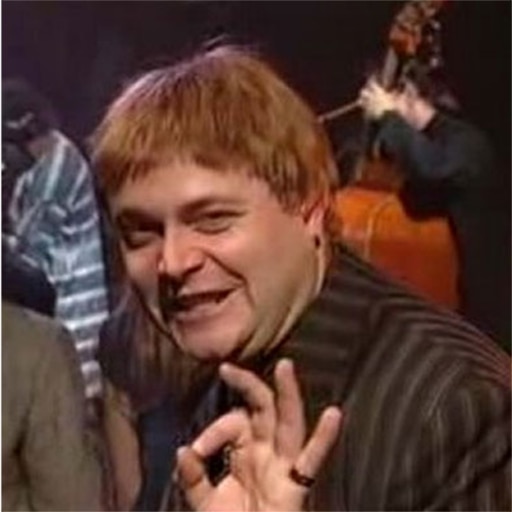
John Thomson, Jazz Club from The Fast Show

The latest suggestion to “trendify” classical music and make concerts more appealing to that elusive younger audience is posited in an episode of BBC Radio 3’s The Listening Service, presented by the affable Tom Service. In it he suggests that audiences should be more vocal; that they should chill, let it all hang out, and behave more akin to their rowdier 18th- and 19th- century concert-going predecessors, or be more like audiences at jazz or even pop gigs where a great improv sequence or a particularly juicy number is met with applause, whistling and more. In short, he wants us whooping in the stalls (the inference here being that silence is terribly elitist and all this listening quietly makes classical music hugely inaccessible and exclusive; nevermind that the same etiquette applies to theatre performances….).

When, 3 minutes into the Tristan prelude you next see me leap to my feet yelling “Whoo! F**king NAILED that cor anglais solo!” you must accept that this is precisely what Wagner would have expected and wanted…

– Richard Bratby on Twitter

For many of us, the chief attraction of classical music concerts, apart from the music itself, of course, is the opportunity to escape into quiet introversion for a few hours. There is also the ‘social code’ of the classical concert: knowing when to keep quiet for the benefit of other people, including the performers. We’ve all been to concerts which have been marred by people whispering loudly, opening blister packs of cough sweets, or – horror of horrors! – a mobile phone going off. I was at a recital of Scriabin piano music at Wigmore Hall some years ago where a couple a few rows ahead of me snogged loudly throughout the performance, and were reprimanded with a sharp rap on the shoulders with a rolled up programme by the person immediately behind them. And quite right too! They should have got a room, not seats at WH!

Joking apart, and at the risk of coming over all communist about it, it’s really a simple case of accommodating the many not the few: because even a small interruption can spoil the experience for the majority. It’s also a basic common courtesy to one’s fellow concert-goers.

And, curious as this may seem in our noisy, extrovert modern times, classical music audiences actually like to listen in silence so that they can enjoy and appreciate the music being performed.

So let’s let classical audiences remain quiet. We show our appreciation in other ways – by applauding, cheering and bravo-ing at the end of the performance, and while these behaviours may seem antiquated, or even elitist (they’re not!) to some, to the regular concert-goer this is what comes out of silence.

Just like the music.

A painter paints his pictures on canvas. But musicians paint their pictures on silence. We provide the music, and you provide the silence.

– Leopold Stokowski, May 1967
In response to my article Where Have All The Audiences Gone, a reader, and a keen concert-goer, makes this response:

First, we need a functioning transport system at a price that normal people can afford.  We need trains outside London running 24/7 as tube and bus has inside London for years.

Second, we need to radically reduce the “cost of experience”. I have no issue with venues making a profit but a sandwich in Waitrose is about £3 so a 10% uplift would seem reasonable – say £3.50.  Drinks likewise.  And have everything open!  Covid is being used as excuse for poor customer service – plain-as.

Tickets – bring the cost down and fill all the seats. The Proms was a case in point – much better to have ALL the seats filled for £10 each rather than the 50% empty I witnessed. I found £44 stalls seats for the Labeque Sisters on StubHub for £11, a sure sign that the market has collapsed. Have transport-included/subsidised offers – buy two tickets for concert X and get the associated rail fare for 50%.

And start giving out tickets for students and children for free via schools and heavily reduced for their responsible adults – get young, really young people back just as the Schools Opera and Robert Meyer concerts did for my generation.

And. Stop Talking about COVID! My view is that our reaction to it was totally overblown, likely to kill more people through a depressed economy than the illness itself. My generation (50s) has always been the cultural backbone audience and so many that I know have taken Covid as an excuse to curl-up into early retirement. I rage against the dying of that light.


Comments are open if you would like to join in this discussion, or respond via Twitter

One of the secondary pleasures of going to live music in concert is “audience watching”. Different artists and repertoire attract different audiences (the music of Scriabin, for example, seems to attract a particularly ‘unusual’ audience…..). The ritual of concert going and the habits of audiences have fascinated and intrigued me since I was a young child when my parents took me to the Proms and concerts at Birmingham Town Hall (where the CBSO was based before Symphony Hall was built).

I love the very palpable sense of “collective listening”, that curious vibration in the concert hall when everyone is listening very intently, or when the musician/s creates a remarkably intense connection via his/her performance and the power of the music. At the end of a particularly concentrated performance, one senses the audience uncurling and flexing, like an animal, before exhaling a collective breath and applauding. At a recent lunchtime concert at my local music society, I was amused to observe the reactions of several members of the audience to some rather outré contemporary music which was being performed by a piano and percussion duo. The final piece in the programme, during which the performers alternated between throwing themselves onto the piano keyboard and clapping (including some quite intricate “Pat-a-Cake” clapping patterns), seemed particularly “challenging” for certain members of the audience. Some people shifted uncomfortably in their seats, presumably because they found the music unpleasant or difficult to understand. Another person rested his head on his left hand, feigning boredom or sleep; others lowered their heads or looked down at their laps in embarrassment. Luckily no one walked out, though I suspect a couple of people might have considered doing so. When the piece ended, some of the applause felt like relief, that this curious “musical” experience was over, though in general I felt the applause was given generously, as it always is at my local music society’s concerts.

scientist-crowd-surf
Crowd-surfing is generally not acceptable at a classical music concert…..

I think it’s important to be challenged by music and that listening should not necessarily always be a passive activity – though of course a concert can, and should, be a relaxing and enjoyable activity as well. I have experienced sidelong glances from other audience members when I have laughed at the wit of Haydn or Beethoven, or a certain gesture by a performer to highlight a moment of humour in the music. These days I quite regularly cry at concerts, overwhelmed by the music and the emotional experience of hearing it (a friend of mine believes I suffer from Stendhal Syndrome with this regard). Yet the etiquette of the concert hall, a mode of behaviour which developed at the end of the nineteenth century when concert going became more formal, and largely remains so today, can make people feel constrained, obliged to sit in rigid reverential silence for the duration of the performance. It is this etiquette which can also put people off attending classical concerts, and the unwelcoming attitude of some fellow concert-goers, and the conventions of the concert hall – how to behave, in particular when to applaud – can make concert-going a behavioural minefield for the ingenue concert-goer. There is a small contingent of audience members who wish to maintain these conventions and they manifest their antagonism to the more relaxed concert-goer by curious (mostly) passive aggressive behaviour including glaring at the person who accidentally drops their programme or loudly shushing others. Sometimes these are the same people who bellow “Bravo!” at the end of the concert, or start applauding almost before the final note has sounded. All of this behaviour would probably seem very alien to the likes of Mozart and Beethoven, and even Brahms and Tchaikovsky, who were used to a much more rowdy and noisily engaged audience. Somehow we need to find a middle way between the very formal behaviour which still dominates classical concert going and a more relaxed attitude akin to an earlier age which allows people to react spontaneously to what they hear, feel and experience……

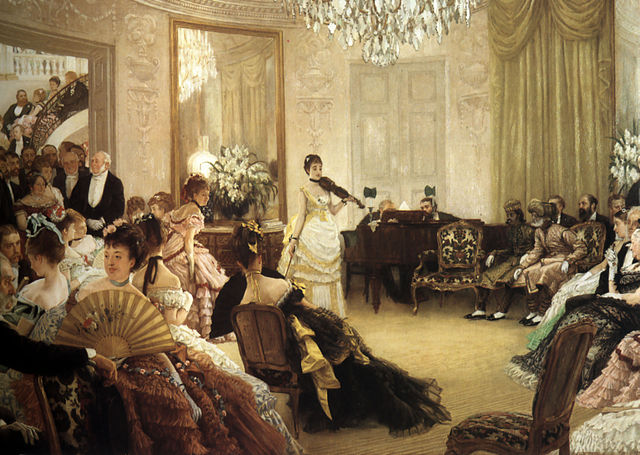
640px-james_tissot_-_hush21
Hush! (The Concert) by James Tissot

Recently, The Guardian published an article by Leo Benedictus on the subject of badly behaved audiences at theatre, film, concerts, and similar events. The article included a sort of ‘manifesto’ for audiences, with tips and advice on how not to behave. It is both amusing and true. I ran an informal poll amongst Twitter and Facebook followers, asking for people to submit their particular “audience irritations”. The best ones follow below:

People who sit behind and scratch their knees… An odd one I know, but sat in a tiered theatre their knees are at ear level!

Flash photography when one is performing – very distracting!

People talking through overtures is my worst bugbear. I was at South Pacific in Cardiff recently and it was so noisy throughout the overture, and the chap behind me constantly was singing and humming along to most of the songs and making comments….

At a Proms concert once, I saw a Prommer reading a John Grisham novel while Abbado conducting the Bruckner’s 9th symphony provided some no doubt pleasant background music.

Child unwrapping sweets during a Bach Suite… grrrrrr!

People who go to a concert with a cold! Sniffling every other minute. So distracting, inconsiderate and unhygienic!

Re. hummers, I remember childhood carol services at church where every year, without fail, one old man who couldn’t sing in tune to save his life would persist in joining in with the solo first verse of Once in Royal. Pity whichever poor child had been given that dubious privilege…

I was at a Chopin recital where the man next to me hummed tunelessly throughout Chopin’s last Piano Sonata (indeed, throughout the entire concert!). It reminded me of a sketch from ‘Alas Smith & Jones’ in which a certain concert-goer (Smith) hums throughout the performance. Another (Jones) becomes very irritated by this and starts shushing the hummer, only to be told by others around him: “Would you please be quiet? We have come here tonight specifically to hear Mr Smith humming!”

Because of the average age of its audience (very elderly), the Wigmore auditorium is often a cacophony of whistling hearing aids, snuffling, stentorian snoring, and – particularly at lunchtime recitals – satisfied, fruity farting (the sign of a good lunch in the Wigmore restaurant!)

My father’s first visit to Carnegie Hall was marred by a man in front of him who conducted, from his seat, with full score, throughout a Beethoven Symphony.


Please feel free to share your own particular “audience irritations” via the comments box!

Read Leo Benedictus’ article in The Guardian here