I came across a video of an exasperated ballet dancer talking about parents who had turned to AI to correct their children’s posture. It prompted this article, a response to the dizzying speed at which AI is infiltrating every facet of our lives. The uptake is so fast that the night before, I had been reading through people’s responses to a question about jobs they thought were safe from AI-driven redundancy. Several suggested cleaning or other manual work, apparently unaware of another post showing a robot slowly but methodically cleaning a house and neatly folding clothes. One thing is for certain: we still can’t grasp how our lives will change in the next few months and years.
Meanwhile, my path as pianist, teacher, musicologist has had a surprising turn: I am conducting a pilot study with Imperial College, on the biomechanics of elite piano performance and training, with access to resources provided by Steinway Hall and Goldsmiths College’s Deptford Town Hall. AI is not going to trail very far behind: there is 3D body imaging, motion tracking and data to analyse. In this narrower respect, AI is simply an augmentation of a computer’s abilities.
Since the advent of the internet, availability of information masks from view the more concerning shrinking of the new ‘reality’ into a colourful yet ‘flat’ experience: that of the phone, tablets and tv screens. Everything is one, or a few swipes away. In the case of a non-domain expert parent, i.e. someone who hasn’t trained in the same subject, AI can provide some background information fast, provided the right questions are asked and provided that the AI’s limitations are acknowledged. AI itself is not a ‘knowing’ entity, but a processing entity. The instigator and recipient of this knowledge is the human. A deceptive communication, which is actually cyclical: it reflects and engages with the human input in a seeming loop. So, yes, the information is available, but the context, in terms of indispensable layers such as aesthetic pursuits and creativity, is missing.
If we try to probe the matter deeper, AIs such as the general public uses, Gemini, Claude, ChatGPT, are actually language models. The basis of their functionality is that of predicting a probability distribution over next tokens and sampling from it to arrive at cogent and context-realistic verbal responses. And I am reminded of a very pertinent excerpt highlighting the process in humans, which connects internal thought processes with language, from Language, Thought, and Reality: Selected Writings of Benjamin Lee Whorf, edited and with an introduction by John B. Carroll, Foreword by Stuart Chase
The Greeks took it for granted that back of language [sic] was a universal, uncontaminated essence of reason, shared by all men, at least by all thinkers. […] Whorf flatly challenges it in his second major hypothesis. “A change in language,” he says, “can transform our appreciation of the Cosmos.”
Taken simply, internal processes of thought and experience go at least hand-in-hand with language. Although AI are language models, their output is not an interaction in the sense of having the initiative to communicate unprompted or the result of thought: the initial stimulus is the user’s thought and it is anchored in that. It could be that our over-reliance on AI ‘transforms our appreciation of the Cosmos’ in unintended ways. This is certainly unchartered territory. What about the teacher’s concern over AI teaching movement without human supervision? Expert skill acquisition, such as required for elite ballet dancing or piano performance, is narrow and deep. The idea that anyone will do because ‘the child will not pursue seriously music’ is wrong on so many levels it requires a separate article. And I think that it is this attitude which operates in the background when parents think that AI can be a good substitute for a teacher or a sufficient supplement. The generalisations that come out of Google currently have to do both with data poverty and the fact that biomechanics, the abstraction of art to physical movement, are the necessary substrate of what we call Art, but these two cannot be equated. A good teacher is simply indispensable to instil the basics for specific outcomes to be achieved. Strategy is also not the strong point of AIs.
Teaching is an interaction, so the process is not just a passing down or the rehearsing of a physical skill, but a process within a social context. For non-expert parents, the necessary critical faculty to efficiently sift through sometimes conflicting information is lacking precisely because the requisite is not just information; it is lived experience. In her book Producing Excellence: The Making of Virtuosos, Izabela Wagner writes about this very idea in terms of “socialisation” in the arts: you need a human to transmit not only physical technique but also the lived experience of the milieu you are trying to become a member of.
The Arts are quintessentially the means of probing the eternal questions that torture us, to echo nineteenth century sentiments, a time when many of the canonic works of classical music were composed and are heard regularly on concert stages around the world to this day. More to the point, unlike science which seeks to prove and to know, the Arts seek to engage, no matter what the answer might be, or even when the ‘answer’ represents, like Edvard Munch’s painting The Scream (1893), an expression that cannot be ‘answered’. It just is. Uniqueness would be the other identifier, discussed in connection to seemingly artless or mundane, now iconic, works such as Andy Warhol’s Campbell’s Soup Cans (1962): the ability to reproduce it, underlines its emphasis away from the skill of the craft and on the effect on its unsuspecting audiences. This then supplies the third aspect of human artistic production, the intent to communicate and the decision to take action towards this direction. This is what parents of young learners miss: to develop a real relationship with the arts is to engage with socialisation which cannot be abstracted or equated to ‘interaction’ with a machine and ultimately to connect through one of the most fundamental of human needs: love, and belonging.
1 Benjamin L. Whorf, Language, Thought, and Reality: Selected Writings of Benjamin Lee Whorf, edited and with an introduction by John B. Carroll, Foreword by Stuart Chase (The Technology Press of Massachusetts Institute of Technology and John Wiley & Sons, Inc. New York London, 1956) Foreword, p. 8.
Natalie Tsaldarakis is a Greek concert pianist, researcher, and co-Artistic Director of the PianoPlus International Recital Series, now in its 4th edition. Her research sits at the intersection of biomechanics and piano pedagogy, currently underway in collaboration with the MSk Lab at Imperial College London, and she is completing a forthcoming Routledge publication on the pianist and pedagogue Gordon Green (1905–81). A graduate of Royal Holloway, where her teachers included Chopin scholar Prof. John Rink, she performs internationally as a member of the Ivory Duo Piano Ensemble and Convivium Label Artist, and is a published author (Classical Music in a Changing World, eds. Kramer & Nones, Vernon Press, 2021).
An essay in six variations Written by GPT-3 and Howard Smith
The six essays below were written by an Artificial Intelligence called GPT-3. In the final essay, Satie speaks in his own voice and composes a poem reflecting on the influences of his work. The AI-generated essays were guided by Howard Smith, a human. Howard only had to give the briefest of instructions to the remarkable AI. Such ‘generative’ systems are making waves across the world. GPT-3 is but a taste of what’s to come. Humankind will shortly have many new AI companions.
Howard Smith is the human author of Note For Note, Bewitched, Bothered and Bewildered.Howard is also the author of an experimental book on the topic of Climate Change. The 180 page book was written by GPT-3 in response to questions posed by Howard. The two collaborators ‘wrote’ the book in just 12 hours. The work was self-published 6 days later and is now available via Amazon worldwide. In Conversation with GPT-3: An AI On Climate Change is a taste of what’s ahead for anyone working in any creative field.
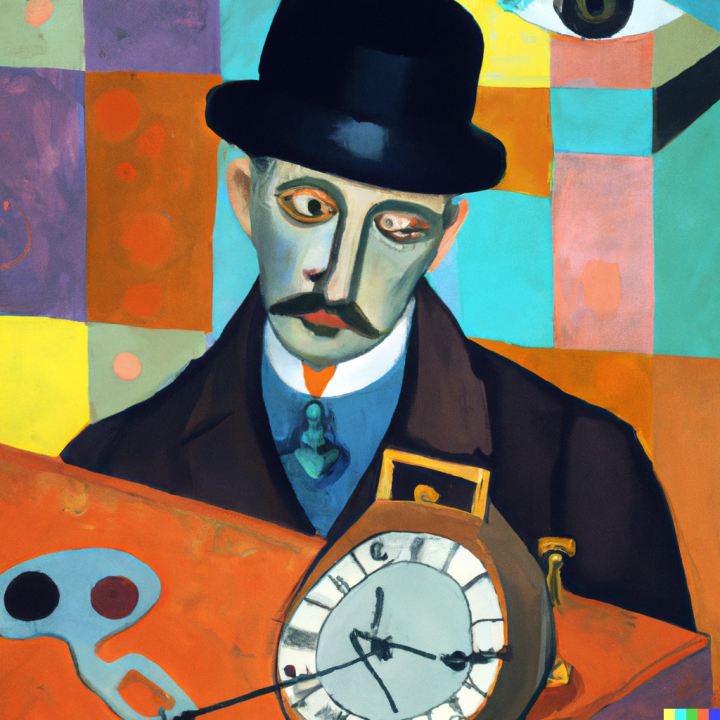
One of 30 images generated by DALL*E 2 in response to a prompt by the author: A painting in the style of Dada art of the composer Erik Satie and a ticking clock
And now, dear friends, the essays:
Version 1
Human in italics. All else written by an AI.
Write an essay about the music of Erik Satie. Concentrate on explaining the musical influences and genres that led to Satie’s unique style. Also cover the way Satie’s music influenced composers that followed him.
Erik Satie was a French composer and pianist known for his unique and unconventional musical style. He was born in 1866 and began composing music at a young age. Throughout his career, Satie experimented with a wide range of musical genres and influences, which ultimately led to the development of his distinctive style.
One of the major influences on Satie’s music was the impressionism movement in art. Impressionist painters, such as Monet and Degas, were known for their use of light and color to create a sense of atmosphere and mood. Satie similarly sought to evoke a sense of atmosphere in his music through the use of harmonic and melodic color. He often employed unconventional harmonies and dissonant chord progressions to create a sense of tension and dissonance.
Another important influence on Satie’s music was cabaret and café-concert culture. These venues were popular in Paris during the late 19th and early 20th centuries and featured a wide range of musical styles, including folk songs, popular songs, and vaudeville. Satie was heavily influenced by the playful, irreverent, and often satirical spirit of these performances, and he incorporated elements of cabaret and café-concert music into his own compositions.
Satie’s music also drew inspiration from other genres, including folk music, medieval and Renaissance music, and popular music. He was particularly interested in the use of simple, repetitive rhythms and melodies, which he often incorporated into his music to create a sense of hypnotic and meditative states.
Satie’s unique and unconventional musical style had a significant influence on composers that followed him. Many of his techniques and ideas were adopted and adapted by other composers, particularly those working in the field of minimalism. Satie was one of the first composers to use repetitive rhythms and simple harmonies, techniques that would become central to the minimalist style. He was also an important influence on the development of ambient and experimental music.
In conclusion, Erik Satie’s music was shaped by a wide range of musical influences and genres, including impressionism, cabaret and café-concert culture, folk music, medieval and Renaissance music, and popular music. His unique and unconventional style had a significant influence on composers that followed him, particularly in the field of minimalism and experimental music. His music still continues to be celebrated and performed today.
Version 2
Improve the essay please by including some quotes by Erik Satie.
Erik Satie was a French composer and pianist known for his unique and unconventional musical style. He was born in 1866 and began composing music at a young age. Throughout his career, Satie experimented with a wide range of musical genres and influences, which ultimately led to the development of his distinctive style.
One of the major influences on Satie’s music was the impressionism movement in art. Impressionist painters, such as Monet and Degas, were known for their use of light and color to create a sense of atmosphere and mood. Satie similarly sought to evoke a sense of atmosphere in his music through the use of harmonic and melodic color. He often employed unconventional harmonies and dissonant chord progressions to create a sense of tension and dissonance. In his own words, Satie stated “I have found it necessary to get rid of all the parts that everyone likes and keep all those which no one likes”
Another important influence on Satie’s music was cabaret and café-concert culture. These venues were popular in Paris during the late 19th and early 20th centuries and featured a wide range of musical styles, including folk songs, popular songs, and vaudeville. Satie was heavily influenced by the playful, irreverent, and often satirical spirit of these performances, and he incorporated elements of cabaret and café-concert music into his own compositions. He once said, “I am a country whose boundaries are the imagination.”
Satie’s music also drew inspiration from other genres, including folk music, medieval and Renaissance music, and popular music. He was particularly interested in the use of simple, repetitive rhythms and melodies, which he often incorporated into his music to create a sense of hypnotic and meditative states. His music was described as being “inventive and original” by himself.
Satie’s unique and unconventional musical style had a significant influence on composers that followed him. Many of his techniques and ideas were adopted and adapted by other composers, particularly those working in the field of minimalism. Satie was one of the first composers to use repetitive rhythms and simple harmonies, techniques that would become central to the minimalist style. He was also an important influence on the development of ambient and experimental music.
In conclusion, Erik Satie’s music was shaped by a wide range of musical influences and genres, including impressionism, cabaret and café-concert culture, folk music, medieval and Renaissance music, and popular music. His unique and unconventional style had a significant influence on composers that followed him, particularly in the field of minimalism and experimental music. His music still continues to be celebrated and performed today. Satie’s own words offers a glimpse into his artistic vision, his revolutionary approach and his enduring legacy.
Version 3
Can you extend the essay by listing some of Satie’s best loved music. Place the list of works at the end of the essay.
Erik Satie was a French composer and pianist known for his unique and unconventional musical style. He was born in 1866 and began composing music at a young age. Throughout his career, Satie experimented with a wide range of musical genres and influences, which ultimately led to the development of his distinctive style.
One of the major influences on Satie’s music was the impressionism movement in art. Impressionist painters, such as Monet and Degas, were known for their use of light and color to create a sense of atmosphere and mood. Satie similarly sought to evoke a sense of atmosphere in his music through the use of harmonic and melodic color. He often employed unconventional harmonies and dissonant chord progressions to create a sense of tension and dissonance. In his own words, Satie stated “I have found it necessary to get rid of all the parts that everyone likes and keep all those which no one likes”
Another important influence on Satie’s music was cabaret and café-concert culture. These venues were popular in Paris during the late 19th and early 20th centuries and featured a wide range of musical styles, including folk songs, popular songs, and vaudeville. Satie was heavily influenced by the playful, irreverent, and often satirical spirit of these performances, and he incorporated elements of cabaret and café-concert music into his own compositions. He once said, “I am a country whose boundaries are the imagination.”
Satie’s music also drew inspiration from other genres, including folk music, medieval and Renaissance music, and popular music. He was particularly interested in the use of simple, repetitive rhythms and melodies, which he often incorporated into his music to create a sense of hypnotic and meditative states. His music was described as being “inventive and original” by himself.
Satie’s unique and unconventional musical style had a significant influence on composers that followed him. Many of his techniques and ideas were adopted and adapted by other composers, particularly those working in the field of minimalism. Satie was one of the first composers to use repetitive rhythms and simple harmonies, techniques that would become central to the minimalist style. He was also an important influence on the development of ambient and experimental music.
In conclusion, Erik Satie’s music was shaped by a wide range of musical influences and genres, including impressionism, cabaret and café-concert culture, folk music, medieval and Renaissance music, and popular music. His unique and unconventional style had a significant influence on composers that followed him, particularly in the field of minimalism and experimental music. His music still continues to be celebrated and performed today. Satie’s own words offers a glimpse into his artistic vision, his revolutionary approach and his enduring legacy.
Some of Satie’s best known works include:
“Gymnopédies” (1888)
“Sports et divertissements” (1914)
“Vexations” (1893)
“Socrate” (1918)
“Parade” (1917)
“Three pieces in the form of a Pear” (1903)
“Avant-dernières pensées” (1911-1915)
“Furniture Music” (Musique d’ameublement) (1917)
“Sonatine bureaucratique” (1908)
“Véritables préludes flasques (pour un chien)” (1913)
Version 4
Rewrite the essay please, in a writing style that Satie might have used.
My dear friends, let me regale you with tales of my musical endeavors. I, Erik Satie, have always been drawn to the unconventional, the unorthodox. I sought to challenge the status quo and to push the boundaries of what is considered to be “music.”
The movement of Impressionism, with its emphasis on light and color, has had a profound influence on my compositions. I strive to evoke a sense of atmosphere and mood through the use of harmonic and melodic color. I often employ unconventional harmonies and dissonant chord progressions to create a sense of tension and dissonance. As I have said before, “I have found it necessary to get rid of all the parts that everyone likes and keep all those which no one likes.”
The cabaret and café-concert culture of my beloved Paris have also had a great impact on my music. The playful, irreverent, and often satirical spirit of these performances has been a constant source of inspiration for me. I have incorporated elements of cabaret and café-concert music into my own compositions, always seeking to push the boundaries of what is considered acceptable. As I have said, “I am a country whose boundaries are the imagination.”
I have also been heavily influenced by the simplicity and repetition found in folk music, medieval and Renaissance music, and popular music. These have all played a role in my quest to create music that evokes hypnotic and meditative states. My compositions have been described as “inventive and original,” and I take great pride in that.
My unique and unconventional style has had a significant influence on composers that have followed me. My use of repetitive rhythms and simple harmonies, for instance, have become central to the minimalist style. And I have also been an important influence on the development of ambient and experimental music.
In conclusion, my dear friends, my music is the product of a wide range of influences and genres. I have always sought to challenge the status quo, to push the boundaries of what is considered to be “music.” And I will continue to do so, for as I have said, “The essential thing is to invent.” And with that, I bid you adieu, and hope that you will enjoy my compositions.
Some of my most notable works include:
“Gymnopédies” (1888)
“Sports et divertissements” (1914)
“Vexations” (1893)
“Socrate” (1918)
“Parade” (1917)
“Three pieces in the form of a Pear” (1903)
“Avant-dernières pensées” (1911-1915)
“Furniture Music” (Musique d’ameublement) (1917)
“Sonatine bureaucratique” (1908)
“Véritables préludes flasques (pour un chien)” (1913)
Version 5
Rewrite the essay once again to make it sound like Dada art.
Ladies and gentlemen, behold the absurdity of my musical creations. I, Erik Satie, have always been attracted to the nonsensical, the illogical. I sought to mock the status quo and to shatter the boundaries of what is considered to be “music.”
The movement of Impressionism, with its emphasis on light and color, has been a source of inspiration for my compositions. I strive to evoke a sense of chaos and confusion through the use of harmonic and melodic nonsense. I often employ unconventional harmonies and dissonant chord progressions to create a sense of confusion and disorder. As I have said before, “I have found it necessary to get rid of all the parts that make sense and keep all those which don’t.”
The cabaret and café-concert culture of my beloved Paris have also been a great influence on my music. The nonsensical, irreverent, and often satirical spirit of these performances has been a constant source of inspiration for me. I have incorporated elements of cabaret and café-concert music into my own compositions, always seeking to mock the boundaries of what is considered acceptable. As I have said, “I am a country whose boundaries are the absurdity.”
I have also been heavily influenced by the simplicity and repetition found in folk music, medieval and Renaissance music, and popular music. These have all played a role in my quest to create music that evokes hypnotic and chaotic states. My compositions have been described as “nonsensical and illogical,” and I take great pride in that.
My unique and unconventional style has had a significant influence on composers that have followed me. My use of repetitive rhythms and simple harmonies, for instance, have become central to the Dada style. And I have also been an important influence on the development of chaotic and experimental music.
In conclusion, my dear friends, my music is the product of a wide range of influences and genres. I have always sought to mock the status quo, to shatter the boundaries of what is considered to be “music.” And I will continue to do so, for as I have said, “The essential thing is to invent absurdity.” And with that, I bid you adieu, and hope that you will enjoy my nonsensical compositions.
Some of my most notable works include:
“Gymnopédies” (1888)
“Sports et divertissements” (1914)
“Vexations” (1893)
“Socrate” (1918)
“Parade” (1917)
“Three pieces in the form of a Pear” (1903)
“Avant-dernières pensées” (1911-1915)
“Furniture Music” (Musique d’ameublement) (1917)
“Sonatine bureaucratique” (1908)
“Véritables préludes flasques (pour un chien)” (1913)
Version 6 (the ‘final’ version, or is it?)
Include and invent an absurdist poem by Satie.
Ladies and gentlemen, behold the absurdity of my musical creations. I, Erik Satie, have always been attracted to the nonsensical, the illogical. I sought to mock the status quo and to shatter the boundaries of what is considered to be “music.”
The movement of Impressionism, with its emphasis on light and color, has been a source of inspiration for my compositions. I strive to evoke a sense of chaos and confusion through the use of harmonic and melodic nonsense. I often employ unconventional harmonies and dissonant chord progressions to create a sense of confusion and disorder. As I have said before, “I have found it necessary to get rid of all the parts that make sense and keep all those which don’t.”
The cabaret and café-concert culture of my beloved Paris have also been a great influence on my music. The nonsensical, irreverent, and often satirical spirit of these performances has been a constant source of inspiration for me. I have incorporated elements of cabaret and café-concert music into my own compositions, always seeking to mock the boundaries of what is considered acceptable. As I have said, “I am a country whose boundaries are the absurdity.”
I have also been heavily influenced by the simplicity and repetition found in folk music, medieval and Renaissance music, and popular music. These have all played a role in my quest to create music that evokes hypnotic and chaotic states. My compositions have been described as “nonsensical and illogical,” and I take great pride in that.
My unique and unconventional style has had a significant influence on composers that have followed me. My use of repetitive rhythms and simple harmonies, for instance, have become central to the Dada style. And I have also been an important influence on the development of chaotic and experimental music.
In conclusion, my dear friends, my music is the product of a wide range of influences and genres. I have always sought to mock the status quo, to shatter the boundaries of what is considered to be “music.” And I will continue to do so, for as I have said, “The essential thing is to invent absurdity.” And with that, I bid you adieu, and hope that you will enjoy my nonsensical compositions.
Here is an example of my absurdist poetry:
“The notes danced on the page
With no care for time or age
They sang of chaos and confusion
In a melody of self-illusion
The harmony was out of tune
But that only added to the moon
The rhythm was a mess
But it was the best
For in this madness, we find art
In this chaos, a brand new start
So let us revel in the absurd
For it is in this, true beauty is heard”
Some of my most notable works include:
“Gymnopédies” (1888)
“Sports et divertissements” (1914)
“Vexations” (1893)
“Socrate” (1918)
“Parade” (1917)
“Three pieces in the form of a Pear” (1903)
“Avant-dernières pensées” (1911-1915)
“Furniture Music” (Musique d’ameublement) (1917)
“Sonatine bureaucratique” (1908)
“Véritables préludes flasques (pour un chien)” (1913)
End of interaction with GPT-3
This site is free to access and ad-free, and takes many hours to research, write, and maintain. If you find joy and value in what I do, please consider making a donation to support the continuance of this site
ChatGPT (Chat Generative Pre-trained Transformer) is a chatbot which uses Artificial Intelligence and Natural Language Programming to interact with the user in a remarkably conversational way. One of its most interesting features is its ability to remember the thread of your dialogue, using previous questions and answers to inform its next responses. It sources its answers from huge volumes of information on the internet.
It has, understandably, induced quite a storm amongst creatives (see this article by composer Thomas Hewitt Jones about the threat of AI to music), who fear not just their replacement by AI but also the potential for plagiarism, copyright and royalty issues, lack of regulation and much more, which Thomas explains in his article.
Others see it as a potentially chilling example of the “power of the robots” and a sign that AI is gradually replacing human beings and human ingenuity. (Remember the AI computer on the spaceship in the film 2001: A Space Odyssey which turned against the astronauts?).
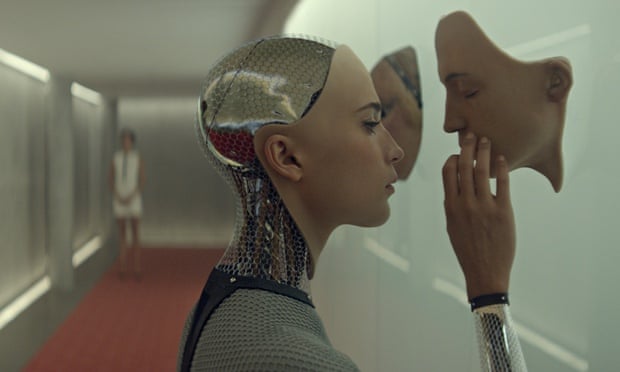
Alicia Vikander in the film Ex Machina
In fact ChatGPT, by its own admission, is probably not going to do that – because it doesn’t exactly know everything. It’s a form of Artificial Intelligence that is trained (by human developers) to recognise patterns in vast areas of text harvested from the internet which is then trained, with human assistance, to deliver more useful or better dialogue. The answers you get may sound plausible and even authoritative, but they might well be entirely wrong – as OpenAI, the creator of ChatGPT, warns.
Because I am curious minded, and because I was interested in the slightly hysterical response, from some quarters, to ChatGPT, I decided to try it for myself.
It’s very simple to use, but it does, like most computer programmes, function on the GIGO (Garbage In, Garbage Out) principle – so if you ask it vague, non-specific questions and requests, you are like to get vague, non-specific replies.
In an early encounter with ChatGPT, I asked it to write programme notes for a concert. To make it simpler, and so that I could assess the responses, I asked it to write a separate programme note for each piece in the programme. What quickly emerged was a very generic, bland text, with certain phrases and statements repeated in each instance (such as “this is one of the finest works in the piano repertoire, admired for its virtuosity”).
Another time, I asked it to write me a “short essay highlighting the key points of Schubert’s last three piano sonatas” and this is what it produced:
Schubert’s last three piano sonatas, composed between 1822 and 1828, are considered some of his most profound and challenging works for the instrument. They showcase his unique musical voice and mastery of form, harmony and texture. Some key features of these works are:
Complex forms: Schubert employs unconventional structures in these sonatas, blending traditional classical forms with his own innovations, such as incorporating variations, multiple themes and unexpected modulations.
Emotional expressiveness: Schubert’s last sonatas are known for their intense,melancholic and introspective character, reflecting his state of mind during the final years of his life. He achieves this through lyrical melodies, harmonic ambiguity, and the use of contrasting moods and tempos.
Diversity of textures: Schubert experiments with a wide range of textures, from delicate and ethereal to powerful and dramatic, to create different emotional effects. He uses innovative techniques like cross-handed playing and rapid arpeggios to create rich and complex textures.
Expansion of the piano’s capabilities: Schubert pushes the limits of the instrument, exploring new technical and sonic possibilities, and creating a large-scale, symphonic sound. He also incorporates elements of chamber music, such as dialogue between different voices, into his solo piano works.
In conclusion, Schubert’s last three piano sonatas are considered landmarks of the genre and demonstrate his unique musical vision and creativity. They are complex and emotionally charged works that challenge the performer and reward the listener with a rich and deeply moving musical experience.
It’s not a bad attempt. In fact, I think it would probably secure a decent pass in a GCSE exam. But a little deeper, and really this response reveals very little actual “depth”. If I was marking this essay, I would mark the candidate down for lack of actual examples from the music to underpin certain statements, and the whole text does come across as rather bland and superficial, with meaninglessly vague or clichéd descriptions of, for example, texture, and a distinct lack of question, argument, comparison or contextualisation – the sort of elements one would expect from an A-level or undergraduate essay.
However, what I do think this offers is a starting point from which to develop a far more detailed and involved essay – and for me this is probably how I would use ChatGPT.
I have also used it to generate marketing plans and social media posts for my publicity work. Like the programme notes exercise, the responses have been rather generic, with recurring phrases appearing regardless of the topic, but once again, I have found this a useful spark for my own creativity. I see ChatGPT as a tool, a kind of “office assistant”, if you will, but certainly not as a replacement or substitute for me
Finally, for a bit of fun, and because it was Schubert’s birthday the day I was playing with ChatGPT, I asked it to do the following:
“Rewrite this essay in the style of a poem by Heinrich Heine” – and it obliged with this fine piece of doggerel
Schubert’s final sonatas, so grand and divine, Piano masterpieces of his final nine. Complex forms, a blend of old and new, Unconventional structures, for a pianist’s view.
Intense, melancholic, introspective, these works, Reflecting his soul, so beautifully lurks. Lyrical melodies, harmonious dreams, Contrasting moods, and emotional streams.
Texture diverse, delicate to strong, Creating emotional effects, in each and every song. Innovative techniques, cross-handed play, Arpeggios rapid, in musical array.
Piano’s capabilities, Schubert did push, Exploring new sounds, so grand and lush. Chamber music’s elements, in his solo sound, Dialogue of voices, all beautifully wound.
Schubert’s final sonatas, a masterpiece of the art, Complex and emotional, a beautiful start. Challenging performer, rewarding the ear, A rich experience, so deeply sincere.
In a later article, a friend of mine shares his own encounters with ChatGPT, with some intriguing results….
This site is free to access and ad-free, and takes many hours to research, write, and maintain. If you find joy and value in what I do, please consider making a donation to support the continuance of this site
Music composed by Artificial Intelligence (AI) and Machine Learning (ML) is enjoying a resurgence of interest, in part due to the completion of Schubert’s ‘Unfinished’ Symphony by Chinese tech firm Huawei. The international harpsichordist Mahan Esfahani has also performed music created by AI in a concert exploring the relationship between music and maths, and the notion that J S Bach was a musical “coder”.
Music created using AI is not new. Back in the 1980s, American composer David Cope experimented with music composed by AI using a computer programme he devised himself. This was actually in response to his own compositional writer’s block and he quickly found that his computer could compose far more – and far more quickly – than he ever could. One afternoon, he left his computer running the composing programme and when he returned, it had created 5000 original chorales in the style of J S Bach.
This music does not happen automatically – though it may appear to. In order for AI to create, it needs to be given a set of instructions, rules and parameters. David Cope fed into his computer a complex code (algorithm) based not only on the patterns and “rules” found in Bach’s music but also the tiny but myriad places where Bach breaks his own rules which makes his music distinctive. Cope also factored in fluctuations in tempo, dynamics, narrative tension and suspense, and indeed as many of the “storytelling” elements in music as he could identify (being a composer himself he would be alert to these details). The resulting music is surprisingly convincing, idiomatically Bach and in many instances indistinguishable from the original. Cope put his AI music to the test with a live performance of music created by Bach, AI and musicologist Dr Steve Larson in the style of Bach. The audience selected the AI piece as genuine Bach and Larson’s piece as composed by the computer. Reactions were mixed. Some people were angry, fearful that the role of composer would become superfluous if a computer could do the job as well – and better, in terms of its ability to create so much music so quickly.
This of course is the true “power” of the computer. Its processing capability is far in excess of anything even the most quick-thinking, mentally agile human being could ever achieve, and it has the ability to run the musical algorithm through seemingly endless permutations. Not only can a computer process many thousands of calculations per second, it can do this 24/7 without ever getting distracted or tired, hungry or bored. Compound this with the ability to network many processors together and their processing power and speed massively exceeds anything we mere humans can manage. The machine learning aspect of the programme enables the system to analyse and identify commonalities which signify the style and characteristics of a particular composer or musical genre, and then compose “new examples of music in the style of the music in its database without replicating any of those pieces exactly” (David Cope).
Other critics of David Cope’s music claimed it had no “humanity”, that it was without emotion or “soul” – unlike music written by human composers whose unique style (apparently) springs from a deep well of emotion and experience. Others denounced it as plagiarism, pure and simple. But this is not “copying” or plagiarism per se because the AI music contains the musical signature of Bach via the code created by Cope and makes new music based on that rather than simply replicating. And don’t all composers “borrow” from others, to a greater or lesser extent?
Music created by AI presents an interesting philosophical question: where does the “soul” or emotional content of music actually reside? In the notes on the score? In the musicians’ interpretation of those notes? Or in the individual emotional responses of the listener?
The score is just ink on paper, and the organisation of the notes a form of code. We can easily decode this if we know how to read it. One could argue that the notation encodes the “soul” through expression, articulation, dynamics, tempo, harmony and melody – directions which are given to us, the musician, through the score. And as David Cope acknowledged, it is all the subtleties and nuances, the tension and release, suspensions and resolutions which give music its character.
The musicians provide a bridge between the score and the audience and bring the musical code to life. They “interpret” the score, not only by reading and decoding what’s written on the page, but also through their personal experiences, musicianship and musical intelligence. Here we may come close to the soul of the music, and it is that personal interpretation which leads so many people to enjoy music. Consider for a moment how many recordings there are of Schubert’s final piano sonata – yet each is different and each contains the unique ‘fingerprints’ of the individual performer in their understanding and decoding of Schubert’s musical DNA as set out in his score. Equally, the sparsest lead sheet, that pared-down ‘code’ used by jazz musicians for example, can result in a ‘soulful’ or deeply emotional performance.
If there is any ‘soul’ in music, it is perhaps most potently found in the relationship between the music, the performers and the listener, and our personal emotional responses to the music.
The feelings that we get from listening to music are something we produce, it’s not there in the notes. It comes from emotional insight in each of us, the music is just the trigger.
David Cope
What music created by AI and reactions to it reveal is that we can get over-attached to the mystery of human agency necessary for the creation of music: the varied and finite lives of composers and the romanticisation of their lives and deaths adds to our emotional response to music. We want to believe we can hear in their music Schumann’s mental breakdown, or Schubert railing against the illness which killed him at 31, and we may attach all sorts of meanings to the music which aren’t actually in the sound itself. We describe the emotions unleashed by the music and speculate on what the composer was trying to say.
AI also poses questions about creativity, and given that human beings love making music, and art, and there is already plenty to fill an audience’s liftetime, does its further production need to be automated? David Cope certainly believes it can benefit from automation and regards his AI programme as an extension of his composing self which enables him to compose more quickly. Reassuringly, he also concedes that “real” music is better than the music created by AI, and that professional composers are unlikely to be seriously threatened by automation.
Creativity is simple; consciousness, intelligence, those are hard.
The Cross-Eyed Pianist is free to access and ad-free, and takes many hours every month to research, write, and maintain.
If you find joy and value in what I do, please consider making a donation to support the continuance of the site