Ailsa Dixon’s sonata for piano duet Airs of the Seasons, is the latest work to be published by Composers Edition, in a new edition by pianist Waka Hasegawa. This is part of an ongoing project to bring Ailsa Dixon’s music to a wider audience; the publication of scores of her music coincides with the release of The Spirit of Love, a landmark recording of her chamber music and songs on the Resonus Classical label. (Find out more here)

Airs of the Seasons is in four movements, each prefaced by a short poem, evoking in turn the magical stillness after a winter snowfall, the first stirrings of spring, a dragonfly darting over the water in summer, and finally amid the turning leaves of autumn, a retrospective mood which recalls the earlier seasons and ends with the hope of transcendence in ‘Man’s yearning to see beyond death’.

The sonata was unperformed in Ailsa’s lifetime, but in the months before she died in 2017 the score was sent to pianists Joseph Tong and Waka Hasegawa, who would give the work its posthumous premiere at St George’s Bristol in November 2018.  A week before her death, Tong wrote with the news that they were already rehearsing: ‘It is a beautiful set of pieces and each of the movements ‎evokes aspects of the seasons suggested in the poems in an original and imaginative way – the musical language itself and the way in which Ailsa creates four-handed piano textures are absorbing and distinctive.’  For a composer who received very little recognition in her lifetime, it was a poignant indication that her music would survive her.

In a review of the premiere, Frances Wilson (AKA The Cross-Eyed Pianist) wrote ‘The opening chords of the first movement are reminiscent of Debussy and Britten in their distinct timbres, and the entire work has a distinctly impressionistic flavour. Ailsa’s admiration of Fauré for his “harmonic suppleness” is also evident in her harmonic language, while the idioms of English folksong and hymns, and melodic motifs redolent of John Ireland and the English Romantics remind us that this is most definitely a work by a British composer with an original musical vision.  The entire work is really delightful and inventive, rich in imagination, moods and expression.’ 
 
Airs of the Seasons has subsequently been performed for Wye Valley Music in 2019, for Wessex Concerts at St Mary’s church in Twyford near Winchester in 2022, and in a concert in 2024 celebrating Ailsa Dixon’s musical legacy at St Mary’s College, Durham University where she studied in the 1950s. 

Order the score from Composer’s Edition here

This article, written by Ailsa’s daughter Josie, first appeared on the Ailsa Dixon website. Find out more about Ailsa Dixon’s music here

Guest post by Michael Johnson

Morton Feldman’s delicate, will o’ the wisp compositions demand a spiritual investment, a belief in music’s potential to enter the human consciousness almost unnoticed. The simplicity can be deceptive. One is tempted to say, as a young English mother whispered to me recently at a Feldman recital, “My ten-year-old could play this.”

Marc-André Hamelin and a large fan club disagree. Hamelin once told me that the first time be heard Feldman’s For Bunita Marcus he felt he was transported to an entirely new dimension. He was stunned, and went on to perform, and finally to record (Hyperion  B06Y3L26GC)  the entire one hour and twelve minutes of Bunita Marcus. Now I was stunned and transported.

Here is the Feldman sheet music played by Hamelin.

Ivan Ilic, the Serbian-American pianist based in France, is also leading a renaissance of the Feldman oeuvre – dormant for decades. He says he might be tempted to retort to the mystified mother, “Madame, either you get it or you don’t.”

Ilic and Hamelin and I got it, profoundly, as a result of an effort to get into Feldman’s head and play him the way his work was intended. Ilic says he is determined to show the way to the rapture  he felt, which he describes as wanting “the spell to continue … interruption seems unthinkable”.

His Bunita Marcus CD, ‘Ivan Ilic Plays Morton Feldman’ (Paraty/Harmonia Mundi), delivers a rarefied performance that gets to the very essence of music. “Nothing distracts from the backbone of single notes or quiet chords,” he wrote.  In one of the tracks, Feldman creates a tremendous feeling of space, with a hollow chord in the left hand and only two notes in the right hand. “Few composers can do so much with so little,” says Ilic.

To quote poet Robert Frost, the minimalist playing enters your mind on “little cat feet”. Feldman and his mentor John Cage believed in the wisdom of India that says quietude in music can trigger divine intervention in the mind.

Feldman also saw a morbid side. He has written,“In my art I feel myself dying very, very SLOWLY.’ The last third of For Bunita Marcus’ is a wonderful illustration of that idea.

Ilic has attempted to describe in his liner notes the Feldman ceffect. “Ever patient, using the same notes, (Feldeman ) wears me down. Then slowly I start to forget my feelings. I hear the music again, but now it has a glow to it. My ears and mind have adjusted, and  my ego fades into the background.”

Who was this enigmatic Bunita Marcus? They met at the University of Buffalo, in New York State, in 1975. She was a doctoral student in composition and her professor Feldman was clearly star-struck. No photos survive.  “I am very enthusiastic about this girl,” he once said. “I think she is something to be enthusiastic about. I am never going to have another student like her as long as I live. Never.” Although he  called her compositions “gorgeous and elegant” they left no trace in the repertoire. Nevertheless, his hour-long tribute guaranteed a certain notoriety.

Ilic admits that his first brush with Feldman left him feeling “edgy”. He says he felt that “the music isn’t going anywhere”.  He warns that others might feel the same initial barrier. But his experience consisted of “puzzlement-tension-release-trance”. 

He discovered that his sense of time could disappear. “The piece can last one hours, or four hours; I know I’ll follow it to the end.”

Feldman the writer published his music philosophy in a collection of his works, Give My Regards to Eighth Street. He offers this thought – that the “chronological aspect of music’s development is perhaps over, and that a new mainstream of diversity, invention and imagination is indeed awakening. For this we must thank John Cage.”

In the years following his voluminous oeuvre, he has proven to be at least partially right.


MICHAEL JOHNSON is a music critic and writer with a particular interest in piano. He has worked as a reporter and editor in New York, Moscow, Paris and London over his journalism career. He covered European technology for Business Week for five years, and served nine years as chief editor of International Management magazine and was chief editor of the French technology weekly 01 Informatique. He also spent four years as Moscow correspondent of The Associated Press. He is a regular contributor to International Piano magazine, and is the author of five books. Michael Johnson is based in Bordeaux, France. Besides English and French he is also fluent in Russian. He is a regular reviewer for this site’s sister site ArtMuseLondon.com.

Guest post by Luca Bianchini


Mozart is said to have written a catalogue of his works, which he reportedly began in 1784 and completed in 1791—or so it was believed until recently.

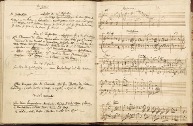
The Thematic Catalogue, held in the British Library in London, is a small, ninety-page book in excellent condition. It is bound and features an elegant part-leather cover. Fifty-eight of its pages contain text and music. The catalogue is arranged with detailed descriptions of the instrumentation on one page and the incipits of the pieces—typically four bars written on two staves—on the opposite page.
All major books on Mozart, including the recently updated Köchel catalogue, which officially lists and dates his compositions, rely on this so-called autograph catalogue as a critical source. It serves to document and certify Mozart’s most important works, including, for example, the Jupiter Symphony. Mozart’s Clarinet Concerto is attributed to him precisely because it is included in this thematic catalogue, supposedly in his own handwriting.

A recent study by Professors Luca Bianchini, Anna Trombetta, and Martin Jarvis, published in the prestigious Journal of Forensic Document Examination (JFDE), introduced an innovative method of ink analysis. This study revealed that the catalogue is a forgery, fabricated around 1798 and written by multiple hands.

To verify the authenticity of a document, one must first examine the paper’s watermark. In the case of the Thematic Catalogue, no identical watermark has been found from before 1802. Furthermore, Mozart never mentioned or wrote about the catalogue during his lifetime, nor did any of his closest relatives or acquaintances. The catalogue was not included in the inventory of Mozart’s possessions compiled by court officials after his death in late 1791. In fact, there is no record of the catalogue until 1798—seven years after his death.

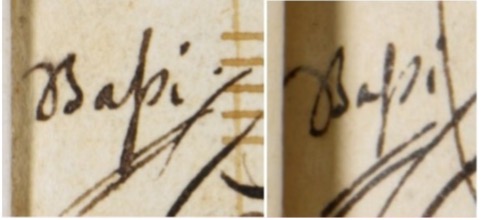
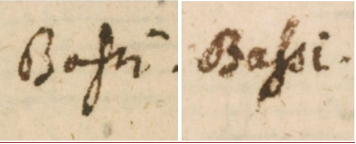
At the IGS 2023 international conference on forensic handwriting analysis, Professors Bianchini and Trombetta demonstrated, using new software developed by Bianchini in C#, that the handwriting in the catalogue does not match Mozart’s own. (For instance, consider how Mozart wrote “Bassi” in his autographs, compared with how it appears in the catalogue.)

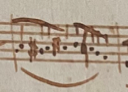
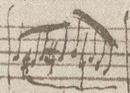
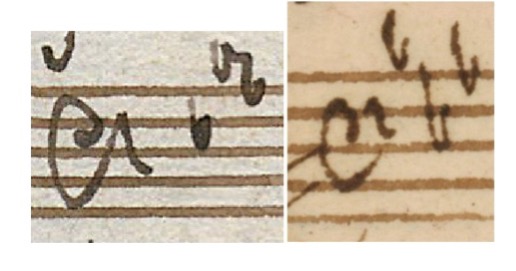
At the same conference, held at the University of Évora, Professor Anthony Jarvis presented another article, also subjected to rigorous double-blind peer review. He showed that all the bass clefs in the catalogue were not written by Mozart. If Mozart did not write the bass clefs on every stave, it is unlikely he wrote the rest of the catalogue. (Compare: on the left is an autograph, on the right the catalogue.)

Professor Heidi Harralson, a leading authority in forensic document examination, co-authored another article with Professor Martin Jarvis of Charles Darwin University in Australia, who is also an expert in the field and a Board Member of the Australia and New Zealand Forensic Science Society Northern Territory Branch. They presented evidence suggesting that Mozart could not have authored the catalogue. (For example, the regular strokes in The Marriage of Figaro autograph differ from the tremulous lines in the Thematic Catalogue, indicating copying or forgery.)

Bianchini and Trombetta had already published a book in 2018 highlighting numerous contradictions between the catalogue and Mozart’s original manuscripts.

For instance, the catalogue claims that a well-known aria was sung by the bass Albertarelli. However, it was written for the tenor Del Sole, since the higher notes would be unsuitable for a deep bass voice. Tempo markings, notes, rests, and musical themes often differ between the catalogue and the original manuscripts. Additional instruments are also listed in the catalogue, though they do not appear in the autographs.

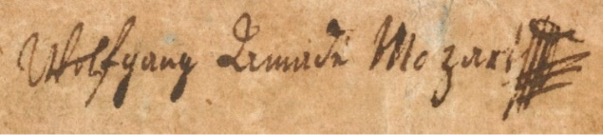
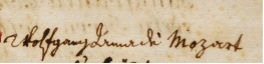
Even the signature on the cover is forged.

Signature in the catalogue:

Mozart’s verified signature (from his marriage certificate):

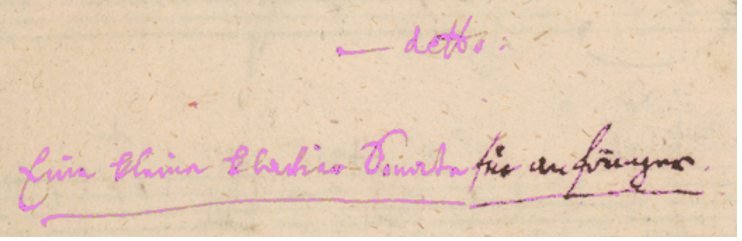
Furthermore, certain entries were added later using different inks. These discrepancies are invisible to the naked eye but become evident when computer filters are applied, as demonstrated in the recent scientific article by Bianchini, Trombetta, and Jarvis. (For instance, the initial text highlighted in pink differs in ink composition from the darker addition at the end of the line.)

It is no wonder that the musical world, especially Mozart scholars, is in turmoil. The revelation that the catalogue is a forgery challenges long-held assumptions.

For the sake of accuracy, the newly published Köchel catalogue must be revised to account for these findings. All works attributed to Mozart from 1784 to 1791 must be re-examined, as their dates and attributions have so far relied on this forged document. Given that Mozart often left his autographs unsigned and undated, the authenticity of many works is now in doubt, potentially revolutionising the history of music.

For those interested in exploring this topic further, please refer to the press release available at: https://www.mozartrazom.com/mozarts-legacy-under-scrutiny-groundbreaking-forensic-study-published/


Luca Bianchini is a musicologist from the University of Pavia, Italy, specializing in historical musicology and document analysis.