Guest interview by Michael Johnson

A legend in contemporary piano music, Ursula Oppens has just turned 80 and shows no sign of trimming back her busy life of recording, performing, teaching and commissioning new works from American composers. She fights the aging process with tremendous vitality and mostly wins.

But as she told The New York Times recently, “The eyesight goes, the fingers, the retention”.

A few weeks later in my telephone interview with her, she was more optimistic. “My mind is still functioning the way I would like it to function. I am lucky to be very active at this time and I plan to continue.”

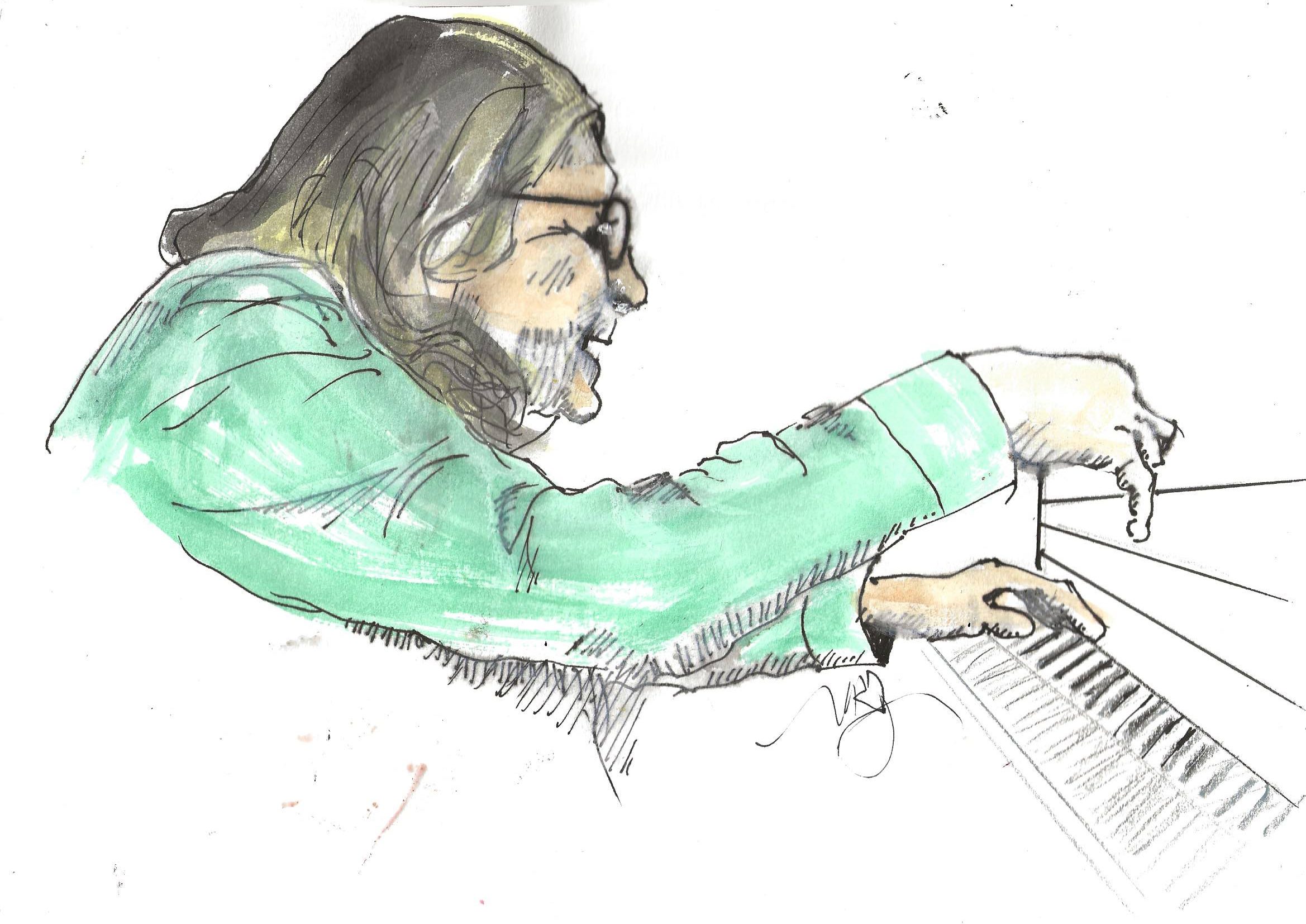
The Times rather bluntly described her as “a little fragile, tiny and stooped”. I tried to capture some of that in my portrait of her.

But she is also recognized as a powerful performer who tackles the thorniest of new pieces. As she said in our interview, she remembers hearing the difficult works of Julian Hemphill for the first time and thinking “This is for me!”.

Composers who have been commissioned by her or who have written works for her include such leading lights as Frederic Rzewski, William Bolcom, and Charles Wuorinen.

Perhaps her best known collaboration was with expatriate American Rzewski with whom she became “very, very, very close friends” and produced the now standard “People United will Never be Defeated”, a magnificent set of 39 variations. Some critics have classed it alongside Bach’s Goldberg Variations and Beethoven’s Diabelli Variations.

She worked together at a distance with Rzewski during the pandemic, ending with his musical tribute “Friendship”. As Oppens told me, we could not meet in person for two years but “he could write and I could play”.

In this clip she plays Rzewski’s “Friendship” on a Fazioli grand.

Her attraction to modernity took shape when she attended lectures and a concert at Radcliffe College with the young French composer Pierre Boulez. She was musically smitten and never looked back.

Edited excerpts from our recent conversation, recorded while she was at a music festival in North Carolina:

You have helped shape contemporary American music through your commissioning of new works. How did you become so interested in modernity?

My parents were refugees from Europe and they felt they had left a great culture behind. I found out much later in life that my mother had taken a course with Anton Webern. And my father joined the ISCM (International Society for Contemporary Music). So they had been interested in new music all along. I didn’t know that as I was growing up but it might have been an influence in ways I didn’t understand.

You are perhaps best known for your commissioning. Are there other people out there also looking for new works? Or are you alone?`

Oh no. There are people like that all over the place.

Where has the commissioning money come from? Family funds?

No, some has come from foundation grants. For example, I received a big grant from the Washington Performing Arts Society. But funding commissions can come from all kinds of sources.

When did you start commissioning?

I didn’t really commission until after college. The first composers I approached to write pieces for me were Tobias Picker and Peter Lieberson. I recorded both their pieces. One composer who had a great influence on me was composer John Harbison. I also played with this wife, the violinist Rosemary Harbison.

I believe the late Fredric Rzewski was among your friends. You knew him, didn’t you?

Oh yes, he was a very, very very close friend. I commissioned his “People United Will Never be Defeated”. The most recent piece I commissioned from him was “Friendship”. It was very much a pandemic piece. For two years we couldn’t see each other but he could write and I could play. He died at 83 in Italy during the pandemic.

You have a new CD coming out soon?

Yes, it’s the music of Charles Wourinen. Mostly solo piano but there’s also a ballet for two pianos that we still have to record. I knew Charles well and worked with him from 1966 to his death in 2020, maybe the longest relationship I’ve had.

What was your relationship with Julian Hemphill?

I lived with Julian for almost twelve years. He is a fine composer and a wonderful man. When I heard his difficult music I thought, “This is for me!”

In your CD “Winging It”, you featured the John Corigliano music that you had commissioned. Does that happen often? You commission something, the composer writes it and you record it. Is that how it works?

That’s what it’s all about. Yes, when you commission a piece it’s a little bit like having a child. You let the child go out into the world, make his own friends, and live his own life. What’s exciting is that after a while other people start playing it.

You seem to be focused on the American composers.

Basically yes, because American composers are people I can work with, people I can bump into. You want this personal contact and you become their friends, like Thomas Picker — I am very honored to be a friend of his, you know. Working with him has made my life very exciting.

Your fans worry about your health. Should they?

Not really. I work more slowly. I don’t run any more. But I’m perfectly healthy as far as I can tell. Of course as one gets older things get a little creakier. My mind is still functioning the way I would like it to function. I am lucky to be very active at this time and I plan to continue. I have had a wonderful share of happiness in my life.
What has aging done to your piano technique?

Luckily I don’t have any serious problems but I cannot say I play as well as I did when I was fifty. I am careful about expanding my repertory. I don’t take on impossible pieces, like Prokofiev’s eighth Sonata.

Are you slower, are you careful about your repertory?

Yes, recently I was teaching the Prokofiev. It was very sad that I had never played it. It’s too difficult a piece for me to learn at this point. I could practice but I probably would not be able to perform it.

But you could still teach it?

Oh yeah.

It is like a master class, I suppose? You play a few bars to show the way?

Not necessarily. You can point out the phrasing, and this and that. You’ve got to hear this note to make sense of the next one — and stuff like that.

Most of the musicians I talk to avoid contemporary music because it requires a lot of learning and they are not sure it’s worth the trouble. Is it really that difficult to master?

It can be difficult, yes, but often it is absolutely wonderful. There is no limit to how exciting it can be. It’s very, very thrilling. You bring to life something that has not existed before.

What about the limited reception by people who are not tuned into contemporary sound worlds? They say well, it’s not Mozart. Doesn’t that drive you up the wall?

No. Live music in a small hall with an audience of sixty people can be so wonderful. Sometimes I tell the audience to listen for certain passages. It makes it an exciting experience for them.

Do you have any fear of being slightly crowded out by the Asians who have suddenly discovered us?

No. If immigration were not part of America I would not exist. I am the daughter of immigrants. We are a mixture, and that is fantastic. I know some of the great young pianists are Chinese. There are people everywhere who can run better, who can jump better, and there are people who can play the piano better.

Do you have a swan song in mind? Are you even thinking of your legacy after the inevitable end?

I will keep making music as long as I can. I know that one day I won’t be able to, and that’s a normal part of life. But I don’t wish to be playing the harp for eternity.

(Ursula Oppens, portrait by Michael Johnson)


MICHAEL JOHNSON is a music critic and writer with a particular interest in piano. He has worked as a reporter and editor in New York, Moscow, Paris and London over his journalism career. He covered European technology for Business Week for five years, and served nine years as chief editor of International Management magazine and was chief editor of the French technology weekly 01 Informatique. He also spent four years as Moscow correspondent of The Associated Press. He is a regular contributor to International Piano magazine, and is the author of five books. Michael Johnson is based in Bordeaux, France. Besides English and French he is also fluent in Russian.

Michael Johnson, in collaboration with The Cross-Eyed Pianist (Frances Wilson), has published ‘Lifting the Lid’, a book of interviews with concert pianists. Find out more / order a copy
Mozart wrote 18 piano sonatas and American pianist Orli Shaham has recorded all of them for the Canary Classics label, the final two volumes of the series being released in February this year. These sonatas have an enduring appeal, for players, both professional and amateur, and audiences alike.

For Orli Shaham the fascination with Mozart’s piano music began at an early age: this recording is the result of an exhilarating 40-year journey through the sonatas, getting to know them intimately, studying them deeply to appreciate their individual characters, and to understand the composer’s musical methods and motivations. “Was he trying out that piano? Was he writing for someone’s daughters? I want that something from every single one of them.” (Orli Shaham)

The recording was made in August 2019 and August 2020, at Mechanics Hall in Worcester, Massachusetts. The timing was deliberate to ensure consistent humidity in the hall: the result is a wonderful clarity and evenness of sound.

The piano sonatas reveal Mozart’s compositional genius in microcosm – from big orchestral gestures and brass fanfares to chamber music textures and eloquent operatic arias. Shaham pays great attention to the changing textures of Mozart’s writing but also his chiaroscuro – those remarkable emotional shifts from light to dark and back to light which occur in phrases or indeed a single bar. This is most evident in the slow movements where Shaham finds particular intimacy, poignancy and depth of expression – for example, as here in the Adagio from the sonata no. 2 in F Major, K.280:

There’s a delightful clarity too, in Shaham’s approach, with impeccable attention to details of dynamics, phrasing and articulation combined with tasteful use of pacing and rubato to create drama (take the opening movement of the sonata K.310, for example, where she takes time to appreciate the increasing operatic tension). There are moments of wondrous spaciousness, especially in the slow movements, where the contrasting hues of Mozart’s compositional palette are really brought to the fore.

I interviewed Orli Shaham to find out more about the pleasures and challenges of recording the complete Mozart piano sonatas

Congratulations on completing your recording of Mozart’s piano sonatas. What have been the particular challenges and pleasures of recording this cycle?

From a pianistic point of view, the greatest pleasure has been feeling Mozart’s hand at the keyboard and the way that he must have used his musculature, the technique. When you play all of these sonatas you feel like you know how it felt to be inside his hands and some of the brilliant ideas that he came up with of getting your fingers around the keyboard in virtuosic and delightful ways.

The complete sonatas run from his earliest maturity to quite late in his output. Therefore, the musical trajectory of how he put together notes, how he was thinking from a formal point of view, how he was thinking of the storytelling of a sonata and how the audience would be engaged throughout that whole time, that’s been a tremendous pleasure to learn from him.

The challenges are many. Mozart had a tremendous technique, so the sonatas are challenging to play because he was such a master of the keyboard and was so free to express himself in so many different ways. Internalizing what that is and getting to the place where I felt comfortable to convey as many of his intentions as possible, was certainly a wonderful challenge from the beginning.

There’s no question that part of the challenge of playing his sonatas is the fact that I’m playing them on a beautiful modern Steinway, which of course he didn’t have access to. While I love that, and it is a pleasure, the question of how do I make this as close to what I think he would have done if he were around in 2020 to record it is definitely challenging and something that I put a lot of thought into.

In terms of the recording sessions of the sonatas, we had a great challenge. Our first session was in August 2019. The world looked quite different when we recorded the second session in August 2020, during the first months of the Covid pandemic, and we came up against quite a lot of challenges. This was before any of the technologies were available for remote recording and remote engineering. We had to use 27 different apps and programs to make that second recording session possible.

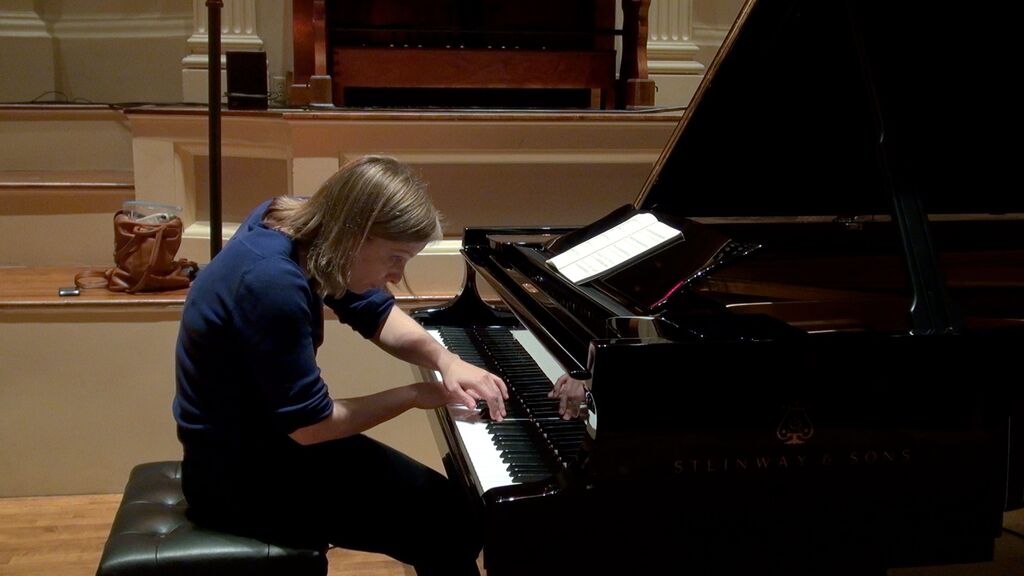
Orli Shaham in the recording studio

A particularly tough moment was when I had just finished playing the first movement of the C Minor Sonata, which is so emotional and such a moment of vulnerability for the performer. I played my heart out, and then there was radio silence from my wonderful producer Erica Brenner hundreds of miles away in Cleveland, because the internet service for the entire neighborhood had failed. Luckily, the audio was captured, and a few hours later, using a lot of workarounds, we were able to continue recording.

Schnabel said of the sonatas “too easy for children, and too difficult for artists”. What do you think he meant by this statement?

It’s a really interesting commentary. I’m not sure I entirely agree with “too easy,” but there are places in those sonatas where the writing is something that makes sense for a student to play because it’s so idiomatic for the keyboard. It will teach you how to use your hand correctly at the most basic level. But at the same time, he’s doing it with such grace and artistry and intelligence that there are layers and layers of meaning to unpack, even with the simplest phrase.

Why, in your opinion, do Mozart’s piano sonatas have an enduring popular appeal, with both artists and audiences?

They have an enduring popular appeal because Mozart had an enduring popular appeal in mind. I love that that’s so, so true. You see it in his letters. He writes to his father, “Don’t worry. I’m putting something in for the really super educated. I’m putting something in for the ones who really don’t know anything about music yet. I’m putting something in for the ones who want to play themselves but aren’t that good.” He thought about everybody and he tried from very early on to consciously put all of that into every sonata, into every work of music that he wrote, actually. I love that he was very mindful of his audience. Of course, that’s part of where he was in time. He was one of the first composers to try to get by without the benefit of somebody’s patronage, meaning he had to appeal to the audience.

Do you have a favourite sonata out of the entire cycle?

Yes. The one I’m playing at the moment.

Orli Shaham’s complete Mozart Piano Sonatas are available in 6 volumes on the Canary Classics label and via streaming

Photo credit Karjaka Studios

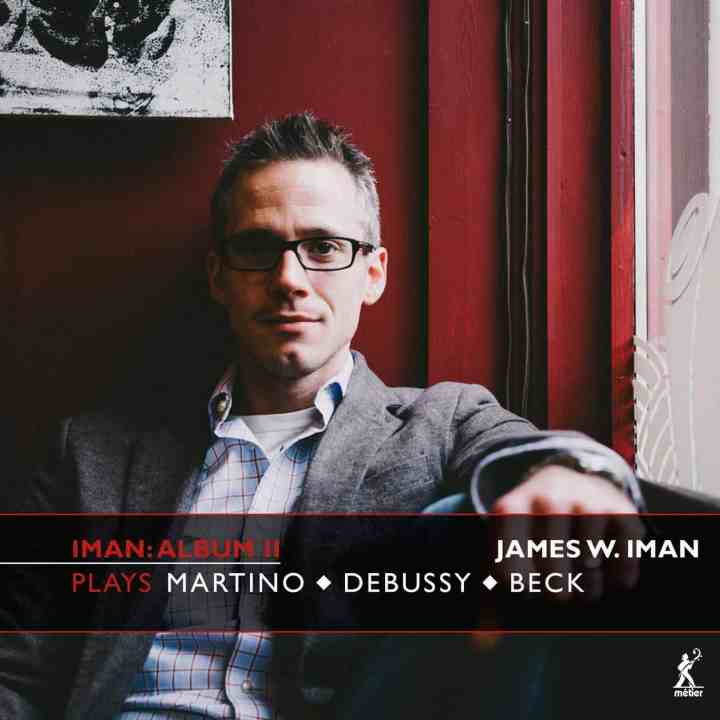
In his latest album, American pianist James Iman places Debussy’s everygreen Images alongside works by Jenny Beck and Donald Martino


IMAN: ALBUM II James W. Iman, piano (Divine Art Recordings)

This second album from American pianist James Iman places Debussy’s ‘Images’ alongside works by Donald Martino (1931-2005) and contemporary composer Jenny Beck (b.1985), whose work ‘Stand Still Here’ receives its premiere recording on this disc.

A specialist in music written since 1900 – with an emphasis on music written since 1945 – James Iman’s repertoire spans many stylistic developments since Debussy. He is particular in his study and research of the music he performs and records to enable him to find fresh interpretations and approaches to the familiar, as well as presenting the new and more leftfield corners of the repertoire to listeners. When I reviewed his debut album, I was impressed by his willingness to rise to the challenge of this music and meet it head on with conviction and musicality, alert to its myriad details and quirks. He is perhaps most at home in the contemporary and more unusual, yet on this second album, he displays a remarkable appreciation of Debussy’s music which I really enjoyed, allowing me to hear these well-known pieces afresh.

James Iman has, by his own admission, taken a very different approach to Debussy, one which some may find controversial. I asked James to explain how he arrived at his interpretation of the works by Debussy on this disc:

There are a few factors that went into my conception of these pieces. The first was a general frustration with recordings, and the homogeneity of most performances. This, of course, isn’t a new phenomenon, nor one specific to Debussy but, for whatever reason, it bothers me more in his music. While first digging into these pieces, my approach was probably similar to most pianists; you digest the text, and find the bits you think are interesting, and come up with an interpretation that highlights them. At first, my goal wasn’t to present a radical departure from typical interpretations, but the further into Debussy I dug, the more it seemed necessary. Improvisation was almost a character trait of Debussy. He would improvise at the piano before class, and for hours at parties. Moreover, Debussy’s performances of his own pieces were said to sound improvised. Likewise, one of the things that Debussy expressed, repeatedly, was his desire to compose music that sounded as though it was being improvised. This was, of course, mainly an aesthetic concern – Debussy was looking to overcome the strictures of convention, and was (primarily, perhaps) referring to the perceived structure of his works and not necessarily the nature of the performance.

Two things crystalized all of these ideas for me. First was my discovery of the recordings by Paul Crossley. I don’t know how well-known his performances are, but they were new to me, and a revelation. Absolutely every measure is inflected! Every single note feels important. Somehow, miraculously, he avoids making the music sound manic. Second was discovering Debussy’s own recordings of his works. It’s really difficult to describe just how radical Debussy’s playing is! Notes of the same duration are two distinct speeds within the same phrase and occasionally within the same bar. He pushes and pulls tempo without warning and to degrees that would be regarded as well-outside what we might consider “good taste.”

All of these things together made it clear to me that, not only could I approach these pieces differently, but that I should. We’re a history-obsessed culture – we’re excessively concerned with the fidelity of a text (the “letter”), whether it’s law or religion or music. I wanted to concern myself more with the spirit of the text – get the notes, of course, but try to capture what Debussy has clearly shown was his intention.”

Iman’s ‘Images’ are bold and direct, brightly-lit and vividly hued: no impressionistic veils of sound here nor excessive use of the pedal. Mouvement thrums and pulsates; Hommage à Rameau has a stately grandeur that feels at once ancient and modern; the darting fish of Poissons d’or are not shy goldfish but bold, muscular Koi carp. Debussy’s vibrant musical language comes to the fore in Iman’s playing with an emphasis on the more piquant or crunchy harmonies and timbres, rather than melody. Attention to these details perhaps comes from Iman’s experience with more contemporary repertoire: there are passages where Debussy sounds ultra-modern when Iman highlights interior or bass details which are sometimes lost or underplayed in other performances of this music. Given Debussy’s dislike of the term “impressionist” in relation to his music, I suspect he may have enjoyed Iman’s interpretation.

After the myriad colours, harmonies and rhythms of Debussy, Jenny Beck’s ‘Stand Still Here’ – a suite of five terse miniatures each no longer than four minutes at most – provides an extraordinary contrast. These introspective, intimate pieces have a remarkable emotional presence, yet expressed so sparely, almost minimalistic. Yet, like Debussy, Beck exploits the timbres and sonorities of the piano to create a hypnotic intensity. Of this work, Iman says, “I have played Stand Still Here more times than any other work in my repertoire”. Through a deep familiarity, and affection, for this work, Iman is able to achieve a wonderful sense of spontaneity and improvisation: notes linger, vibrate, shimmer and fade. It’s a deeply absorbing interlude on this fascinating disc.

The final works are by Donald Martino. He studied with Roger Sessions and Milton Babbitt, two of America’s foremost twelve-tone composers, but did not adopt the practice himself until he studied in Italy with Luigi Dallapiccola (though he never described himself as a “twelve-tone composer”). From Dallapiccola, Martino took a more lyrical approach to composing twelve-tone music, which culminates in his Fantasies and Impromptus. Like Debussy and Jenny Beck, Donald Martino enjoyed the myriad sonorities the piano offers. Iman gives a masterful performance of this collection of pieces which combine virtuosity and expression, improvisation and structure, making them the perfect complement to Debussy.

IMAN II is available on the Divine Art label and via streaming platforms


This review first appeared on my sister site ArtMuseLondon.com

To coincide with the release of her new recording of Mozart Piano Sonatas Vols 2 and 3, I caught up with pianist Orli Shaham to find out more about her influences and inspirations and why one of her most treasured possessions features Snoopy the dog…..

Who or what inspired you to pursue a career in music and who or what have been the most important influences on your musical life and career?

It was my parents and my older brothers who inspired me to start music more than anybody else. My parents listened to a lot of music, and my older brothers were just enough older that they were beginning to be accomplished at instruments when I was coming into consciousness. I just really wanted to be part of that and be able to play with them and do the same sort of things that they were doing. That was very much the source of the initial inspiration. I also went to an untold number of conservatory concerts to listen to my brothers perform, and then also heard the 49 other pianists or violinists who were on the same program. That was hugely inspirational too.

A big part of my influences are the people in my life who also love music and who also play music. For me, that’s changed over time from being my elders to being my children and my students. I find them all incredibly inspiring.

Which performances/recordings are you most proud of?

Ultimately, it’s always the last project you just finished that you’re most proud of, because on some level you feel like it’s better than everything you’ve done before. I have certain highlights throughout my career that I think back on quite fondly. At the moment, I’m riding high on recording the complete Mozart sonatas. That was a monumental mountain to climb. I loved every minute of it, and I learned so much from doing it.

Which particular works/composers do you think you perform best?

I would say whatever I’m doing at the moment, which this year has included a lot of Mozart, and a lot of Clara Schumann and her compatriots. With any luck, we keep getting better at all of them – that’s the hope.

How do you make your repertoire choices from season to season?

That’s a really tough one because you have to choose repertoire quite far in advance. I have to project what I think I will feel like playing 18 months from today. Eighteen months is a long way to plan for your emotional state. These days, 18 minutes is a pretty long way.

I’m so lucky to be a pianist; I have so much repertoire to choose from. I have a list that I haven’t even begun to skim the surface of, of pieces that I would like to play. So I just go down that list based on what I think would work best next.

Do you have a favourite concert venue to perform in and why?

I have a favorite concert venue to record in, but I’ve never actually performed there. It’s Mechanics Hall in Worcester, Massachusetts. I love recording there because there’s something about the atmosphere of the building that makes me feel like it’s all about whatever I’m creating on stage (and also there’s an enormous painting of George Washington and the rear end of his horse looking down on me from high above the stage). The hall has an incredible sound. For pianists, performing or recording at a venue is intricately tied up with the venue’s piano. I really love the instrument at Mechanics Hall, as well as the technician who takes care of it. Any time I sit down at that keyboard, I’m inspired to experiment.

What is your most memorable concert experience?

That’s a very long list. One that I happen to be thinking about recently was with David Robertson and the St. Louis Symphony. I played John Adams’ Century Rolls in Carnegie Hall. The way schedules worked out, the composer couldn’t come to hear any of our performances before that; the first time he could come and hear it was at the Carnegie concert. I was only the second pianist to play that concerto at the time, and there was a great deal of nervous energy.

The orchestra did a magnificent job, and David was incredible. Everything worked, and it was fabulous. When John came on stage for his composer’s bow, he leaned in to me and said, “You got it, you really got it.” There’s really no better feeling as a performer, than for the composer to say, “You got it.” That’s what it’s all about.

I should add that I’m very much looking forward to playing John Adams’ second piano concerto, Why Must the Devil Have All the Good Tunes? in Finland next season, with the Finnish Radio Symphony Orchestra, and the self-same David Robertson conducting.

What have been the greatest challenges of your career so far?

Being a mother of infant twins was a big challenge. We’ve made it through to the other side – those twins are about to turn 15. Things are a lot a lot less intense than they were 15 years ago around this time. I think it’s true for many parents, certainly for a lot of mothers, that it’s tricky figuring out how to keep your commitment to music while also juggling a commitment to family, both of which are all-consuming.

What do you do off stage that provides inspiration on stage?

I do things that have to do with music, like teaching and listening to repertoire other than what I’m working on, which is very inspiring. I also specifically do things that don’t have to do with music. I’m inspired by books I am reading, or TV shows I am watching, or meditation or cooking, that really allow me to get inside my own head in a different way than when I’m getting inside a composer’s head.

As a musician, what is your definition of success?

The not so trite answer is that we musicians don’t have such a definition, because we never think that what we’re doing is good enough, so it can’t possibly be considered a success. Knowing that there will never be a feeling of complete and total success, I set very specific goals for myself, and if I can make those work for an entire performance, then I feel it’s been a success.

Those are often really small things. I had a shoulder injury a few years ago and one of the things that I’ve been working on is maintaining a certain level of muscle relaxation in my upper back, even in performance, from the beginning to the end. That’s no small feat. It has nothing to do with the actual music making, and it has everything to do with the actual music making. When I achieve that, I feel a huge sense of pride, because I know that’s something I wasn’t able to do before.

What advice would you give to young/aspiring musicians?

My biggest piece of advice is that whether other people give you the opportunities you’re hoping for is completely out of your control. But whether you feel that you are constantly improving is entirely in your control, and that way of approaching things will sustain you through the lulls and heartbreaks of a career.

What do you feel needs to be done to grow classical music’s audiences?

There are really two sides to that question. One, how do we get the next generation to understand that classical music is for them? That’s in part why I started Orli Shaham’s Bach Yard, to get to children at the ripe old age of three or four years old. The other side of it is making sure that what you’re presenting to the audience is relevant to their lives in some way. That may have to do with repertoire choices, it might have to do with venue choices, perhaps programme lengths, and the way that you introduce a programme to an audience and explain to them how it connects to them. It’s all about humanizing the musicians and the composers and making people feel that this is something that is actually designed for them and that they can partake of whether they’re three or 30 or 99 years old.

What’s the one thing in the music industry we’re not talking about which you think we should be?

It’s the question of what’s in it for them: What’s in it for your audience? What’s in it for the students? What are they going to get out of that and through their lives? What’s in it for a subscriber or a single ticket buyer? Why are we actually doing this? Because we in the industry get so caught up in the fact that we love it so much, we see what it’s doing for us that we forget to think about the perspective of the people we’re trying to offer it to.

What is your most treasured possession?

I have two favourite possessions. One of them is the Steinway B that’s been with me since 1997, 25 years. I don’t know how I would get it out of the apartment if there’s a fire.

My other favourite possession is the cartoon that Charles Schulz made for me in 1997 – also 25 years ago. It’s a one-panel strip where Schroeder is playing the Beethoven’s “Pathetique” sonata and the final bar line is missing, so the notes are all falling on the ground with their stems up. Poor Snoopy is trying to walk across the floor and the note stems are pricking his little feet, and he’s saying, “Ouch!”


Volumes 2 and 3 of Orli Shaham’s recording of the complete Mozart Piano Sonatas are available now on the Canary Classics label.


A consummate musician recognized for her grace, subtlety, and brilliance, the pianist Orli Shaham is hailed by critics on four continents. The New York Times called her a “brilliant pianist,” The Chicago Tribune referred to her as “a first-rate Mozartean,” and London’s Guardian said Ms. Shaham’s playing at the Proms was “perfection.”

Orli Shaham has performed with many of the major orchestras around the world, and has appeared in recital internationally, from Carnegie Hall to the Sydney Opera House. She is Artistic Director of Pacific Symphony’s chamber series Café Ludwig in California since 2007, and Artistic Director of the interactive children’s concert series, Orli Shaham’s Bach Yard, which she founded in 2010.

Read more


Image credit: Karjaka Studios
