Guest post by Dakota Gale. The latest article in Dakota’s series Notes from the Keyboard, aimed at adult pianists
I recently attended a piano performance, during which I spoke with a 92 year old woman sitting next to me. She’d played and taught piano for decades. When I mentioned that I take lessons online, her eyes widened. “ONLINE lessons? But…that is the most amazing thing!”
She’s not the only one surprised. “Wow, you take lessons online?” is a common response from most people, even after the nuclear proliferation of pandemic Zoom meetings.
Yep, ever since I began taking lessons in spring of 2021, I’ve done them online. My teacher, Antonio, is located in southern Brazil; I’m in the Pacific NW in the U.S, thousands of miles away. And it’s not just me; plenty of people do it, including:
Those looking for specific expertise (e.g. Chopin etudes from a professional)
Those being careful while going through chemo or with a disease affecting their immune system.
Those who travel a lot (tougher if you’re flying, obviously)
If you have a favoured, dear teacher, but one of you moves, going online allow you to continue lessons.
Me and Online Lessons
For me, initially I took online lessons because of two things: to save money and to avoid COVID.
Since then, I’ve seen additional benefits. For one, they’re much more time efficient. No travel across town! For parents, I imagine this would be a huge benefit since you’d avoid shuttling kids around. (Actually, one of my friend’s kids is taking lessons with Antonio.)
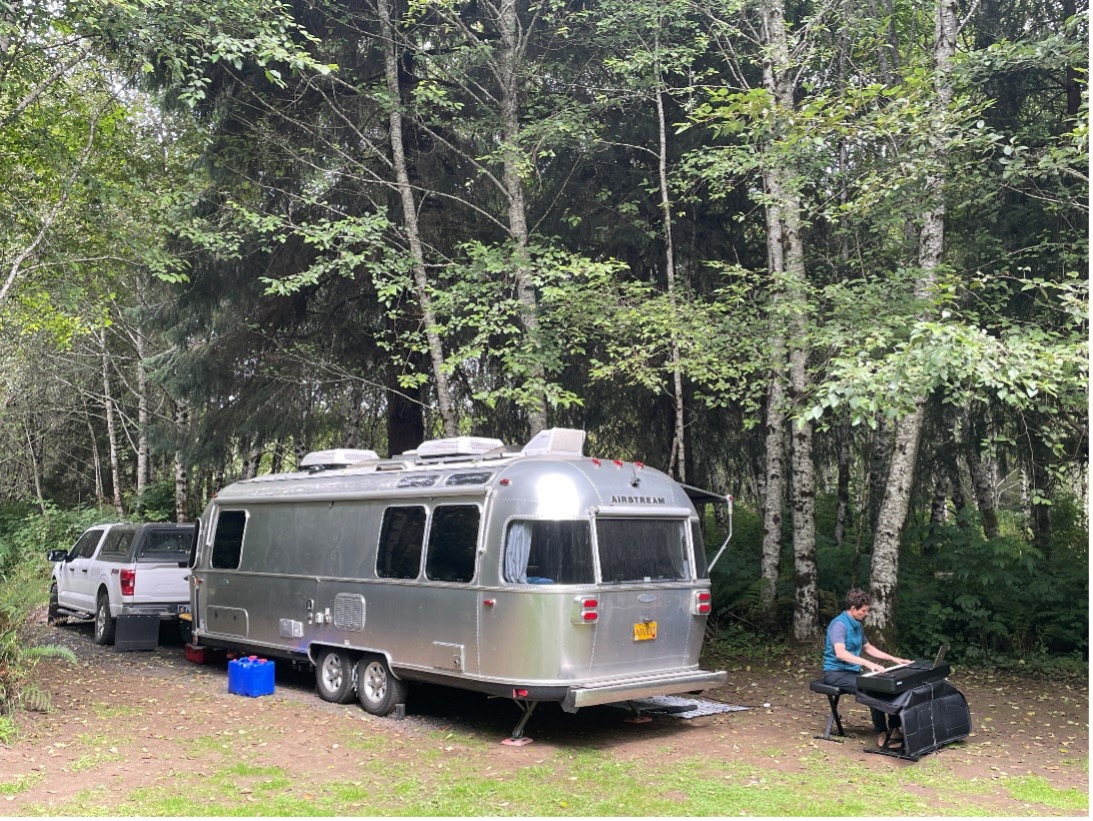
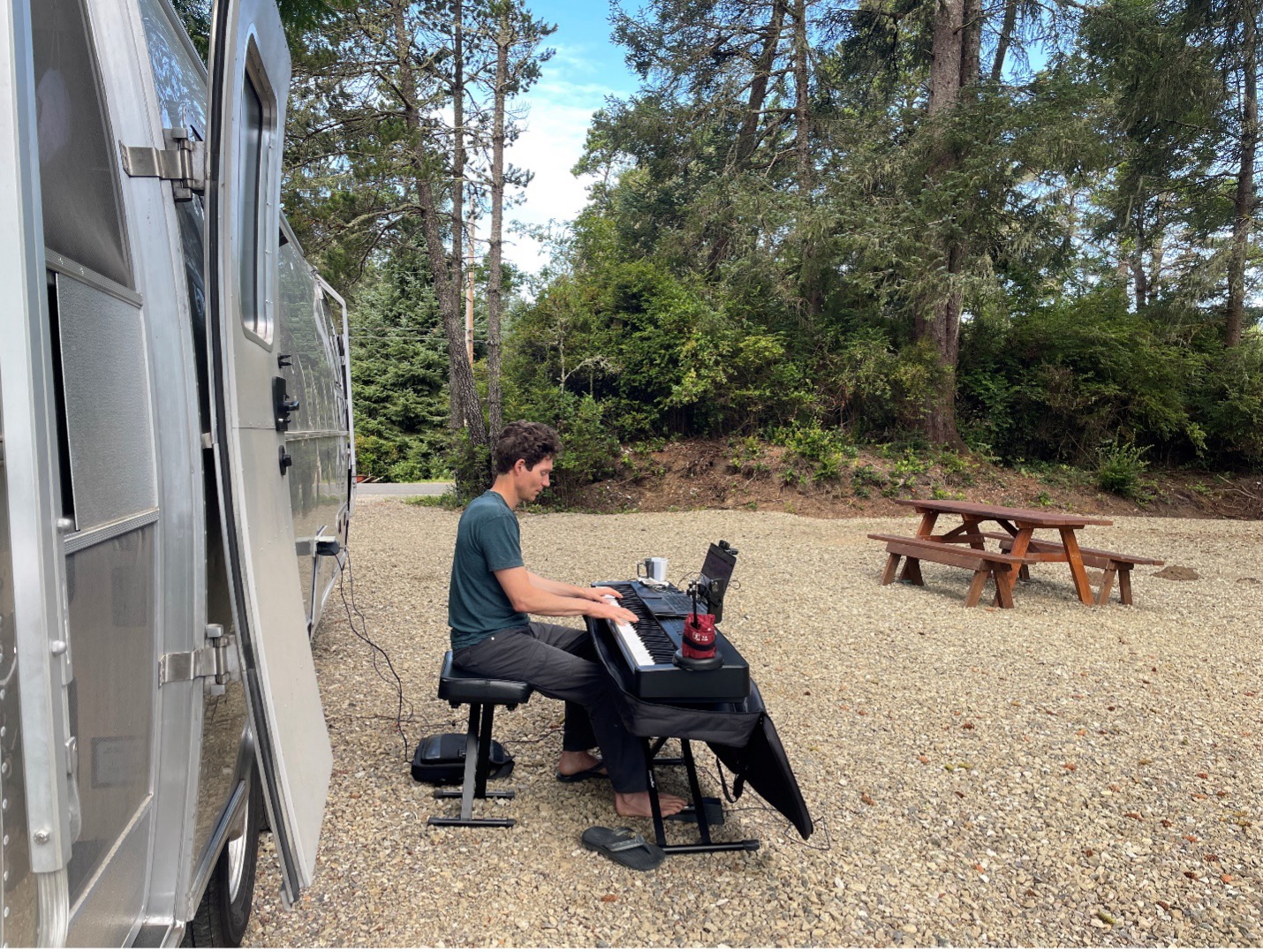
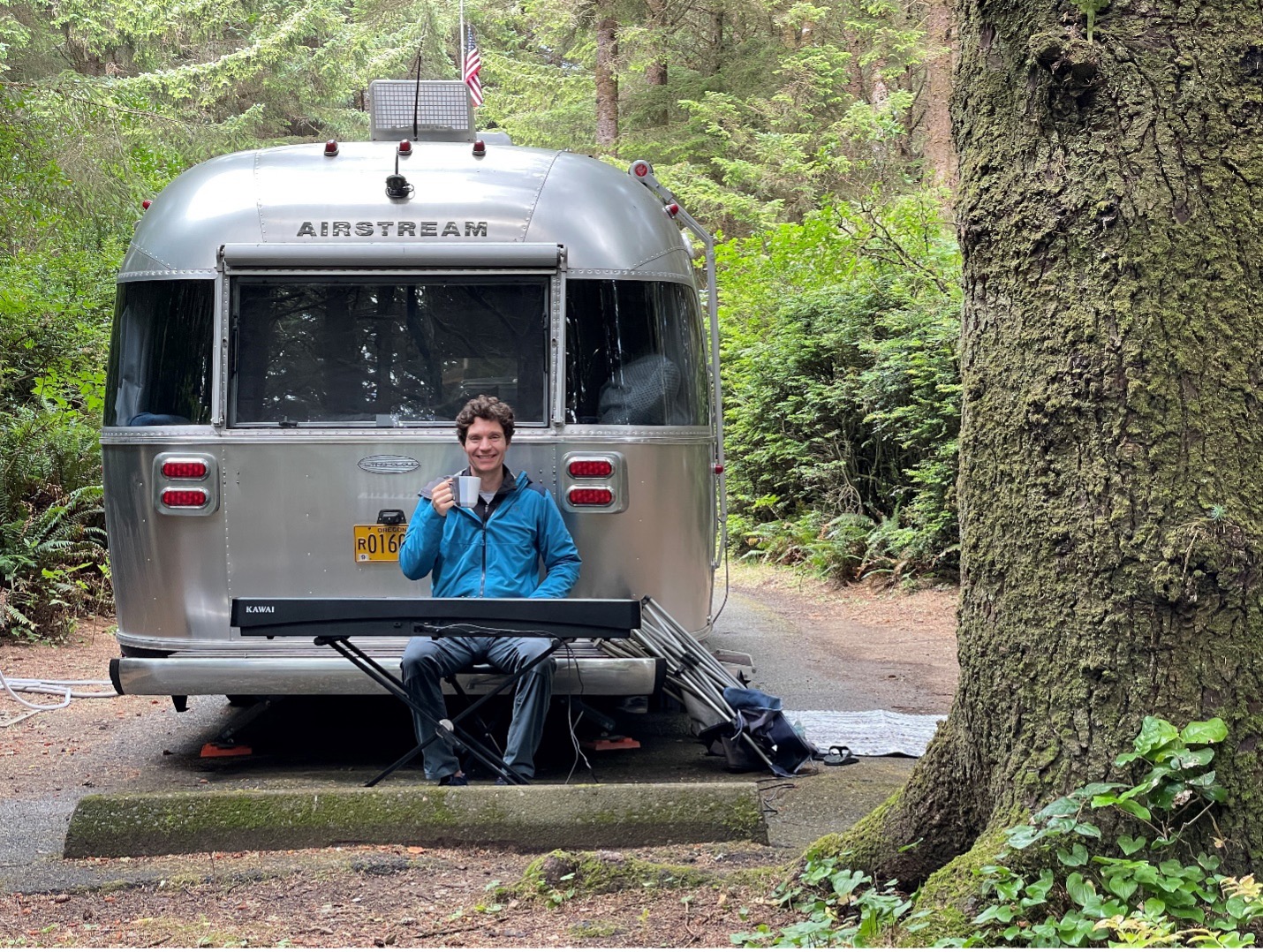
I travel fairly often and like to keep lessons going. In fact, I’m currently rolling around the Pacific NW with my wife for three months in a Airstream travel trailer. Between mountain bike rides, hikes, and hanging with friends, I’m both continuing to play consistently and still taking my weekly lesson. Courtesy of Starlink satellite internet and a digital Kawaii piano, I’m not skipping a beat.
When my teacher is on vacation, I’ve also taken lessons with professionals such as Grzegorz (Greg) Niemczuk, who I found on YouTube. You might be surprised how many YouTubers offer lessons (a friend takes lessons with the popular Heart of the Keys YouTuber.)
You know what makes piano better? Playing outside!
Beyond all those boring logistical things, Antonio being Brazilian brings a fun perspective to my experience. (I’ve learned a few choice phrases in Portuguese, for one!) I’ve also learned about (and love!) Brazilian music that I would otherwise not know, including tangos, the music of Tom Jobim and Ernesto Nazareth, and folk songs arranged for piano.
It inspired me to start a listening quest of different genres and international composers that has deepened my relationship to piano. Perhaps a local teacher would have provided that, but certainly it would have been different.
The nuts and bolts of online lessons
For those wondering how this is possible, allow me to describe the situation:
Antonio uses a Yamaha grand piano to teach. On it, he has four cameras for his face, top down on his hands, sideways on his hands, and another on his pedal. He even uses software that allows the camera to track his hands (AI magic!).
The sound quality is quite good–the nuances he can hear and comment on astonish me.
For my setup, I use a different system depending where I am. At home, it’s my computer with a webcam plus my phone on a stand looking straight down at my hands. While traveling, I just go with my phone on a small tripod set up to the side and occasionally my laptop in front of me. It works great.
The benefit of all this: the only time I’ve missed a piano lesson is when I’ve taken bikepacking trips. I challenge you to carry a full-size digital piano through the mountains…no thanks. A pianist needs to take a break from the keyboard SOMEtimes!
Resources:
To find an instructor, just type “piano lessons online” into any search engine. A few popular services: Superprof or Wyzant; a fellow traveler I met on this trip used Preply to find her ukelele instructor. (If you want to work with Antonio, just ping him on Whatsapp at +55 48 9181-9164.)
The second in Dakota Gales series of guest articles, Notes from the Keyboard, aimed at adult amateur pianists
When my wife gifted me a smooth and shiny Yamaha keyboard for my birthday in 2020, I couldn’t play Chopsticks or even find middle C on it. As an adult learner, I also had limited time, so focused practice was of the essence.
After flailing about, I developed the most effective practice mindset and routine that I could. I’ll share it below.
Over the next four years, I dug into playing piano, but also into how to learn to play piano. Four years later, I’m playing pieces I thought were a decade out. Chopin. Beethoven. Debussy. I sometimes can’t believe my fingers can fly the way they do.
A portrait of Debussy I did while learning to draw people.
None of this magically arrived in a brain chip from Amazon. I didn’t buy Pianist Hands on Ebay and splice them onto my arms.
Nope. This progress was achieved through good old-fashioned dedication. *yawn* I know, I know…show me the TikTok video that has you playing 650 pieces in a week using JUST FOUR CHORDS!
Riiight. The faster success is gained, the shakier it is. Get Rich Quick with this money-making scheme! Learn a language in a week! Get a six pack sitting on the couch! Earn a college degree between episodes of your favorite Netflix series!
Hogwash. Easy come, easy go. There’s so much satisfaction to be found in the effort, the daily scales, the consistency. I’d wager that every pianist who continues to play must embrace the daily grind.
After years of doing this, I’ve realized something important: the toughest part of learning piano is… BEING PATIENT.
It takes as long as it takes. Want to learn a Beethoven sonata or Chopin etude in your first year? That’s nice. It’ll be built on a shaky foundation. Even pros like Andras Schiff didn’t even feel capable of tackling Beethoven’s sonatas until he was in his 40s!
However, if you create a smart practice routine and stick to it, you will improve. Not a matter of maybe: you will.
Ten minutes of practice per day is 60 hours per year. Thirty minutes is 180 hours! I’d wager that you can find 10-30 minutes each day to learn a new skill. Trade some social media or Netflix time for piano. Your future self will thank you.
That said, I’ve wasted plenty of time in the four years since a piano dropped in my lap. Since we’re adults and lack the time to futz about, we’ve gotta maximize our time at the piano!
Here are four key things that benefited me the most:
When I started playing piano, I’d do some scales, arpeggios, whatever to warm up. Then straight into repertoire, which consisted of just trying to play something, over and over. I had no plan, just “start at the beginning and wear this down via submission.”
Picture me with a catapult outside a Piano Piece Castle. If I lobbed enough rocks at the walls, eventually I could break it down! The problem: I wasn’t being thoughtful about where or when to throw the rocks. Sometimes I attacked Castles that were WAY too big for my artillery.
Since then, I’ve learned to use deliberate practice to simplify things and hammer concepts into my brain in smaller chunks.
I break pieces down into their smaller parts (e.g. only working on 2 bars at a time, or breaking an arpeggio into block chords, or an octave into only the root note). I slow pieces to 50% and only increase the tempo once I can lights-out play it. I might play the same bar 25 times in a row, firehosing it into my brain, coating that brain circuit in myelin so that it’s a superhighway, not a goat trail.
It feels slow in the moment, but I learn pieces not just better, but faster, one bar at a time. Deliberate practice builds a stronger structure, brick by brick, versus throwing up a stick built house that blows over in the wind of live performance.
Book recommendations: The Musician’s Wayby Gerald Klickstein,Effortless Masteryby Kenny Werner, andThe Art of Practicing by Deline Bruser. These have helped me dial in my practice routine and develop a different mindset around performing (and mistakes—they’re just feedback!).
Scoring a couple hours of piano in a friend’s studio on a sweet grand piano.
Learning music theory
BLERGH. Music theory, the Brussels sprouts of learning piano. Give me the repertoire, the chocolate cake!
Well, I quickly realized that trying to learn pieces without knowing the basics of theory meant it took forever to figure out a piece. If we compare it to reading, I was basically sounding out letters vs. reading sentences. Th…e. THE. C…aaaa CAT.
Painful. By learning key signatures and basics like major and minor triads (and then their inversions), I made much faster progress. I also developed the ability to memorize pieces quite well because I was thinking in chords and chord progressions instead of individual notes. Now I play all my pieces from memory.
In my experience, spending some time on music theory will drastically speed up your learning progress. I’ve grown to enjoy the analysis that I do with pieces before even putting my hands on the keys. Brussels sprouts as the appetizer, thank you very much.
Resource: This Skillshare course by professor Jason Allen is fantastic.
Hiring a teacher
There are SO many resources for online self-paced piano lessons. They’re affordable and easy to use. They help. I still occasionally do.
Let me encourage you to also hire a teacher, local or online. I cast about for nine months before starting lessons and am so so so glad I didn’t wait longer.
Mine, a Brazilian named Antonio, offers me feedback and insight on my playing a video course could never provide. “Hey, what if you shifted your wrist 10 degrees? In most renditions, pros play that piece like ____. Perhaps this fingering for that passage works better for your hand?”
I’ll write more about my experience with online lessons, but real quick… Not only are online lessons more affordable, they offer the benefit of being portable. When I travel, I can bring my keyboard and still take lessons.
My progress accelerated dramatically when I hired Antonio for a weekly lesson. He corrected things I’d never even considered (like pivoting on my 3rd finger for big left hand arpeggios, not the 2nd finger). If almost every pro had a teacher when they were learning, it’s probably worth it for us amateurs!
Resource: Just search “online piano teacher.” Many popular YouTube pianists also teach lessons.
Piano with a view in my camper van.
Don’t get too big for your britches
Many intro piano pieces felt too simple or boring for me. Right out of the gate, I wanted to play the beautiful pieces.
When the Saint’s Come Marching In? HAH. March on OUTTA here: give me Chopin’s Nocturne in Eb, baby!
The problem: I had zero piano skills. I couldn’t even read music or play a scale!
I was learning how to bungee jump by wingsuit jumping. Less risky on a piano (no bridges to smash into), but certainly a waste of time.
I spent HOURS learning the melody line to the Chopin nocturne…with zeroooo chance I’d be able to actually play it with the left hand added in. I didn’t even know what the key of Eb meant.
My teacher helped me understand which pieces would push me vs. shut me down. Instead of expending hours on a piece I had no chance of playing, I started grabbing achievable pieces. They still took work (I’m looking at you, Consolation No. 3 and your mind-bending triplets), but I could do it!
But I still dream, keeping a list of “goal” pieces. These are pieces that I really want to be able to play that are too difficult for me to learn efficiently at this time. This gives me a long-term set of goal trajectories, which helps me focus on what to work on now. (I’ll also work hard sections of pieces slowly, over months, such as the fast cadenzas in Liszt’s Liebestraum #3 or Chopin’s Db nocturne.)
To keep track of pieces, I created a spreadsheet that I update regularly. I also have an ongoing Spotify playlist to which I add pieces that catch my fancy. (After four years, it’s a tour of my listening.) I listen broadly to different eras of piano music as well as different continents. Albeniz from Spain, Villa Lobos from Argentina, Copland from America, and of course the core canon from Western Europe.
Keep dreaming, but stay reasonable! No wingsuiting just yet…
Your future self will thank you
In college, on a whim I test drove a Lexus I had zero chance of affording. The sound system was top-notch, crystal silky magic.
Later, I chatted with a friend about how I couldn’t wait to own a car like that and listen to classical music while I drove.
“Don’t turn into an old man TOO fast,” she cautioned.
Now I’m an almost-old man at the ripe age of 42. I get to listen to classical music while I drive…but I can also PLAY a bunch of it!
Sure, it took focused work and required shifting time from other activities.
It was worth it. I’ve launched a ship I can sail on for the rest of my life, a journey into a whole new language—nah, world— I hadn’t visited before.
A gift my younger self forwarded to future me that I gratefully accept.
When he isn’t playing piano, Dakota Gale enjoys learning languages (especially Italian) and drawing. He also writes about reclaiming creativity as an adult and ditching tired personal paradigms in his newsletter, Traipsing About. He can often be spotted camping and exploring mountain bike trails around the Pacific Northwest.
This site is free to access and ad-free, and takes many hours to research and maintain. If you find joy and value in what I do, why not
Following one of those wonderfully serendipitous encounters on the internet, I am delighted to present “Notes from the Keyboard”, a series of articles for adult amateur pianists, by Dakota Gale, chronicling his own experiences of learning the piano as an adult.
Four years ago, my wife surprised me with a digital piano for my birthday. I’d mentioned my desire to learn a few times and, ever the muse, she called my bluff.
I couldn’t read music. Finding middle C was a quest. I was a B-E-G-I-N-N-E-R.
And yet…she was right. At 38 years old, I tumbled rapturously into the world of piano.
Four years later, the honeymoon phase is over, and yet I remain motivated to play every day and am still loving the journey. (<–understatement: I’m head-over-heels for it.)
I even do stuff like learning to do portraits by drawing musicians! (My wife tells me that’s eccentric…)
I’m playing pieces by Chopin, Debussy, Beethoven, Liszt, and other famous composers that I thought were a decade off. Even facing the inevitable frustrations of piano study, I’m finding joy in piano every.single.day.
Learning piano transcends fun – I feel like I’ve unearthed a gift, a path to access some of the most beautiful music ever written. Accessing the pieces revealed a fountain of satisfaction that isn’t tied to money or achievement, a much-needed oasis of play as an adult.
In fact, I’ll often drop into a flow state for 30 minutes and be surprised when my timer goes off. Where else do we get that feeling once we’re done playing with Legos or mud pies?
You, mega-savvy adult reader, can do it too!
Adults CAN learn to play piano
I share my achievements not to brag (many pianists young and old far outshine my abilities), but to offer hope to adult learners. If you’re telling yourself, “Oh, I could never learn to play” or “I’m not musical” or “only kids can learn piano,” let me persuade you otherwise.
I’m shocked how many people tell me only children can learn. Well, kids are “naturals” at learning because:
They don’t over-complicate things, focusing on foundational blocks that are small and approachable. (Be it music, language, or other skills.)
Kids are able to practice more undistracted hours because an adult provides housing, food, and does their laundry. Their job is to be curious sponges; our Adult Role is often yawn-tastic Tuesdays, repeated.
Adults lack those luxuries. We put pressure on ourselves, try to play songs that are too hard for us, question if the time investment is worth it, and simply don’t have as much time to practice.
I’m an adult. (It snuck up on me.) On top of all the typical adult stuff, I have far too many hobbies. Sometimes friends do annoying things like interrupt my piano reverie to invite me to dinner or on bike rides. *sigh* The inconsiderate louts, I must practice!
And yet by carving out time each day to study piano, in a few months I reached a deeply satisfying level of proficiency that kept me coming back. After four years, I’m frankly astonished sometimes at what my fingers can do.
As a bonus, it’s beautiful for people to listen to (or so they pretend). A skill I’ll enjoy and develop for a lifetime, long after I’m done taking irresponsible risks on my mountain bike.
Beyond that, I’m fired up! I look forward to enjoying creating music the rest of my life and only wish I’d started earlier.
Dear reader, welcome to “Notes from the Keyboard: Adult Piano Chronicles” on The Cross-Eyed Pianist. This will be an ongoing series about my journey learning piano as an adult. I’ll share my journey (ups and downs!) and headaches with pieces and how I resolve them. I promise to absolutely not take myself too seriously—after all this is a hobby, not a vocation.
If you have ideas for topics you’d like to hear about from a dedicated amateur student of classical piano such as myself, please don’t hesitate to reach out. I’m looking forward to sharing this journey with you!
Dakota Gale
When he isn’t playing piano, Dakota Gale enjoys learning languages (especially Italian) and drawing. He also writes about reclaiming creativity as an adult and ditching tired personal paradigms in his newsletter, Traipsing About. He can often be spotted camping and exploring mountain bike trails around the Pacific Northwest.
This site is free to access and ad-free, and takes many hours to research, write, and maintain. If you find joy and value in what I do, why not
In a large early nineteenth-century former church – its previous life still evident from the grand organ situated above an elegant balcony – a group of people are ranged across plastic seating on tiers more usually occupied by orchestras in rehearsal. Some lounge in their seats in a pretence of relaxation, others crane forward eagerly for a better view of the keyboard, many clutch music scores. Below us are two beautiful gleaming Steinway concert grands, nose to nose like sleek racehorses. Players are called forward alphabetically and each person introduces their repertoire before sitting down to play. There’s an added frisson to today’s gathering because of the choice of pianos, a rare treat for these ‘piano nuts’ more used to playing at home on uprights or digital instruments (few have the luxury of space or money for a grand).
The performances are varied, some highly polished, a couple near-professional in their finesse and virtuosity, others are more tentative, a little hesitant as nerves get the better of the player and turn fingers trembly and the mind blank. But each performance is greeted with enthusiastic applause and there’s a palpable sense of community and collective experience.
I can’t remember exactly what I played at that particular gathering of the London Piano Meetup Group (LPMG), a club for adult amateur pianists which I co-founded back in 2013 when I was keen to meet others like me (being a pianist can be lonely!), but I do recall what Howard Smith played because it was by Satie, something of a rarity at LPMG events – and indeed in the concert hall. I’d not met Howard before, and I remember being struck by the sensitivity with which he played. Later, in the pub, we got talking and he admitted that he had felt very nervous playing in front of others, and had also found the advanced players quite intimidating. I assured him that he was not alone in feeling like this and that many of us were nervous (but had learnt to hide it!). We talked about the exigencies of practicing, the pleasures and the frustrations, and I discovered that Howard, like me, was a “returner” to the piano, and was working towards his Grade 6 exam. As we chatted, I sensed a quiet determination in him, to improve his playing, overcome his performance anxiety and connect with other pianists like us. Later, in an email, he told me he was writing a book about his experiences as an adult amateur pianist.
The world of the amateur pianist is a curious one – obsessive, often nerdy, richly varied, as our LPMG membership attests. We’re a motley bunch – several doctors, an actuary, a video games designer, a retired OU lecturer, a handful of piano teachers – of mixed ability players, from almost beginners to those who’ve had a formal musical training in conservatoire but who decided to take a different career path. Some have played the piano all their life, others have taken it up in retirement, or, like me and Howard, returned after an absence. But there’s one thing that unites us….
These are all people who confirm and reinforce the true meaning of the word “amateur” – not maladroit, dilettante “Sunday pianists”, but people who absolutely love the piano. Eavesdrop on any conversation between members of LPMG and this love is more than evident as we discuss the myriad aspects of our obsession: practising, repertoire, exams, concerts, instruments, performance anxiety, favourite professional performers, recordings and more. Released from their living rooms, basements and garden studios, where practising is often undertaken in pleasurable solitary confinement, regular meetups allow these people to indulge their passion and share it with likeminded others.
“You’re all weird!” says my cycling-obsessed husband. But when I point out to him that I have encountered a similar passion amongst his cycling fraternity, he concedes that we are all “nuts” of one kind or another!
Amateurs may never touch the professionals, but they might just conceivably touch the audience with their fidelity and commitment to the piano and its literature. Sometimes the most hesitant performance can move because the audience knows the sheer amount of hard work, and anxiety, grit and determination, that has gone into preparing for that performance.
And it is this hard work – the practising, the striving and a desire to improve, the sheer bloody-mindness to stick to the task – which colours Howard Smith’s book ‘Note for Note’.
In part a memoir, ‘Note for Note’ is a Pilgrim’s Progress for the amateur pianist, and in it Howard charts the pleasures and the pitfalls, the achievements and “lightbulb moments”, as well as the sloughs of despond when one can feel stuck in a rut due to lack of progress or having reached a plateau in one’s musical development with no clear way of moving forward. These are aspects which all pianists, indeed all musicians, whether professional, amateur or student, will recognise, and Howard describes the setbacks and the triumphs, small and large, in an engaging, candid and witty narrative. There’s an immediacy to his writing too, which reflects his excitement in the discoveries or progress he makes: those wonderful breakthroughs when one thinks “Oh yes, now I understand!”.
Having had some lessons as a child, Howard decides to revisit the piano in his retirement, throwing himself into his practising and musical study with all the dedication and passion that befits the word “amateur”. That Howard loves the piano is clear from the outset: beguiled by the instrument, its literature, those who play it, the practice of practising, and the will to improve, he sets out on the rocky road to mastery, with the support of teachers, friends and other pianists (amateur and professional). The result is a remarkably honest book that will resonate with others on the same path and will provide inspiration and practical information for those who are just starting out on the journey.
But there’s more to this book than a straightforward ‘What Howard Did Next…..’. His intellectual curiosity and a voracious appetite for information lead him to explore music theory, harmony, improvisation and song-writing, and all his discoveries are documented within the pages of the book, as Howard shares his growing musical understanding with his readers. Such information is explained clearly, in some instances with diagrams, to assist the reader, and because it is presented from the point of view of someone who has only recently grasped the concepts, it is easy to understand and absorb. Thus, this book is also a primer for those interested in exploring harmony, and particularly jazz harmony, lead sheets and the building blocks of jazz improvisation, in more detail. Meanwhile, the ‘Postlude’/appendix includes a helpful checklist for the piano student and advice on managing performance anxiety, a perennial issue for many musicians.
I sense a courageousness in Howard too. It’s not easy to set oneself on a musical path such as this: playing for a teacher or in front of others at piano club or on a course, or taking practical music exams are perhaps the hardest things for the amateur pianist, yet Howard’s willingness, tempered with a healthy dose of humility, to “just do it” (to quote a famous advertising slogan) is admirable and inspiring.
This personal testimony, written by someone who understands both the daily practicalities and exigencies of learning a musical instrument and who also has a deep appreciation of the art and craft of music, regardless of genre, is a celebration of the wonderfully enriching experience, both physical and emotional, that music brings to so many people – as players and practitioners, teachers and listeners.
Above all, this book is a love story – for the piano and those who play it, and music and musicians in general.
This site is free to access and ad-free, and takes many hours to research, write, and maintain. If you find joy and value in what I do, please consider making a donation to support the continuance of this site
The Cross-Eyed Pianist is free to access and ad-free, and takes many hours every month to research, write, and maintain.
If you find joy and value in what I do, please consider making a donation to support the continuance of the site







 The Cross-Eyed Pianist