Occasionally I and indeed other musician friends and colleagues have come across the suggestion from other professional musicians and even some teachers that certain repertoire is the exclusive preserve of the professionals and should be left well alone by “amateurs”. This includes the final piano sonatas of Beethoven and Schubert, the Goldberg Variations, Chopin’s Piano Sonatas, Balakirev’s ‘Islamey’, Ravel’s ‘Gaspard’ and all of the big well-known piano concertos. The suggestion is that no amateur could possibly ever be “good enough” to master any of these great works and that the professional “know” how to play them best. Conversely, I recently I came across a blog post describing a suite of miniature variations as music for the “amateur pianist”, the implication being that no pro would touch it (in fact, the variations in question were premiered by pianist Melvyn Tan and have subsequently been performed by him to much acclaim: more on the blurring of the boundaries between professional and amateur later in this post….)

I posed the question “Should certain repertoire be off limits to amateur pianists?” in a piano group I belong to on Facebook and it was met with a stream of lively and vociferous comments. Most people agreed that no repertoire should be off limits to anyone, with the proviso that we should all be aware of our own limitations and select repertoire which we are capable of mastering. There were interesting comments about bad performances of great music by so-called amateur musicians and how this appropriation of the great composer’s great works shows a lack of respect towards the music, but the general consensus was that amateurs should have the freedom to play whatever they like. Indeed any musician should have the freedom to play whatever they like: music was written to be played and fundamentally it matters not a jot whether one plays badly in the privacy of one’s living room or beautifully to a paying audience. It is about exploring and loving this wonderful repertoire.

I have occasionally taught adult amateur pianists and I find their ambitions to master Rachmaninov’s Second Piano Concerto sometimes have to be tempered by their limitations. A good teacher will guide and advise, suggesting repertoire that is achievable so that the student gains experience, develops technique and musicality and above all enjoys playing the music, rather than growing frustrated by it because it is too challenging. However, I also believe that we shouldn’t always play within our comfort zone, and I think it’s important to have one or two pieces in one’s repertoire that are challenging and “difficult” (for me currently this is Schubert’s penultimate piano sonata). Learning and playing outside our comfort zone pushes us, forces us to problem-solve, tests technique and musicianship, and equips us with useful learning tools which can be applied to easier repertoire. Alongside this, it is also important to have repertoire that is doable, and even some that is “easy”. In fact, it is hard to play easy music well (often because there is nowhere to “hide” in easy music): the simplest pieces played beautifully can be the most exquisite. This brings me back to the suite of variations which have been labelled “for amateur pianists” by another blogger, thus suggesting that this is not the kind of music a “professional” would touch. How ridiculous! Anyone can play this repertoire, and anyone can gain enjoyment and pleasure from it.

In 2013, I co-founded a London-based group for adult amateur pianists which meets regularly for informal performance opportunities and to socialise. Pianists of all ages and abilities are members and everyone clearly adores the piano and its repertoire. Occasionally people have come to performance platforms and stumbled through a favourite piece or attempted something that is clearly beyond their capabilities, or not ready for a public performance. Here it is a case of “knowing one’s limits” rather than feeling that repertoire is “off limits” – and I always advise people to select music they know well and feel comfortable with for such performance events. At the other end of the scale, some members of my piano group are fine pianists and seasoned performers. Many have attended music college or achieved external performance diplomas (such as DipABRSM, ATCL, LRSM, LTCL and FRSM) but have chosen to pursue another career path (we have an actuary, several doctors and scientists, a lawyer and video games designer amongst our members). These “amateur” pianists play to what most people would consider a “professional standard” and if one were to do a blind performance of these people and some professional pianists, I doubt anyone could tell the difference. At this point the boundaries between amateur and professional become extremely blurred and the only difference is the career choice and the pay cheque.

The joy of being an amateur pianist is that one can play whatever one wants to because one is not in the thrall of concert trends, agents, promoters and the mortgage/rent. Many professional pianists envy this freedom because it puts one in touch with the real reason why music was written – to be played and enjoyed. As a professional, it is important to retain that joy and excitement in the music to avoid concert giving and performing turning into a chore (and the best performers, professional or amateur, will transmit that joy and excitement in their playing).

So go ahead, play what you like. Love your piano and its glorious and hugely varied repertoire. And if you are looking for something a little different to try from contemporary piano repertoire may I suggest the following:

Variations for Judith – a set of variations based on the Chorale ‘Bist du bei mir’ (Stolzel arr. J S Bach) with contributions by Richard Rodney Bennett, Tarik O’Regan, Thalia Myers and Judith Bingham.

A Little Book of Hours – Peter Sculthorpe. Don’t be put off by the description “elementary”. These seemingly simple pieces take care and thought to shape their spare melodies and unusual harmonies.

The Complete Piano Etudes – Philip Glass. I’ve just discovered these works by the master of American minimalism. Technically and musically challenging and very satisfying to play

Unicorn in Rainbows – Alison Wrenn. A beautiful short work infused with jazz harmonies, lingering chords redolent of Bill Evans, and subtle rhythms.


Piano courses for adult amateur pianist are very popular now, in part thanks to Alan Rusbridger’s book Play It Again. (For many years, Alan was a regular at what he described as “piano camp” – Lot Music, based in the Lot-et-Garonne region of France.)

So what is the attraction of a piano course? I think most adult pianists would agree that in addition to the opportunity to study with some top-class teachers and international concert artists, the social aspect is very appealing. As pianists we spend a lot of time alone with only dead composers (mostly) and that box of wood and wires that is our instrument for company. Many of us like the solitude, but it is also important for us to connect with other pianists. A course is one of the best ways to meet other pianists, to hear one another play, share repertoire, receive expert tuition in a friendly and supportive atmosphere, indulge in piano chat, and have fun. I have formed firm, lasting friendships with people I have met on piano courses, and some of us return year after year because we gain so much from the experience. If you are preparing for an exam, diploma, competition or audition, a course is also a great way of receiving invaluable feedback from a skilled teacher and the other participants, and is an opportunity to run a programme by an informal and sympathetic audience ahead of the big day. Some courses aim to combine expert tuition with a “piano holiday” (partners are welcome too), and there is plenty of time to relax, explore the local area and food, or simply chill out by the pool in between masterclass sessions and tutor recitals. Other courses have a special focus on particular composers and/or repertoire, others on duo or chamber music, and most cater for pianists of all levels and ages.

Many courses are organised in a “masterclass” format – the “private lesson in public” – with group activities too. If you have never attended a piano course before, the masterclass experience can be daunting, and I know from my own experience that hearing other people play very well can be quite unnerving, especially if you lack confidence as a performer. However, most teachers go out of their way to be sympathetic and encouraging to novice or nervous students, and the masterclass can be one of the most rewarding and interesting ways of receiving tuition, for you gain not only the input of the teacher but also useful feedback from other pianists. This interaction can be particularly useful in helping you to evaluate how you practise and study, and watching others play and problem-solve at the piano, with the support of a teacher, can be enlightening and thought-provoking. For piano teachers, observing others being taught offers plenty of food for thought as one is exposed to new ideas and methods.

Another excellent benefit of piano courses is the chance to share and explore new repertoire. On every course I have attended I have discovered new music, from Cyril Scott’s sensual ‘Lotus Land’ to works by contemporary composers such as Stephen Montague and Peteris Vasks. I’ve even attended a course where one of the participants performed his own compositions, written for his young daughter and played with warmth and affection.

And then there is the opportunity to perform, which for many amateur pianists can be one of the most nerve-wracking things one will ever do, and also one of the most rewarding and inspiring. Performing to a group of people whom you have got to know over the course of a weekend or a week-long course allows you to perform in a ‘safe zone’, and can be less stressful than a more formal concert setting. The preparation, both musical and emotional, is the same, but it can be hugely less stressful, and there are usually opportunities to discuss aspects such as memorisation, organising page turns, and strategies for coping with nerves.

Above all, piano courses can be great fun, and I can think of few better ways to spend a long weekend than in the company of a bunch of equally fanatical pianophiles, all unashamedly in love with the instrument and its literature. I wouldn’t want to do it every weekend, but twice a year it is, for me, the pianistic equivalent of going on a retreat, and in addition to the very useful advice and skills I pick up during the course, as a pianist and teacher, I return to my piano with renewed enthusiasm and focus. And playing for one another at a course also reminds us of the primary reason why music was created in the first place – for sharing.
Piano Courses in the UK and Europe

Alan Rusbridger goes to piano camp

On Saturday the London Piano Meetup Group ventured south to Wimbledon for a recital at the showroom of Hanna Pianos. Nine pianists performed an interesting and varied programme of works by Shostakovich, Brahms, Granados, Chopin, Debussy, Scriabin, Stanchinsky and Szymanowski; we also enjoyed a performance of a clarinet piece by Paul Reade.

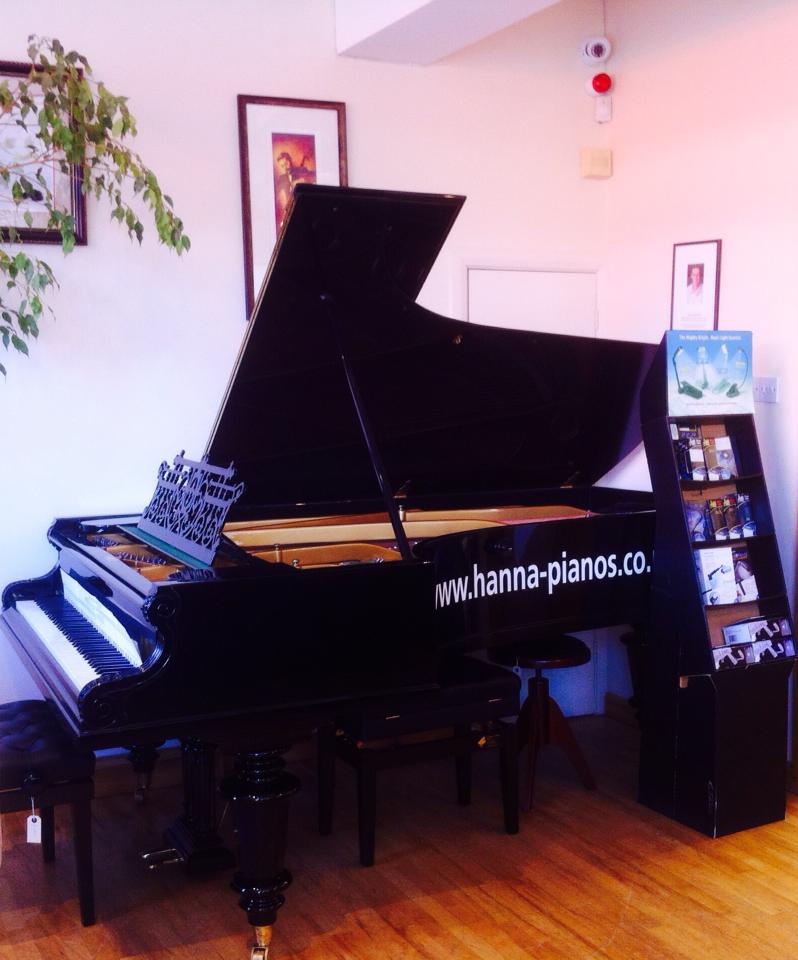
1452077_600409663360040_497822147_nHanna Pianos has had its showroom on Kingston Road SW19 since 1990. It’s a family-run business and the owner, Fadi Hanna, learnt his trade from a young age, observing and working with his father who established the business in 1960; meanwhile Fadi’s brother, Chucri, looks after the technical and tuning side of the business. When we visited the showroom was graced by a beautifully restored 1900 Bechstein, a Steinway Model O with a lovely burr walnut case and a 1927 Bluthner autographed by Kelenyi (?). We were lucky enough to play the Bechstein for our recital.

DSC_3952
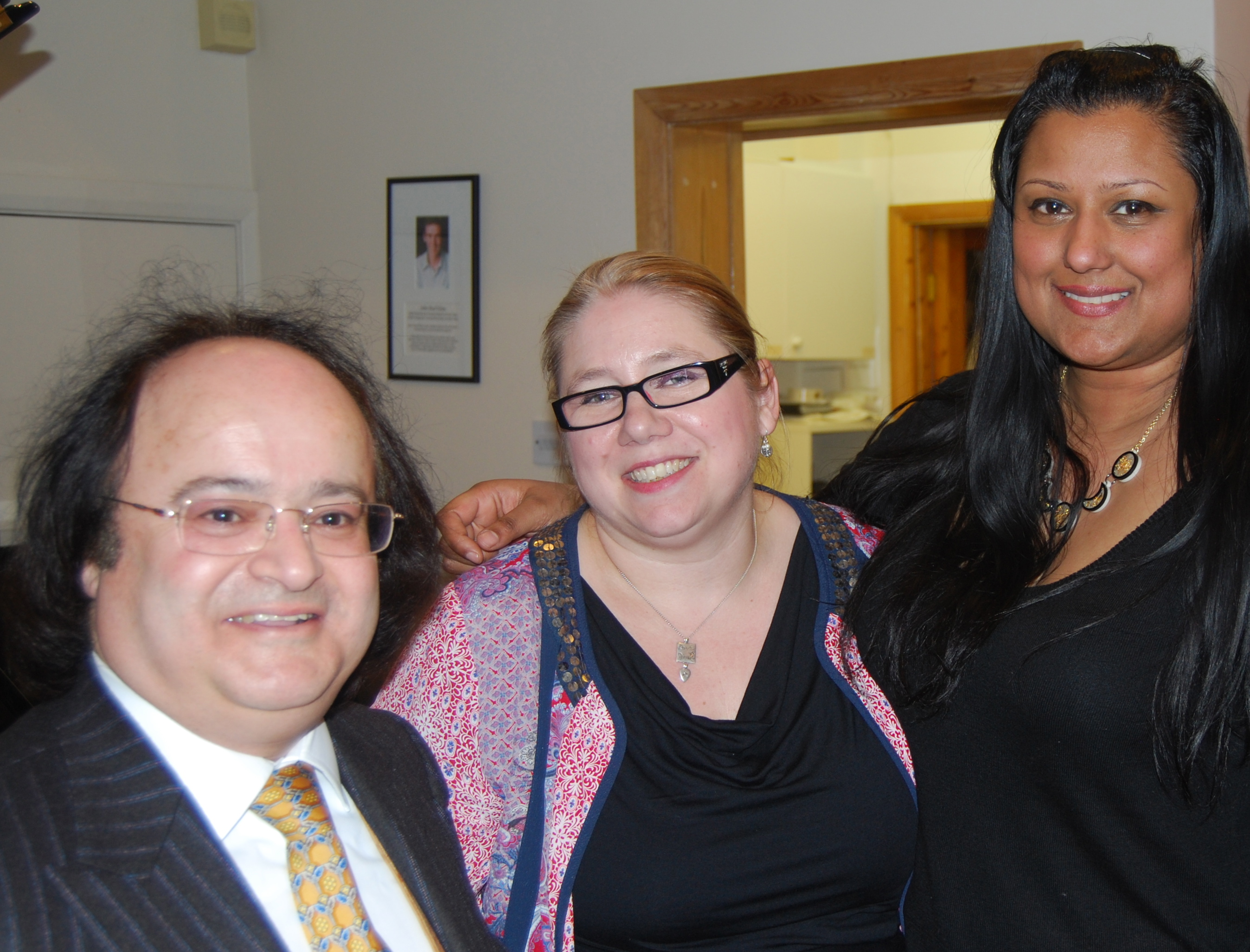
Mr Fadi Hanna with LPMG co-hosts Frances & Lorraine


The audience, seated around the piano on stools and chairs, listened attentively and applause was given generously for every performance. The atmosphere was intimate and friendly, and one had the impression of everyone listening very carefully to such high-quality piano music. At the end of the event, Mr Hanna produced the most delicious baklava and other gifts for us. We were absolutely bowled over by his hospitality and generosity, and there was much positive feedback after the event, praise for both venue and instrument. We are hosting a masterclass with Graham Fitch at Hanna Pianos towards the end of this month, and we very much hope to host further recitals in the showroom.

1920 Steinway Model O with burr walnut case

A Hanna & Sons Pianos Ltd

London Piano Meetup Group

PeteCHow long have you been playing the piano?

Started with lessons at school 60-odd years ago, but never did any exams or grades; Kept it up, informally and somewhat chaotically, until after retirement; (I’ve usually had a piano in the house); started lessons again 3 years ago.

What kind of repertoire do you enjoy playing, and listening to?

Mostly romantic standards: learned a few Chopin pieces recently, earlier did some Granados Spanish Dances. Also, Ravel, but I find most of it too hard, Debussy: a bit easier!

How do you make the time to practise? Do you enjoy practising? 

I’m retired, so I practise an hour or so most days when at home. Yes, I enjoy it or I wouldn’t be doing it.

Have you participated in any masterclasses/piano courses/festivals? What have you gained from this experience? 

Masterclasses at Broughton in Furness with Anthony Hewitt, Martin Roscoe and others. I feel I get more from the fact of performing in front of people than from what I learn at the class

If you are taking piano lessons what do you find a) most enjoyable and b) most challenging about your lessons? 

Making discernable progress: e.g. attempted a piece 2 years ago (Ravel: ‘Menuet’ from Tombeau de Couperin) and gave up as it seemed beyond my abilities. Took it up again a month or two ago and realised that it was now quite feasible. I feel I am hampered by having done little work on scales, arpeggios etc – there is no infrastructure to my playing!

Has taking piano lessons as an adult enhanced any other areas of your life? 

Socially, we have a Piano Circle, hosted by my piano teacher. We meet once a month and play our pieces to each other. Most of the other members are more advanced than me, but we all encourage each other and I get some compliments about my playing, which is good for my confidence. I find that the challenge of playing to others means that I have to get a piece up to a presentable standard rather than giving up when the going gets tough. (For example I have played the first two pages of Debussy’s Clair de Lune for years but always gave up when the arpeggios begin). I’m planning to learn it properly when I’ve done my present piece.

In addition, we go to local concerts, for which I might not be motivated without social pressure.

Do you perform? What do you enjoy/dislike about performing?

I play at Piano Circle and at masterclasses. I’m a nervous performer, and tend to play much worse than I do at home in private. I wish I could stop making careless mistakes!

What advice would you give to other adults who are considering taking up the piano or resuming lessons? 

Go for it!

If you could play one piece, what would it be? 

I’ve been trying to learn the Chopin’s Prelude no 17 in A flat. It’s a wonderful piece with those amazing chromatic episodes: trouble is, it’s just a bit too hard for me at present! I gave it a trial outing at Piano Circle a few months ago and made a bit of a mess of it, but doubtless it will come! As we’re thinking about Alan Rusbridger and ‘Play It Again’, perhaps it is my G minor Ballade! 

Peter Cockshott lives in the Lake District. He studied physics at University and went on to a career in industry, working in physics and electronics, retiring from this some 10 years ago. From an early age he has spent his spare time climbing or running in the hills, but now has to fit in piano practice as well.


He has piano lessons with Rosemary Hamblett in Ulverston.


