Frances Wilson (AKA The Cross-Eyed Pianist) has written detailed notes on all aspects of taking a diploma, from choosing a syllabus and constructing a programme to writing programme notes and presentation skills. The document includes live links to selected resources, including all the main exam board performance diploma websites.
I’ve been writing a sister blog, A Piano Teacher Writes…. with a special focus on piano teaching, since 2011, but the time has come to streamline my writing (because I don’t have time to maintain both sites), and so from now on piano teaching related articles, including guest articles, will be posted on this site.
If you would like to contribute a guest article to this site, on any piano or music-related subject, please feel free to contact me here
Who or what inspired you to pursue a career in music?
Ultimately, I have to say that it was my mother who inspired me to pursue a career in music. It was her idea for my sister and I to start piano lessons, as a means of us staying out of trouble when she wasn’t around!
I doubt if we knew then that both my sister and I would go on to pursue various musical ventures throughout our youth and then end up as choir directors for our careers!
Who or what have been the most important influences on your musical life and career?
I would have to say that the biggest influences on my musical life and career would be the church that I grew up in, as well as the classical influences that I learned from my teachers of oboe and piano, and my music teachers at school.
What drew you to singing and conducting?
The Pentecostal church, in which I grew up, had a strong musical culture where singing accompanied everything. It would have been very hard not to have developed a love of music and singing in such an environment.
Whilst I loved the singing, I never wanted to be a performer intentionally. I think it is fair to say that I fell into it, alongside my sister and friends. We would gather around the piano at church, where my sister would play and the rest of us would stand her around singing in harmony. It all came about so naturally. After doing this for a while, we decided one day that we would perform at an upcoming concert, and that’s how I started singing.
Our particular denomination had choirs up and down the country – and they were very competitive! Soon, my singing extended to one of these choirs that was London wide. It wasn’t too long before I graduated from being a choir member, to helping out with the conducting, and finally to being a main conductor. My classical training meant that I had extra tools with which to teach and impart to others.
What are the special pleasures and challenges of conducting a gospel choir?
There is nothing like the sound of voices joined in singing to me. It’s a very spiritual experience in the broader sense of the word. The best choirs will always say that they are like family, and I believe that it is togetherness and connection that actually impacts the sound a choir makes.
What did it mean to you and the choir to perform at the wedding of Prince Harry and Meghan Markle?
It was a wonderful honour, and hugely exciting to be asked. It was completely unexpected, seemingly coming out of the blue. We knew that we would be setting a precedent, however, as there has been no other black Gospel choir that has sung at a royal wedding.
We didn’t understand at the time how much this would change things for us. It’s been a rollercoaster of a ride, thrilling, dizzying, and sometimes challenging. I don’t think we would have it any other way.
What have been the greatest challenges of your career so far?
I think surviving through the lockdown and the pandemic has been the greatest challenge for the choir, and for the whole industry. It hasn’t just been a matter of being locked away in your house; I believe that so much was also locked away – creativity, connection, and the list goes on. I must say, though, we had some wonderful opportunities during the lockdown which helped to keep us hopeful, and connected.
I think it’s always important to remember your ‘why,’ and this is what we try to do. As people of faith this is quite important and we back that up with prayer and times of worship.
What is your most memorable concert experience?
My most memorable concert experience has got to be the whole of our US Tour in 2019. It was incredible as a gospel choir to be singing in the land where gospel music first came into being. We were so well received, it was an amazing and unforgettable time.
As a musician, what is your definition of success?
Personally, success is always about the impact that one’s art has on other people. When I’m teaching my choirs I will often say to them that people should come to your performance one way and leave another. It’s about transformation that makes things better. I have been privileged to see the power of music do this so many times over my singing career. It’s always thrilling to me. This is what I call success.
What advice would you give to aspiring musicians?
I think it’s important to love what you’re doing, but more, love the people that you are doing it with and doing it for. It makes all the difference. Fame will only last for so long, but real love is solid and true. I know that this sounds like a real cliché, but I believe it.
What is your present state of mind?
Anticipatory! I am hopeful and looking forward to great things coming to pass!
The Kingdom Choir’s new EP, Together Again, featuring Jake Isaac, is out now
Karen Gibson MBE is a choir conductor and workshop leader with London’s The Kingdom Choir, which she founded. She led the Kingdom Choir’s gospel performance of “Stand by Me” at the wedding of Prince Harry and Meghan Markle in May 2018, after which she was described as “Britain’s godmother of gospel”.Gibson has previously provided backing vocals for acts such as Grace Kennedy and The Beautiful South. She has been involved with vocal groups and choirs since 1993, conducting gospel workshops all over the UK and Europe as well as Nigeria, Japan, Zimbabwe, Rwanda and the United States.She was appointed Member of the Order of the British Empire (MBE) in the 2020 Birthday Honours for services to music.
Listening in not-quite-darkness, with only the dim light from my bedside clock radio, I heard An Ending (Ascent) by Brian Eno. Of course I recognise it, but not quite in this arrangement. The sounds wash gently over me and in the dark and still of the night, it’s intimate and meditative, almost a lullaby.
Listening again, in daytime, in the surround sound of my kitchen HiFi, the music floats, weightless but for a simple sequence picked out on the harp, now growing in intensity with a soaring violin line over lusher instrumental textures….
It’s a soundworld which perfectly exemplifies the ethos and approach of Orchestra of the Swan and artistic director David Le Page, and which is given full creative rein in their latest release, Labyrinths. With its exploration of themes of isolation, distance and a longing for human connection, it’s an appropriate album for our strange corona times. It also explores ideas of pilgrimage, contemplation and enlightenment, filtered through a sequence of beautifully atmospheric music, imaginatively arranged and exquisitely performed.
Formed in 1995, Orchestra of the Swan (OOTS) is a chamber orchestra based in Stratford-upon-Avon. Under the artistic direction of violinist David Le Page, an innovative, self-contained musician and one of the nicest people I’ve met in the industry, OOTS is passionate about audience inclusivity and this is reflected in its imaginative and adventurous programmes which blur the lines between genres. Labyrinths is the perfect example of the orchestra and its director’s vision. Devised as a “mixtape”, it continues the spirit of the mixtape of the 1980s (something which many of us of a certain age will remember creating for friends and boyfriends/girlfriends) with a diverse compilation of arrangements and reinterpretations of works by an eclectic mix of composers, which, as the album title suggests, takes labyrinthine twists and turns through music from the 14th century to the present day, from Buxtehude to Nico Muhly, Purcell to Brian Eno, and much else in between to delight and intrigue the listener. The range of musicians is equally diverse, including tenor Nicky Spence, saxophonist and composer Trish Clowes, Guy Schalom on darbuka drum, folk singer Jim Moray, and David Gordon on harpsichord.
…the joy is to be found in discovering the surprising and delightful connections between culturally disparate and musically contrasting time periods. Themes of isolation, distance and a longing for human connection are filtered through beautifully atmospheric and exquisitely rendered sound worlds. This last year has been one in which we have all been confronted by the spectre of isolation and have certainly felt the need for face-to-face communication. Labyrinths invites the listener to immerse themselves completely in a sonically rewarding and wholly unexpected musical experience.
– David Le Page, violinist and Artistic Director of Orchestra of the Swan
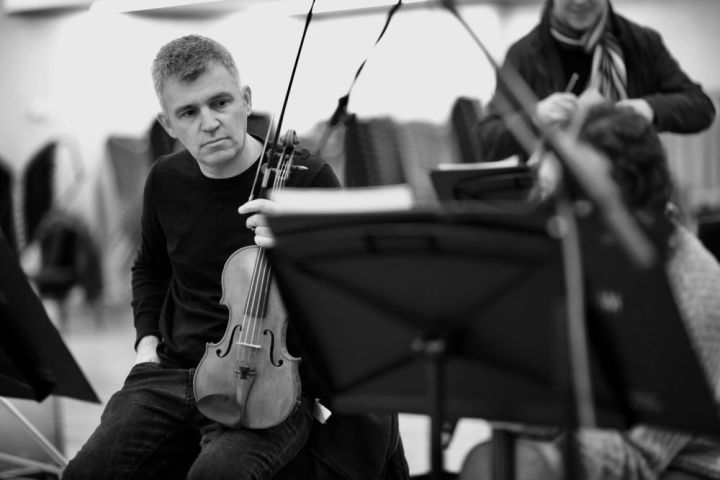
David Le Page, violinist & Artist Director of OOTS
Labyrinths also celebrates a long tradition of arranging and transcription. This is seen most imaginatively in Jim Moray’s Cold Genius, a modern twist on Purcell’s ‘What power art thou?’ cold song from King Arthur, which in this rendering recalls the iciness of Vivaldi’s Winter with its spikey, slicing string accompaniment to Moray’s hypnotic, pulsing vocals. Or an arrangement of Piazzolla’s ‘Oblivion’, with a haunting clarinet (played by Sally Harrop) and the lush, silky strings of a 1930s cocktail orchestra.
The adventurous spirit of OOTS and David Le Page is evident throughout the album – not only in the arrangements but also the mix of instrumentation, blends of timbres, textures and colours, and the diverse repertoire. There is truly “something for everyone” on this album, and it’s an ideal intro for the classical music ingénue too, with tracks from the world of film, including Yann Tiersen’s soundtrack to Amélie and Max Richter’s ‘On the Nature of Daylight’, which has appeared in films by Martin Scorsese and Denis Villeneuve, and pop music from Pink Floyd’s ‘See Emily Play’ from one of their earliest albums to Joy Division’s ‘New Dawn Fades’.
Tenor Nicky Spence joins the orchestra in the ‘Pastoral’ from Benjamin Britten’s Serenade for Tenor, Horn and Strings; this is preceded by ‘Bounce’, a new work composed by Trish Clowes during lockdown, a jazzy number with Bernstein-infused rhythms and an infectious sense of joy and freedom. Other highlights include ‘La Rotta’, in which Guy Schalom’s darbuka (a kind of drum) brings a raw, contemporary street sound to this Medieval dance, overlaid with fiddle and saxophone masquerading initially as a shawm, then drone, before taking off into an improvisatory flight of fancy.
And that ambient Eno track? It’s the perfect close to this brilliantly conceived, generous and rewarding recording.
Highly recommended
Labyrinths is available on the Signum label and on streaming platforms including Apple Music and Spotify
The Cross-Eyed Pianist is free to access and ad-free, and takes many hours every month to research, write, and maintain.
If you find joy and value in what I do, please consider making a donation to support the continuance of the site






 The Cross-Eyed Pianist