Contemporary music publisher Music Haven has launched a new digital download service for its sheet music collection. Available via the Music Haven website, this service will initially offer digital downloads of piano music, the centrepiece of which is the first published edition of Czech composer Pavel Zemek Novák’s 24 Preludes and Fugues for solo piano.
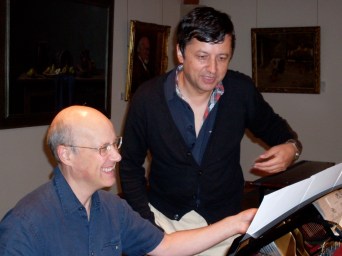
William Howard and Pavel Novák
Described by British composer David Matthews as “one of the finest piano works of our time, a worthy companion to Ligeti’s three books of Etudes”, Pavel Novák’s 24 Preludes and Fugues were composed for pianist William Howard between 1989 and 2006, and were recorded by Howard on the Champs Hill label in 2011. But like much of Novak’s music, this work has remained unpublished until now.
Peter Fribbins, composer, writes:
“Music Haven Ltd. is delighted to announce the publication of Pavel Zemek Novák’s 24 Preludes and Fugues for piano. An ambitious and important contribution to the contemporary piano repertoire, they are written in a musical language that has immediate connection and expressive presence. We are also pleased to be able to make Novák’s work more widely and easily available around the world by launching this work via our digital publishing platform.”
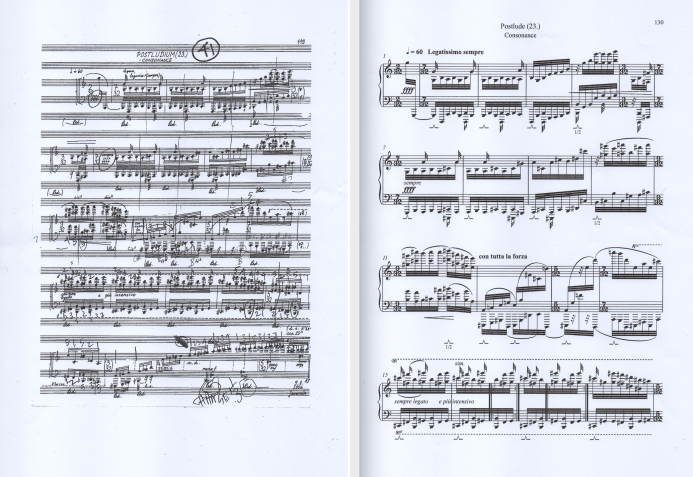
The new edition has taken several years to prepare and the process has been extremely challenging. Painstakingly typeset by composer Cydonie Banting from a hand-written manuscript replete with complex and idiosyncratic notation, and edited by Pavel Novák and William Howard, the work is divided into four books, which reflect the evolution of Novak’s musical language.
Excerpt from score, before & after typesetting
Now for the first time, pianists can explore this remarkable music in an accessible and beautifully typeset digital edition, available from Music Haven. Pianist William Howard says: “I am confident that other pianists around the world will now take up this powerful and dazzlingly original work.
The complete score is available to purchase as a digital download from Music Haven’s webshop
Music Haven Ltd publishes and promotes new classical music in all its manifestations. At its core are the works of a number of established contemporary British composers, including James Francis Brown, Peter Fribbins and Alan Mills, whose music is complemented by exciting new discoveries, or reconstructions, of lost classical works of the past. Scores are beautifully presented and edited to the highest standards.
A key part of Music Haven’s mission is to foster meaningful collaboration between composer and performer, and in doing so, bring fine music to a wider audience.
Who or what are the most significant influences on your musical life and career as a composer?
I didn’t begin to compose until I was sixteen. At that time I had given up piano lessons (I learned the piano between seven and thirteen) and attended a school where there was no music teacher, so composing was something I had to teach myself, or rather with the collaboration of my younger brother Colin, who also began to compose shortly after me. What made me start to compose was hearing Beethoven’s Ninth Symphony for the first time, and thinking that this was the most wonderful music I’d ever heard and that I must write a symphony of my own – so I did, and spent the next two years writing one, and when I’d finished, writing another. Beethoven is still my favourite composer, the ideal of everything I believe in. Meanwhile Mahler, all of whose works I’d got to know, became a huge influence, not just the music itself, but also what he stood for as a composer in Beethoven’s succession. Many other composers too were influential, Sibelius and Stravinsky pre-eminently, as I spent all my spare time listening to music and studying scores.
When I left university – where I read Classics as Music wasn’t possible as I hadn’t got music A level), I had the great good fortune to have got to know Deryck Cooke, who had made the performing version of Mahler’s Tenth Symphony and whom Colin and I later helped with a comprehensive revision. Deryck introduced me to a number of significant people in the musical world, among them Donald Mitchell, who had just founded Faber Music, mainly to publish Britten’s music. I began working freelance for Faber Music and quite soon Britten needed someone to help him with editorial work. Donald suggested me, and I then worked part time for Britten for four years. As the greatest living composer in this country, he was probably the most important influence in my life. He didn’t give composition lessons but I learned from him how to be a composer – see your later question, how do you work?
Other important influences were Michael Tippett, whom I also got to know and on whose music I wrote a short book – I liked his music even more than I liked Britten’s; Nicholas Maw, who became a friend and an unofficial teacher – I thought him the best of the younger composers; and the Australian composer Peter Sculthorpe, whom I met in England in 1974 and who became a close friend until his death in 2014. I visited many him many times in Australia and we collaborated on three film scores. Peter said that the music of the whole world was tonal, so why we should we pay attention to a few central European composers who said tonality was no longer possible? From Australia I saw music in a new light.
What have been the greatest challenges of your career so far?
The greatest challenge was getting my music played when I was young. As I hadn’t been to a music college I knew virtually no musicians. But I did send the score of a string quartet to the BBC when I was about 23 – they then had a reading panel – and it was played and broadcast; and when I was 26 I sent two orchestral songs to the Society for the Promotion of New Music (which sadly no longer exists) and they were performed at the Royal Festival Hall by Jane Manning with the London Philharmonic Orchestra conducted by Norman Del Mar (who became a friend and who commissioned my Symphony No.1 – I’d withdrawn my three earlier ones). That was a big step forward. However, I didn’t get a full publishing contract from Faber until 1982.
What are the special challenges/pleasures of working on a commissioned piece?
It’s easier, I find, to write a piece if you are given some limitations – i.e. how long it should be, the instrumentation, etc. I wouldn’t want too precise instructions, but that rarely happens.
What are the special challenges/pleasures of working with particular musicians, singers, ensembles or orchestras?
I much prefer writing for musicians I know (as Britten almost always did). I recently wrote an Oboe Sonata for Nicholas Daniel, someone I know well and for whom I wrote a Concerto. He has a very individual sound, a wonderful ability to play long sustained passages without taking breath, and extraordinary virtuosity. It was a real pleasure writing for him and hearing his special sound in my head.
The same with singers, of course, and with string players. I’ve written two CDs worth of solo violin music for my violinist friend Peter Sheppard Skaerved, and his Kreutzer Quartet are recording all fifteen (so far) of my string quartets, of which five were written especially for them. They know exactly what to do with my music as they’ve played so much of it. I’m not a string player but Peter has taught me so much about string technique. And with orchestras, I have a special relationship with the BBC Philharmonic, for whom I’ve written three of the last four of my ten symphonies. I can write for them knowing just how they will sound, and I’m also careful not to write anything that they won’t enjoy playing.
Of which works are you most proud?
I enjoy listening to my own music – well, if the composer doesn’t like his own music he shouldn’t expect anyone else to! There are quite a few pieces I’m proud of; for instance among my symphonies, No.8, several of my string quartets; also my Cello Concerto, Concerto in Azzurro, written for Steven Isserlis and recorded on CD by Guy Johnston. The piece I’m most proud of is my choral and orchestral piece Vespers, of which there is a splendid recording by the Bach Choir and the Bournemouth Symphony Orchestra conducted by David Hill. And in the last two years I’ve composed my first opera, which hasn’t yet had a stage performance, only a run-through with piano, but I hope I’ll be proud of it if and when I hear it with orchestra.
How would you characterise your compositional language?
It’s tonal, though usually not in a traditional way. I use very wide-ranging harmony. I use counterpoint modelled on the way the great masters of the past used it, and above all I try to write memorable melodies. I think the loss of memorable melody in most contemporary music is very sad.
How do you work?
When I’m composing, I like to work every day from after breakfast until lunch. I may go back for a while in the late afternoon. I learned regular hours from Britten. But I’m always thinking about the piece I’m writing, and I quite often wake up at night with ideas.
I try to start a piece well in advance of the deadline (another thing I learned from Britten: always meet deadlines). I think a lot about what character the piece will have, and its shape, and then I have the first musical idea, generally a melodic idea, and after that I may leave the piece to grow inside my head for some while before I start it properly. Once I’ve started, I don’t often get stuck – just for a day or two perhaps. I revise a lot while I’m writing, and don’t usually write more than ten to twenty bars a day, though sometimes more when I’ve almost reached the end.
As a musician, what is your definition of success?
My music is concerned with my feelings about life, expressed to the best of my ability in melody, harmony and counterpoint, and in a form that I hope conveys what I intended. I’m happy if I think I’ve done my best with these aims. I also hope that the musicians, who work so hard to bring my pieces to life, will enjoy playing what I have written.
What advice would you give to young/aspiring composers?
Don’t write pieces that present impossible difficulties to players. Also, be patient, it may take a long time before you can get your pieces played regularly. And find your own voice, don’t get led astray by fashion.
What do you feel needs to be done to grow classical music’s audiences?
Of course it worries me that a lot of people who are brought up on a constant diet of pop music find classical music difficult, and especially modern classical music. Because of this, audiences for contemporary music are almost always small. It’s this that worries me most: I feel that a lot of new music today supplies very little to move audiences, if it’s written in a virtually incomprehensible language, and often a very aggressive, off-putting one. And then, except (rightly) for the Kanneh-Mason family, none of the brilliant young musicians around now are being praised by the mass media, which now largely ignores classical music. Their extraordinary talent should be widely celebrated.
What’s the one thing in the music industry we’re not talking about but you really think we should be?
I’m worried that decisions about what new music to programme, by the BBC for instance, are no longer based purely on quality, which I think they should, but on other criteria. I’m very happy to hear music by women composers, but it must be good music. To play it just because it’s by a woman is in fact insulting.
What next – where would you like to be in 10 years?
Still alive – as long as I can keep my current good health, and still composing reasonably well, if I’m still able to.
What is your idea of perfect happiness?
Sharing a meal at home with my wife.
What do you enjoy doing most?
Apart from composing: reading, drinking good wine, walking in the countryside, and watching and listening to birds.
With a singular body of work spanning almost 60 years, David Matthews has established an international reputation as one of the leading symphonists of our time. Born in London in 1943, he began composing at the age of sixteen. He read Classics at the University of Nottingham – where he has more recently been made an Honorary Doctor of Music – and afterwards studied composition privately with Anthony Milner. He was also helped by the advice and encouragement of Nicholas Maw and spent three years as an assistant to Benjamin Britten in the late 1960s. In the 1970s a friendship with the Australian composer Peter Sculthorpe (leading to collaboration and numerous trips to Sydney) helped Matthews find his own distinctive voice.
To Steinway Hall in London last week to celebrate the release of the third volume of Norma Fisher At The BBC, a recording project initiated by Sonetto Classics to bring Norma Fisher’s remarkable pianism to a wider audience.
Born in London in 1940 to Russian-Polish parents, Norma Fisher’s talent was evident from a young age. Mentored by Ilona Kabos, Gina Bachauer and Annie Fischer, as a young woman, barely out of her teens, she won prizes at major piano competitions, including the Ferruccio Busoni International Piano Competition, and shared the Piano Prize (with Vladimir Ashkenazy) at the 1963 Harriet Cohen International Music Awards; that same year she made her Proms debut. She appeared at major concert venues around the world and with some of the “greats” of the era, amongst them Jacqueline du Pré. Hailed as one of the finest pianists the country had ever produced, she broadcast extensively for the BBC in the 1950s and 60s – at a time when this was the key to succeeding as a classical musician in the UK – yet these performances were never committed to disc. In the 1990s she noticed a tremor in her right hand, which was eventually diagnosed as focal dystonia, one of the cruellest conditions to befall a musician, and withdrew from the concert stage.
“I developed a focal dystonia,” she says, “a highly-debilitating neurological condition that affected my right hand, causing the muscles to seize up without warning. Public performances became unbearably nerve-wracking, knowing that at any moment my hand could just stop working. It never actually happened mid-way through a concert, but I didn’t want to inflict that on myself or an audience and it seemed only a matter of time before it could actually do so.”
She turned to teaching, and has established a reputation as one of the finest piano teachers in the world, nurturing young talents such as Pavel Kolesnikov and Anna Fedorova. She also regularly serves on international competition juries and is artistic director of London Master Classes – which is where I first met her.
Observing Norma teaching talented young students at a London Master Classes event was immensely inspiring and stimulating. Chatting to Norma during a break in the class, her enthusiasm and passion was evident and her eyes literally shone with the excitement of encouraging these talented young musicians. In an interview for this site, she stressed “the importance of sound, understanding the depths and possibilities the keyboard has to offer, and how vital is stylistic awareness“, and one of the chief aims of her teaching is the importance of an “individual sound world”, combined with delicacy and precision (one hears this in former students like Pavel Kolesnikov, where the influence of his teacher is clear in his own personal sound world).
These qualities are more than evident in the three volumes of Norma Fisher’s BBC recordings, now remastered and released on the Sonetto Classics label. An “instinctive pianist”, by her own admission, who eschewed extensive analysis in favour of vibrancy of sound and breadth of expression, these recordings reveal the full range of Norma Fisher’s talents. There is drama and passion, nuance and texture, glittering virtuosity and delicacy of touch, sweet timbres and subtle dynamics, and above all, a profound musical understanding in her interpretations. And due to the constraints of the original recordings and broadcasts (artist and producer were allowed only 90 minutes to make a 60 minute recording and there was almost no opportunity for editing in the way there is today), these recordings have a wonderful spontaneity and freshness – in effect, true “live” performances.
The event at Steinway Hall on 11 May was both a celebration of the launch of the third CD, but also a tribute to Norma Fisher’s remarkable life in music – as both a performer and an inspiring teacher – and many of the guests were personal friends and close colleagues (including Piers Lane, Peter Frankl, Tasmin Little, Dmitri Alexeev, Nelly Miricioiu and John Tomlinson) as well as some of her former students, including two more recent graduates, Siqian Li and Daniel Hyanwoo, who both performed at the event.
Above all, this event seemed to perfectly embody Norma Fisher’s belief that “If we can’t share, there is no point in life, and I think that will remain my philosophy until my dying day“. Norma has shared her music and her musical wisdom throughout her life, and this was an occasion where we all shared in the joy of music and music making.
Norma Fisher At The BBC is released in three volumes from Sonetto Classics
One does not often have the opportunity to hear all of Beethoven’s sonatas for piano and ‘cello performed live in a single afternoon or evening. Yet it’s a fascinating and absorbing experience because to hear the complete sonatas, one is offered a unique snapshot of Beethoven’s creative and compositional development at three key periods of his life.
The Opus 5 Sonatas are a young man’s works: fresh, vibrant, colourful, and humorous. They are clever and witty – take the false cadences in fast movement of the G minor sonata – but nor do they lack depth, or emotion. They are real “concert pieces”, and also remind us that Beethoven was a fine pianist: the Opus 5 sonatas were composed at a time when Beethoven was carving a career for himself as a virtuoso. The F Major and G Minor sonatas are works for piano with ‘cello, not the other way around, and the piano definitely gets the greater share of the virtuosity: Beethoven was clearly not going to allow himself to be overshadowed by some ‘cellist! Over and over again in these sonatas, the piano seems to lead, and the ‘cello replies.
The A major sonata, the Opus 69, is from the middle, most productive, period of Beethoven’s life. It was at this time that the composer wrote his moving Heiligenstadt Testament, in which he contemplated suicide. His deafness was now acute, if not quite total. The Opus 69 sonata marks a turning point, particularly in the variety and organisation of its thematic material, and its improvisatory nature. It was composed during the same year as the Violin Concerto, the Opus 70 piano trios, and the completion and publication of the Fifth and Sixth Symphonies. It is an entirely classical sonata in its well-proportioned construction, and, in contrast to the earlier sonatas, where the piano and ‘cello are, more often than not, engaged in witty musical repartee, the first movement of the Opus 69 opens with the ‘cello alone; variations of its expansive main theme and a pair of contrasting secondary motifs allow much contrapuntal and melodic interplay between the two players. This an equal sonata for ‘cello and piano, and the material is distributed between the two instruments with wonderful symmetry. The entire work radiates warmth, positivity, serenity and joy.
The final pair of sonatas, the Opus 102, dating from the beginning of the “late” period of Beethoven’s life, sit alongside the beautiful, pastoral Opus 96 violin sonata and the last three piano sonatas – all truly miraculous works. Like the Opus 96 violin sonata, and the last three piano sonatas, these sonatas seem to inhabit another world entirely, expressing an almost transcendental spirituality. And like Beethoven’s other late works, they are imbued with a sense of “completion”, of acceptance, but most defiantly not resignation!
The last ‘cello sonata, in D major, contains a prayer in its beautiful slow movement, offering an almost Messiaen-like vision of eternity. The final movement is a life-affirming fugue, that most stable and triumphant of musical devices, bringing us most emphatically back to earth.
Cellist Guy Johnston and pianist Melvyn Tan perform Beethoven’s complete Cello Sonatas over the course of two concerts as the finale to this year’s Hertfordshire Festival of Music, on Saturday 11th June in Harpenden.
This site is free to access and ad-free, and takes many hours to research, write, and maintain. If you find joy and value in what I do, please consider making a donation to support the continuance of this site
The Cross-Eyed Pianist is free to access and ad-free, and takes many hours every month to research, write, and maintain.
If you find joy and value in what I do, please consider making a donation to support the continuance of the site


 Born in London in 1940 to Russian-Polish parents, Norma Fisher’s talent was evident from a young age. Mentored by Ilona Kabos, Gina Bachauer and Annie Fischer, as a young woman, barely out of her teens, she won prizes at major piano competitions, including the Ferruccio Busoni International Piano Competition, and shared the Piano Prize (with Vladimir Ashkenazy) at the 1963 Harriet Cohen International Music Awards; that same year she made her Proms debut. She appeared at major concert venues around the world and with some of the “greats” of the era, amongst them Jacqueline du Pré. Hailed as one of the finest pianists the country had ever produced, she broadcast extensively for the BBC in the 1950s and 60s – at a time when this was the key to succeeding as a classical musician in the UK – yet these performances were never committed to disc. In the 1990s she noticed a tremor in her right hand, which was eventually diagnosed as focal dystonia, one of the cruellest conditions to befall a musician, and withdrew from the concert stage.




 The Cross-Eyed Pianist