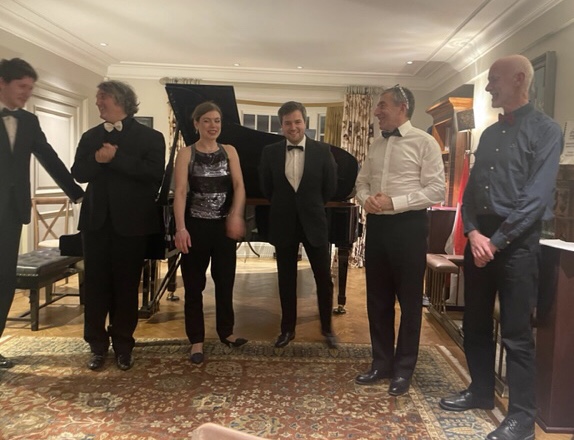
Described by Terry Lewis of Jaques Samuels Pianos as “one of the best kept secrets in the UK” and by Musical Opinion as “a most gifted artist”, pianist, teacher and performance coach Christine Croshaw has recently retired from Trinity-Laban Conservatoire of Music & Dance, where she taught for nearly 50 years.

Miss Croshaw, who celebrated her 80th birthday in October 2022, has enjoyed a long and distinguished career as a concert pianist and revered teacher. She studied with Harold Craxton, Gordon Green and Vivian Langrish, and was awarded all the major prizes for solo piano, chamber music and song accompaniment, including the coveted Chappell Gold Medal.

In addition to her solo work, she has worked as a noted collaborative pianist, partnering many eminent artists including Nathan Milstein, Alan Civil, Antonio Janigro, Robert Winn, Peter-Lukas Graf, Jacques Zoon and Michel Debost.

The opportunity to play recitals with Christine Croshaw was something not to be missed. Always a wonderful fresh musical approach to whatever the repertoire. I remember so often being touched by the candid and nuanced phrases which emanated from her hands. Treasured memories

Robert Winn, flautist

As a pioneering music educator and performance coach, she was one of the first to recognise the benefits of Neuro-Linguistic Programming (NLP) for performing musicians, in particular in relieving stage fright and the anxiety of playing from memory. In 2014 she was given a Lifetime Achievement Award for her “seminal contribution to music education” at the Music EXPO/Classic FM Awards at London’s Barbican Centre.

Shortly after her 60th birthday, Christine Croshaw faced a huge challenge in her personal and professional life when she lost most of her sight due to haemorrhages behind the retinas of both eyes. She had been looking forward to more solo and collaborative work, with concert dates already in her diary. Determined not to give up playing, she referred to the techniques of NLP, which had allowed her to eliminate memory anxiety, and embarked on a solo career, playing and recording everything from memory. She gave many words and music recitals with leading actors, including Sir Derek Jacobi, Edward Fox, Prunella Scales and Dame Eileen Atkins, and released two acclaimed recordings of solo piano music by Camille Saint-Saens and Gabriel Fauré, the latter rightly seen as one of the “go to” recordings of the composer’s piano music.

Here colleagues, friends and former students pay tribute to Christine Croshaw on the occasion of her 80th birthday.

She is a lady who possesses a rare and quietly enchanting charm and sweetness with a greatly generous heart.

The mastery and command evoked by her playing has, in my thinking, that touch of aristocratic and refined artistry, that flash of light tenderness, the fleet of foot touch, which in earlier times was the stamp and style of Solomon, Myra Hess and Clara Haskell.

Edward Fox OBE, actor


I have long admired her crisply pliant playing, especially in her recordings, which in its unshowy but characterful style seems to me to reflect exactly the person.

Roger Vignoles, pianist


Christine Croshaw. What a force!

After being introduced by a dear mutual friend at a recital, I knew she was enormously good company, with a witheringly dry wit and a winning line in wry observations.

I then heard her play the Fauré Ballade with such unflashy thoughtfulness and such technical ease that you would never for a moment believe that this was music usually swerved by even the most virtuosic. The fact that for the last 20 years she has been learning and performing this repertoire whilst almost completely blind adds a layer of awe to my admiration of her as a musician.

It’s time – way beyond time in fact – that we celebrated (crowed for?) La Croshaw, an unsung hero of the British piano world.

Katie Derham, BBC Radio Three and BBC Proms presenter 


Studying with Christine is almost a martial art. She believes fully and correctly that if the mind and body are not aligned then nothing can really happen. A complete musician; for Christine music is an addiction not a career.

She is that rare performer of natural brilliance for whom the psychology of learning, and how to best enable fellow musicians, is a golden thread running through her life.

There are too many lessons I recall with fondness, where moments of real frustration have been dissolved by fits of laughter. Humour is her secret weapon, and her stories of her life in music are to be treasured, usually over a cocktail!

I am one of countless pianists who owes more to Christine than he would ever readily accept.

Andrew Matthews-Owen, pianist, professorial staff, Trinity Laban Conservatoire.


It is a challenge to describe Christine Croshaw adequately in her roles as pianist and teacher; in common with all great musicians, what she communicates in her playing, and verbally to her students, defies any easy analysis.

The ability to dig deep into a score, to really hear what a piece of music is ‘saying’ on both micro and macro levels, and to communicate these things with absolute technical focus and musical integrity, is at the centre of Christine’s approach. This sounds like it might be a dry way to teach, but the reality is quite the opposite: lessons are full of laughter; intensity and rigour are cushioned by a sense of play and fun.

Christine is a truly holistic teacher; she is deeply interested in the whole person, to the extent that I came to realise the best, possibly only, way to improve as a pianist would be to work on my personal development in all ways: physically, artistically and emotionally. I am enormously grateful to Christine for her musicianship, technical knowledge, her insights, perceptiveness, personal warmth and her sense of humour.

John Reid, pianist, Chamber Music Professor at the Royal Academy of Music.


She is such a well-grounded yet open-minded musician. I remember mentioning that I thought NLP might have interesting applications for musical performance. Little did I suspect how quickly she would investigate and seriously study it, and then apply it to her teaching, both individually and in classes in quite groundbreaking ways. She immediately dispensed with any of the cultishness surrounding this psychological discipline or any attempt to take credit for or ownership of any new pedagogical ‘method’. She just generously gave her new-found knowledge to anyone who was interested. This total lack of self-aggrandisement was also evident in her playing….It was clear, thoughtful and moving and just went straight to the heart of the music.

Douglas Finch, pianist, composer and professor of piano at Trinity-Laban


Christine was always very approachable, friendly and always somewhat self deprecating. She was modest and unassuming; great qualities in a teacher and performer….I was aware of the high regarding which she was held and how greatly loved she was by generations of students.

Philip Fowke, pianist


Christine played a key role in my development, not just as a pianist, but perhaps more importantly as a person that worked in music, with musicians. That might sound unnecessarily cryptic, but what I found so extraordinarily inspiring and unfailingly effective about Christine’s teaching was that everything she said and demonstrated was completely connected to and drawn from her many years’ experience as a professional pianist of the highest level. As a BMus Year 1, it was quite something to be having coaching sessions on canonic violin sonatas with someone that had performed this repertoire with Nathan Milstein, but looking back, what was perhaps more unusual was the sheer breadth of Christine’s knowledge – of the wind and piano repertoire, of Lied and Chanson, and also more informal music making contexts such as choral accompaniment, ‘light music’ as it used to be called, and dance accompaniment. Whatever I brought to Christine, she would have lots of useful things to say that were not only connected to the music itself, but also to how it should be prepared, learnt and rehearsed, and how to manage and lead the collaborative interactions that went along with these processes. Throughout my four years as an undergraduate my piano trio played to her almost every week, and the rehearsal techniques that she took us through are the ones that I still use today and pass on to my own students and the groups that I coach. I remember as a final year student, telling Christine that I felt that I still couldn’t really reliably produce a particular legato effect that she had explained to me several times in the first year… “Oh, don’t worry, Aleks”, she said, “these things can often take a couple of decades. I’m still realising what people really meant when they were talking to me about music when I was your age, sometimes these things take time.” It was a very reassuring thing to say to a student who, at the time, was in far too much of a hurry to learn everything as soon as possible!

Aleks Szram, pianist and BMus Programme Leader, Trinity Laban


I worked with pianist Peter Higgins, who studied with Christine; there were coaching sessions with Christine, which I enjoyed very much, and I wish her a happy retirement.

Katarina Karneus, mezzo soprano


I have known Christine since we were both young students at the RAM living in Minnie Freeman’s house in West Hampstead. That should bring back some memories!

I remember playing some 2 piano concerts with her which, which of course was very enjoyable. Playing the Bartok Sonata was certainly no problem for her, which showed what an excellent technique she had even then!

Since those early days our paths have gone in different directions but I was always impressed with her musicality and unassuming personality and her quiet but concentrated attitude.

I am sure many students will wish her to continue teaching and share her natural musical knowledge. I am sure that Christine will want to carry on and enjoy helping others . Lucky them.

Martin Jones, pianist


An earlier, shorter version of this article appeared in Classical Music magazine’s online edition


The lockdowns, imposed by our governments in response to the coronavirus pandemic, had little, if anything, to recommend them, but for me one of the more positive aspects of the long monotonous months of the UK lockdowns were my regular conversations with my friend Dr Michael Low.

Michael lives in South Africa. I first “met” him online through Graham Fitch, with whom Michael studied, and who taught me when I was preparing for my FTCL diploma. Some years ago, when Michael was visiting his family in the UK, we met for lunch in London’s Chinatown and we talked, and talked, and talked…..about the piano, pianists, repertoire, and more.

During the lockdowns, my regular conversations with Michael were an opportunity to talk not just about the piano, pianists and music in general but also about politics and our respective government’s response to the pandemic. It was both refreshing and comforting to know there was a kindred spirit on another continent.

Many of us found our creativity severely impaired by the lockdowns – at first the opportunity for endless practising, or writing, or other creative pursuits felt like a treat for those of us who lead busy lives, but it quickly sapped creative impulses. Not so, Michael, whose Lockdown Liszt Project was recorded in the summer of 2021.

Michael recorded two works by Franz Liszt, the Vallée d’Obermann from the Swiss book of Années de pèlerinage, and the Ballade No. 2.  I first heard Michael’s Obermann when I was reading Paul Roberts’ new book ‘Reading Franz Liszt’ and my head was full of the literary and poetic inspirations behind this and many other of Liszt’s works. What Michael captures so wonderfully in this performance is not only the poetry and drama of Liszt’s writing but also the evocation of the monumental, awe-inspiring landscape of the Alps, which Liszt himself would have experienced during his travels in Europe.

There’s a wonderful spaciousness in Michael’s performance and he really savours the drama of silence as well as that of sound – of which there is great variety in the colours and timbres he offers. The portentous opening theme, restated throughout the piece, is contrasted with moments of great lyricism and introspection, perfectly capturing the dilemma of the character of Obermann as well as the physical drama of the Alpine landscape.

The Ballade No. 2 is similarly picturesque, and like the Ballades of Chopin charts a fantasia-like narrative (pianist Claudio Arrau maintained that the piece portrays the Greek myth of Hero and Leander) through 15 minutes of operatic grandeur, rapidly shifting moods and contrasting soundscapes.  Here, as in Obermann, Liszt confronts the listener with wide-ranging, often extreme emotions – from menacing, stormy rumblings in the bass to a serene hymn-like melody and clusters of chords high in the treble. There’s beauty in the darkness of this Ballade and Michael really appreciates this, relishing the contrasts in note-saturated, complex textures without any loss of clarity or expression. It’s an absorbing performance and the quality of the recording has an immediacy which really suits this music.

Watch both performances on Michael Low’s YouTube channel


Dr Michael Low will be in conversation with Frances Wilson, The Cross-Eyed Pianist, in a new podcast series, Piano 101, launching soon

Shameless begging bit:

This site is free to access and ad-free, and takes many hours to research, write, and maintain. If you find joy and value in what I do, please consider making a donation to support the continuance of this site


Make A Donation

An interview with Frances Wilson AKA The Cross-Eyed Pianist by author and poet Leslie Tate.

Leslie: Why do you call yourself ‘The Cross-Eyed Pianist’?

Frances: I wanted a catchy title for my blog and this seemed a good one, since I am actually cross-eyed – and I play the piano.

Leslie: Can you tell the story of what drove you to return to the piano after an absence of 20 years? What were the difficulties? How did you manage the ups and downs of achieving advanced certification in your late 40s?

Francis: A few years before my son was born, my mother bought me a digital piano and suggested I start playing again. I tinkered with it, playing some of the music I’d played in my late teens before I left home to go to university, but then my son was born and for some years my time was taken up with him. When he went to school full-time, I began to play more seriously and found it a wonderful escape from being a mum at home, and it gave me some much-needed “me time”. Around the same time, I started going to concerts again and I realised how much I had missed music and especially the piano. So then I began to really throw myself into rediscovering the piano and improving both my technique and artistry. In a way, it wasn’t that difficult because a lot of the music I was playing had been well learnt previously and it was gratifying to find how much of it was still “in the fingers” even after such a long absence. 

In 2006, I started teaching privately at home, mostly children from my son’s primary school, and my private practice quickly grew into a popular studio of more than 25 students. At this point, my husband bought me an acoustic piano which made a big difference to my playing and the kind of advanced repertoire I could tackle. Then, in 2008, I started taking piano lessons myself again, with a master teacher who was professor of piano at one of London’s leading conservatories. My main motivation for this was a personal one, to enable me to develop and extend my pianistic abilities and to gain some experience in performance – something I hadn’t done since I was at school. After 6 months of fairly intensive work to bring my technique up to scratch, my teacher suggested I work towards a diploma. I was 43 at the time and this felt like a massive, positive endorsement of my abilities from a teacher/mentor whom I really respected. That I then went on to achieve a distinction in this and a higher diploma (also with Distinction) in 2013 was a huge personal achievement and gave me the impetus to continue playing and improving. 

In order to manage my teaching work and my family, I was very strict about my practicing when preparing for the diplomas, creating a daily routine and setting myself regular goals. This was interspersed with lessons and practice performances. I also attended masterclasses and courses with other leading pianist-teachers and took some mentoring from a concert pianist. In addition, I did a lot of research on the psychology of performance and observed professional musicians in concerts to gain insights into the practice of performance. In effect, I taught myself to be a performer.

Read the entire interview here

Frances Wilson (photo by James Eppy)

Shameless begging bit:

This site is free to access and ad-free, and takes many hours to research, write, and maintain. If you find joy and value in what I do, please consider making a donation to support the continuance of this site

Make A Donation

I first heard this work live over 10 years ago at a concert given by the American pianist and noted Mozart specialist Robert Levin, with the Orchestra of the Age of Enlightenment. Played on a fortepiano, whose relatively modest voice spoke so elegantly in the Queen Elizabeth Hall, from the opening measures I was completely hooked. The next day, I purchased the music and started to learn it. It took at last three attempts to learn it “properly” – it’s one of those pieces which benefits from being put aside for a few months and then revisited, not once, but time and again to reveal its details and many layers of meaning and emotion. It’s a piece that keeps surprising both listener and performer.

Composed in the spring of 1787, after Mozart returned from Prague, it has been suggested that its composition was in response to the news that one of the composer’s closest friends, Count August von Hatzfeld, had died, and may therefore be a rare example of a personal event in Mozart’s life prompting a composition. The piece is introspective and private, freighted with melancholy and sadness, with a thoughtful, measured elegance throughout. It is touching and beautiful, simple and perfect; but its deceptive transparency offers no place to hide. It requires great clarity and preciseness in order to express its overriding melancholy, and its poignant charm.

The Rondo theme is a pensive melody which looks forward to Chopin – and has even been mistaken for Chopin by a naive listener when I’ve played it. A rising theme, yet it hardly seems to move forward, and with each weary semitone step, there is a dying fall, almost sigh or a painful intake of breath, emphasised by the quaver rests. The dissonance, created by the first ornament (which reappears regularly throughout the piece) further enhances the sense of tragedy.

Each reappearance of the theme is treated slightly differently, further emphasising its pathos and poignancy. The C major phrase is somewhat less painful, but, tinged with poignancy, it is hardly hopeful.

The first subsidiary theme (‘B’), beginning at bar 31, harks back to J S Bach in its use of counterpoint and chromaticism, while the texture is suggestive of string quartets with its different voices. As the new theme pours forth, the mood is now more hopeful and consoling, with a lovely LH cello line which is very different to the haunted bass of the opening melody. There’s an almost operatic grandeur through these measures, immediately dispelled when the music lurches unexpectedly into D-flat major at bar 46. The music then creeps chromatically, recalling the opening theme, and, after an episode marked by plaintive descending and ascending chromatic figures, the earlier ‘B’ material returns, building to a climax in bar 59, marked by the octave figures in the LH. A greater, more full-toned climax at bar 63 is carried through to bar 69 with a grand, energetic arpeggiated figure in the RH. From bars 69-75, the long chromatic notes hark back, once again, to the chromaticism at the beginning of the piece, while from bars 74-80, the music seems hang in suspense in the dominant, in anticipation of the rondo theme, which returns at bar 81.

The second statement of the theme is stripped of its C major sentence, and is even more haunting, with its sobbing, breathless syncopations in bars 86-87, a kind of written rubato, which needs no additional increase or decrease in tempo in the bass line (prefiguring Chopin). The quaver rest in bar 88 can be lengthened in readiness for the A major section (“C”).

Now, we are in more familiar, comfortable territory, for here is Mozart at his most charming and elegant, before a brief shift into B minor, with dissonance created by the ornaments. A more hopeful D major passage (I read somewhere once that Mozart declared D major “the happiest key”) begins at bar 101, reprising some of the material from the A major interlude. At bar 116, the chromaticism in the bass again recalls the opening motif, leading into further chromatic surges and grinding diminished seventh harmonies. The thematic material of the opening is never really forgotten, thus further reminding us of the prevailing sense of sorrow.

At bar 129 the rondo theme returns in its original form, but with more elaborate ornamentation this time, tortured rather than decorative. There’s a real sense of desolation at bar 155, while the repeated A’s and chromaticism in bars 155-157, evoke almost a wailing, grief-laden lamentation.

The Coda, beginning at bar 163, heartbreakingly recapitulates all the elements that have gone before and all the motifs return in a grim, Bachian setting. It is highly emotional, mixing tragedy and frustration, with a final, whispered statement of the opening theme in the closing measures.

More a Fantasia than a strict Rondo in the organisation of its thematic material, the K511 offers many technical challenges, and, as stated earlier, requires absolute clarity in its delivery. Overly fussy playing will only obscure the deeply emotional nature of this work – and this, to me, is the real heart of it. Conveying that sense of melancholy, sadness and grief is the hardest part, while always maintaining honesty and fidelity to the score. For those of us whose early pianistic encounters were with the early works of Mozart, the pieces with the lowest ‘K’ numbers, all smiling childlike innocence and playfulness, the Rondo K511 represents a work of great maturity and profound expression.

The piece contains all the subtleties of Mozart’s music in microcosm: its chiaroscuro, its many moods, some fleeting, passing in the space of a single bar, its storms and its sunshine. Leonard Bernstein said “Mozart combines serenity, melancholy, and tragic intensity into one great lyric improvisation“, a quotation which perfectly sums up the enduring fascination and appeal of the K511.


If you would like to contribute an article to the Repertoire in Focus series, please get in touch via the contact page


This site is free to access and ad-free, and takes many hours to research, write, and maintain. If you find joy and value in what I do, please consider making a donation to support the continuance of this site

Make A Donation