I am aware that this is a very contentious issue/question for many; however it is something I personally feel very strongly about and believe that it should be addressed and discussed widely within the profession.
To that effect, in preparation for my article, I posed the question on an online piano forum as to whether or not piano teachers ought to have achieved a minimum level of piano specific qualifications in teaching and/or performance before setting themselves up as piano teachers, and whether or not the profession should be regulated to ensure that teachers do have the minimum piano specific qualifications.
The post drew some pretty strong reactions, and I must admit I was very surprised at the number of piano teachers who strongly disagreed with me. However, there were many who strongly agreed, one of whom is eminent concert pianist and Professor of Piano, Karl Lutchmayer, who has kindly agreed to share his thoughts and views for this article below:
“Would you send your child to a ‘paediatrician’ who only had an A level in biology? Of course not, and neither would you be able to because it is a regulated profession. Yet, anyone can set up as a private music teacher. As such, every year, professionally qualified music teachers take on students who have been poorly taught and have to put them through the utterly disappointing process of unlearning bad teaching. This may turn the student off music entirely, and occasionally, particularly at higher levels of study, the student has endured long-term psychological or physically damaged that will seriously undermine their future learning. Yet, as long as the first teacher has done nothing illegal there is no way to prevent them doing the same to hundreds of other students.
Such a situation would be intolerable in other forms of teaching. Various commentators point out that there are bad qualified teachers. This is certainly true, and only means that regulation should set the bar higher, particularly with CPD, than it is at the moment, it is not a reason to avoid regulation. Others point out the cost for teachers, but such regulation is required, for instance, for osteopaths who bear the cost as part of their costs. Would you really want osteopathy without regulation? If we are going to accept that bad teaching can cause both psychological and physical damage, then the lack of the requirement for a regulatory body is not only bizarre, it is a derogation of our duty of care as professionals educators..”
I wholeheartedly agree with Karl. Like many piano teachers I regularly inherit transfer students from other teachers, and whilst many have been well taught, and have strong foundations on which to build, at least an equal number have not. The majority of those students who come to me with poor technique, notes written in the score, no idea about phrasing, articulation, tone production, balance and voicing etc, have been taught by unqualified teachers. By this I mean people who have set themselves up as a teacher with a very minimum level of skills themselves, perhaps a playing level of below even grade 5 standard, and very little understanding of the instrument and its repertoire, nor of pedagogy or andragogy.
Sadly, many of these students will not have realised that their teacher does not have the necessary skills required in order to help them build the strong foundations they will need to be able to play the piano well, and by the time they transfer to a teacher who does they are already frustrated at not being able to play the repertoire which they are learning as they lack the technical and musical skills to do so, unfortunately many find the task of rebuilding those foundations too daunting and will give up. I find that incredibly sad as they will have started out with enthusiasm and joy for the piano.
To add to my concerns, I frequently see job advertisements stating ‘piano teachers required, no qualifications or experience necessary’ this is a very worrying situation and not only will lead to more poor teaching and the increased risk of physical injuries due to poor technique, but it seriously undermines our profession.
Every interview I have ever attended has required me to perform and to teach to a panel of highly qualified professionals, followed by rigorous questions on technique, repertoire, my entire teaching ethos and also questions on child protection/ safeguarding issues. This is in addition to evidencing my qualifications and experience, so for me this is answers the argument that others are raising about qualifications not guaranteeing good teaching, they don’t always, but evidencing them in some way, and a requirement to undergo CPD goes a long way towards doing so.
As Karl mentions, other professions require qualifications and have a system of ensuring that standards are upheld. For example, I have recently completed a Coaching course at Guildhall School of Music and Drama where I teach piano, the course is not specific to piano but I have a great interest in studying and in a wide range different educational approaches so I decided to delve deeper into the coaching approach. On completion of this course I received a certificate from GSMD, but to gain the Foundation level qualification I must now complete another 20 hours of coaching which I must record and send for assessment, then this will be submitted to the EMCC for accreditation, if I did not pass then I would need to complete further training and resubmit an application to gain my qualification. This qualification still does not mean that I would be a qualified Coach, the ‘coaching’ which I have experience of within my teaching does not count at all for this qualification, I must evidence that I am competent in order to call myself a Coach. This first course is just a start, I must then complete another course and another 100 hours of (non paid) coaching practice before I can give myself the title of coach. Do I think this is wrong or unfair, no absolutely not and I believe that a similar system would work well for piano teachers.
Another example is that I sing and have done so all my life – from madrigal groups to London theatre choirs and bands; I have been in many professional shows within these choirs but I would never attempt to teach singing lessons. I know how to use my own voice but I do not have the first clue of how to teach someone else to use theirs so it would be morally and professionally wrong of me to try and do so.
There are other professional issues which are really important to consider, one of which is that without professional status it would be more difficult to obtain public liability insurance and the enhanced DBS certificate along with the necessary child protection/safeguarding training that one should have if teaching children one to one in private practice. It will also not be possible to belong to a professional body such as the ISM as a professional member with private teacher status.
Finally, unfortunately because anyone can set themselves up as a piano teacher, it does lead to us being seen as having a lovely ‘hobby job.’ There is much discussion in the press and within music education in general of how music continues to be downgraded, how it is seen as unimportant and more as an add on hobby than a serious subject. By continuing to allow this situation of unqualified piano teachers setting up to continue are we not perpetuating this school of thought?
I am proud of my career and my hard-earned qualifications, I continue to study not only because I am passionate the piano and my lifelong journey with it as a player and teacher, but because I strongly believe that we owe it to our students to offer the very best teaching we can give them because the students, the music and the piano deserve no less.
This article first appeared on Lorraine Augustine’s blog
Lorraine Augustine is a Pianist, teacher and adjudicator based in Bedfordshire, with over 40 years’ experience of teaching and performing she teaches piano at the Guildhall School of Music and Drama in London and runs a busy private practice in Bedfordshire.
Due to work commitments, I am finding it harder to produce regular, meaningful articles for this site.
However, I don’t want the site to lie fallow, and for this reason I am inviting guest posts. I’m afraid there is no payment for guest articles, but your writing will be shared with a social network of c13,000 followers and an average monthly blog readership of c25,000.
Guest articles can be:
Reviews of concerts, opera, recordings, music-related books (fiction and non-fiction) and other music-related events/activities (e.g. courses, workshops etc.) or products.
Opinion/”think” pieces on music-related subjects, including the music industry, music education etc.
At The Piano interview – specifically for piano teachers (sample here)
Piano Notes interview for amateur pianists (samples here)
An essay in six variations Written by GPT-3 and Howard Smith
The six essays below were written by an Artificial Intelligence called GPT-3. In the final essay, Satie speaks in his own voice and composes a poem reflecting on the influences of his work. The AI-generated essays were guided by Howard Smith, a human. Howard only had to give the briefest of instructions to the remarkable AI. Such ‘generative’ systems are making waves across the world. GPT-3 is but a taste of what’s to come. Humankind will shortly have many new AI companions.
Howard Smith is the human author of Note For Note, Bewitched, Bothered and Bewildered.Howard is also the author of an experimental book on the topic of Climate Change. The 180 page book was written by GPT-3 in response to questions posed by Howard. The two collaborators ‘wrote’ the book in just 12 hours. The work was self-published 6 days later and is now available via Amazon worldwide. In Conversation with GPT-3: An AI On Climate Change is a taste of what’s ahead for anyone working in any creative field.
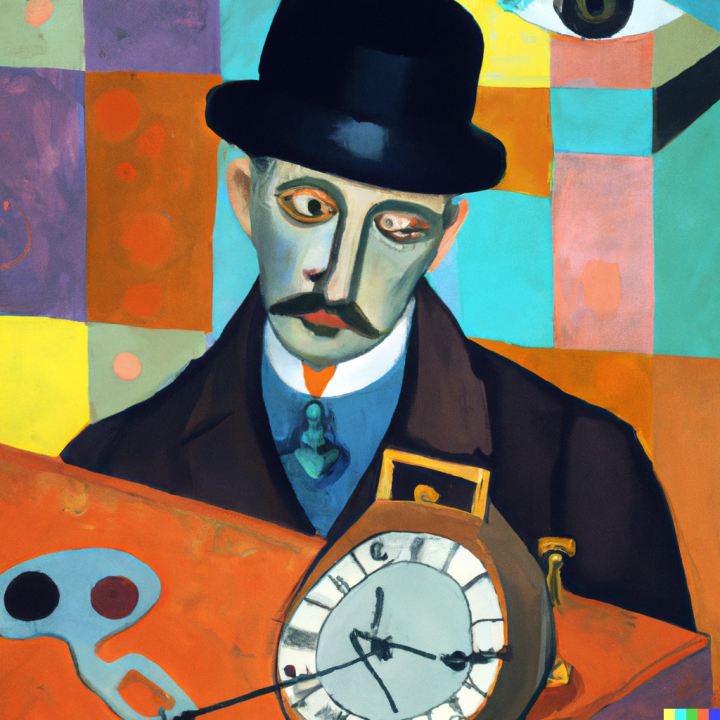
One of 30 images generated by DALL*E 2 in response to a prompt by the author: A painting in the style of Dada art of the composer Erik Satie and a ticking clock
And now, dear friends, the essays:
Version 1
Human in italics. All else written by an AI.
Write an essay about the music of Erik Satie. Concentrate on explaining the musical influences and genres that led to Satie’s unique style. Also cover the way Satie’s music influenced composers that followed him.
Erik Satie was a French composer and pianist known for his unique and unconventional musical style. He was born in 1866 and began composing music at a young age. Throughout his career, Satie experimented with a wide range of musical genres and influences, which ultimately led to the development of his distinctive style.
One of the major influences on Satie’s music was the impressionism movement in art. Impressionist painters, such as Monet and Degas, were known for their use of light and color to create a sense of atmosphere and mood. Satie similarly sought to evoke a sense of atmosphere in his music through the use of harmonic and melodic color. He often employed unconventional harmonies and dissonant chord progressions to create a sense of tension and dissonance.
Another important influence on Satie’s music was cabaret and café-concert culture. These venues were popular in Paris during the late 19th and early 20th centuries and featured a wide range of musical styles, including folk songs, popular songs, and vaudeville. Satie was heavily influenced by the playful, irreverent, and often satirical spirit of these performances, and he incorporated elements of cabaret and café-concert music into his own compositions.
Satie’s music also drew inspiration from other genres, including folk music, medieval and Renaissance music, and popular music. He was particularly interested in the use of simple, repetitive rhythms and melodies, which he often incorporated into his music to create a sense of hypnotic and meditative states.
Satie’s unique and unconventional musical style had a significant influence on composers that followed him. Many of his techniques and ideas were adopted and adapted by other composers, particularly those working in the field of minimalism. Satie was one of the first composers to use repetitive rhythms and simple harmonies, techniques that would become central to the minimalist style. He was also an important influence on the development of ambient and experimental music.
In conclusion, Erik Satie’s music was shaped by a wide range of musical influences and genres, including impressionism, cabaret and café-concert culture, folk music, medieval and Renaissance music, and popular music. His unique and unconventional style had a significant influence on composers that followed him, particularly in the field of minimalism and experimental music. His music still continues to be celebrated and performed today.
Version 2
Improve the essay please by including some quotes by Erik Satie.
Erik Satie was a French composer and pianist known for his unique and unconventional musical style. He was born in 1866 and began composing music at a young age. Throughout his career, Satie experimented with a wide range of musical genres and influences, which ultimately led to the development of his distinctive style.
One of the major influences on Satie’s music was the impressionism movement in art. Impressionist painters, such as Monet and Degas, were known for their use of light and color to create a sense of atmosphere and mood. Satie similarly sought to evoke a sense of atmosphere in his music through the use of harmonic and melodic color. He often employed unconventional harmonies and dissonant chord progressions to create a sense of tension and dissonance. In his own words, Satie stated “I have found it necessary to get rid of all the parts that everyone likes and keep all those which no one likes”
Another important influence on Satie’s music was cabaret and café-concert culture. These venues were popular in Paris during the late 19th and early 20th centuries and featured a wide range of musical styles, including folk songs, popular songs, and vaudeville. Satie was heavily influenced by the playful, irreverent, and often satirical spirit of these performances, and he incorporated elements of cabaret and café-concert music into his own compositions. He once said, “I am a country whose boundaries are the imagination.”
Satie’s music also drew inspiration from other genres, including folk music, medieval and Renaissance music, and popular music. He was particularly interested in the use of simple, repetitive rhythms and melodies, which he often incorporated into his music to create a sense of hypnotic and meditative states. His music was described as being “inventive and original” by himself.
Satie’s unique and unconventional musical style had a significant influence on composers that followed him. Many of his techniques and ideas were adopted and adapted by other composers, particularly those working in the field of minimalism. Satie was one of the first composers to use repetitive rhythms and simple harmonies, techniques that would become central to the minimalist style. He was also an important influence on the development of ambient and experimental music.
In conclusion, Erik Satie’s music was shaped by a wide range of musical influences and genres, including impressionism, cabaret and café-concert culture, folk music, medieval and Renaissance music, and popular music. His unique and unconventional style had a significant influence on composers that followed him, particularly in the field of minimalism and experimental music. His music still continues to be celebrated and performed today. Satie’s own words offers a glimpse into his artistic vision, his revolutionary approach and his enduring legacy.
Version 3
Can you extend the essay by listing some of Satie’s best loved music. Place the list of works at the end of the essay.
Erik Satie was a French composer and pianist known for his unique and unconventional musical style. He was born in 1866 and began composing music at a young age. Throughout his career, Satie experimented with a wide range of musical genres and influences, which ultimately led to the development of his distinctive style.
One of the major influences on Satie’s music was the impressionism movement in art. Impressionist painters, such as Monet and Degas, were known for their use of light and color to create a sense of atmosphere and mood. Satie similarly sought to evoke a sense of atmosphere in his music through the use of harmonic and melodic color. He often employed unconventional harmonies and dissonant chord progressions to create a sense of tension and dissonance. In his own words, Satie stated “I have found it necessary to get rid of all the parts that everyone likes and keep all those which no one likes”
Another important influence on Satie’s music was cabaret and café-concert culture. These venues were popular in Paris during the late 19th and early 20th centuries and featured a wide range of musical styles, including folk songs, popular songs, and vaudeville. Satie was heavily influenced by the playful, irreverent, and often satirical spirit of these performances, and he incorporated elements of cabaret and café-concert music into his own compositions. He once said, “I am a country whose boundaries are the imagination.”
Satie’s music also drew inspiration from other genres, including folk music, medieval and Renaissance music, and popular music. He was particularly interested in the use of simple, repetitive rhythms and melodies, which he often incorporated into his music to create a sense of hypnotic and meditative states. His music was described as being “inventive and original” by himself.
Satie’s unique and unconventional musical style had a significant influence on composers that followed him. Many of his techniques and ideas were adopted and adapted by other composers, particularly those working in the field of minimalism. Satie was one of the first composers to use repetitive rhythms and simple harmonies, techniques that would become central to the minimalist style. He was also an important influence on the development of ambient and experimental music.
In conclusion, Erik Satie’s music was shaped by a wide range of musical influences and genres, including impressionism, cabaret and café-concert culture, folk music, medieval and Renaissance music, and popular music. His unique and unconventional style had a significant influence on composers that followed him, particularly in the field of minimalism and experimental music. His music still continues to be celebrated and performed today. Satie’s own words offers a glimpse into his artistic vision, his revolutionary approach and his enduring legacy.
Some of Satie’s best known works include:
“Gymnopédies” (1888)
“Sports et divertissements” (1914)
“Vexations” (1893)
“Socrate” (1918)
“Parade” (1917)
“Three pieces in the form of a Pear” (1903)
“Avant-dernières pensées” (1911-1915)
“Furniture Music” (Musique d’ameublement) (1917)
“Sonatine bureaucratique” (1908)
“Véritables préludes flasques (pour un chien)” (1913)
Version 4
Rewrite the essay please, in a writing style that Satie might have used.
My dear friends, let me regale you with tales of my musical endeavors. I, Erik Satie, have always been drawn to the unconventional, the unorthodox. I sought to challenge the status quo and to push the boundaries of what is considered to be “music.”
The movement of Impressionism, with its emphasis on light and color, has had a profound influence on my compositions. I strive to evoke a sense of atmosphere and mood through the use of harmonic and melodic color. I often employ unconventional harmonies and dissonant chord progressions to create a sense of tension and dissonance. As I have said before, “I have found it necessary to get rid of all the parts that everyone likes and keep all those which no one likes.”
The cabaret and café-concert culture of my beloved Paris have also had a great impact on my music. The playful, irreverent, and often satirical spirit of these performances has been a constant source of inspiration for me. I have incorporated elements of cabaret and café-concert music into my own compositions, always seeking to push the boundaries of what is considered acceptable. As I have said, “I am a country whose boundaries are the imagination.”
I have also been heavily influenced by the simplicity and repetition found in folk music, medieval and Renaissance music, and popular music. These have all played a role in my quest to create music that evokes hypnotic and meditative states. My compositions have been described as “inventive and original,” and I take great pride in that.
My unique and unconventional style has had a significant influence on composers that have followed me. My use of repetitive rhythms and simple harmonies, for instance, have become central to the minimalist style. And I have also been an important influence on the development of ambient and experimental music.
In conclusion, my dear friends, my music is the product of a wide range of influences and genres. I have always sought to challenge the status quo, to push the boundaries of what is considered to be “music.” And I will continue to do so, for as I have said, “The essential thing is to invent.” And with that, I bid you adieu, and hope that you will enjoy my compositions.
Some of my most notable works include:
“Gymnopédies” (1888)
“Sports et divertissements” (1914)
“Vexations” (1893)
“Socrate” (1918)
“Parade” (1917)
“Three pieces in the form of a Pear” (1903)
“Avant-dernières pensées” (1911-1915)
“Furniture Music” (Musique d’ameublement) (1917)
“Sonatine bureaucratique” (1908)
“Véritables préludes flasques (pour un chien)” (1913)
Version 5
Rewrite the essay once again to make it sound like Dada art.
Ladies and gentlemen, behold the absurdity of my musical creations. I, Erik Satie, have always been attracted to the nonsensical, the illogical. I sought to mock the status quo and to shatter the boundaries of what is considered to be “music.”
The movement of Impressionism, with its emphasis on light and color, has been a source of inspiration for my compositions. I strive to evoke a sense of chaos and confusion through the use of harmonic and melodic nonsense. I often employ unconventional harmonies and dissonant chord progressions to create a sense of confusion and disorder. As I have said before, “I have found it necessary to get rid of all the parts that make sense and keep all those which don’t.”
The cabaret and café-concert culture of my beloved Paris have also been a great influence on my music. The nonsensical, irreverent, and often satirical spirit of these performances has been a constant source of inspiration for me. I have incorporated elements of cabaret and café-concert music into my own compositions, always seeking to mock the boundaries of what is considered acceptable. As I have said, “I am a country whose boundaries are the absurdity.”
I have also been heavily influenced by the simplicity and repetition found in folk music, medieval and Renaissance music, and popular music. These have all played a role in my quest to create music that evokes hypnotic and chaotic states. My compositions have been described as “nonsensical and illogical,” and I take great pride in that.
My unique and unconventional style has had a significant influence on composers that have followed me. My use of repetitive rhythms and simple harmonies, for instance, have become central to the Dada style. And I have also been an important influence on the development of chaotic and experimental music.
In conclusion, my dear friends, my music is the product of a wide range of influences and genres. I have always sought to mock the status quo, to shatter the boundaries of what is considered to be “music.” And I will continue to do so, for as I have said, “The essential thing is to invent absurdity.” And with that, I bid you adieu, and hope that you will enjoy my nonsensical compositions.
Some of my most notable works include:
“Gymnopédies” (1888)
“Sports et divertissements” (1914)
“Vexations” (1893)
“Socrate” (1918)
“Parade” (1917)
“Three pieces in the form of a Pear” (1903)
“Avant-dernières pensées” (1911-1915)
“Furniture Music” (Musique d’ameublement) (1917)
“Sonatine bureaucratique” (1908)
“Véritables préludes flasques (pour un chien)” (1913)
Version 6 (the ‘final’ version, or is it?)
Include and invent an absurdist poem by Satie.
Ladies and gentlemen, behold the absurdity of my musical creations. I, Erik Satie, have always been attracted to the nonsensical, the illogical. I sought to mock the status quo and to shatter the boundaries of what is considered to be “music.”
The movement of Impressionism, with its emphasis on light and color, has been a source of inspiration for my compositions. I strive to evoke a sense of chaos and confusion through the use of harmonic and melodic nonsense. I often employ unconventional harmonies and dissonant chord progressions to create a sense of confusion and disorder. As I have said before, “I have found it necessary to get rid of all the parts that make sense and keep all those which don’t.”
The cabaret and café-concert culture of my beloved Paris have also been a great influence on my music. The nonsensical, irreverent, and often satirical spirit of these performances has been a constant source of inspiration for me. I have incorporated elements of cabaret and café-concert music into my own compositions, always seeking to mock the boundaries of what is considered acceptable. As I have said, “I am a country whose boundaries are the absurdity.”
I have also been heavily influenced by the simplicity and repetition found in folk music, medieval and Renaissance music, and popular music. These have all played a role in my quest to create music that evokes hypnotic and chaotic states. My compositions have been described as “nonsensical and illogical,” and I take great pride in that.
My unique and unconventional style has had a significant influence on composers that have followed me. My use of repetitive rhythms and simple harmonies, for instance, have become central to the Dada style. And I have also been an important influence on the development of chaotic and experimental music.
In conclusion, my dear friends, my music is the product of a wide range of influences and genres. I have always sought to mock the status quo, to shatter the boundaries of what is considered to be “music.” And I will continue to do so, for as I have said, “The essential thing is to invent absurdity.” And with that, I bid you adieu, and hope that you will enjoy my nonsensical compositions.
Here is an example of my absurdist poetry:
“The notes danced on the page
With no care for time or age
They sang of chaos and confusion
In a melody of self-illusion
The harmony was out of tune
But that only added to the moon
The rhythm was a mess
But it was the best
For in this madness, we find art
In this chaos, a brand new start
So let us revel in the absurd
For it is in this, true beauty is heard”
Some of my most notable works include:
“Gymnopédies” (1888)
“Sports et divertissements” (1914)
“Vexations” (1893)
“Socrate” (1918)
“Parade” (1917)
“Three pieces in the form of a Pear” (1903)
“Avant-dernières pensées” (1911-1915)
“Furniture Music” (Musique d’ameublement) (1917)
“Sonatine bureaucratique” (1908)
“Véritables préludes flasques (pour un chien)” (1913)
End of interaction with GPT-3
This site is free to access and ad-free, and takes many hours to research, write, and maintain. If you find joy and value in what I do, please consider making a donation to support the continuance of this site
ChatGPT (Chat Generative Pre-trained Transformer) is a chatbot which uses Artificial Intelligence and Natural Language Programming to interact with the user in a remarkably conversational way. One of its most interesting features is its ability to remember the thread of your dialogue, using previous questions and answers to inform its next responses. It sources its answers from huge volumes of information on the internet.
It has, understandably, induced quite a storm amongst creatives (see this article by composer Thomas Hewitt Jones about the threat of AI to music), who fear not just their replacement by AI but also the potential for plagiarism, copyright and royalty issues, lack of regulation and much more, which Thomas explains in his article.
Others see it as a potentially chilling example of the “power of the robots” and a sign that AI is gradually replacing human beings and human ingenuity. (Remember the AI computer on the spaceship in the film 2001: A Space Odyssey which turned against the astronauts?).
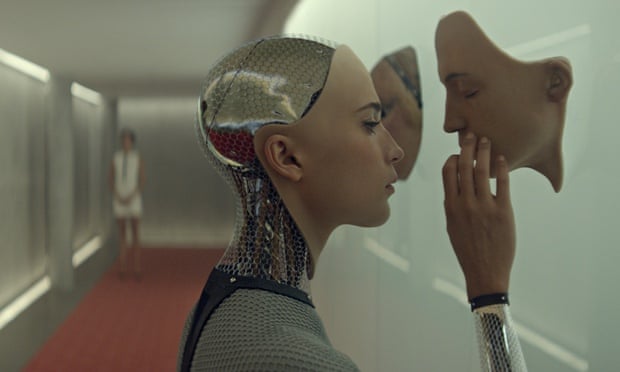
Alicia Vikander in the film Ex Machina
In fact ChatGPT, by its own admission, is probably not going to do that – because it doesn’t exactly know everything. It’s a form of Artificial Intelligence that is trained (by human developers) to recognise patterns in vast areas of text harvested from the internet which is then trained, with human assistance, to deliver more useful or better dialogue. The answers you get may sound plausible and even authoritative, but they might well be entirely wrong – as OpenAI, the creator of ChatGPT, warns.
Because I am curious minded, and because I was interested in the slightly hysterical response, from some quarters, to ChatGPT, I decided to try it for myself.
It’s very simple to use, but it does, like most computer programmes, function on the GIGO (Garbage In, Garbage Out) principle – so if you ask it vague, non-specific questions and requests, you are like to get vague, non-specific replies.
In an early encounter with ChatGPT, I asked it to write programme notes for a concert. To make it simpler, and so that I could assess the responses, I asked it to write a separate programme note for each piece in the programme. What quickly emerged was a very generic, bland text, with certain phrases and statements repeated in each instance (such as “this is one of the finest works in the piano repertoire, admired for its virtuosity”).
Another time, I asked it to write me a “short essay highlighting the key points of Schubert’s last three piano sonatas” and this is what it produced:
Schubert’s last three piano sonatas, composed between 1822 and 1828, are considered some of his most profound and challenging works for the instrument. They showcase his unique musical voice and mastery of form, harmony and texture. Some key features of these works are:
Complex forms: Schubert employs unconventional structures in these sonatas, blending traditional classical forms with his own innovations, such as incorporating variations, multiple themes and unexpected modulations.
Emotional expressiveness: Schubert’s last sonatas are known for their intense,melancholic and introspective character, reflecting his state of mind during the final years of his life. He achieves this through lyrical melodies, harmonic ambiguity, and the use of contrasting moods and tempos.
Diversity of textures: Schubert experiments with a wide range of textures, from delicate and ethereal to powerful and dramatic, to create different emotional effects. He uses innovative techniques like cross-handed playing and rapid arpeggios to create rich and complex textures.
Expansion of the piano’s capabilities: Schubert pushes the limits of the instrument, exploring new technical and sonic possibilities, and creating a large-scale, symphonic sound. He also incorporates elements of chamber music, such as dialogue between different voices, into his solo piano works.
In conclusion, Schubert’s last three piano sonatas are considered landmarks of the genre and demonstrate his unique musical vision and creativity. They are complex and emotionally charged works that challenge the performer and reward the listener with a rich and deeply moving musical experience.
It’s not a bad attempt. In fact, I think it would probably secure a decent pass in a GCSE exam. But a little deeper, and really this response reveals very little actual “depth”. If I was marking this essay, I would mark the candidate down for lack of actual examples from the music to underpin certain statements, and the whole text does come across as rather bland and superficial, with meaninglessly vague or clichéd descriptions of, for example, texture, and a distinct lack of question, argument, comparison or contextualisation – the sort of elements one would expect from an A-level or undergraduate essay.
However, what I do think this offers is a starting point from which to develop a far more detailed and involved essay – and for me this is probably how I would use ChatGPT.
I have also used it to generate marketing plans and social media posts for my publicity work. Like the programme notes exercise, the responses have been rather generic, with recurring phrases appearing regardless of the topic, but once again, I have found this a useful spark for my own creativity. I see ChatGPT as a tool, a kind of “office assistant”, if you will, but certainly not as a replacement or substitute for me
Finally, for a bit of fun, and because it was Schubert’s birthday the day I was playing with ChatGPT, I asked it to do the following:
“Rewrite this essay in the style of a poem by Heinrich Heine” – and it obliged with this fine piece of doggerel
Schubert’s final sonatas, so grand and divine, Piano masterpieces of his final nine. Complex forms, a blend of old and new, Unconventional structures, for a pianist’s view.
Intense, melancholic, introspective, these works, Reflecting his soul, so beautifully lurks. Lyrical melodies, harmonious dreams, Contrasting moods, and emotional streams.
Texture diverse, delicate to strong, Creating emotional effects, in each and every song. Innovative techniques, cross-handed play, Arpeggios rapid, in musical array.
Piano’s capabilities, Schubert did push, Exploring new sounds, so grand and lush. Chamber music’s elements, in his solo sound, Dialogue of voices, all beautifully wound.
Schubert’s final sonatas, a masterpiece of the art, Complex and emotional, a beautiful start. Challenging performer, rewarding the ear, A rich experience, so deeply sincere.
In a later article, a friend of mine shares his own encounters with ChatGPT, with some intriguing results….
This site is free to access and ad-free, and takes many hours to research, write, and maintain. If you find joy and value in what I do, please consider making a donation to support the continuance of this site
The Cross-Eyed Pianist is free to access and ad-free, and takes many hours every month to research, write, and maintain.
If you find joy and value in what I do, please consider making a donation to support the continuance of the site







 The Cross-Eyed Pianist