In a recent interview for Reuters, French pianist Pierre-Laurent Aimard described Debussy as a “hedonist” of sound, and this definition was clear in Aimard’s performance – one of incredible precision, intensity, sensitivity, and sensuality, which showed Debussy to be a composer of great complexity, a profound and dark artist, and a revolutionary of sonority and musical colour. Read my full review here
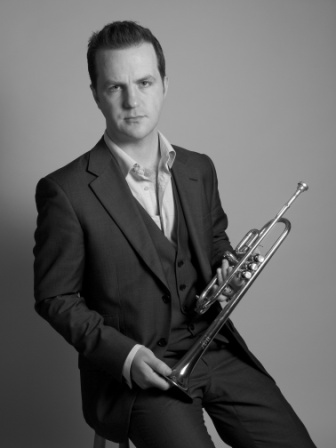
Who or what inspired you to take up the trumpet and make it your career?
I began learning the trumpet in year five in primary school – so I would have been around the age of nine – with a local peripatetic teacher. Funnily enough, I actually wanted to take up the trombone, but there was no option! I took my music very seriously, although I did not decide to pursue it professionally until I was around the age of sixteen. This was after filling out, but never sending, an application to university to study physics. I found that music was the only path where I could express myself, which was brought on by a typically challenging adolescence. I also had a very strong focus on composition, which is an avenue I will return to one day.
Important pedagogical influences upon me included early lessons with Brendan Ball as a teenager, and then Iaan Wilson, who taught me to expect standards that I did not realise were possible. Paul Archibald, Andrew Crowley and Neil Brough also did wonders for my playing at the Royal College of Music.
Who or what are the most important influences on your playing?
Wynton Marsalis’ ‘Carnival’ album had a tremendous influence on me as a young teenager. I love the way that the music excites the audiences, through a combination of physical and musical virtuosity. Apart from the trumpet, the canonical Romantic piano repertoire – from late Beethoven through to Scriabin – will always affect me in a way few other genres can. I am also a massive fan of Gesualdo and JS Bach’s fugue writing.
What have been the greatest challenges of your career so far?
Adapting to ‘Classical’ pitch (A=430). While Baroque pitch can be understood as a semitone below modern pitch, the Classical version is somewhere in between. This can really affect intonation, and something I had to acclimatise to on stage in Covent Garden!
The other big challenge for me is balancing performing with academia. I take both very seriously, and I am just about to complete my doctorate in musicology at Oxford. The two areas are mutually beneficial, and despite the extra work commitment, I am always surprised by how few people try to tackle both. For me, it comes down to a matter of motivation and time management.
What are the particular challenges/excitements of working with an orchestra/ensemble?
As a solo performer, there is a great deal of freedom; the ensemble follows you. This comes with some obvious artistic satisfaction. In an ensemble, however, the freedom is much less – you can shape the musical lines in a personal way, but the degree of precision must be very high, otherwise you can let down your fellow ensemble musicians. You rely on them, and they rely on you – this is quite a special bond, and a very different reward from solo performance.
Which recordings are you most proud of?
Johann Wilhelm Hertel’s Third Trumpet Concerto – I recorded this piece on the natural trumpet aged 26, and it has received some very positive international reviews. It was my first commercial recording, so it will always hold special memories for me. I also recorded David Bednall’s Christmas Cantata a few months ago, which is a very special piece for solo trumpet, choir and organ, of around one hour in length.
Do you have a favourite concert venue?
The Barbican – it is just such a pity that there is no built-in organ!
Who are your favourite musicians?
Wynton Marsalis, Hakan Hardenberger, Pierre Boulez and Daniel Barenboim.
What is your most memorable concert experience?
On the 15th June, I performed three trumpet concertos in one concert: Robert Saxton’s ‘Psalm: A Song of Ascents’, John McCabe’s ‘La Primavera’ and Deborah Pritchard’s ‘Skyspace’. The last two were also world premieres. I had been recording these concertos for around four and a half hours on the same day for Signum Classics, so getting through them in concert was the biggest challenge to stamina and concentration that I have ever faced. The Orchestra of The Swan, conducted by Kenneth Woods, were so wonderful and supportive throughout – I do not know what I would have done without them.
What is your favourite music to play? To listen to?
I love playing the natural trumpet, but Arban’s theme and variations on the cornet/modern trumpet are always a joy. I also use them frequently in educational workshops. I have recently been enjoying Messiaen, particularly his Vingt Regards for piano solo, which combines an extraordinary, advanced sound world with a clear theoretical compositional technique. After obtaining a flugelhorn to play the second movement of John McCabe’s new trumpet concerto, I am also considering a foray into jazz – watch this space!
What do you consider to be the most important ideas and concepts to impart to aspiring musicians/students?
Music stems from desire. If you want something enough you will always achieve it. Likewise, if you do not reach your goals, chances are you did not want them enough. So, to achieve in life, simply isolate that thing you want the most, and follow it with all the energy that you can muster.
What are you working on at the moment?
Following on from my recent work on British trumpet concertos, I am focusing on a brand new repertoire for the combination of trumpet and string quartet – more about this another time! I am also preparing Robin Holloway’s solo trumpet sonata for what may be the first ever complete live performance – the work is generally performed only a single movement at a time, due to the intense stamina demands on the performer. Other works on my practice pile at the moment include concertos by Peter Maxwell Davies and James MacMillan.
Where would you like to be in 10 years’ time?
A critically recognised international trumpet soloist and a university lecturer. I also hope to have at least a couple of books published by then, the first of which will be on the music theory of Paul Hindemith.
What is your idea of perfect happiness?
Looking back on my life and feeling no regrets about the difficult choices, and sacrifices, I have had to make. You only get one chance in life, and I intend to make it count.
What do you enjoy doing most?
Spending the day with my wife and daughter, perhaps including a visit to the river Thames. I proposed to my wife on Waterloo Bridge after dinner at the Savoy – that whole area of London will always be the most perfect place in the world to me. It is also just round the corner from King’s College London, my Alma Mater.
I am also a massive football fan – Arsenal, of course (!!) – and an avid brewer of beer. I grow hops in my back garden, although I am yet to have a suitable harvest! Close friends like to offer names for my home-brew, the daftest solution as a play on my surname, ‘De-Brew’…
Choral octet Platinum Consort made their King’s Hall debut with an impressive and impeccably prepared concert of music for, or inspired by, the Tenebrae tradition. Read my full review here.
Never underestimate the value of performing, whether at home for family and friends, or in a ‘proper’ concert venue on a really special grand piano. Performing for others, and the ability to get up and do it, is an important life skill as it builds confidence and self-reliance – and not just in the sphere of music.
The rush of adrenaline that comes with performing often encourages you to ‘raise your game’ and play better, and interesting things can happen to your music when played before an audience, which may not occur during practice. As a musician, of whatever level, it is crucial in one’s musical study and development to experience the difference between practice and performance, to put your music ‘out there’ and offer it up to other people for scrutiny. Performing endorses all those lonely hours we spend practising, and reminds us that music is for sharing.
It is important for students to hear each other perform too: listening to others in your peer group can be a useful benchmarking exercise, allowing you to measure your own efforts against those of others. If you hear more advanced students perform, you will feel inspired and keen to progress. Performing for and with others is also a means of sharing and discovering new repertoire. At every piano course and piano group I’ve attended I’ve come across new repertoire.
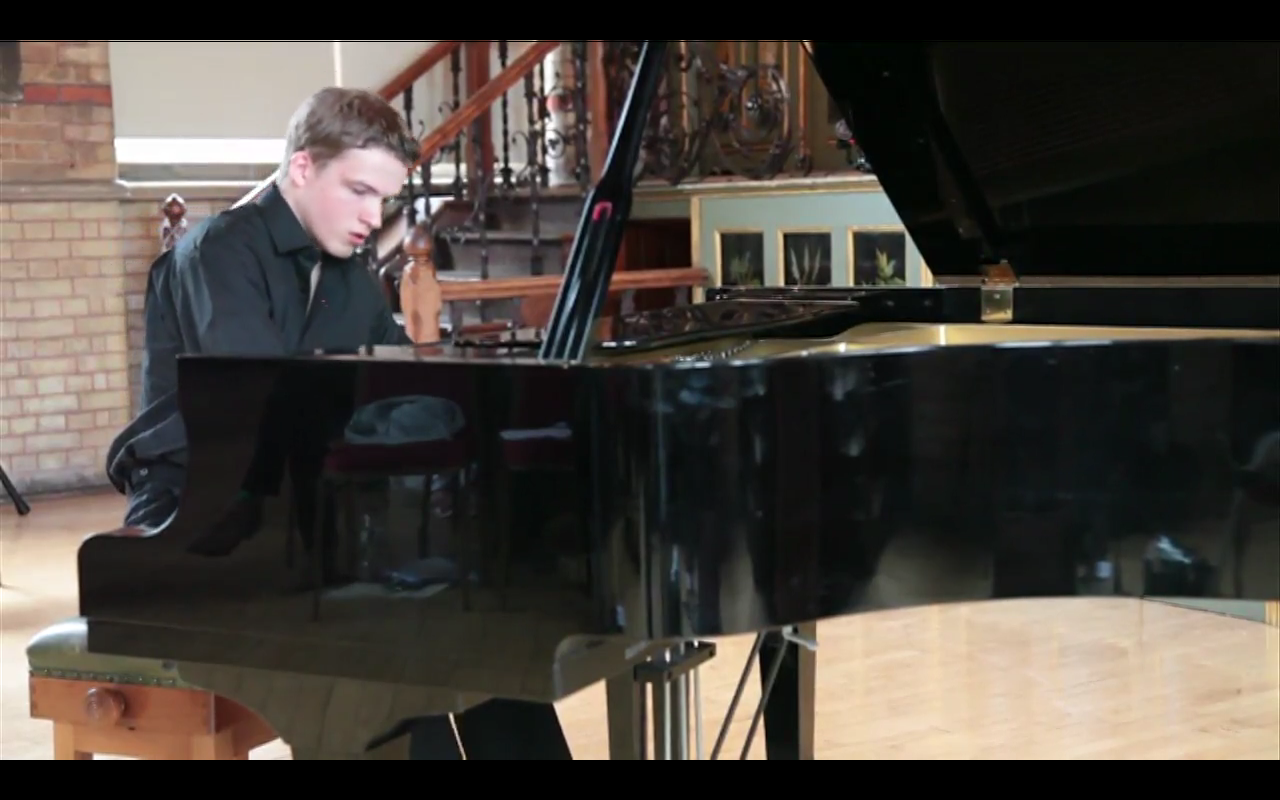
Stephen Gott, a student at Trinity Laban Conservatoire of Music & Dance, performing Debussy’s Prelude Ce qu’a vu le vent d’ouest at my concert, 20th May 2012
As a teacher it is also very important to perform, whether for students in student concerts, or in more formal settings in the concert hall. How can you train others how to perform if you haven’t done it yourself? I have met many piano teachers who rarely or never perform, claiming they are too nervous to play in front of their students, or that they simply do not have the time to prepare repertoire. In my experience, my students want to hear their teacher play – lessons often end with me playing something at the student’s request, and I hope that by hearing and watching me playing, my students can better grasp aspects of technique or interpretation we might have discussed in lessons, as well as enjoying more advanced repertoire and the sheer pleasure of listening to piano music. I also feel it is crucial, as their teacher, to show that I can actually do it, that I fully prepared when I perform, and that I have managed my performance anxiety properly. I also get ideas when I am performing which inform my teaching.
Performing adds to one’s credibility. Whether a professional or an amateur, it is important to prove that you can actually do it, and, for the amateur pianist, the benefits of performing are immeasurable: you never really demonstrate your technique properly until you can demonstrate it in a performance. Music and technique are inseparable, and if you perform successfully, it proves you have practised correctly and thoughtfully, instead of simply note-bashing. This works conversely too, for if you are properly prepared, you should have nothing to fear when you perform. The benefits for younger students are even greater: preparing music for performance teaches them to complete a real task and to understand what is meant by “music making”. It encourages students to “play through”, glossing over errors rather than being thrown off course by them, and eradicating stop-start playing which prevents proper flow. It also teaches students to communicate a sense of the music, to “tell the story”, and to understand what the composer is trying to say. And if you haven’t performed a piece, how can you say it is truly “finished”?
The Cross-Eyed Pianist is free to access and ad-free, and takes many hours every month to research, write, and maintain.
If you find joy and value in what I do, please consider making a donation to support the continuance of the site







 The Cross-Eyed Pianist