Joseph Haydn: ‘London’ Trio in F Hob XV no 17

Bohuslav Martinů: Trio

Josef Suk: Elegie, Op 23

Jean-Michel Damase: Sonate en concert

Just five minutes’ walk from Camden Town tube station, tucked up a side street off Camden High Street, is the relatively new arts venue of The Forge. Custom-designed as a flexible arts space, bar and restaurant, The Forge squeezes a lot into its small site: the airy recital space can accommodate around 100 people, and has a good reverberating acoustic, thanks to hard and reflective surfaces. The Steinway Model B grand piano is just right in this size of venue. The Forge is run by a husband and wife team who juggle their baby daughter while welcoming guests. The atmosphere within the venue is friendly and relaxed, and if you come to a Sunday morning ‘Keys and Coffee’ concert, as we did, you can take your coffee into the recital space.

Metier Ensemble is a flute, piano and ‘cello trio, comprising Claire Overbury (flute), Elspeth Wyllie (piano) and Sophie Rivlin (‘cello). They met while studying at the Royal Academy of Music and the University of Oxford, and all three have won prizes and awards for their playing. They perform solos, duos and trios, and this mix of instrumentation allows them to explore a wide range of repertoire, as was evident from the programme for their concert at The Forge. The musicians introduced each piece, engaging our interest before they had played a single note.

The concert opened, appropriately, with one of Haydn’s ‘London’ Trios (Hob. XV, 17). This is unusual amongst Haydn’s trios of the time as it has only two movements (in fact, Haydn originally billed it as a sonata for piano with flute or violin). The first movement Allegro is sprightly and, after the opening piano solo, the flute takes prominence, with the ‘cello in a supporting role. Claire Overbury played with a sweet, bright tone, combined with crisp articulation. The development section is dramatic, foreshadowing Beethoven, with some unusual modulations, before the cheerful opening motifs return. There were some lovely ‘conversations’ between piano and flute in this first movement, underpinned by some rich ‘cello support from Sophie Rivlin. The second movement is marked ‘tempo di Minuetto’, though it feels more like a proper finale, and was, like the opening movement, executed with humour, grace and evident enjoyment on the part of the musicians.

Martinů composed his Trio for flute, piano and ‘cello in 1944, a highly productive year for the composer, who was by now resident in America. It is a largely extrovert work, full of Eastern European folk motifs and nostalgic resonances of his homeland (former Czechoslovakia). The outer movements are imbued with boisterous, holiday moods, while the middle Adagio reveals the composer’s homesickness in a yearning hymn-like theme, expressively played by Elspeth Wyllie. As in the Haydn, the interplay between all three instruments was colourful, precise and lyrical.

Suk wrote his Elegie, op 23, in memory of the Czech poet Julius Zeyer, and the subtitle to the work, “Under the Impression of Zeyer’s Vysehrad,” is a reference to the writer’s epic poem based on elements of Czech mythology. The music is nostalgic rather than elegiac, full of rich, warm melodies, striking chromaticism and harmonic shifts, and an aching passion, all sensitively executed by Metier Ensemble.

The concert closed with an effervescent trio by Jean-Michael Damase (b. 1928). Damase chose not to follow his contemporaries Messiaen and Boulez into new, experimental realms of composing, and instead continued to explore the possibilities of the kind of elegant French musical language set out by Debussy and Ravel, and later Poulenc. The Sonate en Concert is organised in the manner of a Baroque suite, with contrasting movements based on different dance rhythms. The music is uplifting in mood, melodic and tonal, though containing some unusual harmonic complexities. The flute and piano carry the main interest in the work, with the ‘cello providing a Baroque ‘basso continuo’. There are several recapitulations based on the stately, expressive opening motifs, including a beautiful ‘Aria’, interspersed with livelier movements. The ‘Sicilienne’ had a delightfully relaxed lilt, while the presto ‘Gigue’ crackled with excitement, the sparkling glissandi in the piano accompanied by the happy gurgling of The Forge owners’ baby daughter. The entire work was pulled off with elan, humour and yet more obvious enjoyment by the musicians.

This was a really charming concert: a programme guaranteed to refresh and delight everyone, combined with the relaxed, convivial atmosphere at The Forge made for a thoroughly enjoyable morning.

www:metierensemble.co.uk

Pianist Elspeth Wyllie featured in my Meet the Artist series. Read her interview here

More about The Forge here: www.forgevenue.org

Concert grand piano on the stage at London’s Wigmore Hall (picture source The Guardian)

This post was prompted by this question from a friend: “How has reviewing piano concerts influenced your own playing?”.

In the 18 months I’ve been reviewing for Bachtrack, I’ve been to many excellent solo piano and chamber recitals, given by top international artists, and lesser-known, or up-and-coming artists too, at venues large and small. Reviewing has been a way of indulging my passion for piano music, while also being allowed to write about it, and, I hope, share my passion with others. When I select concerts to review, I tend to make choices largely based on repertoire rather than performer, though this year I have made one or two deliberate choices to hear certain performers, out of curiosity, namely Yuja Wang and Benjamin Grosvenor. I also wanted to hear again Marc-André Hamelin and Pierre-Laurent Aimard, and for the first time, Noriko Ogawa.

I often urge my students to go to concerts for “inspiration” (sadly, few of them take up my suggestion). There is something very special about live music, and seeing and hearing a professional musician at work can be illuminating and inspiring – and sometimes just jaw-droppingly extraordinary (in the case of Hamelin). You don’t experience that same excitement from hearing music, however expertly played, on disc, as you do in the concert hall. You can listen to a disc any number of times, but in the concert hall, it’s an entirely unique experience – for performer and audience. I’ve heard a couple of pianists in the same repertoire at different concerts, and after a pause of several years, and have been surprised, and excited, at the changes in the music. Not significant changes of interpretation, but small adjustments – a little more rubato here, some subtle shading or tenuto there – which shine a new light on the works or highlight different aspects. As a performer, it is these flashes of illumination and insight that make performing such an interesting and exciting experience, aside from the cultural gift of sharing music with others.

I couldn’t really claim that any particular concert or performer has directly informed my playing, but occasionally I’ve considered some of my repertoire in a new way after hearing it in concert. One is unlikely to pick up any nuggets of technique in the concert hall: you’re often too far away from the stage to see details, but listening attentively is helpful, particularly for pedalling. It’s amazing how many pro pianists don’t seem to know how to pedal properly, or who use the pedal as some kind of on-off switch to hide mistakes or inconsistencies of technique. I’ve been doing a lot of work on refining my pedal technique this year, specifically with regard to Mozart’s Rondo in A minor K511 (which requires very minimal pedal), so I have a heightened sensitivity about sloppy or inconsistent pedalling! Peter Donohoe, in his early spring concert at Queen Elizabeth Hall, gave a fantastic demonstration of how to pedal Debussy effectively in his performance of Estampes (read my review here). It was an enlightening and expert performance.

Similarly, hearing Noriko Ogawa play Toru Takemitsu’s evocative Rain Tree Sketch II, a piece dedicated to Olivier Messiaen, and full of Messiaenic echoes in its colourful tonalities and ‘flashes’, was very illuminating. I had just started looking at the piece when I went to hear Noriko in a lunchtime concert at the Wigmore featuring this piece and Debussy’s Études. To hear the work performed live by one of the composer’s compatriots, who clearly has a profound understanding of his work, was special enough, but the beauty and refinement of Noriko’s playing made this a truly spectacular five minutes of music for me. I went home to practise the piece with an excitement and enthusiasm, which has remained every time I open the score or indeed think about the work.

A really vibrant or emotionally powerful performance of a piece I am working on will often send me home to study the score in detail away from the piano, or may encourage me to try something new or different. I’ve stopped trying to copy what the pros do – the frustrated concert pianist within has long since been put to bed, and I now concentrate on trying to bring my own interpretation to the music – but a well-executed performance of some of my repertoire may force me to raise my game, always a good thing, especially when one has been working on the same repertoire for a long time.

I think the best aspect of reviewing is the exposure to a such great variety of music, and this is probably the most significant influence on my own playing. My reporter’s notebook, and the black Moleskine notebook I keep by the piano for practising notes, are full of lists of repertoire I’ve heard in concert and mean to learn one day. Here’s a small sample, in no particular order, with a note of where I heard the work:

Liszt – Bénediction de Dieu dans la solitude (Proms 2011, Marc-André Hamelin)

Liszt – Legende: St. François de Paule marchant sur les flots (Proms 2011 – Marc-André Hamelin)

Debussy – Les soirs illumine de l’ardeur du charbon (Proms 2012 – Pierre-Laurent Aimard)

Copland – Muted & Sensuous from Four Piano Blues (Peter Jablonski, QEH 2012)

Bach, trans. Liszt – Prelude & Fugue in a minor BWV 543 (Khatia Buniatishvili, Wigmore 2011)

Bartok – Dirges, no. 4 Andante Assai (Aimard, QEH 2011)

Messiaen – any of the Catalogue d’Oiseaux (Aimard, QEH 2011)

At his spring concert at QEH, Leif Ove Andsnes played one of Rachmaninov’s opus 33 Études-Tableaux for an encore (C major) and in an instant I was hooked (those slavic open fifths!). Sadly, I had some difficulties with tension in my left arm when I attempted to play this one, so I switched to the g minor. I am also learning the E flat Etude-Tableau from the same opus. Together, these pieces form the close of my LTCL programme. Thank you, Leif!

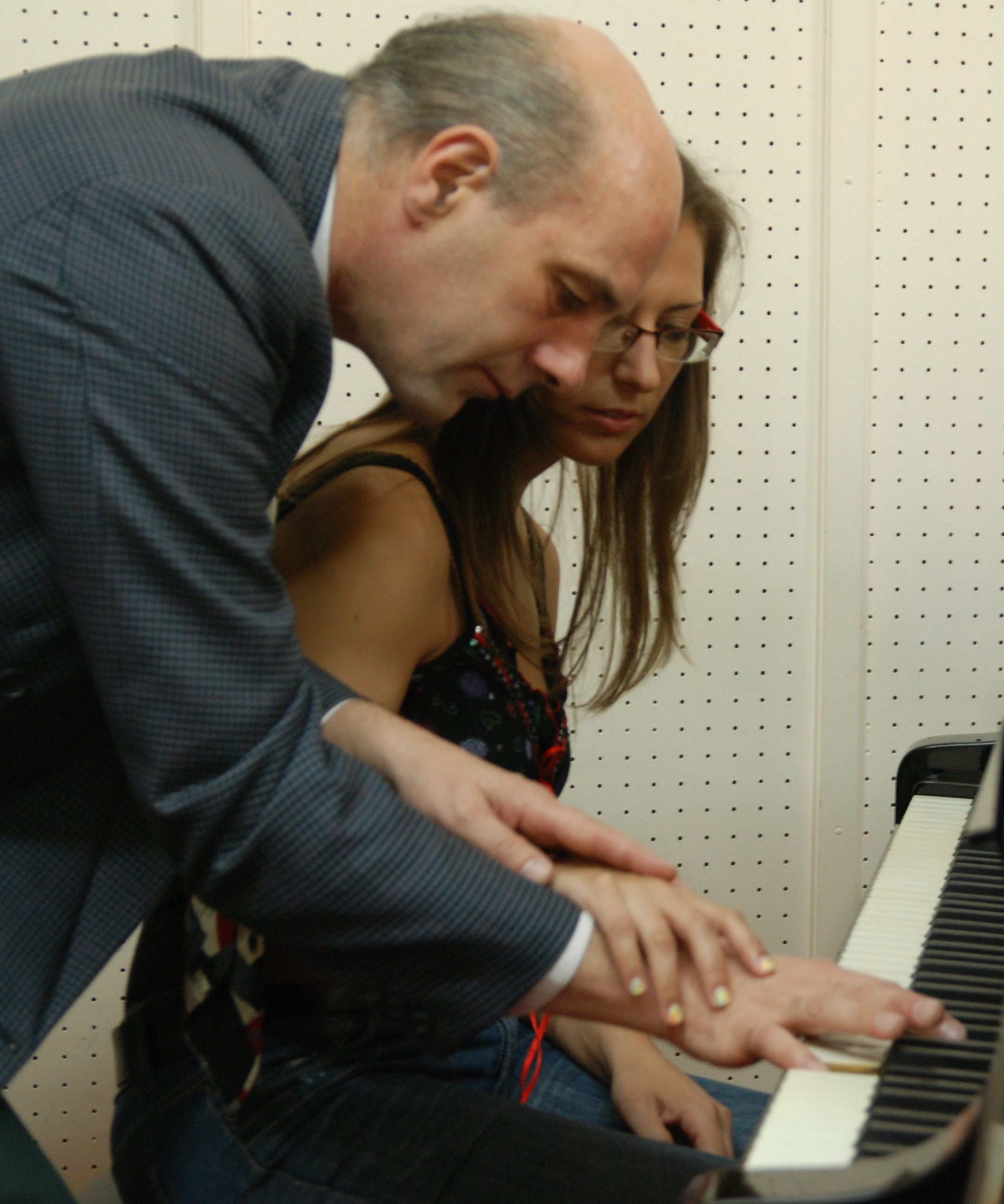
Alan Fraser teaching

What is your first memory of the piano?

I was learning a piece called ‘Baby Bear’, and I was having difficulty with it. It was about the sixth piece in my grade one book, and I think you actually had to play hands together or something incredibly challenging like that. My mother sat down with me and patiently helped me through it. For some reason that always stuck in my mind – it’s one of the few memories I have of a warm and caring feeling between my mom and I.

Who or what inspired you to start teaching?

The lack of good piano teachers. I figured there has got to be some way of offering students better than what I received. But it was also just by chance – some neighbourhood kids needed lessons, so I taught them. I was 16 which means I’ve now been teaching over 40 years.

Who were your most memorable/significant teachers?

First off the bat is Richard Hunt, an Englishman who ended up in Montreal and later founded Quartango, one of the best tango groups around. He taught me for only two years when I was 8 and 9 years old, but he instilled a love of music in me that I carry to this day. He was very clever and he let me have fun! We even had some of our lessons on the church organ instead of the piano.

Then there was Phil Cohen who had been Yvonne Hubert’s assistant (she had been a student of Cortot and taught such Canadian greats as Janina Fialkowska, Marc-Andre Hamelin, Ronald Turini who later studied with Horowitz, Andre Laplante and Louis Lortie). Phil was fascinated with the psycho-physical aspects of performance and would do strange things with your hand that made you play way better but you weren’t sure what exactly was going on.

When I finished my studies with Phil I wanted to understand what had just happened to me, so I did a training in Feldenkrais Method, and I count Moshe Feldenkrais as my next most memorable and significant teacher.

I concluded that Phil had given me an amazing degree of refinement, but I had never acquired the firm foundation upon which such sophistication needs rest. So I went to study with Kemal Gekić in Yugoslavia. More or less a product of the Russian School, he rebuilt everything from the ground up and indeed gave my hand a strength and security it had never had before.

Finally, in the past few years I have again been having occasional sessions with Phil – getting some reminders about that sophisticated part and synthesizing what I’ve learned from both Phil and Kemal to develop what I call Craft of Piano Method, the approach presented in my three books on piano technique.

Who or what are the most important influences on your teaching?

All of the above. Also Richard Feynman, the physicist and author of ‘Surely You’re Joking, Mr. Feynman – Adventures of a Curious Character’, and Werner Erhard, whose work now goes by the name Landmark Education. Also G. I. Gurdjieff. And various psychological disciplines…… what they gave me is the idea always to make it a positive, creative experience. To respect the person. To try to discover the person. Never to fault the student for not understanding but to fault myself for failing to discover the language that would have him or her understand.

Most memorable/significant teaching experiences?

Hoo boy, there are hundreds of those… Recently I worked with a violinist in Pensacola, Florida, who had shoulder pain. I had him continue his up bow way past the violin, towards the ceiling, then around in a big circle. Then his down bow expanded into a big circle in the other direction. Then I had him play not moving his bow at all but moving his violin back and forth underneath the bow. Finally I explained to him where his arms are attached to his body: do you know? It is only at the central end of the collarbone where it attaches to the sternum. I put my bunched fingertips one on each of these collarbone-sternum joints and palpated them while he played, just kept physically in touch with them. His sound went through the roof. It had been improving steadily but this was a quantum leap, it had power, sonority, richness, expressivity – it gave us all goosebumps.

I recently worked with a young Italian pianist in Geneva. She had been given a steady diet of arm weight technique and told not to move her fingers too much. When I showed her a way of moving her fingers which gave them activity and tonus without stiffening them or causing any stiffness elsewhere, her playing became amazingly poetic. I was blown away because I didn’t have to tell her to be more expressive or poetic, we just worked to undo the physical block which had been preventing her natural expression from finding its voice.

I taught an American pianist in Trossingen, Germany many years ago. Her hand suffered (as so many do) from over-relaxation, and I worked to build up its structure, just to get it to stand nicely on the keyboard even before we tried to play anything. All of a sudden she says, “Gee, I feel so muscular!” We all laughed, because of course, it wasn’t her muscles at all that were giving her the sense of power, it was her skeletal structure.

I remember teaching a Chinese student during my year in Wuhan. She was playing Liszt’s Dante Sonata and couldn’t really get the special atmosphere of the second theme. I tried explaining to her how Liszt was pulled in two directions, towards divine love but also towards carnal love, and that we don’t really know which one this theme represents. I myself feel it as towards the divine, how about you? No result. I try another tack: “Imagine you are the Emperor of China and it is your yearly pilgrimage to the Sun Temple. You must pray to the Gods for rain, and if you fail, your people will die of famine. You enter the temple, you pray with all your heart, and suddenly, a sound of brass from the sky, a divine melody descends from the clouds – you know your prayers have been answered. Play this theme as if it was that heavenly melody.” She played and we were literally in tears. It was indeed heavenly. It was a prayer. I was fascinated because I had to go into her culture to access the universal quality of that theme. Trying to get her to understand Liszt’s culture met with no success, but her own culture proved an admirable path for her to understand that music, music which does indeed speak to us all. She needed her own culture to access the right side of her brain, which of course possesses a perfect understanding of the spiritual element in this theme.

What are the most exciting/challenging aspects of teaching adults?

Exciting: their intelligence, their sensitivity, their curiosity, their receptivity, and their willingness to be beginners. Challenging: 1) the slightly rusty nature of their brains, compared to the incredible flexibility and speed of their younger colleagues. 2) having to fix the sometimes vast amounts of garbage they have been taught over the years…

What do you expect from your students?

Curiosity, engagement, dedication….

What are your views on exams, festivals and competitions?

They are excellent, a stimulus to high level work. Competitions are the equivalent of a scientific congress where people go to meet their colleagues, share ideas and be stimulated. It’s a chance to feel like you are part of a community instead of this weirdo who mostly sits between four walls practicing on his or her own. Whenever I prepared a competition I played better, because I knew I had to. Perhaps theoretically I should play my best simply out of love for the composer, but I find the practical stimulus of a concrete goal a much more effective kick in the pants.

What do you consider to be the most important concepts to impart to beginning students, and to advanced students?

Beginning:

  • Sing a simple song, sense your own voice. Let your fingers begin to find that song on the piano. Experience your fingers on the piano as an extension of your voice.
  • Tap simple rhythms, one hand on your knee, the other on a piano key. Let rhythmic sense be as important as the sense of the notes from the very beginning.
  • Play first, read second.
  • Never let the task of reading distract you from the task of making music.

Advanced:

  • Never let relaxation lead you into a state of emasculated collapse.
  • “Don’t bang” does not mean “play like a wimp,” it means “find a way to play where you stand up into your hand’s structure instead of letting it collapse. Banging mostly comes from weakness not too much strength.
  • Have your hands learn to stand, walk, run and jump well on the keyboard, then give them musical tasks that give them a reason for doing these things.
  • Never let technique distract you from the sound you are making, the music you are making. They are intimately connected.
  • Understand your hand’s structure and function, then find out where it is not working optimally for you. Find out how the body participates in supporting the hand in working well.

What are you thoughts on the link between performance and teaching?

They feed each other. I couldn’t really do one well without the other.

Who are your favourite pianists/pianist-teachers and why?

Passed on: Horowitz, Rubinstein, Rachmaninoff, Ignaz Friedman, de Pachamann. They all had supreme virtuosity, compared to which most of the best pianists today only move their fingers well. This virtuosity is way beyond digital dexterity – it’s creating orchestral sonorities and emotional characterizations that grow naturally and organically out of the soundscapes the composers created.

Living: Kemal Gekić. He is the one pianist today who is breaking new ground in this realm. He is using his transcendent mastery of the keyboard to explore new emotional and spiritual elements in the music he plays, and dealing with adjustments to the sonority at the micro- or even nano- level to evoke unbelievably huge changes in the expressive dimension.

Canadian pianist Alan Fraser is best known as the author of three major volumes on piano technique: The Craft of Piano Playing (also in DVD), Honing the Pianistic Self-Image, and All Thumbs: Well-Coordinated Piano Technique. Fraser’s new approach grows out of his many decades’ study with Phil Cohen and Kemal Gekić, synthesizing the best features of previous schools of piano technique in order to move beyond them. Analyzing piano technique in the light of the Feldenkrais Method of neuromotor reeducation (Fraser is a senior Feldenkrais practitioner) allows Fraser to unlock the hand’s innate potency at the keyboard by returning to its inherent structure and function. Instead of distracting from musical aspects of piano playing, Fraser’s focus on the physical brings the pianist, by improving his physical relationship to his instrument, back into contact with his essential artistic self. Thus Fraser’s students gain not only in technical mastery; but in their artistic expression which develops a whole new dimension of tonal breadth, emotional subtlety and spirituality.

In 2011 Fraser inaugurated the Alan Fraser Piano Institute, a week-long intensive course designed to create a breakthrough in one’s piano technique. Branches of the Institute have already sprung up at Smith College, Massachusetts; Salt Lake City, Utah; Concord New Hampshire; Stuttgart, Germany; Geneva, Switzerland; Nice, France; and Haarlem, the Netherlands. In addition to his Institutes, Alan Fraser gives recitals and master classes throughout Europe and North America, and continues to teach at the University of Novi Sad, Serbia. He has composed several vocal works including two masses and a Magnificat, and is a respected digital sound engineer who edited Kemal Gekić’s monumental recording of the 27 Chopin Etudes.

Robert Schumann

ABEGG Variations, Op. 1, Widmung (Dedication) Op 25 no. 1 (arr. Liszt)

Fryderyk Chopin

Étude, Op 10, no. 5 ‘Black Keys’, Mazurka in D, Op 33 no. 2, Mazurka in F minor, Op 68 no. 4, Scherzo No. 2 in B-flat minor, Andante Spianato et Grande Polonaise Brillante

Anna Stachula, piano

While a brisk November gale whipped up fallen leaves in Bushy Park and rattled the long windows of the Scientific Museum at the National Physical Laboratory, Teddington, Silesian-born pianist, Anna Maria Stachula, gave an impressive debut concert at the NPL Musical Society.

Now in its 62nd season, the NPL Musical Society (NPLMS) hosts regular lunchtime concerts in an elegant room in Bushy House. Concerts are very well-supported by staff, former staff and the general public, and the Society attracts a varied range of chamber musicians. Concerts are held in the Scientific Musuem, an intimate space with a hundred year old medium-sized Steinway, and fine views across Bushy Park.

Anna Maria Stachula first came to my notice through her teacher, John Humphreys (Birmingham Conservatoire). John described Anna as possessing the kind of talent and technique one could expect at the Wigmore Hall, but despite this, Anna is virtually unknown in the UK and her day job is in a post office sorting office (where, she told me after the concert, she listens to music through her headphones while she is sorting post).

In a programme of popular works by Schumann and Chopin, Anna played with huge commitment and conviction, technical assuredness, dynamic shading, and musical insight. The opening piece, Schumann’s ABEGG Variations had a romantic sweep, yet there was humour and warmth too, and an understanding of the varied characters of this work. The casual closing cadence earned a chuckle of delight from the audience.

Liszt’s transcription of Schumann’s ravishing love song Widmung, composed the year he married Clara Wieck, and Anna did justice to this beauty of this music with an enchanting performance.

Two contrasting Mazurkas by Chopin followed. The first, in jaunty D major, had a foot-tapping, dancing metre, and Anna brought a distinctly folksy vibrancy to the piece with her characterful playing. The second, in F minor, and one of the last works Chopin composed, was poignant and sincere, with tasteful rubato and subtle dynamic shading.

Anna’s account of Chopin’s B-flat minor Scherzo, the most popular of his Scherzi, was highly dramatic, brave and heartfelt, the contrasting sections of the work highlighted with careful attention to detail, and some really gorgeous playing, particularly in the trio which opened with a gentle hymn-like motif. (This for me was the highlight of an excellent programme.) The same rich cantabile tone was evident in the Andante Spianato (which translates as “smooth”), while the Grande Polonaise Brillante was fearless, spirited and virtuosic. The audience’s appreciation was very evident at the end with enthusiastic applause, and several people went to congratulate Anna afterwards.

Anna’s teacher John Humphreys will feature in my ‘At the Piano…..’ series

The next NPLMS concert is on Monday 26th November. Pianist Petra Casen performs a Spanish programme with music by Granados, Albeniz and Mompou. Concerts are held in the Scientific Musseum, Bushy House, and start at 12.45pm. Tickets £3 on the door.