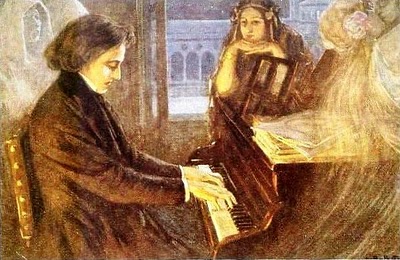
The story of composer Fryderyk Chopin and writer George Sand is one of the most compelling, romantic and passionate, a nine-year love affair which continues to fascinate and grip the imagination. It is a story of creative union and artistic inspiration, of a relationship severed by ugly jealousy and recrimination, and one which ended tragically with the untimely death of Chopin in October 1839.

For many, the relationship between Chopin and Sand is an attraction of opposites: she with her fiery, mercurial, outspoken personality, her penchant for men’s clothes and cigars contrasted with Chopin’s fastidiousness, his delicacy and shyness (particularly in performing in public). Yet during the nine years of their relationship, Chopin produced some of his finest piano music, including the 24 Preludes Op 28 and the B minor Piano Sonata. Despite her reputation for taking up with and then discarding lovers with the casualness one might discard a dirty chemise, Sand gave Chopin love and affection, and a settled home life, divided between Paris and her house at Nohant, that enabled him to compose. She nursed him when he was ill and offered solace and support when he felt his muse had deserted him. Added to this, their circle of friends comprising artists (the painter Eugene Delacroix, amongst others), musicians (Pauline Viardot, Auguste Franchomme), writers and composers (Franz Liszt) provided Chopin and Sand with a supportive and inspirational background against which they could create music and words.

‘Divine fire’ was Sand’s own description of the intensity of her attraction to Chopin, suggesting a love that transcended the purely physical to a more spiritual plane, a meeting of bodies and minds. It is also the title of a words and music presentation conceived and written by actress Susan Porrett with music performed by pianist Viv McLean.

The narrative runs chronologically, picking up the story of Chopin and Sand from their first meeting in Paris (at which Chopin initially found Sand “repulsive”) through their ill-starred winter in Majorca, contentment at Nohant, Chopin’s acclaimed recital at Salle Pleyel to their stormy parting and Chopin’s tragic death. The narrative is interspersed with music, selected by Viv to complement the text, and comprising some of Chopin’s loveliest works. The opening piece, the fleeting Prelude in A, Op 28 No. 7, set the tone for the evening – played with an ethereal delicacy, the last note was no more than a whisper.

The great strength of this format is the subtle interweaving of words and music. Susan’s text brings to life the personalities of Chopin and Sand through letters between them and their friends, and contemporary accounts. The readings set the tone, and the music reflects it, each piece sensitively rendered by Viv with expression and commitment, from the tenderest, most intimate Nocturnes (Op 9, No. 2, Op post. In C sharp minor) to an intensely poignant Mazurka (Op 17 No 4). Two Ballades (A major and G minor) illustrate Chopin’s contrasting textures and moods, while the Scherzo in C sharp minor is a heroic declamation, shot through with a contrasting motif combining a chorale-like figure with sound showers high in the treble register. Viv’s understated, modest delivery always allows the music to speak for itself, while Susan’s words lend greater focus, encouraging us to listen to the music even more attentively.

Viv expressed some concerns about the piano (an Estonia) to me afterwards, but I and several other audience members assured him that the range of sound was absolutely appropriate for the size of the venue (Bridport Arts Centre is a converted chapel, with cinema-style seating for c200), from the sweetest, most lyrical cantabile (in the Nocturnes, Prelude and Mazurka) to the thunderous, dramatic Presto con fuoco coda of the G minor Ballade. At times the music was accompanied by the faint, plaintive wailing of seagulls (Bridport is close to Dorset’s Jurassic coast), which lent even greater pathos to the music and narrative.

The concert closed with a poignant account of Chopin’s death, and an intense and emotional performance of the Polonaise Fantasie in A flat, Op 61, bringing to an end an absorbing, moving and beautifully presented evening of words and music.

www.vivmclean.com

More about 7 Star Arts

Further reading:

Chopin’s Funeral – Benita Eisler

Chopin: Prince of the Romantics – Adam Zamoyski

Chopin in Paris – Tad Szulc

Chopin’s Letters (Dover)

A Winter in Mallorca – George Sand

Nadav Hertzka

Who or what inspired you to take up the piano and make it your career?

There was always music in my family, my father played the cello as a boy and my sister played piano for a few years. It was never a conscious decision to make it a career, more of a realisation that this is what I wanted to do with my life. I don’t want to sound too naïve, but I still view it that way.

Who or what are the most important influences on your playing?

In a way, the early influences are the most important ones, so I still consider the first recording I’ve heard of Murray Perahia as the single most powerful influence on my playing.

What have been the greatest challenges of your career so far?

There are lots of imperfect pianos out there, flight delays, last minute repertoire changes, etc. The main challenge is to have the right approach and try to make the best out of every situation.

Tell me about your new recording. How did you find the recording experience?

I feel very lucky, I’ve had a gorgeous Fazioli and an incredible team to work with. I’ve been in a studio many times before, but Henry Wood Hall felt different of course, a place with such rich history of recordings. At first you’re very aware of the situation, but once you let go it’s really just you and the music, and that’s a beautiful feeling.

I hear there is a second recording coming up in 2014?

Yes, I’m already hard at work. Very exciting repertoire, and it also gives me a chance to work with both my teachers again, Arie Vardi and Christopher Elton, so I’m very happy about that as well.

Do you have a favourite concert venue to perform in?

I’ve performed several times in Wigmore Hall now and each time is special. So that’s probably my favourite.

Favourite pieces to perform? Listen to?

Anything by Schubert, really. I hope that doesn’t sound too simplistic.

Which performances/compositions/recordings are you most proud of?

Well, I don’t compose, but I did write a few Cadenzas to some Mozart Concerti. Not proud enough I guess, in the end I’ve always played the original Mozart cadenza.

What is your most memorable concert experience?

Playing Mozart’s “Coronation” Concerto, and from the first note everything just clicked, it all fell into place straight away. That’s very rare.

What do you consider to be the most important ideas and concepts to impart to aspiring musicians?

I think the most important thing is to understand the language, how music is written. There’s a strange Schenkerian consensus among too many people I think, that no one seems to question. To impose this method on every piece, every composer, is precisely to miss the point. It also goes without saying that one should be familiar with as much repertoire as possible, especially the kind you don’t find appealing at first.

What are you working on at the moment?

I’m preparing for some concerts, playing Prokofiev’s Romeo and Juliet for the first time, as well as some new Liszt and Debussy. I’m also premièring a new work by Freya Waley-Cohen, titled “Five Breaths”.

What is your idea of perfect happiness?

I don’t know about “perfect”, but in one way or another it would include a David Aaronovitch piece, defending free expression and democratic values, a Mahler Symphony and most likely some Baklavas to go with my Turkish coffee.

Nadav Hertzka performs in the “Pietre Che Cantano” international Festival in Rocca di Mezzo, Italy.

Nadav’s Tchaikovsky disc (Skarbo) is available now from Amazon, iTunes and other retailers.

Israeli pianist Nadav Hertzka has performed throughout the United States, Europe and Asia in major venues such as Carnegie Weill Hall, Wigmore Hall, Kings Place, Shanghai Conservatory, and Avery Fisher Hall. His festival appearances include the Mostly Mozart Festival in Lincoln Center, the Beethoven Festival in Israel and the Mozart Festival in Malta, as well as engagements in China, Russia, Czech Republic, Switzerland, Austria, Belgium, England and Scotland.

Mr. Hertzka made his orchestral debut at age 14 with the Haifa Symphony Orchestra, and has since worked with conductors Trevor Pinnock, Yi-An Xu, Mendi Rodan, Ishay Steckler, Eliezer Hachiti and Talia Ilan among others. He was featured on Radio and Television, including BBC3 and BBC Scotland. Winner of many international prizes and awards, including the Pinault Society International Piano Competition in New-York, the Frank Peleg and Ben-Haim competitions in Israel, the Rubin Academy Piano Prize, The Daniel Howard Trust Award, the Carlton House Award, and Howard de Walden Award. He is also a winner of the America-Israel Cultural Foundation Scholarship Competition, and has won scholarships in both Piano and Chamber Music.

Born in Tel-Aviv in 1986, Mr. Hertzka began his studies at age seven with Mrs. Nina Tansky. In 1996, he continued his studies with Mrs. Hadassah Gonen at the Israeli Conservatory of Music. He received his BMus Degree from the Tel-Aviv Rubin Academy as a student of Prof. Arie Vardi, and his MA Degree with Mr. Christopher Elton at the Royal Academy of Music, London.

Here’s a delightfully simple and utterly enjoyable way to allow yourself some time off during your busy day.

Every day for a month pianist and conductor Alisdair Kitchen will post one of Bach’s iconic Goldberg Variations on Norman Lebrecht’s blog Slipped Disc, accompanied by Alisdair’s personal commentary on the music.

Here’s the Aria

Get your Daily Goldberg Variations on Slipped Disc

Klara Min (photo credit © Lisa-Marie Mazzucco)

Who or what inspired you to take up the piano, and make it your career?

Music itself.

My mother is a composer and she taught many piano students at home so I became familiar with the sound of piano when I was very little. I remember enjoying the beautiful sound, and I was amazed that my fingers could make music. As a child, I always liked singing and I think I tried searching for my own way of singing on piano, too. Since then my dream was to become a pianist who performs all around the world.

Who or what were the most important influences on your playing?

I think I cannot just pick one. Music is a reflection of life, and all I absorb, observe and experience in life influence my playing.

One day when I was twelve in Japan, my grandmother bought me two cassette tapes with Horowitz’s playing Beethoven’s Piano Sonatas. I didn’t know who he was and didn’t know much about different pianists back then, but his playing of Beethoven’s third movement of Moonlight sonata made my heart run. I remember very clearly that I was extremely excited about the inner beats of that movement. I also grew very closely to Tchaikovsky’s Symphonies and Chopin’s music.

What have been the greatest challenges of your career so far?

I guess challenges change according to where you are in life. I must say that the greatest challenge nevertheless is to accept what we call ‘Ars longa, Vita brevis’ (Art is long, Life is short). I can only do my best in music, so I give in and be humble before music. It is so easy to let your ego burn yourself, but if you truly appreciate the beauty of music nothing else but for the sake of music, then you learn and grow.
And I like challenges in general, so I gladly accept them. It is so easy to give up, so give up giving it up!!

Which performances/recordings are you most proud of?

I am happy when I feel that the audience empathizes with me in music. Sometimes it is not easy. But there are certain moments that I feel connected to the listeners. Those moments give me a heartfelt pleasure.

Do you have a favourite concert venue to perform in?

I like concert halls with good acoustics. Performing is listening and the acoustic is very important.

I used to love intimate spaces for a performance, but nowadays I prefer spacious venues where I can project farther.

Favourite pieces to perform? Listen to?

I enjoy complete silence. I like to imagine sound before creating or listening. I don’t listen to music all the time but when I do, I enjoy listening to Lied, Beethoven String Quartets, Kreisler, Cortot,  J.S. Bach, and many more.

Who are your favourite musicians?

There are so many for so many different reasons!

My favourite pianist of all time is Alfred Cortot. He really has a distinctive tone I love.

But there are so many musicians who I respect and admire, not only limited to pianists. The list will go on and on. Being a good pianist is one thing, but being a good musician is more important for me.

What is your most memorable concert experience?

The Berlin Philharmonie Hall, where the stage is surrounded by the audience in 360 degrees. I felt a bit dizzy in the beginning as everywhere I looked, I could have eye contact with the audience. I found it most fascinating, and the audiences in Germany are such sincere listeners. I felt that they really expected to hear music not a show-off. It was a very special experience.

What do you consider to be the most important ideas and concepts to impart to aspiring musicians?

Love. Love life. Embrace human nature. Be joyful with what life gives you and cherish.

There is a Russian poem by Pushkin I used to enjoy in my teenage years.

Should this life sometime deceive you,

Don’t be sad or mad at it!

In the day of grief, be mid
Merry days will come, believe.

Heart is living in tomorrow:

Present is dejected here:
In a moment passes sorrow:

That which passes will be dear

Music is to cherish life. And musicians, performers in specific, should carry enormously positive spirit even in the midst of performing the gloomiest music in order to do so, and that comes from loving.

It takes great maturity. It is a great mind that enables all, not a dexterity.

What are you working on at the moment?

I have been working on the programme for my Wigmore Hall bebut Recital (which took place on April 23): Schumann Arabesque, Fantasiestuecke Op. 12, Chopin Sonata No. 3 and Mazurkas, and a UK premiere of Sean Hickey’s Cursive.

After the debut recital, I will be working on character pieces I have commissioned with American composer Henry Martin, and all Beethoven Piano Concertos for which I will be making a recording with DELOS next year.

What do you enjoy doing most?

I enjoy travelling, discovering new façade of life by experiencing different cultures, food, people and language.

And by travelling, giving concerts, it is the most exciting experience.

But what really nurtures my mind, what makes myself in tune is the connection with God and another human being. I think my longing for deeper connecting with another being is a fuel for making music.

In everyday life I love hanging out with friends, and walking in Riverside Park with my puppy.

Pianist Klara Min has appeared in concert in North America, Europe and her native South Korea in major concert halls, including the Berlin Philharmonie Hall, Gasteig Hall in Munich, New York’s Carnegie Hall, and the Korean Broadcasting System (KBS) hall in Seoul. She made her Carnegie Weill Recital début in 2002 as a winner of the Artists International Competition in New York. She is a recipient of a Samsung scholarship. Her competition prizes have included the Grand Prize of the IBLA Grand Prize International Competition, the Best Performance of Mozart Prize at the Viotti-Valsesia International Piano Competition in Italy and a top prize at the World Piano Competition in Cincinnati. Born into a musical family in Seoul, Klara Min started her first piano lesson with her composer mother, going on to study at Yewon School and Seoul Arts High School, the Manhattan School of Music and the Lübeck Musikhochschule. She has been a member of the piano faculty at Wesleyan University in Connecticut and an assistant teacher at Cincinnati Conservatory of Music. She is a Yamaha Artist.

www.klaramin.com


