Acclaimed pianist and chamber musician Susan Tomes is also an engaging writer. I have enjoyed her previous books and her blog, which offer interesting and revealing insights into the daily life of a classical musician and her personal thoughts on the many facets of music making. Her latest book, Sleeping in Temples, continues this, focusing on subjects such as the exigencies of finding the right concert clothes to coughing and other noises made by audiences, the physical and mental strains placed on musicians in their working life, and the pleasure people gain from attending concerts.

The title comes from an Ancient Greek habit of sleeping in temples in the hope that the powerful atmosphere would “incubate dreams”. In her final chapter, Susan explains that throughout her musical life her own version of “sleeping in temples” has been the privilege of spending time with the “sacred texts” of the music of Bach, Mozart, Beethoven, Schubert et al, the challenges of living and working with this music, and her great love of it, and its ability to take us on powerful emotional journeys and through varied and contrasting landscapes.

In a series of essays and musings, Susan reveals the joys and challenges of her career as well as discussing some perennial issues surrounding classical music and the musician’s day-to-day life, including what ‘interpretation’ really means, the effects of daily practise on one’s character, the benefits and burdens of memorisation, the influence of significant teachers, and the links between music and health. In one chapter she explores the fascinating dynamics that exist within a chamber ensemble and debunks the myth that the members of a string quartet, for example, are the greatest of friends outside the rehearsal room and concert hall. Another chapter ponders the (misguided) attitude that classical music “is not for everyone” (an attitude I encounter regularly and have done since an early age, having always been interested and engaged in classical music), and the pleasure and relief of connecting with like-minded people at university. The light-heartedly titled chapter ‘Fashion Parade’ explores the performer’s attire and the importance of finding the right shoes (for pedalling) and dress. The chapter has a more serious intent, however, as “appropriate” concert attire and the way solo musicians and orchestras dress is the subject of continued debate and has an impact on the way the music and the musicians are perceived by the audience: it shouldn’t matter – after all, the music is the most important thing – but somehow it does. In ‘Bullfrogs’, Susan examines that perennial irritant – coughing at concerts – and the performer’s own anxieties if struck down with a cold or cough and how adrenaline can miraculously “cure” a cold for the duration of a concert (another experience I can identify with, having played my diploma recital last April with a dreadful chest infection). The book also describes some of the challenges facing classical musicians today, including the effect of high quality recordings on live performance.

Sensitively and articulately written, this absorbing and insightful book will delight and inspire musicians and music lovers, and indeed anyone with an interest in classical music. Highly recommended – put it on your Christmas list.

Sleeping in Temples – Susan Tomes. £19.99. Published October 2014. ISBN 9781843839750. Full details here

Susan Tomes’ website and blog

Let’s face it, playing a musical instrument is bad for your health.

A few weeks ago I attended a seminar led by Drusilla Redman, a physiotherapist who works with BAPAM and is also Student Health Adviser and Physiotherapist for Guildhall School of Music and Drama. When Drusilla asked the participants to raise their hands if they were “in pain at the moment”, everyone put their hand up. The attendees were all musicians and music teachers – a guitarist, a violinist, several pianists, a flautist and a clarinettist.

Sadly, being in pain is a common condition for many musicians: a number of my pianist friends suffer from recurrent back problems, chronic tendonitis and other RSI-type conditions. Being hunched over a piano is not good for the body – nor is holding a violin or a flute, or humping a cello – or worse, a double bass – around.

Many of us suffer from “T-shaped pain” across the base of the neck, shoulders and down the back. In my case, this is almost certainly the result of too much time spent at both computer and piano, and not enough time spent stretching between practise sessions and when I leave my desk. Muscles don’t like being kept still, but sitting playing an instrument makes us still. For those who play instruments which need to be supported or held – for example, the French horn, trombone, cello, bassoon, violin, flute – the body can suffer from being in an awkward posture or out of alignment for periods of time.

There are many other factors which contribute significantly to pain, including:

  • bad technique
  • lack of proper warm up
  • unresolved or existing traumas/injuries
  • untreated or ignored chronic conditions such as RSI and tendonitis/tenosynovitis
  • too much repetition in practising
  • bad seating
  • tension and anxiety
  • a punishing practising and/or working schedule
  • over-practising or intense practising before a performance
  • poor choice of repertoire (the pianist with tiny hands is going to really suffer in Liszt or Rachmaninoff)
  • lack of sleep
  • poor diet

Until relatively recently, musicians were expected to simply get on with it, without complaining, and without help from specialists such as Alexander Technique, Yoga and Pilates practitioners, physiotherapists, osteopaths and chiropractors, as well as mainstream medics. Little was really understood, or wished to be understood, about the strain playing an instrument can put on the body and students in conservatoire were given no support or advice on how to look after themselves. When I was studying the piano as a teenager in the 1980s, for example, my then teacher gave me no advice on hand health, avoiding injury, tension or RSI conditions, nor any help on managing nerves and performance anxiety. Today, music students and musicians in general can seek the support, advice and care of professionals to ensure that they keep themselves fit to play. But admitting one has an injury is still stigmatised: in a world where most of us our freelance, admitting we are unable to play can result in no work and therefore no money and musicians often play through pain – because they have to.

Compare this scenario to that of top sports players: no sportsman or woman would tolerate the kind of bodily travails the musician undergoes. Sportspeople, and their trainers, understand about the need to exercise and rest the muscles properly, to engage in a proper warm up regime, eat well, sleep well, and never, ever exercise – or indeed play – through pain.

Through a better understanding of the musician’s body and lifestyle, and the many parallels to be drawn from sport, the musician’s body is now treated in a similar way to the sportsperson’s: we should regard ourselves as “elite musical athletes”, and caring for our bodies in the way a sportsperson would can ensure we avoid injury and enjoy pain-free playing.

The following may seem obvious, but how many of us really, truly adopt these measures on a daily basis?

  • do a proper warm up and stretching session, preferably away from the instrument, if you are a pianist or keyboard player
  • practise in sensible increments (say, 20-30 mins per session) and take regular breaks
  • incorporate mental practise, away from your instrument
  • stretch between practise sessions
  • consider your posture (sit with knees lower than hips)
  • take regular exercise
  • take care when lifting
  • eat sensibly
  • drink plenty of water
  • don’t smoke
  • sleep well
  • enjoy a social life and do activities which are not music-related
  • think positively
  • if in pain, stop right away and seek help
  • By looking after our bodies properly, our practising and music making will be more productive and enjoyable.

Further resources:

BAPAM – specialist help support to performing artists http://www.bapam.org.uk/

Yoga for pianists – warm up exercises devised by pianist and teacher Penelope Roskell

(photo credit: Ruairi Bowen)

Who or what inspired you to take up singing, and make it your career? 

In common with a lot of singers, I’ve been singing for most of my life – first as a chorister for my dad at St Davids Cathedral in Pembrokeshire, then at St Paul’s Cathedral. The latter part has come much more recently and still takes me a bit by surprise: for my whole teenage years I was working towards a career as a jazz pianist, but singing took over during my undergraduate degree.

Who or what are the most important influences on your musical life and career? 

An insultingly short list would have to include my parents and extended family; my singing teachers to date – Ulla Blom, Susanne Carlström, Philip Doghan and Ryland Davies; Ralph Allwood, Nick Goetzee and Jim Wortley at school; at Cambridge, Stephen Layton, the director of music at Trinity College, Paul Wingfield, my director of studies, Maggie Faultless, who took over performance at the music faculty, and Alice Goodman, chaplain at Trinity; hosts of generous teachers, colleagues and friends.

What have been the greatest challenges of your career so far? 

As I’m still a student, I’m hoping sure the biggest challenges are still to come, but a fair answer for now might be the two roles at Cambridge which were my operatic baptisms of fire, Pelléas and Tom Rakewell.

Which performance/recordings are you most proud of?  

When often working on the maxim that “you’re only as good as your last gig”, I’m going to go with the positive version: each project or concert, whether it’s months or hours long, is something worth taking pride in, and I wouldn’t particularly like to pick between them.

Which particular works do you think you perform best? 

My musical first love is Bach, and I’m lucky to have a voice which fits some of his occasionally specific challenges – all human life is there, I think, even if filtered through potentially arcane theology which is a fascinating area in itself. I need a new music fix quite frequently, and have been lucky to work with some brilliant friends in that regard – new operas by Kate Whitley and songs by Joel Rust & Jude Carlton are some recent things which have stayed with me.

How do you make your repertoire choices from season to season? 

Within vocal reason (sadly I see little Wagner in my imminent future), I’ll jump at anything which leaps off the page, makes light work of all the defences daily life throws up, and goes for the guts: recently that’s been Ives and Messiaen in the 20th century, Rameau and Handel in the early 18th, Mozart Mozart Mozart. The rhythm of the year gives a natural shape with regard to concert work – the Passions in Lent, the Messiahs and Christmas Oratorios in December, and summer throws up interesting operatic projects.

Do you have a favourite concert venue to perform in and why? 

Not particularly: currently I’m enjoying the Duke’s Hall at the Royal Academy of Music, where I’m studying, which affords a mixture of grandeur and intimacy. But every venue has its ups and downs – I can’t recall any real shockers, however, which is perhaps tempting fate.

Favourite pieces to perform? Listen to? 

A tricky one – I’ve mentioned the Passions, which are inexhaustibly wonderful masterpieces, but very often it’s whatever I’m involved in at the moment. Listen to is a very different matter – the last concert I went to was the LSO’s Turangalîla-Symphonie, which is up there for its extravagance, visceral thrills and blinding virtuosity, but day-to-day between me, the tube and my iPod, it’s mostly jazz, funk, soul.

Who are your favourite musicians? 

An endless list, but the letter J is a good start: JS Bach, John Coltrane, Jimi Hendrix, Joni Mitchell, Jaco Pastorius, John Zorn, an expensive vocal quartet of Jessye Norman, Joyce Di Donato, Jonas Kaufmann and John Tomlinson.

What is your most memorable concert experience?

Turangalîla again, actually, at the Proms in 2008 with the BPO and Pierre-Laurent Aimard. I’d queued my way to right in front of Aimard, and could see every single intention between score, eyes, hands and whatever else. Then in the outrageous piano cadenza in the fifth movement I fully lost track of time – that 12-second shower of notes seemed an ecstatic eternity, which was something. Seeing Dave Brubeck when I was eleven was pretty influential for the next decade, and I was lucky to see Ravi Shankar at the Proms in 2005 – I’d just started playing the sitar, and to see the global master incredibly close was wonderful. As a treble, a run of concerts with Oliver Knussen on Louis Andriessen and Elliott Carter made a lasting impression, both in terms of loving new music and having the nerve to get out on a big stage and deliver – much harder to start from scratch as an adult, I’m sure.

What do you consider to be the most important ideas and concepts to impart to aspiring musicians? 

I’m still very much an aspiring musician, but hard work, keeping a childish enthusiasm, and a streak of punk aesthetic seems a good mix.

What are you working on at the moment? 

I’ve been working on two different productions of Monteverdi’s L’incoronazione di Poppea, in a tour with Ryedale Festival Opera and on the Britten-Pears Young Artists Programme in Aldeburgh – a work which could take a lifetime to unpick, let alone a summer. In between those,  plenty of work preparing for my first year in the Academy’s opera school, with Gianni Schicchi, The Rake’s Progress and Lennox Berkeley’s A Dinner Engagement.

Where would you like to be in 10 years’ time? 

Hopefully doing more or less what I’m doing now, at as high a level as who’ll have me, and 10 years into my project of writing about every song written by Schubert in chronological order, 200 years after the fact – 1824’s a fairly quiet year, actually, but doing any kind of justice to Die schöne Müllerin the year before might take a bit of work.

Born in Hereford, Gwilym Bowen is a postgraduate student at the Royal Academy of Music, having graduated from the University of Cambridge in 2011 with a double First class degree in Music. He studies with Ryland Davies and Jonathan Papp, and is due to take up a place at Royal Academy Opera from September.

Gwilym’s full biography

Interview date: 19th July 2014


http://www.gwilymbowen.com/

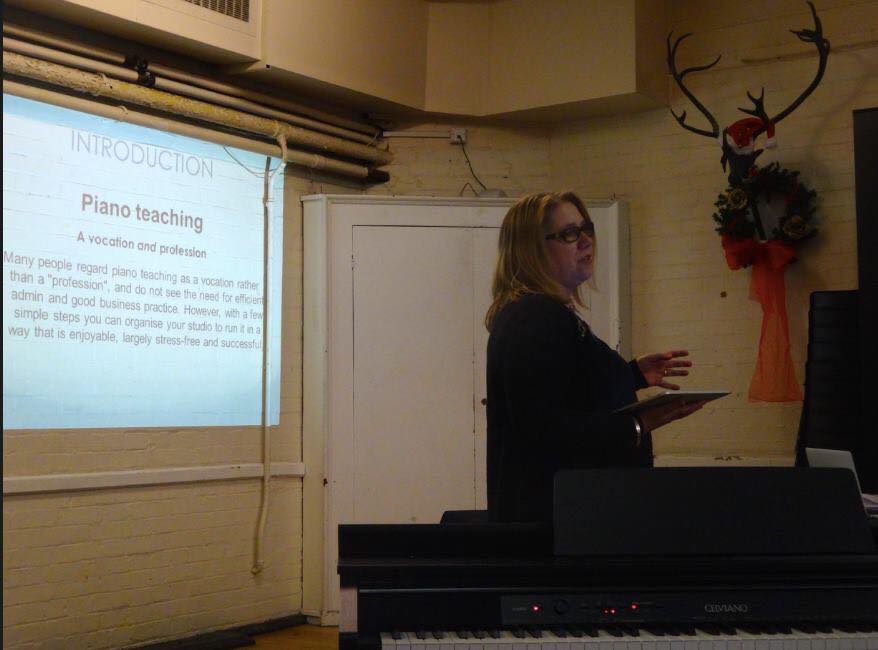
The following text formed the basis for a presentation and discussion which I led at a workshop for piano teachers held on Sunday 23rd November at Cecil Sharp House in north London. The presentation slides can be accessed here (Powerpoint presentation) or here (PDF file).

A vocation and a profession

Many people regard piano teaching as a vocation rather than a “profession”, and many do not understand or see the need for admin and business practice to enter into the craft of piano teaching. However, with a few simple steps you can organise your studio to run it in a way that is enjoyable, largely stress-free and profitable

10612940_1002689153080373_8621179464935562584_n

MARKETING YOUR STUDIO

1. Website

This is the 21st century business card and the first port of call for most people who are looking for a piano teacher.  Your website is your “shop window” and you should present a professional appearance. Pick a website design that is clear, accessible and easy to navigate. Having a website allows you to put up things like your studio policy, fees, term times (if applicable), business hours, your CV and qualifications, and teaching philosophy. Some teachers also like to include exam results and testimonials, sound and video clips and links to other sites. A well-designed website reduces time-wasting questions. You don’t even have to pay a specialist web designer to create a website: attractive and easy to build templates are available free from platforms such as WordPress, Blogger, Wix and Tumblr.

2. Get listed

Take advantage of free listings on sites such as MusicTeachers.co.uk and also local sites such as Mumsnet or a local site for small businesses (I belong to something called Teddnet). Being listed shows you are proactive and “out there”. Local music shops often have teacher listings too.

3. Use social networks

Don’t underestimate the usefulness of social networks such as Facebook and Twitter. Use both platforms to advertise your studio and connect with other teachers and music professionals etc around the world. Include links to your Twitter and Facebook profiles on your website. You can set up a Facebook page which is separate from a personal Facebook profile. Be intelligent about how much information about yourself you share on these networks, but don’t be afraid to use them: they can be a fantastic source of resources, information sharing and interaction between others in the profession.

BEING PROFESSIONAL

Adopt a professional demeanour in everything you do – from the way you dress to teach to how you interact with your students and their parents (your “clients”)

Have a clear studio policy/T&Cs and post this on your website. And stick to it! If you don’t offer catch up lessons, don’t make an exception for one or two students. Your policy must include information on payment, cancellation and make-up policies, punctuality, practising, exams and your expectations of parents and students. Some teachers ask students/their parents to sign a contract to indicate they have understood the T&Cs. Clear policies like these give credibility and confidence by setting expectations from the outset and let everyone know they are being treated fairly. You can also refer to them in the future to clarify things for anyone who may have forgotten or who queries missed lessons, payment of fees etc.

You can obtain a contract template from bodies such as EPTA and ISM.

Fees – always a tricky area as you don’t want to price yourself out of the market nor undersell yourself. Your fees should reflect your experience and qualifications but also take into account the demographic of area you live/work in. Look at what other teachers in your area are charging for guidance. The ISM publishes an annual survey of fees which gives a national average (currently £25 – £36 per hour for private instrumental teaching outside London) and London average (currently between £30-£50). How you choose to bill your students is up to you, but invoicing termly or half-termly reduces admin. Collecting fees can be a major headache so encourage all your clients to pay by direct bank transfer and give a date by which fees must be paid each term. Consider using billing software such as Music Teacher’s Helper (30-day free trial)

Tax and record keeping – be scrupulous about record keeping and keep your tax affairs in order. Use a tax accountant to help you if necessary.

Join a professional body such as EPTA or ISM if you feel this will lend credence to your professional standing. These bodies offer free listings, legal advice, , child protection, and can assist in disputes about fees etc

Get CRB checked – if you work with children you need to be completely transparent. An Enhanced Disclosure Certificate (formerly CRB check) is easy to obtain https://www.gov.uk/disclosure-and-barring-service-criminal-record-checks-referrals-and-complaints#types-of-check. State on your website that you have this certification.

Ongoing professional development – attending seminars, workshops and courses all feed into your teaching experience, allow you to connect with other teachers, and demonstrate that you are a teacher who is enquiring and interested in keeping up to date with new trends in piano pedagogy.

Personal development as a pianist – taking lessons and attending courses, masterclasses and conferences, learning new repertoire, performing, demonstrating to students that study does not end at Grade 8; that it is an ongoing process

Extra-curricular activities – enhance and add value to the teaching experience for your students by organising concerts and encouraging them to enter competitions and festivals, attend concerts and visit museums with musical connections. Student concerts are a wonderful way of celebrating your students’ achievements and allow family and friends a chance to see how your students are progressing. They are also a way of showing that piano lessons and regular practise bring recognisable achievement and progress.

Feel in charge of your own professional destiny and maintain your integrit  – for example, setting fees which you feel reflect your value and experience; being honest about who you want to tell (you don’t have to take on everyone!), setting high expectations of yourself and your students; not resting on the laurels of exam successes.

Related articles

An Image Crisis in Independent Piano Teaching?

Being Professional – the debate