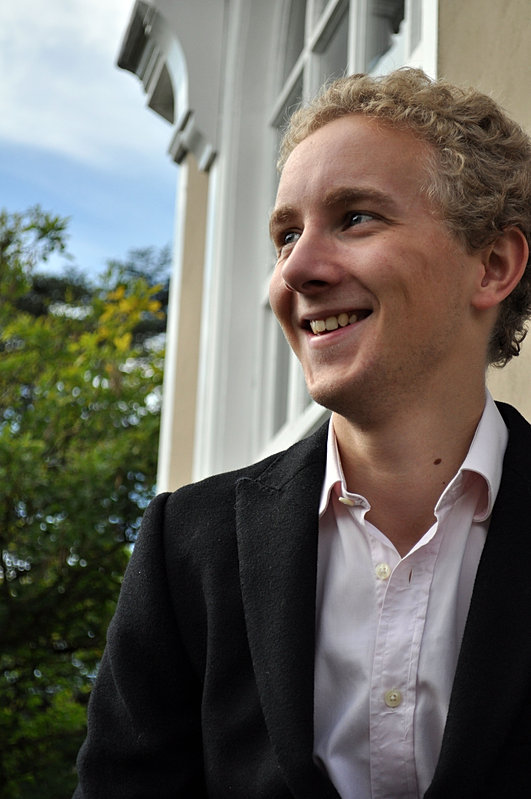
(photo: Roberto Masotti)

Who or what inspired you to take up the piano and pursue a career in music? 

I was inspired by the music and my never-ending desire to be part of such a unique art form, be absorbed by it, forgetting everything around me and becoming the music itself by bringing it to life under my fingers. Only then, being able to communicate it to others.

Who or what were the most important influences on your musical life and career? 

Musicians and artists around me, such as the countless performances, concerts, operas, ballets, expositions I was enriched with since I was a child and now. Also, my teachers, contemporary music and the art and the beauty I was surrounded by in my native Tuscany.

What have been the greatest challenges of your career so far? 

Playing Stockhausen for Stockhausen. I was really nervous, and being very young I wasn’t sure at all if what I had carefully prepared by myself was simply “right”.

Which performance/recordings are you most proud of?  

My next recording, which will be out soon.  It focuses on the evolution of Stravinsky’s music, starting from his folk roots, his native Russia and traditional folk tunes and themes featured in Petrushka. Stravinsky is then inspired by returning to music of ancient Classicism also following his refusal of the new revolutionary Russian ideals, and it is what we call now his “neoclassicist” period. Here I linked it with the Suite for piano or harpsichord by living French composer Karol Beffa. It features at the same time Stravinsky’s concept of “non descriptive” music as “the music expresses it-self”. It is followed by his serial period: Stockhausen and Stravinsky influencing each other. Stockhausen was influenced in his youth by listening to the Rite of Spring. Less obvious is the influence of Stockhausen’s serial groups music on Stravinsky’s later production.

Which particular works do you think you play best? 

Everything I love.

How do you make your repertoire choices from season to season?

Ideally every recital I play would feature one new piece and a juxtaposition of music picked from my repertoire. I always follow my wishes when choosing new repertoire.

Do you have a favourite concert venue to perform in and why? 

I love to perform at the Wigmore Hall: the projection of sound is very clear and transparent yet rich and warm.

Favourite pieces to perform? 

I have many, and these have been changing over years. At this particular moment I would say Chopin Piano Concerto n. 1, the 4 Chopin Ballades, Petruska by Stravinsky, and Brahms Paganini Variations among others.

Listen to? 

The Rite of Spring

Who are your favourite musicians?

Igor Stravinsky, Sviatoslav Richter, Natalia Gutman.

What is your most memorable concert experience? 

One of them was performing Liszt Piano Concerto n.1 at the Berliner Philharmonie: just before walking on stage the conductor I was playing with said to me the following words: “just think about music”. I will remember that forever, and it gave me huge confidence. Only after the closing chord of the Concerto performance I realized I was surrounded by thousands of people in this amazing artistic architecture.

What do you consider to be the most important ideas and concepts to impart to aspiring musicians? 

We do it to make people’s lives better.

What are you working on at the moment? 

On my next recitals: chamber music programmes, concertos and recitals including Schumann’s Adagio and Allegro, 5 Pieces in Folktunes, Janacek Pohadka, Tsintsadze 5 Pieces, Rachmaninov cello and piano Sonata, Chopin Polonaise Brillante for cello and piano, Bartok Romanian Dances, Beethoven Spring Sonata, Franck Sonata, Chopin Ballades, Rachmaninov 2nd Concerto, Arensky and Shostakovich 1st Trios, C.M. Weber and Nino Rota and Tchaikovsky Trios and a solo recital programme featuring Mozart and Liszt, up to December 2014.

Where would you like to be in 10 years’ time?

Around the world performing every day.

What is your idea of perfect happiness?

See above plus my and my dears’ health.

What is your most treasured possession?

Hand written notes.

What do you enjoy doing most?

Being surrounded by friends, reading, travelling.

What is your present state of mind?

In constant pursuit of perfection.


Vanessa Benelli Mosell is a rising star on the international music scene. She is continuously praised for her virtuosity, her technical brilliance and the sensitivity of her musical insight, which have been shaped significantly in mentorships with Karlheinz Stockhausen and Yuri Bashmet.

Benelli Mosell gave her debut appearance at eleven years old with pianist Pascal Rogé, who described her as “the most natural musical talent I have encountered in my entire life”. She has since performed with orchestras such as the Münchner Symphoniker, Berliner Symphoniker, the Zurich Chamber Orchestra and Orchestra del Teatro Comunale di Bologna.She also performed with the Moscow Soloists, replacing Martha Argerich in 2012. In the same year, Vanessa gave her celebrated debut at Londonʼs Wigmore Hall. Last year was one of new encounters including a tour to South America, concerts with the Jerusalem Symphony Orchestra and the Orchestre Philharmonique de Strasbourg, as well as a sell-­out solo recital at Hamburgʼs Laeiszhalle.

Vanessa Benelli Mosell began her comprehensive musical studies when she was exceptionally admitted at the International Piano Academy in Imola at seven years old, where she studied with Franco Scala. In 2007 she was invited to the Moscow Tchaikovsky Conservatory to study with Mikhail Voskresensky. Vanessa entered the Royal College of Music in London in 2007, where she graduated in 2012 studying with Dmitri Alexeev, generously supported by the Russell Gander Award.

Full biography

www.vanessabenellimosell.com

This week I was delighted to attend a concert to launch British pianist Richard Uttley’s new CD Ghosts and Mirrors. Richard is a passionate advocate of contemporary piano music, and this CD, his third, follows his previous recordings with its focus on contemporary and 20th-century music. In addition to works by Toru Takemitsu and Luciano Berio, the disc includes the first recordings of Marvin Wolfthal’s Lulu Fantasy and Mark Simpson’s Barkham Fantasy which was written especially for Uttley and was premiered at the Royal Festival Hall in 2010.

Richard explains the title of his CD as “the works collected here [are] are reflection on something”, and the “ghosts” appear, in part, in memoriam to departed composers, namely Messiaen (Takemitsu/Rain Tree Sketch II and Murail/Cloches d’Adieu, et un Sourire). There are more metaphoric ghosts and reflections here too: Thomas Ades harks back to the Mazurkas of Chopin and Szymanowski in his Op. 27 Mazurkas, while Marvin Wolfthal’s Lulu Fantasy is a paraphrase on themes from Berg’s opera which charts the rise and horrific fall, ending in death at the hands of Jack the Ripper, of its eponymous heroine. In Mark Simpson’s Barkham Fantasy, the work opens with a fragment of an “alberti bass”, an eighteenth-century musical device in which chords are broken or arpeggiated to create continuous sound.

It can be hard to present a programme entirely comprising contemporary music in concerts (witness the BBC’s anxieties about this in its Proms broadcasts this year – more on this issue here) and some performers seek new ways to present contemporary programmes which challenge and excite the eyes as well as the ears. Thus, Richard Uttley, was joined onstage by Nat Urazmetova, a visual artist, who created the artwork for the CD, and who designed and mixed live visuals as Richard played. These were not a simple “accompaniment” to the music, but rather had been designed to reflect not only the mood and characteristics of the pieces performed (a selection from the CD), but also textures, colours, dynamics and articulation. From trembling, pulsing sea anemones to a dizzying, plane’s eye view of London at night, the frenetic rhythm of a weaving machine to an unsettling tour of a ruined Gothic church, these visuals enhanced and informed the music, without detracting it from it. Perhaps the most powerful was the film which accompanied the Lulu Fantasy, suggesting the horrible fate of the protagonist through shuddering black and white images, hinting at sexual depravity and violence.

It was evident throughout the performance that Richard really enjoys the challenges, both musical and technical, of playing this kind of repertoire. His total immersion in and understanding of this music produced a performance that was entirely convincing, and, more importantly, extremely absorbing.  A pristine sound, clean articulation and broad dynamic range combined to create one of the most exciting concerts of contemporary music I have attended. I was pleased to find even more to delight and intrigue in the CD, which is also elegantly designed with copious and intelligent liner notes by Richard, with contributions from the composer’s themselves.

Recommended.

‘Ghosts and Mirrors’ is available on the ARC label

www.richarduttley.com

Who or what inspired you to take up the piano, and make it your career? 

When I was 4, my parents bought a piano from a friend.  No one in my family plays an instrument, so it happened by chance.  Soon after, my musical abilities were discovered – I had perfect pitch and good musical memory, and I started taking piano lessons and other musical classes at the music school in my hometown, Dnepropetrovsk, Ukraine.  Another turning point was when I was accepted at the age of 13 to study at the Special Music School for gifted students in Kharkov, Ukraine.  Somehow, I never questioned my desire and intended to become a musician after that.

Who or what were the most important influences on your playing? 

My piano teachers – Victor Makarov in Ukraine, probably one of “the most wanted” teachers in the country at that time, whose knowledge, musicianship and energy still inspires me; Alexander Volkov in Israel, who taught me to better hear and convey beauty of music; and Solomon Mikowsky, who helped me to refind my musicianship and find my own voice.

What have been the greatest challenges of your career so far? 

To find the true meaning of every piece I work on, and to match my inner image to what comes out my fingers.  Also, to find fresh view on the pieces I’ve performed many times.

Which recordings are you most proud of? 

My all-Schubert CD

Do you have a favourite concert venue to perform in? 

Palau de la Musica Catalana in Barcelona; Preston Bradley Hall at the Chicago Cultural Center, Tel Aviv Museum of Art

Favourite pieces to perform? Anything by Schubert; Schumann Humoreske

Listen to?  Mozart Symphonies, anything by Bach.  Also, recently – music for Soviet cartoons (I discovered that those are masterpieces! Listening together with my now 11 month old daughter)

Who are your favourite pianists? 

Sviatoslav Richter, Emile Gilels, Vladimir Horovitz, Arthur Rubinstein

What is your most memorable concert experience? 

Performing in a two-piano encemble with a blind pianist, Carlos Ibay in a concert dedicated to 60th birthday of Israel in Jerusalem in 2008.

What do you consider to be the most important ideas and concepts to impart to aspiring musicians? 

Stay true to yourself.  Do not try to copy anyone, or “please” anybody.  Try to find your own, unique calling in music.

What is your idea of perfect happiness? 

To be busy working on many interesting projects alone or with inspiring musicians (this may happen!), and to have an adequate time to spend on those projects, family, and rest (this may never happen!)

Inesa Sinkevych is a Ukrainian born Israeli concert pianist, currently living in New York. Her recent CD, ‘Schubert Piano Works’ was released in 2012. She has performed as a soloist with the Israeli Philharmonic, Minnesota Symphony, Gulbenkian Symphony, Gran Canaria Philharmonic Orchestras, as well as solo recitals in such venues as the Purcell Room at the Queen Elizabeth Hall in London, Palau de la Musica Catalana in Barcelona, and Merkin Hall in New York. She was awarded top and special prizes at the Arthur Rubinstein International Master Piano Competition in Tel Aviv, Piano-e-Competition in Minneapolis, Vianna da Motta International Piano Competition in Portugal, among others. She received her DMA from the Manhattan School of Music.

inesasinkevych.wordpress.com

Over the past weeks and months I have been working, amongst other things, on pieces by two great composers of music for the piano – Beethoven and Schubert (the Piano Sonata in A flat, Opus 26, and the Impromptu in F minor, D935/1 respectively). For both pieces, I have been working from the Henle urtext edition of the score.

A good urtext score is the result of careful scholarly research and editing, offering a “clean” version of the manuscript, without the distractions of an editor’s markings, and opinions, and is the most faithful indication of the composer’s original intentions, which provides the starting point for independent thought and interpretative possibilities.

newsign

But before we start exploring interpretative possibilities the music offers,  it is important that we study the score carefully, taking note of the composer’s directions and markings. As I say to my students, the score is our “map”, with “signposts” to guide us in tempo, mood, expression, articulation, dynamics. At a simplistic level, these markings tell us “how to play the notes”, and we ignore them at our peril.  These markings are also the composer’s personal “signs”, indicating to us how he/she imagined the music and illuminating for us, at a distance of often several hundred years, how he/she expected it to sound. Some composers write very little in their scores, but what they do write is precious and important; others offer very clear instructions and even some very quirky ones (Olivier Messiaen, for example, even added his annotations about the “colours” of notes and chords as he perceived them as a synaesthete, and Satie’s Gnossiennes are liberally annotated with curious quotes). Composers knew what they were doing and many were experienced performers themselves (Beethoven, for example, before his deafness forced him to retire from public performances), with clear indications of how to bring their music to life, and, in piano music, how to create different textures and suggest different instruments, from a woodwind solo to a full orchestral tutti.

Last year, I worked with one of my students on the Rondo from Beethoven’s Sonatina in F Anh. 5 as part of his Grade 4 exam programme. This (and the other Sonatinas) is a wonderful introduction to Beethoven’s piano music, in particular the piano sonatas, and offered my student (and me as teacher) an important lesson in showing fidelity to the score. I think my student grew quite bored of me saying “Read the score! Look at the details!” at every lesson, to impress upon him the importance of following Beethoven’s directions. This score is not so heavily annotated with directions as the Opus 26 Sonata on which I am currently working, but it has enough in it to demonstrate Beethoven’s clear intentions, in particular suggesting different instruments (staccato in the opening measures suggests woodwind – bassoons and oboes), textures (the forte at bar 4 suggests the full orchestra and demands a rich, orchestral sound), and expression (note that the D minor section is largely played legato, adding to the more sombre, lyrical mood of this section). By accurately observing the markings as written in the score, my student was able to create a colourful and faithful reading of this work, largely based on what he had in front of him on the page.

By the same token, the markings in the Sonata Opus 26 offer clear instructions as to how the piece should be played. Throughout the opening movement, Beethoven suggests string-quartet textures and string articulation in both the organisation of the main melodic line, interior harmonies and melodies, and accompaniments, and also through detailed articulation, indicated by staccato, drop slurs and sforzandi. In addition, his very specific dynamic markings lend drama and colour to the music. I find the opening movement, a theme and five variations, most intriguing because of Beethoven’s interest in exploring rhythm, articulation and texture as a means of creating variants on the opening theme: the melody is always there, but in each subsequent variation it is cleverly embedded. In the final variation, all the string quartet textures are given glorious full rein in music of great lyricism and wit.  (It is worth listening to the second movement of the Opus 47 Sonata for Piano and Violin, the ‘Kreutzer’, also a theme and variations, with reference to the opening movement of the Opus 26.)

Schubert, like Beethoven, had clear ideas of how he intended his music to be played. There are certain pianists who choose to ignore Schubert’s directions, perhaps the most cavalier sin of omission being the exposition repeat in the final piano sonata. British pianist Stephen Hough describes this movement as “Schubert’s miraculous ability to bare his soul without a trace of narcissism” – and I feel this sentiment also applies to the repeats in the Impromptu D935/1. The sections in question (bars 69-83 and 84-109) are the first time we hear a beautiful and tender “trio” of duetting fragments in treble and bass, with a undulating semiquaver accompaniment which provides the harmonic structure, a structure which is, in itself miraculous. To hear these sections a second time seems to highlight the delicate poignancy in the music, and lends greater contrast and drama to the sections which precede it and the reprise of the opening motif at bar 115.

Often, the composer’s markings can also tell us a great deal about the kind of instrument with which the composer was working. For example, Chopin’s pedal markings tell us as much about the kind of piano he was used to working on as his musical ideas. Sometimes, coming at these markings with modern sensibilities and a big resonant modern instrument, we might feel his instructions are “wrong”, but it is possible to make small adjustments (a half-pedal mid-bar to avoid a muddy sound or dissonance) and remain true to the spirit of Chopin’s intentions. I was fortunate enough to experience a “Chopin piano” when I played the Pleyel (c1846) at the Cobbe Collection in Surrey. The piano offered many insights into Chopin’s markings and an important reminder that Chopin’s soundworld was more softly-spoken and delicate than some recreations of his sound on a modern concert instrument.

Another prime example of this is the first movement of Beethoven’s ‘Moonlight’ Sonata. At the start, Beethoven gives the direction “sempre pp e senza sordini“. “Senza sordini” translates as “without mutes”, i.e. with the dampers lifted away from the strings by depressing the right pedal. If one were to follow this direction literally on a modern piano, the sound would be very muddy, especially on a large, resonant concert instrument, and the wondrous harmonic changes would be obscured. In Beethoven’s day the piano was considerably more “feeble”, smaller and far less resonant than a modern instrument, and the sound of the undamped strings would not last through the slow changes of harmony. To recreate something like the sound Beethoven probably intended, the dampers should be lifted only fractionally away from the strings to allow a slight blurring between the new harmony and the old.

So, sometimes we have to make considered judgements in order to balance fidelity to the score and the possibilities offered by the modern instrument. As Charles Rosen says in his ‘Piano Notes’, “historical purity is not the most important goal of a performance, particularly when we can never be sure we are getting it right” and an effective performance is usually one which “respects the composer’s directions with absolutely fidelity and yet with imagination”. The performer has a responsibility to adhere to the composer’s directions, but this can lead to difficulties too. If we religiously follow the directions, we can of course produce a very faithful rendering of the music, but it may not be the most interesting version.

This leads us to “interpretation”, which can be defined as an ability to bring one’s imagination and personality to the music. This has its own difficulties – too much of the performer’s own imagination and personality can obscure the music, too little may result in a dull and colourless performance. The best and most memorable interpretations and performances are usually those where the performer fully convinces the audience that he or she has taken “ownership” of the music and made it their own, the result of the artist creating a version of the music that is meaningful and convincing to them personally. At this point, the musician has gone “beyond the notes” and the markings to create something that is both personal and true to the spirit of the composer’s intentions.

This freedom of interpretation is not an easy state to achieve and is something which develops over a long time – time spent living with the music, studying it (away from the piano as well as at the piano), absorbing all the details and nuances, getting to the heart of the music to discover its “meaning” and narrative, “listening around” the music to gain insights into the composer’s style and soundworld, and to set the music in context, an understanding of performance practice, historical contexts and musical taste.

An interesting, simple question of interpretation came up in a recent lesson with a student who is working on Wiegenlied (Lullaby) by Zilcher, a Grade 3 piece. The piece opens in warm F major, with a cantabile figure in the right hand redolent of the ‘Berceuse’ from Faure’s Dolly Suite (I suggested my student listen to this piece for reference). The dynamic range of the music is small, mostly p and mp, retaining the gentle, drowsy mood. The first section ends with a piano marking, before the music moves into D minor and the mood changes. But the dynamic marking is still piano. I suggested to my student that she might consider a more intense sound here, to signal the change of mood. “But how can that p [at the end of the F major section] be different to that one? [start of D minor section] and how do you know that?” asked my student. I explained that not all piano markings are equal (likewise forte, mezzo-forte, mezzo-piano et al!) and that it is down to us, as performers, to interpret the markings and make a considered judgement – based on what we see in the score and our knowledge of the music and the context of the music in general.

Back to the D935 Impromptu, and there are similar considerations of interpretation of dynamics. For example, bar 44 is marked pianissimo – and so is bar 45. But bar 44 is a bridging bar from the descending octave passage which precedes it and an introduction to the new material which follows. I feel it is important to differentiate the pianissimo markings here to signpost what is happening in narrative of the music. Later, at bar 90, the decrescendo suggests not only a diminution in sound but also a relaxation in the tempo (“rubato”). Schubert could have indicated this more clearly, with a rallentando or ritardando marking, but he didn’t, and so one is left to one’s musical instincts, knowledge of Schubert’s writing, his distinctive soundworld to decide how to treat bars or passages like this. Likewise, a crescendo may suggest stringendo (“pressing forward”) to create a greater intensity.

There is of course much to be gained in listening to recordings to gain insight into other performers’ myriad interpretations, and to offer inspiration, but never to imitate, for the following reason:

…what bestows upon the performer the status of artist and on the performance the status of art, is the real, full-bloodied possibility of the performer finding a better or at least different way of performing the music from the way the composer has specifically envisioned and explicitly instructed. This is what bestows upon the performance personal style and originality – what makes it the performer’s “version” of the work and not just the composer’s “version”. Peter Kivy, ‘Authenticities: Philosophical Reflections on Musical Performance’ (Ithaca: Cornell University Press, 1995), 197.

(with thanks to Graham Fitch’s excellent blog Practising the Piano).