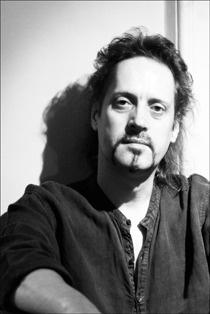
photo: Malcolm Crowthers

Who or what inspired you to take up composing, and pursue a career in music? 

Early years are formative so the environmental factors would include access to pianos (my dad repaired them at one stage) and listening to my mum’s record collection.

Hastings, where I grew up is also a very inspiring place. The American travel writer Paul Theroux singled it out in his tour of the UK coastline as “an artists’ colony full of optimistic romance and spirited intimacy”.

I played one of my piano pieces to Henze and (without knowing where I was from) he said it reminded him of the vague coastline of the south coast of England!

Who or what were the most significant influences on your musical life and career as a composer?  

Channel 4’s series ‘Sinfonietta’, presented by the pianist Paul Crossley who introduced Berg’s Chamber Concerto. Spurred on by this, I bought a recording and tried to get to grips with this tough piece.

Broadcasts from the BBC Proms which stand out: I particularly remember Xenakis’s Keqrops, Barry’s Chevaux de Frise and Michael Finnissy’s Red Earth.

What have been the greatest challenges of your career so far?

Surviving. Beyond that, every new piece presents an artistic challenge, even a more modestly piece such as this latest one for Jonathan Powell. Titles can be tricky. In this instance, I got the idea from a furniture shop of the same name, near the Columbia Road flower market in London.

What are the special challenges/pleasures of working on a commissioned piece? 

Of course, It’s ideal to be commissioned (ie.funded,however small the fee!), but  the challenges are identical to that of a non- commissioned piece.

What are the special challenges/pleasures of working with particular musicians, singers, ensembles and orchestras? 

Jonathan Powell has a good understanding of my piano music, so it is always a pleasure working with him.

In 1999, I played ‘Flaking Yellow Stucco’ (for piano) to the composer and conductor Richard Baker and he noted a similarity with Jonathan Powell’s piano music. At that time, I didn’t know Jonathan or his work.

Which works are you most proud of? 

My Violin Concerto, written for Keisuke Okazaki. A few years after the premiere, it was recorded for NMC with the Esbjerg Ensemble conducted by Christopher Austin.

On a smaller scale, and more recently, I’m very proud of my ensemble piece for Ensemble Reconsil called “The Unrest Cure”.

Who are your favourite musicians/composers?  

Oh, so many!

Of the more recent composers I’d include Aperghis, Babbitt, Dillon, Finnissy, Holt, Toovey and Xenakis.

As well as composing, I also play for dance classes and within this sphere the New Zealand born John Sweeney is without doubt the most amazing improviser I have encountered. He also accompanies silent movies.

What is your most memorable concert experience? 

The London Sinfonietta celebrated its 25th Anniversary in 1989 at the Royal Festival Hall and a frail Michael Vyner (at that time artistic director of the ensemble) walked onto the stage to give a speech. It was a landmark occasion which was also televised, and with hindsight marked the end of an era. I particularly remember the new pieces by Birtwistle and Simon Holt, and the Suite from Henze’s opera ‘The English Cat’. I went backstage where Simon Rattle and Paul Crossley kindly signed a Birtwistle record I’d recently bought.

What do you consider to be the most important ideas and concepts to impart to aspiring musicians?

Don’t get sidetracked by commercial considerations.

Where would you like to be in 10 years’ time?  

London is a fantastic city so I’d happily still be here, albeit hoping for a halt on the unfortunate homogenisation and destruction which seems to have taken grip recently. In a nutshell, private interests prioritised above every other value humans might hold.

What is your most treasured possession?  

Besides an upright piano, a huge print I’ve got on the wall of somewhat dilapidated buildings in Cuba.

What do you enjoy doing most? 

Besides more art-orientated things, swimming – ideally in the sea, but i like the Olympic Pool in Stratford.

What is your present state of mind? 

Cheerful

Jonathan Powell gives the London premiere of Morgan Hayes’s ‘Elemental’ on Friday 8th May at Rosslyn Hill Chapel, Hamsptead, London NW3. Concert starts at 7.30pm, tickets on the door.

Morgan Hayes won the Guildhall School of Music & Drama’s coveted Lutoslawski Prize in 1995; he subsequently studied with Michael Finnissy, Simon Bainbridge and Robert Saxton. His early works include Mirage (1995) and Viscid (1996), the latter recorded by the Composers Ensemble for NMC.

Since then, a series of ambitious pieces composed for many of Britain’s leading new-music ensembles, has included Shellac (1997) for piano and orchestra, and Slippage (1999). An accomplished pianist, Hayes has also composed numerous works for solo piano, which have been performed by soloists including Andrew Ball, Stephen Gutman, Rolf Hind, Sarah Nicolls, Ian Pace and Jonathan Powell.

As 2001-2002 Leverhulme Composer-in-Residence at the Purcell School, Hayes’s major achievement was the ‘Tatewalks’ project, based on Mussorgsky’s Pictures at an Exhibition, and involving young composers in collaboration with photographer Malcolm Crowthers and with the London Sinfonietta, who featured the work in the 2002 ‘State of the Nation’ festival; the Sinfonietta also commissioned Hayes’ transcription of Squarepusher’s Port Rhombus for the South Bank Centre’s 2003 ‘Ether Festival’.

Hayes’ works include Opera for violin and piano, inspired by Italian director Dario Argento’s giallo classic Macbeth and written for Darragh Morgan and Mary Dullea; Lute Stop (2003) for solo piano, premiered by Sarah Nicolls; Hayes’  2005 BBC Proms debut with Strip; and the Violin Concerto, a Birmingham Contemporary Music Group ‘Sound Investment’ commission, premiered by Japanese soloist Keisuke Okazaki.

More recent commissions include Original Version, for the 2007 Spitalfields Festival; Futurist Manifesto for string orchestra, commissioned by the Munich Chamber Orchestra. A period as composer-in-association with Music Theatre Wales, resulting in Shirley and Jane, an operatic scena based on the career of Dame Shirley Porter; a Smith Quartet commission, Dances on a Ground (2009); and Dictionary of London, for the NMC Songbook.

Occasionally I and indeed other musician friends and colleagues have come across the suggestion from other professional musicians and even some teachers that certain repertoire is the exclusive preserve of the professionals and should be left well alone by “amateurs”. This includes the final piano sonatas of Beethoven and Schubert, the Goldberg Variations, Chopin’s Piano Sonatas, Balakirev’s ‘Islamey’, Ravel’s ‘Gaspard’ and all of the big well-known piano concertos. The suggestion is that no amateur could possibly ever be “good enough” to master any of these great works and that the professional “know” how to play them best. Conversely, I recently I came across a blog post describing a suite of miniature variations as music for the “amateur pianist”, the implication being that no pro would touch it (in fact, the variations in question were premiered by pianist Melvyn Tan and have subsequently been performed by him to much acclaim: more on the blurring of the boundaries between professional and amateur later in this post….)

I posed the question “Should certain repertoire be off limits to amateur pianists?” in a piano group I belong to on Facebook and it was met with a stream of lively and vociferous comments. Most people agreed that no repertoire should be off limits to anyone, with the proviso that we should all be aware of our own limitations and select repertoire which we are capable of mastering. There were interesting comments about bad performances of great music by so-called amateur musicians and how this appropriation of the great composer’s great works shows a lack of respect towards the music, but the general consensus was that amateurs should have the freedom to play whatever they like. Indeed any musician should have the freedom to play whatever they like: music was written to be played and fundamentally it matters not a jot whether one plays badly in the privacy of one’s living room or beautifully to a paying audience. It is about exploring and loving this wonderful repertoire.

I have occasionally taught adult amateur pianists and I find their ambitions to master Rachmaninov’s Second Piano Concerto sometimes have to be tempered by their limitations. A good teacher will guide and advise, suggesting repertoire that is achievable so that the student gains experience, develops technique and musicality and above all enjoys playing the music, rather than growing frustrated by it because it is too challenging. However, I also believe that we shouldn’t always play within our comfort zone, and I think it’s important to have one or two pieces in one’s repertoire that are challenging and “difficult” (for me currently this is Schubert’s penultimate piano sonata). Learning and playing outside our comfort zone pushes us, forces us to problem-solve, tests technique and musicianship, and equips us with useful learning tools which can be applied to easier repertoire. Alongside this, it is also important to have repertoire that is doable, and even some that is “easy”. In fact, it is hard to play easy music well (often because there is nowhere to “hide” in easy music): the simplest pieces played beautifully can be the most exquisite. This brings me back to the suite of variations which have been labelled “for amateur pianists” by another blogger, thus suggesting that this is not the kind of music a “professional” would touch. How ridiculous! Anyone can play this repertoire, and anyone can gain enjoyment and pleasure from it.

In 2013, I co-founded a London-based group for adult amateur pianists which meets regularly for informal performance opportunities and to socialise. Pianists of all ages and abilities are members and everyone clearly adores the piano and its repertoire. Occasionally people have come to performance platforms and stumbled through a favourite piece or attempted something that is clearly beyond their capabilities, or not ready for a public performance. Here it is a case of “knowing one’s limits” rather than feeling that repertoire is “off limits” – and I always advise people to select music they know well and feel comfortable with for such performance events. At the other end of the scale, some members of my piano group are fine pianists and seasoned performers. Many have attended music college or achieved external performance diplomas (such as DipABRSM, ATCL, LRSM, LTCL and FRSM) but have chosen to pursue another career path (we have an actuary, several doctors and scientists, a lawyer and video games designer amongst our members). These “amateur” pianists play to what most people would consider a “professional standard” and if one were to do a blind performance of these people and some professional pianists, I doubt anyone could tell the difference. At this point the boundaries between amateur and professional become extremely blurred and the only difference is the career choice and the pay cheque.

The joy of being an amateur pianist is that one can play whatever one wants to because one is not in the thrall of concert trends, agents, promoters and the mortgage/rent. Many professional pianists envy this freedom because it puts one in touch with the real reason why music was written – to be played and enjoyed. As a professional, it is important to retain that joy and excitement in the music to avoid concert giving and performing turning into a chore (and the best performers, professional or amateur, will transmit that joy and excitement in their playing).

So go ahead, play what you like. Love your piano and its glorious and hugely varied repertoire. And if you are looking for something a little different to try from contemporary piano repertoire may I suggest the following:

Variations for Judith – a set of variations based on the Chorale ‘Bist du bei mir’ (Stolzel arr. J S Bach) with contributions by Richard Rodney Bennett, Tarik O’Regan, Thalia Myers and Judith Bingham.

A Little Book of Hours – Peter Sculthorpe. Don’t be put off by the description “elementary”. These seemingly simple pieces take care and thought to shape their spare melodies and unusual harmonies.

The Complete Piano Etudes – Philip Glass. I’ve just discovered these works by the master of American minimalism. Technically and musically challenging and very satisfying to play

Unicorn in Rainbows – Alison Wrenn. A beautiful short work infused with jazz harmonies, lingering chords redolent of Bill Evans, and subtle rhythms.


‘The notes I handle no better than many pianists. But the pauses between the notes – ah, that is where the art resides!’
Arthur Schnabel, pianist (1882-1951)

Tempo Rubato is rhythmic flexibility within a phrase or measure, or a relaxation of strict time. Literally ‘stolen time’, rubato is perhaps most closely associated with the music of Fryderyk Chopin, his friend and fellow composer Franz Liszt, and other composers of the Romantic period. But it is possible to achieve rubato effectively in Bach and other baroque music: indeed, all music, to a greater or lesser extent, should contain rubato in order for it to sound natural. While we should never lose a sense of pulse, music that is strictly metrical, with no sense of shape within phrases or sections, can be dull and monotonous, both to listen to and to play. Playing with rubato allows more space and room to ‘breathe’, giving the music greater expression.

Other instruments, and particularly the human voice, are able to achieve greater expressiveness through sound alone, but because the piano is a percussive machine, the pianist must employ different techniques to achieve expression. When listening to music, the audience want to be ‘surprised’ or ‘satisfied’, and when we are playing, we should be aware of musical ‘surprises’ within the score (unusual harmonies, suspensions, unexpected cadences etc) as well as instances of ‘satisfaction’ or ‘gratification’ (resolutions, full cadences, returning to the home key etc.). We can highlight these through dynamic shifts, and also by the use of rubato – arriving at a note or end of a phrase sooner or later to achieve either surprise or a sense of delayed gratification. Done badly, rubato can sound contrived and self-indulgent; but done well, it can bring subtle shape and expression to a piece.

The opening of Debussy’s Reflets dans l’eau from ‘Images’

Rubato is not always written into the score and is often at the discretion of performer or conductor. It is perhaps most obvious when one hears a singer perform, and as a pianist, we can learn much from reimagining – and singing out loud – the melodic line of our music as if it is a line of song. We can make subtle changes in the rhythm, lingering over one phrase, imbuing another with urgency, to communicate the feelings that the music awakens within us. Sometimes simply delaying our arrival at a certain note can increase the sense of an accent or sforzando rather than laying extra emphasis or force on these notes through finger or hand weight alone. It is the placing of the note and the fractional silence before it that can achieve the most poetic effects.

A crescendo marking can be used to set the music free and let it take flight. Often, our natural inclination when we encounter a crescendo marking is to increase the tempo slightly – just as we might slacken in with a diminuendo. We can also highlight other aspects such as dissonance or unusual harmonic shifts by varying the tempo slightly, or allowing a certain spaciousness when playing repeated notes, for example. The key to good rubato is for it to sound natural: it is the subtlety of rubato that makes it so convincing. The best rubato comes from within, and it should always be intuitive and unforced. It is also very personal and something that develops through spending a lot of time with the music, and making a detailed study of the score (at the piano and away from it) to gain a fuller understanding of the composer’s intentions and a sense of one’s own ‘personal sound’. Gradually, rubato becomes intuitive as we achieve a greater understanding of the music’s shape and its natural ebb and flow.

This article first appeared on the Pianist magazine website and in the April 2015 Pianist magazine e-newsletter

(Photograph by Marco Borggreve)


Who or what inspired you to take up the piano and make it your career?

My family owned a piano but no one was playing it. I was somehow intrigued by it and began to pick out all kinds of cheesy radio tunes and later tried to harmonize them. The piano is a very friendly instrument if you are 5 years old and eager to make a sound, much more so than the violin which makes you practically languish for months until anything more than a scratch is heard. But more than that, I particularly remember how gloriously rewarding it felt to be able to add my own crude chords to those tunes and to literally touch the magic that is melody and accompaniment.                                                                                                                          

Who or what were the most important influences on your musical life and career?

I was very lucky to have a rich musical education from a very early age and the opportunity to study not only piano but also composition and improvisation since I was about 9 had a big influence, I feel, on the way music seemed to me. I would like to think that it enabled me to look at music also through the eyes of the composer and not only from the angle of the performer.

But I was also emotionally affected a lot by the life stories of the great composers, particularly Mozart (Amadeus had just come out as a movie and I went to see it 3 times! At the part where they sing the finale of The Abduction from the Seraglio I completely forgot I was at the movies and started applauding vigorously – I can still remember all those heads turning back at me…) and Beethoven (a dog-eared copy of a book on the lives of composers included a heart-wrenching account of the miseries of his childhood which left me devastated).

Later on, it was mostly recordings that I listened to endlessly as well as a few unforgettable concerts I was lucky enough to be taken to, that made me feel that music was an inseparable part of who I am.

What have been the greatest challenges of your career so far?

The greatest challenge for any performer is to reach the feeling that he or she was able to bring across exactly what they see and feel in the piece and that the audience has been there with them in it throughout. The second greatest challenge is to persist in this quest without being distracted or discouraged by the more mundane aspects of the music business, which are inescapable in their own way.

Which performance/recordings are you most proud of? 

The performances that make me feel most satisfied are the ones where I felt as if (and I repeat, as if!) I was creating the piece as it goes along. Doesn’t happen too often, unfortunately but that’s the goal. As for recordings, I don’t really listen to my own recordings after they are finished because one’s views of pieces naturally changes with time and, of course, once a recording is done, it’s done…

Which particular works do you think you perform best?

I try to avoid seeing works I play this way, because the ones I feel closest to also tend to be ones you spend a lifetime with and never cease to study. But in recent years, I have gravitated towards Mozart, Beethoven and Schubert to a certain extent.

How do you make your repertoire choices from season to season?

I try to start with a main piece that I feel an uncontrollable urge to learn and then see what could go with it in a way that would either illuminate it in an interesting way or that would provide an intriguing contrast to it. I also try to keep a healthy mix of new and less new pieces, as much as possible.

Do you have a favourite concert venue to perform in and why?

There isn’t a single one, but of course there are some that immediately come to mind, with very special acoustics and atmosphere, such as Wigmore Hall in London, to pick a famous example. But also places like Sala di Notari in Perugia, Italy – which is not a full-time concert hall but is absolutely ravishing.

Favourite pieces to perform? Listen to?

I don’t get to listen to music nearly as much as I would like, but when I do I am always in the mood for one of the Mozart da Ponte operas, for example. But there are many others.

Who are your favourite musicians?

What is your most memorable concert experience?

As a child growing up in Israel, one of the concerts that really left a mark was a recital by Radu Lupu which felt like a transformative experience in real time. Another was the first time I heard the Brahms D Minor Piano Concerto. I actually don’t remember the circumstances at all, but I vividly recall the terrifying bang of the timpani and horns in the very beginning and the overall impression that the opening tutti made on me, as if I was being let into the darker realms of music for the very first time.

What do you consider to be the most important ideas and concepts to impart to aspiring musicians?

That what we think we are doing is often perceived very differently to outside listeners and that learning how to listen that way to yourself while you are playing is single most important thing any musician can ever strive to accomplish.

What are you working on at the moment?

More Schubert, as well as Haydn (one of the pieces is subtitled “It takes Eight to sterilize a Sow”…), some Mozart, some Ligeti…

www.shaiwosner.com


