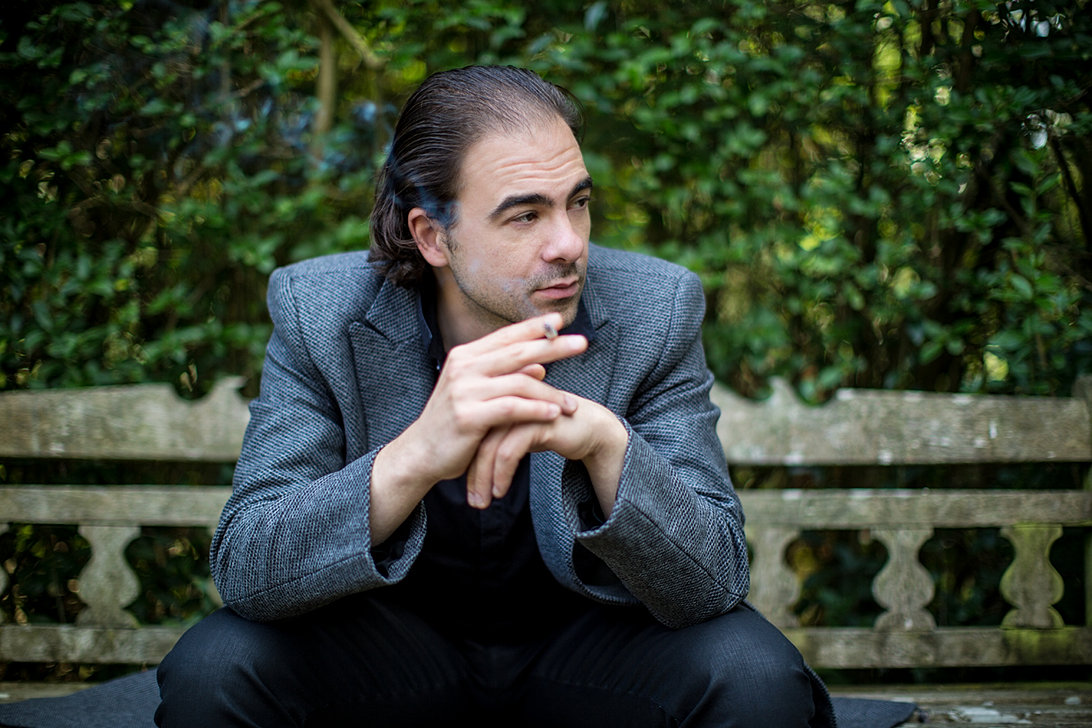
Who or what inspired you to take up the piano and make it your career?
One Sunday morning, on satellite television, I heard for the first time W. A. Mozart’s Eine Kleine Nachtmusik; the family legend says I was in rapture for the whole broadcast and this gave my parents the idea to buy a small toy piano for my next – fourth – birthday. Since that day, piano and music have been faithful companions in my journey through life.
Making it my career was, quite simply, a question I really never posed myself. Practicing the piano was much more entertaining and challenging to me than any other school subject. Certainly it felt much more natural than solving mathematical equations or translating verses from Latin.
Who or what were the most important influences on your musical life and career?
It is amazing how much one can learn from a fellow musician and how the smallest detail, the simplest word or metaphor can have an impact and open a whole new landscape of possibilities and thoughts. I have been very fortunate to study with and learn from tremendously inspirational figures and feel I have inherited from all a composite array of ideas and teachings.
Admiration for artists of the past has played an important role too in my development, on top of being a subject that has often spurred wonderful debates, and I feel that different periods of my life have been marked by an attraction for different giants of the past. When the great Horowitz-Rubinstein debate raged in pianistic circles in the late ‘80s I remember being a faithful follower of the former. Cortot captivated me ever since I heard a Chopin recording in class during my Master’s degree in the USA. Although, if I were forced to make one single name, and I feel you are challenging me for it, Arturo Benedetti Michelangeli is an artist who leaves me speechless and towards whom I am constantly drawn.
What have been the greatest challenges of your career so far?
Mainly the struggle to keep my own development as the primary focus, especially after finishing formal education. I reached emancipation from any doubts after realising the gratification I get in trusting my instinct supported by historical research of a score. Upholding certain principles and my own artistic integrity has guided me through any glitches I may have had at times.
Which performance/recordings are you most proud of?
It is hard to avoid falling for the clichéd answer in this case: the last one. In fact, each album I have recorded is a unique creation; each represents, together with the build up that precedes the red light going on, a set of memories and a particular state of mind in a time and place.
I would like to share a few thoughts on my latest effort, Empire of Sound. The label A Fly on the Wall was set up to allow artists to express their individualities and to capture them at their most creative, taking live footage during recording sessions. A slight, but fundamental, difference with purely studio recordings.
It was by chance I noticed that Debussy’s Second Book of Preludes, Granados’ Second Book of Goyescas and Stravinsky’s Petrouschka (the ballet/orchestral version) were all composed in 1911. All signify a key moment for pianistic writing and music history in general, hence the title – a quote from Debussy in a letter to Stravinsky of the same period. This serendipity was too beautiful to be overlooked.
I could not have asked for a better artistic partnership to put on disc my passion for this programme.
Which particular works do you think you perform best?
I like to think I have a particular affinity for the music and worlds of Schumann and Brahms, although this is just my opinion. Posterity, or the listener, will judge if required.
How do you make your repertoire choices from season to season?
Planning for repertoire often takes unusual and unforeseen twists and turns. One piece may lead to ‘discovering’ another and I especially enjoy finding relations and threads that unite them, to create a combination that, with a little bit of luck, has not been tried before.
Do you have a favourite concert venue to perform in and why?
As an adopted Londoner, Wigmore Hall – inaugurated by the Italian pianist Ferruccio Busoni – is a gem that remains dear to me above all others. I debuted there with the Pavào Quartet on the 40th anniversary of the Moon landing, a date I will forever remember. Aside from the glorious beauty of the stage and the intimate character of the hall, the backstage rooms are inspiring and make one feel part of a centenary musical legacy.
Favourite pieces to perform? Listen to?
Right now it would be Brahms’ Piano Quintet.
Surprisingly perhaps, I seem to escape listening to music as a pastime. Although when the mood strikes, recordings of Bernstein’s version of Tchaikovsky’s 5th Symphony or a Mozart Opera are never far away. I also indulge in some jazz – Jaques Louissier’s Bach arrangements are always in the car – and, probably even more surprisingly, enjoy the dark sounds of Pink Floyd.
Who are your favourite musicians?
Those who know how to listen and have an individual voice.
What is your most memorable concert experience?
When this question arises my memory invariably goes to a solo recital in Nottingham a few years back. I was being driven to the venue and due to difficult road conditions I was still in the car by the 19:30 starting time. Phone calls were made in order to keep the audience reassured of my arrival, which meant I had to change to my performing clothes in the car, enter the venue through the main entrance (free of charge, I admit) and – summing up all courage – start Chopin’s first Scherzo without trying the instrument nor having had a chance to warm up. It all conjured up for a very pleasant post concert celebration.
What do you consider to be the most important ideas and concepts to impart to aspiring musicians?
As with many things in life, it is all about balance. Without a doubt great sacrifices are required through the years, but the priceless payoff is the spiritual relationship created with our instrument. I always insist on the fact that this life-long endeavour gives us a special perspective on the world and a unique means to learn about our own selves.
What are you working on at the moment?
I have two recording projects in the pipeline for A Fly on the Wall. The complete Clarinet Sonatas by J. Brahms (including the transcription for clarinet of his First Violin Sonata) with Jordi Pons and a Violin and Piano recital with Giovanni Guzzo; accidentally, musicians and friends who have an individual voice.
As far as solo repertoire is concerned, I am building a rather wonderful programme based on Variations by different composers, including an exciting 20th century English work.
What is your idea of perfect happiness?
A fleeting moment of awe, a momentary loss of control over the senses. If that fails, a fine meal and a challenging conversation accompanied by a glass of Mosel Riesling and Mozart’s Le nozze di Figaro will get me close to a perfect happiness.
What is your present state of mind?
Rachmaninov is ominously looking towards me and it is suitably late for a short practice session. It’s a good state of mind!
Marco Fatichenti was born in Italy in 1980 to parents of Italian and Spanish heritage. After receiving his Diploma at the Rossini Conservatoire in Pesaro, Italy, he moved to the United States to continue his studies in the class of eminent pianist Joaquin Achucarro at the Southern Methodist University, Dallas. At this institution, by the age of twenty-one, he completed an Artist Certificate program and consequently a Master of Music in Piano Performace. In 2002 Marco was granted a full scholarship to attend the Royal Academy of Music to study with Professor Christopher Elton. Having been a recipient for two consecutive years of the Myra Hess Scholarship, presented by the Musicians Benevolent Fund, and of a prestigious grant by the George Solti Foundation, Marco finished his formal studies receiving the highly coveted DipRAM award.
A keen performer both as recitalist and chamber musician, Marco has performed in some of the most prestigious venues across Europe and the United States, including the Auditorio Nacional de Musica in Madrid, the Teatro Arriaga in Bilbao, the Auditori in Barcelona, the National Concert Hall in Dublin and Birmingham’s Symphony Hall. Recent highlights include an invitation by the Italian Minister for Foreign Affairs to perform at the EXPO in Saragozza, performing on the revolutionary instrument Fazioli ‘Onda’, his debut at Wigmore Hall collaborating with the Pavao String Quartet and a chamber recital in the Palau de la Musica in Valencia.
His performances have been recorded and broadcasted by the Spanish RTVE, Irish RTE, Polskie Radio and several times by the BBC, including a live appearance in the program ‘In tune’ presented by Sean Rafferty. Marco has also released two albums under the Jaques Samuel label, which have received roaring press reviews as well as a great success among the public.
In the past few years Marco has become a very sought after teacher and lecturer, being invited to take a position at Uppingham School and holding annual masterclasses in the prestigious National Young Pianists’ Week.
www.marcofatichenti.net






 The Cross-Eyed Pianist