Award-winning British composer ThomasHewittJones, who has an unashamed love for Christmas and Christmas music, has released a selection of new music for the festive season – from carols for choirs to a dramatic retelling of the Christmas Story, featuring Stephen Fry. Plus a few “Christmas crackers” to entertain and delight…..
Onward We Go
A tuneful, warm and nostalgic tribute to the Christmas story, scored for the children’s touchingly young voices with piano, electric bass and instrumentalists. Words by Gordon Giles, Canon of Rochester Cathedral. Performed by the children’s choir of St Stephen’s Church, Dulwich, directed by Caroline Lenton-Ward. Sheet music available from Stainer & Bell.
The Christmas Story, narrated by Stephen Fry
A dramatic orchestral retelling of the Christmas Story, as told by the Gospel of Luke, narrated by acclaimed actor, broadcaster, comedian, presenter, writer and national treasure Stephen Fry, with the Scottish Session Orchestra and Choristers of St Martin-in-the-Fields, directed by Andrew Earis. Score published by Stainer & Bell.
The Christmas Story will be broadcast on ClassicFM at 6.45pm on Christmas Eve.
The Funny Snowman
From the composer who brought us TikTok sensation ‘Funny Song’, comes another catchy, toe-tapping tune. ‘The Funny Snowman’ has a wonderfully nostalgic vibe, with vocals reminiscent of Frank Sinatra, a “tap dance” section worthy of Morecombe and Wise, and memorable, singalong lyrics which are sure to bring Christmas cheer and merriment. Words by Gordon Giles, Canon of Rochester Cathedral, sung by Freddie Benedict.
Christmas Delivery
Thomas HewittJones says, ‘I am traditionally a last-minute present buyer and wrapper, and the couple of days before Christmas in my family have often been appropriately fraught. I wanted to write an unashamedly light-hearted orchestral encore in the same vein as the orchestral pops of composers such as Leroy Anderson – depicting the mad Christmas rush leading up to the 25th each December. If you listen carefully, you can hear Santa in his sleigh in the sky above, dashing through snowy skies, as the warmth of Christmas is evident to the end.‘
Played by the Scottish Session Orchestra
Camel Carol
The three Magi defer to their trusty steeds in ThomasHewittJones’s hilarious Camel Carol – a perfect offering for choirs this Christmas. Scored for SATB voices and organ, Camel Carol is a light-hearted yet theologically serious take on the visit of the Three Wise Men with their precious gifts, from a trio of grumpy yet not unperspicacious dromedaries. Words by Gordon Giles, Canon of Rochester Cathedral. Sheet music available from Stainer & Bell.
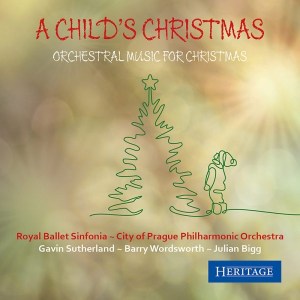
A Child’s Christmas
A collection of orchestral music for Christmas by British composers, curated by Philip Lane, ‘the doyen of light music’ (Gramophone), expertly played by the Royal Ballet Sinfonia and the City of Prague Philharmonic Orchestra. Works by Victor Hely-Hutchinson, Gordon Thornett, Adam Saunders, ThomasHewittJones, Roy Moore, Bryan Kelly, John Lanchbery, and Philip Lane.Performed by the Royal Ballet Sinfonia conducted by Barry Wordsworth & Gavin Sutherland and the City of Prague Philharmonic Orchestra, conducted by Julian Bigg
Released by Heritage Records and available on CD and via streaming.
And finally…..
Crazy Frog Does Funny Song
Funny Song has become a viral sensation with over 14 billion streams on TikTok (it also appears in the new ABRSM Grade 2 cello syllabus!). In its latest incarnation, Crazy Frog, who spawned a worldwide hit single in 2003, and numerous spin offs, does Funny Song. The video has enjoyed almost 6 million views to date since it was launched a couple of weeks ago.
This new release from Heritage Recordings features a delightful collection of music which immediately conjures up the magic, excitement and joy of Christmas, especially for children.
There are jingling bells aplenty, Christmas carols, snowy sleigh rides, Christmas parties, and even a hornpipe, thanks to Philip Lane and Ian Nicholls’ Captain Pugwash Suite. Characters from Beatrice Potter also make an appearance, in John Lanchberry’s suite for the ballet Tales of Beatrice Potter (which I remember seeing, and being utterly enchanted by, as a little girl in the early 1970s).
This enjoyable, uplifting collection of orchestral music for Christmas by British composers is curated by Philip Lane, ‘the doyen of light music’ (Gramophone), expertly played by the Royal Ballet Sinfonia and the City of Prague Philharmonic Orchestra, with conductors Barry Wordsworth, Gavin Sutherland and Julian Bigg.
It’s perfect for enjoying with children, parents, grandparents and friends.
Available on CD and via streaming on Spotify and Apple Music.
Track listing:
Victor Hely-Hutchinson (1901-47): Overture to a Pantomime (1946)
Gordon Thornett (b.1942): A Child’s Christmas (2016) *
Adam Saunders (b.1968): A Magical Kingdom (2003) *
Thomas Hewitt Jones (b.1984): Christmas Party (2016) *
Solo Violin: Simon Hewitt Jones
Roy Moore (b.1948): Santa’s Sleigh Ride (2019)
Bryan Kelly (b.1934): Sing a Song of Sixpence (2020)
Adam Saunders (b.1968): Journey to Lapland (2020)
John Lanchbery (1923-2003):Tales of Beatrix Potter – excerpts
Introduction
Tale of Jemima Puddleduck
The PicnicThe Picnic (continued) & Finale
Thomas Hewitt Jones (b. 1984): Overture: The Age of Optimism (2023)
HEAVEN TO EARTH Joanna Forbes L’Estrange, composer London Voices Ben Parry, conductor Andreana Chan, organist
This is simply beautiful choral writing by someone who knows, from a singer’s perspective, how to compose music which every choir will want to sing.
John Rutter CBE
Heaven to Earth is a collection of singable, accessible, sacred choral music by the best-selling choral composer and multi-faceted musician Joanna Forbes L’Estrange.
The album comprises introits, anthems, canticles, a set of Preces and Responses, and a congregational mass setting, and the 17 pieces display a range of styles, from traditional, church choral music to gospel- and jazz-influenced. Each piece sits comfortably within the SATB vocal ranges, the organ accompaniments are designed to support the choir, there is minimal division within the parts, and the harmonies are attractive and approachable. The texts are drawn from the Bible, the Psalms, The Book of Common Prayer, Holy Communion, writers including St Richard of Chichester, Phineas Fletcher, Jane Austen, and the composer herself, and all of the pieces are suitable for church services: Eucharist, Choral Evensong, weddings and funerals. The settings are written with the intention of enhancing the meaning of the words, both for those who sing them and for those who hear them.
I caught up with Joanna to find out more about her influences and inspirations in creating this album:
Your new album is called Heaven to Earth. Why this title and how does the music on the album reflect the title?
Anyone who’s ever sat in a beautiful church or cathedral in witnessed the evening sunlight streaming in through a stained glass window will know the sensation of a hint of Heaven coming to Earth. When my sons were choristers in the Choir of St John’s College in Cambridge, I would go to evensong as many times a week as I could just to experience that extraordinary, other-worldly atmosphere. It was like a wonderful reset and I would emerge, less than an hour later, feeling completely different from how I felt walking in. By listening to or singing church choral music, we can sometimes get that feeling of recreating the songs of the angelic hosts in Heaven down here on Earth.
The title for this album came to me during one such service. I remember reciting The Lord’s Prayer along with the rest of the congregation and, during the line ‘Thy will be done in Earth as it is in Heaven’, being struck by the notion of praying for things on Earth to be as they are in Heaven. In our busy lives, we can easily be caught up in the endless day-to-day tasks and minutiae of life and the constant news of conflicts, famine and natural disasters. Evensong services allow us respite from this busyness and to be at one with God, whatever we each perceive God to be, with each other and with ourselves; when the music moves you, it can feel as if Heaven has come to Earth. We’re so fortunate that, wherever in the country you find yourself you can pretty much guarantee that there will be a choral evensong happening not too far away.
Almost every piece on this album mentions or alludes to Heaven and Earth. There are those which create strong visual imagery such as in Let My Prayer Rise Up (track 1), where our Earthly prayers rise like incense to Heaven, and High As The Heavens (track 13) which likens the greatness of God’s love to the expanse between Heaven and Earth. Then there are the pieces which remind us that God’s glory can be found on Earth and not just in Heaven, such as For The Beauty Of The Earth (track 10) – ‘For each perfect gift of Thine, to our Earth so freely given, Graces human and divine, Flowers of Earth and buds of Heaven’ – and in my setting of Jane Austen’s prayer Give Us Grace (track 8) in which she writes ‘thou art everywhere present’. Similarly, the words of Holy, Holy, Holy (track 16) includes the line ‘Heaven and Earth are full of your glory’. Elsewhere on the album, there are reminders that Jesus came from Heaven to Earth, such as in the Magnificat (track 3), Mary’s response to the news that she will be the mother of God, and in Drop, Drop, Slow Tears (track 12) which speaks of Mary Magdalene’s tears bathing the ‘beauteous feet which brought from Heaven the news and Prince of Peace’. In Words From The Cross (track 7) we see Jesus communing from the cross on Earth to his Father in Heaven. Finally, there are the pieces such as The Lord’s Prayer (track 18), The Chorister’s Prayer (tracks 5 and 11) and the Preces and Responses (track 6) which long for Heaven’s blessings to be bestowed on us here on Earth, for example this line from one of the Collects in track 6: ‘mercifully grant that, as thy Holy angels alway do thee service in Heaven, so by thy appointment they may succour and defend us here on Earth’.
You have dedicated the album to your foster father, Rev. Richard Abbott. Tell us more about his influence on your musical life and career.
It’s impossible to overstate Richard’s influence on my musical life and my career. Interviewers sometimes assume that, since I’m the daughter and the granddaughter of professional composers and arrangers, this must have been the reason I became a composer myself. In actual fact, it was my foster father, who brought me up from the age of 4 to 11, who encouraged me to start writing music. He and my sister and I had sung together in our local parish church choir; a humble little choir with just one rehearsal and one service a week, but it got me hooked on church choral music. When Richard became ordained in 2007, he asked me to write a piece for the choir to sing as his ordination. I’d been a professional singer for over ten years by that point and, although I’d written a handful of arrangements in my capacity as Musical Director of The Swingle Singers, I hadn’t composed anything original since my GCSE Music coursework! I remember saying to Richard “but I’m not a composer” and him replying “well, I think you might be.” It was a turning point for me; I wrote a setting of Go Forth In Peace (track 21) which the Royal School of Church Music published. Choirs started singing it and sending me nice messages via my website. Not long after that, I was commissioned to write a congregational setting of the mass (The St Helen’s Service tracks 14-17) which again the RSCM published and which many choirs have since adopted as their weekly setting. I find that my experiences as a chorister, as a choir director and as a life-long church-goer all influence me as a composer. I definitely write music from the perspective of a singer more than of a composer, if that makes sense. It’s got to feel nice to sing.
After I left the foster home, Richard and I remained in touch. Once I’d started composing, he would begin every phone conversation in the following way: “Hello darling, how are you and what are you writing at the moment?” He commissioned Saint Richard’s Prayer (track 19) too and cried when I showed him the dedication at the top of the published music. We all need someone like him in our lives to believe in us and to encourage us to believe in ourselves. I was so lucky that Social Services happened to place my sister and me with Richard and his wife Gillian. Perhaps it wasn’t luck at all but part of a bigger plan. In any case, he was my guardian angel just when I needed one most. When Richard died of cancer in October 2022, I knew I wanted to record an album in his memory. I only wish he could have heard the wonderful London Voices singing my music; he’d have been over the moon.
What do you hope listeners will take from the music on your album?
More than anything, it is my hope that people who hear my album will want to sing the pieces themselves. I’m excited about choir directors listening to a track and thinking “Ooh, that would work well with my choir. I’m going to get hold of the sheet music!” The tracks comprise a mix of introits, anthems, Preces and Responses, Canticles, prayer settings, a Mass setting – some are for SATB choir, with or without organ, some have a unison lower line, some are for upper voices – but what all the pieces have in common is that they are singable. Can you tell how hard I’m trying not to use the word accessible?! I find it can have negative and possibly even patronising overtones. What I mean is that I want people to listen to these tracks and have confidence that, however little experience or musical training they may have, they will be able to sing my music. What’s more, they will hopefully find it enjoyable and pleasurable to sing. My husband and I record all of our compositions: I sing the soprano and alto lines and Alexander sings the tenor and bass. There are two reasons for doing this. It’s by recording every line of a piece that you find out how it feels to sing, whether you’ve got the breath markings, note-lengths, dynamics correct and so on. I always make adjustments as a result of this process. The other advantage is that we can create part-learning tracks which we then make available to choirs who find it beneficial to hear their vocal line sung before they learn it.
When I’m composing music intended for use in church services, my overriding motivation is to set the words in such a way that those who hear them are drawn closer to them. Church choral music doesn’t need to be challenging or ground-breaking, in my opinion. There is such beauty to be found in simplicity, something I learned by singing the music of the Taizé community in France; through musical repetition and familiarity, the words come to the fore and the whole experience becomes almost meditative. The same is true of the familiar Gregorian chants of the Medieval music. I like to write music which every choir can sing, not just the professionals. When I found out that over 600 choirs across the world had sung my coronation anthem The Mountains Shall Bring Peace (track 20) it made me so happy.
Singing in a choir is so completely life-affirming. We are so fortunate to have such a rich heritage of church buildings and church music but, sadly, not all churches and their choirs are thriving. The Royal School of Church Music and other organisations such as the Friends of Cathedral Music are doing wonderful work to keep this heritage alive and I want to do my bit to help. People are sometimes put off joining a choir because they think they’re not good enough or don’t have the right background or musical training but my belief is that if everyone sang in a choir, the world would be a better place. And if I can encourage people to do this by composing tuneful pieces which everyone can enjoy singing, I will.
This music is simply heavenly, and no choir, church or performance venue should miss out on the blessing this music brings. Through beautifully crafted accessible melodies, glorious harmonies, and a real ability to convey the sense of meaning of the text, this richly varied repertoire goes straight to the heart.
Ken Burton, conductor, composer, arranger & performer
Music by Thomas Hewitt Jones, narrated by Stephen Fry
Scottish Session Orchestra, Choristers of St Martin-in-the-Fields, directed by Andrew Earis
An orchestral retelling of the Christmas Story, as told by the Gospel of Luke, narrated by acclaimed actor, broadcaster, comedian, presenter, writer and national treasure Stephen Fry, with the Scottish Session Orchestra and Choristers of St Martin-in-the-Fields, directed by Andrew Earis.
Written as a dramatic retelling of the Nativity, the journey to the manger is depicted through symphonic orchestration, dramatic underscore and soaring melody. The final culmination of the piece is a warm, life-affirming rendition of ‘Silent Night’ with choir and orchestra, during which audiences and congregations are invited to sing along with the melody line. Scored for Narrator, Orchestra and Choir joining for the last movement, it is a rich, multicoloured musical setting of the Christmas story according to Luke’s Gospel.
Composer Thomas Hewitt Jones says, ‘The Christmas Story’ was commissioned in 2019 by Canto Deo choirs and orchestra in Denver, Colorado. I have always been extremely passionate about the excitement of Christmas, and the feeling of rebirth that comes afresh each year. Therefore, when Canto Deo approached me earlier that year with a view to commissioning a through-composed orchestral setting of the beautiful text from Luke’s Gospel (King James version), I was delighted to accept. I through-composed the piece from start to finish, and the result is, I hope, a very warm, emotive, Hollywood-esque depiction of the enchanting Nativity story that has inspired so many generations. When the opportunity came to make this recording with the fantastic Scottish Session Orchestra, I approached national treasure Stephen Fry, with whom I had the pleasure of working during the London 2012 Olympics, and was delighted that he gave the text a customarily poignant reading. The work finishes with a quietly passionate rendition of ‘Silent Night’, sung by the Choral Scholars of St Martin-in-the-Fields, conducted by Andrew Earis.’
The Christmas Story is available now on all major streaming platforms. The orchestral score is published in the UK by Stainer & Bell https://stainer.co.uk/shop/hl454/
The Cross-Eyed Pianist is free to access and ad-free, and takes many hours every month to research, write, and maintain.
If you find joy and value in what I do, please consider making a donation to support the continuance of the site

 I caught up with Joanna to find out more about her influences and inspirations in creating this album:
 Heaven to Earth is released on 12 January 2024 on the




 The Cross-Eyed Pianist