
Guest review by Karine Hetherington
I don’t go to the British Museum as often as maybe I should. My education in ancient civilizations sadly ceased the minute I left primary school. However I still love the Greek myths. I have happy memories of fashioning the Greek gods and heroes from papier-mâché and chicken wire in class and recall my felt tip drawing of Prometheus writhing in agony as an eagle pecked out his liver!
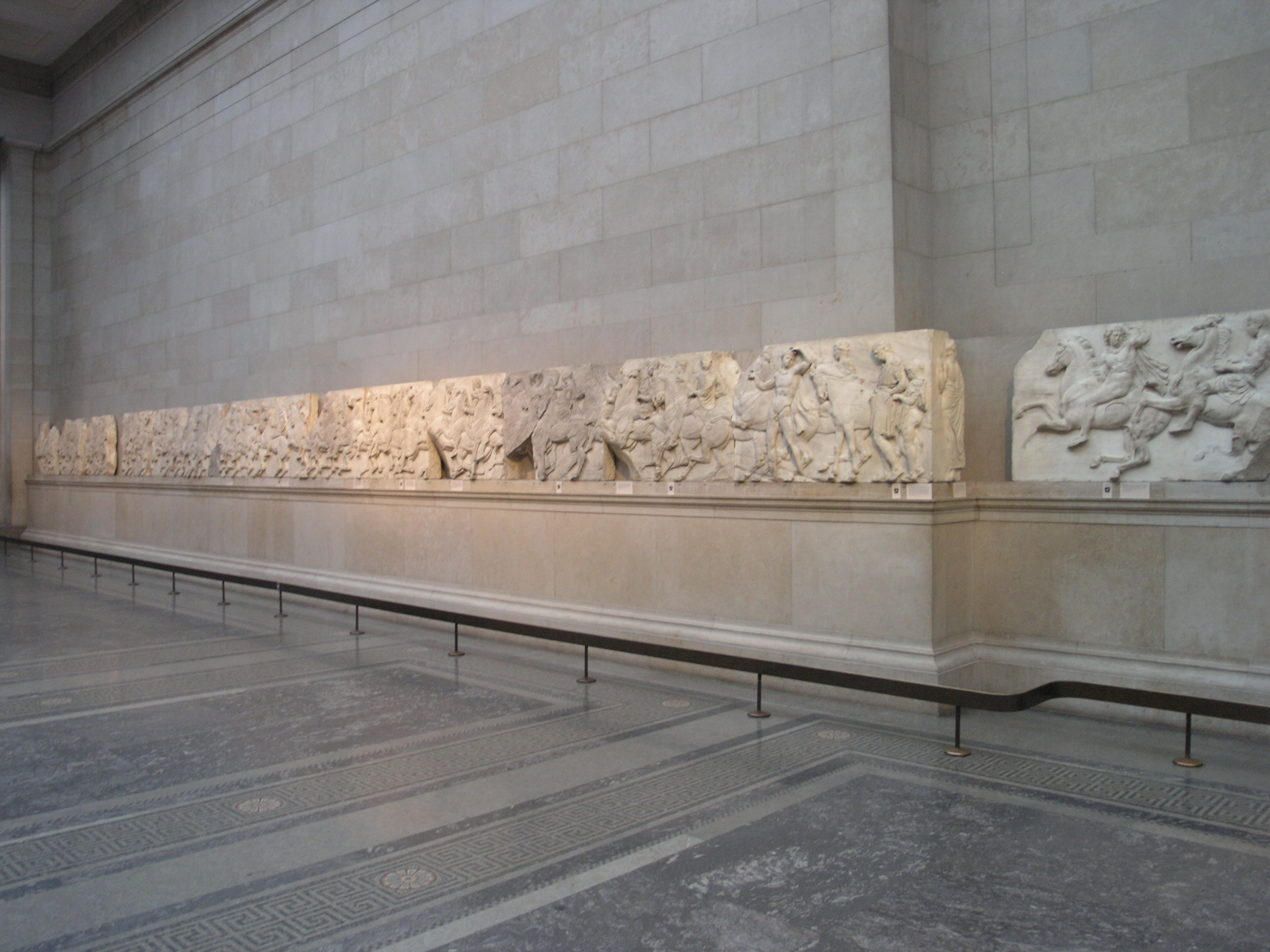
When I received an invitation to attend a talk and musical concert at the British Museum about the Parthenon Frieze in June, it seemed the ideal opportunity to renew my interest and to learn something of the precious exterior ornamental band which ran around the 2,500- year-old Parthenon temple. I also wanted to know what all the fuss was about, why lawyer Amal Clooney, one month after marrying superstar George, was taking up the Greek cause to return the priceless marbles to Greece. Today, around 60% of the frieze is housed in Room 18 of the British Museum, the majority of the remaining 40% resides in the Acropolis museum.
So I set out on a gloriously sunny evening in June with the words of my friend Molly Borthwick (generous supporter of that day’s event) whirling around in my mind: “You haven’t met Ian (Jenkins), you haven’t heard him speak! He’s the world expert on Greek and Roman sculptors. You’ll lurvv him!” When Molly says these things, I listen.
An hour later I was in the back row of the lecture hall. Without any ceremony a silver-haired Ian Jenkins walked on stage, looking the part of Victorian gentleman and flamboyant academic in his slightly creased, pin-striped suit and a silver watch chain, from which hung his museum key. From his lectern he perused the audience. I scanned the room myself. My gaze flitted across the packed lecture hall composed of suited men and women in heels and summer dresses, over to a younger crowd nearer to where I was sitting, in jeans, sneakers and dark tee-shirts, some of whom, started to canoodle the minute they sat down.
I went back to reading the programme: “Ian is the curator of the Museum’s critically acclaimed exhibition ‘Defining beauty: the body in ancient Greek art”. “The body” I thought to myself, a theme which is bound to get the punters in at the British Museum. Tonight however, Ian’s angle had changed. We were being offered: ‘The Parthenon Frieze: a symphony in stone’. As I am a great classical music lover and a Wigmore Hall regular, I was intrigued by the musical connection. This, coupled with the fact that we were going to be treated to a live UK premier of newly commissioned work entitled Panathenaia which had been inspired by the Parthenon frieze.
Ian explained that the frieze was the decorative sculptural upper band of marble, which originally ran off the entrance to the Parthenon temple. The frieze evokes the ‘Great Panathenaia’, the festival held every four years to celebrate the birth of Athena. Here we had to imagine it in situ: two parallel processions progress along opposite sides of the building towards their finishing point on the east wall. We see horsemen, chariots, animals for sacrifice, young women and magistrates or tribal heroes. There are chariot races that day and music competitions, the prizes special jars, filled with olive oil, with a depiction of the event on them. The high point of the ceremony is the presentation of the peplos or sacred cloth, newly woven, to adorn an ancient olive statue of Athena. Presiding over these festivities are the gods and goddesses. The interesting thing, Ian tells us, is that there is a question mark over whether the gods are viewing these events from on high – that is from Mount Olympus – or down at the Temple in Athens, suggesting perhaps the merging of the human and the divine. Have humans become godlier or have the gods become more plebeian? There is a pause whilst we take this in. A man in front of me stops tapping the screen on his iPhone and looks up, as if he has just woken up to this momentous question left hanging in the air. He looks around vaguely then bows his head again and resumes his silent tapping.
Ian’s talk becomes more and more fascinating as he draws all sorts of modern artistic parallels with the frieze. He sees the same arrangement of horses in a work painted by the great artist Mark Gertler in 1916, ‘The Merry go round’ and so on. And then comes Ian’s tour de force. “The symphony” which is to be found in the Parthenon Frieze. Ian starts to show us slides of his transcription of the frieze, which he has converted into a sort of Braille, in which the numerous figures seen from above, are represented by simple shapes. And here I quote from the Panathenaia librettist Paul Williamson, as I’m not a musicologist : “The heads of the horsemen, for example, are shown as ovals, laid out in rows to indicate the depth of field. The effect of the semibreve-like ellipses arranged on staves, as it were, is incredibly like musical notation.”
Oh my! My brain is now reeling, I am eager to hear the music to give it a rest.
Full of anticipation we leave the lecture hall, and make our way up a grand staircase to Room 18, the Parthenon frieze viewing gallery.
Twenty minutes later, having finally settled in our seats, we are able to admire the frieze for real; we stare at the sections of white marble sculptures on the walls, beautifully lit, looking so clean, the figures so beautifully fluid and lovingly preserved, though incomplete. It is hard to believe that they are so ancient. The TV camera is there with Patricia Wheatley, formerly with the BBC and head of the BM Broadcasting unit, the photographers with their telescopic lenses, all now aiming at the stage, for the choir, two sopranos, the orchestra and lead violinist Hugo Ticciati (soon to be playing at the Wigmore I noticed with interest) has just stepped in. The enthusiastic Ticciati starts speaking a little fast on the stage, but it doesn’t matter, all I need to know is in the programme, namely that it was he who had the idea of commissioning this work in the first place. Ticciati enlisted the services of award-winning composer Thomas Hewitt Jones (Winner of the 2003 BBC Young Composer Competition) and they chose Paul Williamson to write the libretto. Ticciati and his orchestra performed the finished work once in Sweden last summer, at a summer festival he organises, and instead of the Parthenon, a rock-balancing artist was called in to reconstruct his own frieze with some stones from a nearby lake. Apparently the last irregular diamond of stone was put in place as the music ended.
Wow! I thought, not bad, not bad at all. But even a rock-balancing artist cannot compete with these beautiful smooth, sculpted warriors running along the wall.
A young bearded conductor steps up on stage with tight corkscrews curls, followed by two late musicians, who, cowering with embarrassment and grasping their violins quickly find their seats.
Panathenaia is a Cantata in eight movements for string orchestra, timpani, soloists and choir. The hugely talented composer, Thomas Hewitt-Jones drew his inspiration from certain figures from the frieze and temple statues.
The instrumental Prelude opens with the tense plucking of strings and jagged rhythms, then the full orchestra enters into a slow lumbering movement of strange, mysterious sounds marking the start of the Athenian procession or is it the wars that preceded the building of the Parthenon temple, as there is the rumble of drums. We are transported back to c. 495-429 BC, where the instruments one imagines to have such different discordant sounds.
In marked contrast, the following “Temple” movement with the Choir, is one of beautiful high, ethereal voices, denoting the harmony and beauty of the land and holy building where justice reigns: “This ancient land’s an orderly/Arrangement, wrought from flowing forms”.
“The Weaver’s Song” following, sung with great feeling by the fine blonde soprano Paulina Pfeiffer is both mournful and serious in tone – serious because she is weaving the sacred cloth which will clothe the statue of Athena, therefore a great responsibility – mournful – because she is alone, separated from her warrior boyfriend who is taking part in the chariot races during the festival: “Eros, has made me dull”. Apparently in rehearsals, Paulina, was disturbed by her voice ricocheting off the frieze in Room 18. She was, I was told, holding back tonight, and I noticed her shoulders stiffen a little as one particular high note echoed around our heads. The effect however was thrilling!
I loved “The Lyric Suite”: Hugo Ticciati’s achingly beautiful violin, sometimes so haunting and then the unsettling bassoon, plucking of strings and tympani which crescendos into a full-blown orchestral swell setting things up for Prometheus and his challenge with the gods.
In “Prometheus” we had the gorgeous pairing of the blonde soprano and dark mezzo-soprano, Karolina Blixt. Blixt looked very striking in her Grecian ivory dress and liquid eye liner eyes which flashed at the audience, causing quite a ripple amongst the male members who looked up at her in complete reverence (I see a star in the making). “Ah but the gods have lost their spark” they sing signifying the decline in the influence of the gods, making way for Prometheus who “…freed the agent of change/That far-seeing rascal”. The sopranos snarl the word “rascal”
In “Shadows in a dream” the choir asks what harmony is possible when humanity inherits the earth? Tympani – storm rumblings loud then soft and distant, set the scene for the following “Birth of Pandora”, Zeus’s revenge on humanity. I loved the amazing anarchic dance of the satyrs attending the birth of the beautiful, ‘baneful’ Pandora. “Caper on your crooked legs” – wonderful alliteration by Paul Williamson the librettist. And finally the Coda – plucking of double basses like footsteps fading away. The music has turned full circle. We are back to where we started.
Loud applause. Ian Jenkins the curator, the musicians, singers, composer, librettist and conductor, had transported us into another world, another time. It had been an exciting, illuminating experience, one that I am very keen to repeat. These sorts of happenings however are rare and require money, time, commitment and passion. Vision too. I felt privileged to have attended such an event.
Since then I have returned to admire the frieze in the British Museum twice!
Discover this extraordinary composition performed by orchestra and singers for the first time ever in the British Museum’s Duveen Gallery, which houses the Parthenon Sculptures. Surrounded by these stunning carvings, Panathenaia celebrates their artistry and tells the story portrayed in the timeless stones.
Karine Hetherington is a teacher and writer who lives in London. A dual-British and French national, with a Russian ancestry thrown in, her short stories and novels reflect her passion for both the detail and grand sweep of European history. After studying creative writing at Birkbeck College in London, Karine has been telling stories that have brought history to life, with tales of love and adventure that draw on the detail of real events and real lives. Karine’s novel ‘The Poet and the Hypotenuse’ is available now. Read an extract here

 Who or what inspired you to take up composing, and pursue a career in music?




 The Cross-Eyed Pianist